


A Guide to Fund Accounting for Nonprofits
Quick Answer: A Guide to Fund Accounting for Nonprofits
Master fund accounting for nonprofits: track funds, boost donor trust, and gain financial.
As an executive director, you have to be an expert in everything. But financial oversight is often the most stressful part of the job. You've likely felt that pre-board-meeting panic, staring at reports and wondering if you truly know how much you can spend.
This guide will give you clarity on your finances. We will walk through fund accounting in simple, practical terms. You will gain the confidence to lead your organization forward.
Get Clear on Your Nonprofit's Finances
Our goal is to give you complete confidence in your organization's financial health. Think of this as a conversation with a fellow director who understands your challenges. We know what it's like to track donor-restricted money and account for every grant dollar.
Many leaders feel their financial systems create more questions than answers. They try to make general business software like QuickBooks work for their nonprofit. This usually ends in a mess of spreadsheets just to track a single restricted fund.
This manual process creates a gap between your fundraising and your finances. Your team might land a major gift for a project, but your accounting system has no easy way to track it. This makes accurate reporting a chore and audit prep a nightmare.
A Better Way Forward
You don't have to operate this way. True fund accounting for nonprofits is a practical method for ensuring accountability. It gives you a clear, real-time picture of your money so you can honor donor intent and plan for the future.
An all-in-one platform brings your accounting, donor management, and marketing into one system. Your departments can finally speak the same financial language. This is how you break free from spreadsheets and gain real financial control.
"A proper system shows you exactly where every dollar came from and where it is going. It provides the financial proof of the promises you make to your donors."
By the end of this guide, you will understand how to:
- Confidently track restricted funds without manual workarounds.
- Generate board-ready reports in minutes, not days.
- Unite your fundraising and finance data in one place.
- Prepare for your Form 990 with less stress.
Let's start by defining what fund accounting means for your mission. We'll explore why it's different from business accounting and how the right tools make it simple. Learn more in our post on nonprofit financial reporting.
What Is Fund Accounting and Why It Matters
Fund accounting organizes your nonprofit's money into separate "buckets." Each bucket holds money for a specific purpose, as the donor intended. This is the foundation of nonprofit financial integrity.
Unlike a for-profit business, your organization has a higher duty of accountability. You must show a donor exactly how their gift supported your program. Fund accounting is what makes that possible and maintains the trust that keeps you funded.
It's About Stewardship, Not Profit
For-profit accounting asks, "Did we make money?" It is all about tracking profit.
Fund accounting asks, "Did we use this money as promised?" It is designed to track stewardship across many revenue streams. Each grant or donation can have its own set of rules.
This responsibility is more complex today than ever before. Charitable giving has grown, meaning nonprofits are juggling more funds with specific donor rules. You can dig into these trends in the latest Giving USA report on charitable giving.
The Two Buckets Every Leader Must Know
Fund accounting separates your money into two main categories. Getting this right is critical for sound financial management.
- Unrestricted Funds: This is flexible money you can use for your mission. It covers general operating costs like salaries, rent, and supplies.
- Restricted Funds: This is money a donor has designated for a specific project. You are legally bound to use these funds only for that purpose.
A common mistake is treating all income as one big pool of cash. This can lead to spending a restricted grant on general overhead. That is a serious compliance breach that can damage your reputation with funders.
"True fund accounting for nonprofits means you never have to guess how much you can spend. It provides instant clarity on available resources for any purpose."
To see the difference, it helps to compare nonprofit and for-profit finances.
Fund Accounting vs. For-Profit Accounting
This table shows the fundamental differences between the two worlds.
| Aspect | Fund Accounting (Nonprofit) | For-Profit Accounting |
|---|---|---|
| Primary Goal | Accountability and Mission Fulfillment | Profitability and Shareholder Value |
| Focus | Tracking funds by donor intent and purpose. | Tracking revenue against expenses. |
| Key Reports | Statement of Activities, Statement of Functional Expenses. | Income Statement, Balance Sheet. |
| Bottom Line | Change in Net Assets (by restriction). | Net Income or Loss. |
The entire mindset is different. A business can use its revenue however it wants. Your nonprofit has to manage money according to hundreds of different donor rules.
Many nonprofits try to use "classes" in QuickBooks to mimic funds. But this is just a workaround, not a real solution. It often hides your true financial position. In contrast, our true fund accounting is built-in, giving you an accurate picture without spreadsheets.
Think of your nonprofit's money as being in different jars on a shelf. Each jar is clearly labeled, showing what the money inside can be used for. This simple analogy is the heart of fund accounting.
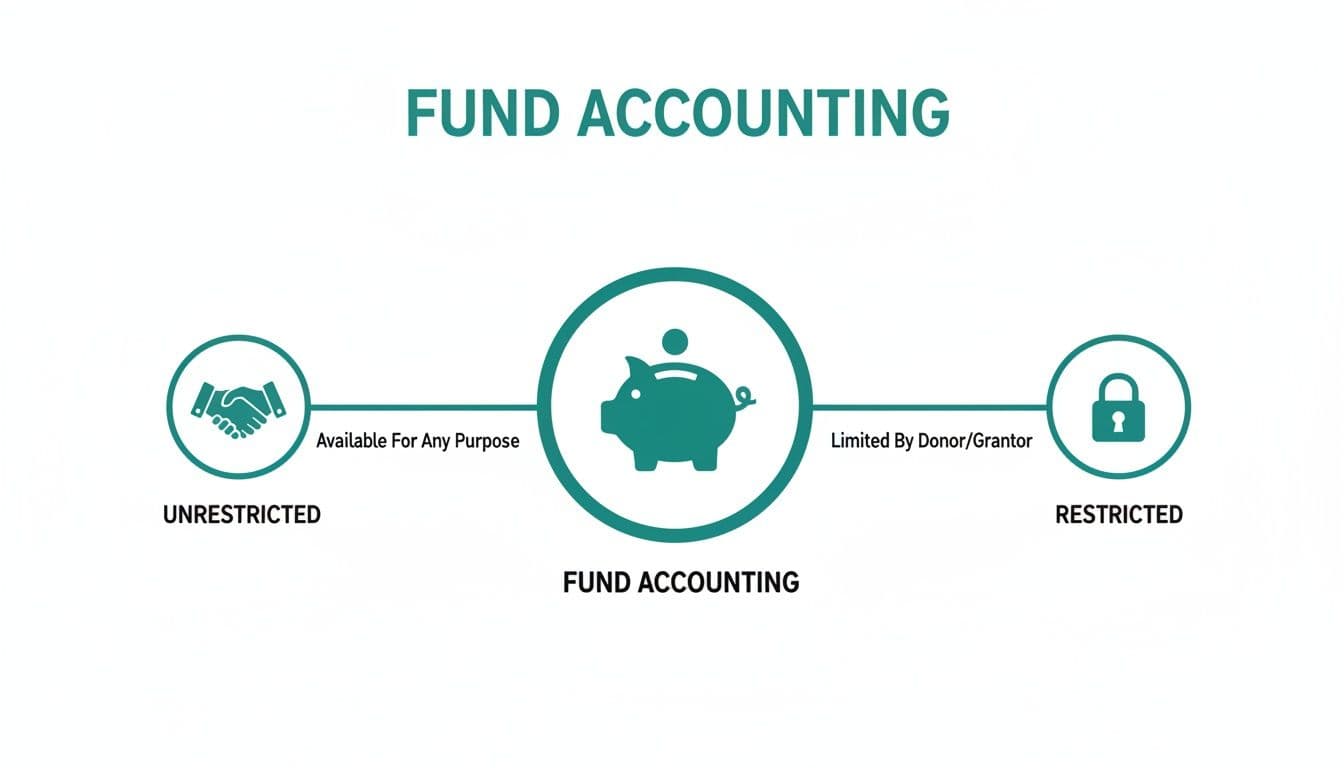
As you can see, some money has a padlock on it. Those are your restricted funds with specific rules. The rest is flexible and ready for general use.
The Two Most Important Jars: Net Asset Classes
In accounting, these "jars" are called net asset classes. They tell you what portion of your money has strings attached. Your reports will show two main classes:
- Net Assets Without Donor Restrictions: This is your general operating jar. It's money you can use for any part of your mission.
- Net Assets With Donor Restrictions: This jar holds funds a donor has designated for a specific purpose. You are legally obligated to honor these restrictions.
Many nonprofits get into trouble by mentally treating all cash as one big pool. Our true fund accounting system automatically walls off these funds for you. It prevents you from accidentally spending restricted grant money on general costs.
Your Key Financial Reports, Explained
Your nonprofit's story is told through its financial statements. They look different from business reports because their purpose is to show stewardship.
Here are the essential reports you will work with:
- Statement of Financial Position: This is your balance sheet. It gives a snapshot of your financial health by showing assets, liabilities, and net assets.
- Statement of Activities: This is your income statement. It shows revenue and expenses over a period and tracks changes in each net asset class.
"The key difference is that every line on a nonprofit report is filtered by donor intent. It separates money by its purpose, which is hard to do in general business software."
This level of detail is almost impossible to get right with spreadsheets. Our true fund accounting software generates these specific reports automatically. You get clear answers instantly.
The Statement of Functional Expenses
Another important report is the Statement of Functional Expenses. It is a requirement for your Form 990 and is a favorite of savvy grantmakers.
It shows how you spend your money by breaking every expense into three categories:
- Program Services: Costs directly tied to your mission.
- Management and General: Administrative and overhead costs.
- Fundraising: Costs associated with raising money.
This statement shows donors how much of their gift goes directly to the cause. It reassures them that you are a responsible steward of their investment.
Your Chart of Accounts: The Financial Backbone
Finally, all of this tracking is organized in your Chart of Accounts. Think of this as the master filing system for every financial transaction.
A chart of accounts designed for a nonprofit will have categories to track restricted grants. When set up correctly, it powers all your reports. It is the foundation for true financial clarity.
How to Avoid Common Fund Accounting Pitfalls
Many smart executive directors fall into the same financial traps. It is rarely about a lack of commitment. It is usually about using tools that were not built for nonprofit finance.
The most common mistake is forcing standard business software to do a nonprofit's job. This creates unnecessary work and can hide the real story your numbers are telling.
The QuickBooks "Classes" Workaround
Many nonprofits start with QuickBooks because it is familiar. The problem is that QuickBooks was built for for-profit businesses. Your financial DNA is completely different.
To manage restricted funds, you have to use a feature called "classes." This means someone manually tags every transaction to represent a specific fund. This approach is tedious and incredibly fragile. One missed tag can throw your entire report out of whack.
"This method forces you into constant manual reconciliation. You spend hours in spreadsheets trying to piece together a true picture of your restricted balances."
QuickBooks is a good tool for small businesses. It is just the wrong tool for managing donor-restricted funds. It doesn't provide true fund accounting for nonprofits, where funds are built into the core structure.
The Disconnect Between Fundraising and Finance
Another major pitfall is the wall between your fundraising and finance teams. Your development team lands a gift and tracks it in a donor database. Your bookkeeper records the check in a separate accounting system.
This disconnect creates a constant struggle to keep both systems in sync. Someone has to manually enter data in two different places. When it is time to report to a funder, you are stuck cross-referencing spreadsheets.
This is more than an annoyance. Research shows that nonprofit staff can lose up to 30% of their day managing data across separate systems. This siloed approach erodes your board's trust in your numbers.
An All-in-One Platform Solves These Problems
You can avoid these pitfalls by uniting your operations on a single platform. When your donor management, fundraising, and accounting are in one system, these problems disappear.
- Give You Automatic Fund Tracking: A donation through an online giving page for a campaign is automatically booked to the correct fund. No manual tagging is needed.
- Create a Single Source of Truth: Your fundraising and finance teams finally look at the same data. A pledge recorded by a development officer is instantly visible in financial forecasts.
- Provide Effortless Reporting: Generating a report on a grant's spending becomes a matter of a few clicks. The system knows which expenses were paid from that grant.
AlignMint was built to provide this unified approach. Because we include true fund accounting, a donor CRM, and marketing tools in one place, we eliminate these gaps. This saves you time and gives you a clear, real-time view of your financial health. You can explore our guide on managing restricted funds to see how this works.
Streamline Your Reports for Boards and the IRS
The point of solid financial management is to produce clear, accurate reports without a fire drill. This is about getting answers quickly. You can satisfy your board, your grantors, and the IRS with total confidence.
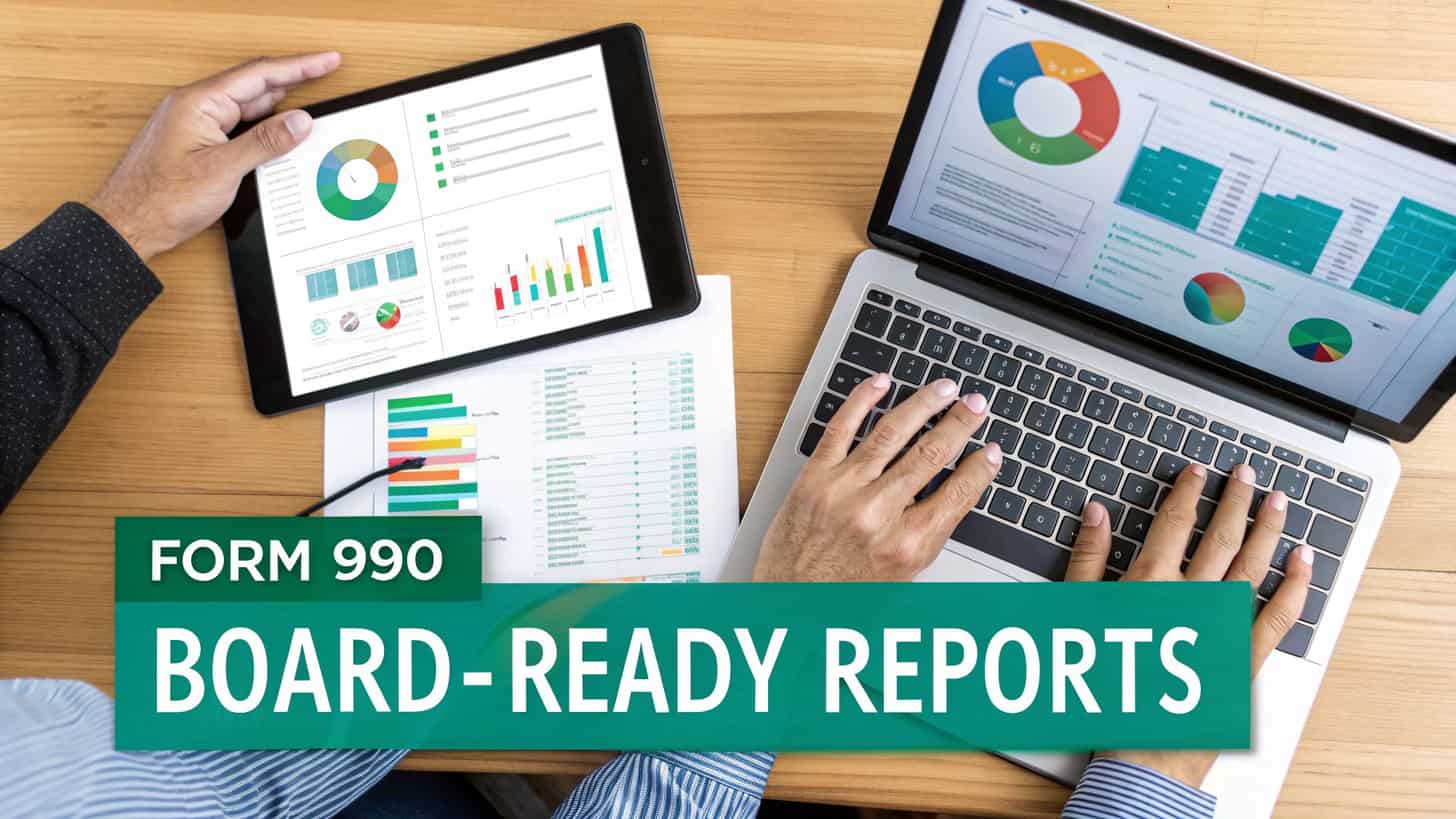
When your systems are disconnected, reporting is a stressful scavenger hunt for numbers. With a true fund accounting system, these essential reports are always available in real-time. They become a byproduct of your daily work, not a project you have to dread.
Make Your Form 990 Less Taxing
Your Form 990 is more than just a tax document. It is a public statement about your financial health and stewardship. For many nonprofits, preparing it is a source of anxiety, but it does not have to be.
A proper fund accounting for nonprofits system handles the hard parts all year. Because every expense is categorized by its function, the system can generate a 990-ready report in minutes. You get the exact numbers you need without weeks of manual work.
This is especially critical today. Recent analysis has shown the precarious state of nonprofit finances, with many organizations operating at a deficit. Clean, immediate reporting helps you navigate that volatility.
Deliver Clear Reports for Grantors
When a foundation gives you a grant, they expect to see how their money was used. A generic profit and loss statement is not enough. You need to provide a clear report that details every dollar spent against that fund.
With a unified system, this is simple. You can pull up a specific grant and instantly see every related expense. This lets you show funders precisely how you fulfilled your promise, building trust for future support.
This clarity is also a lifesaver for grant drawdowns. You always know your exact spendable balance. This prevents you from overspending or leaving money on the table.
Give Your Board the Right Information
Your board members are busy people. They need to understand your financial position quickly. They need a high-level dashboard that gives them essential information at a glance.
A good system lets you present this information cleanly. You can show them a dashboard with just the need-to-know metrics.
- Statement of Financial Position: A clean snapshot of your assets and liabilities.
- Budget vs. Actuals by Program: Shows how each program is performing against its budget.
- Restricted vs. Unrestricted Net Assets: The board can see your operational flexibility.
- Cash Flow Projections: A forward-looking view to help with strategic decisions.
In a platform like AlignMint, these are live views of your finances. You no longer have to tell a board member, "I'll get back to you with that number." The answers are right there. Find more strategies in our guide to nonprofit financial reporting.
Ready for Financial Confidence?
Moving to a better financial system can feel like a huge task. But the peace of mind it creates is priceless. Imagine answering a board member's financial question on the spot, with total confidence in your numbers.
That is the result of having a unified system for your team. We built AlignMint because we are nonprofit people who got tired of the chaos. We wanted that clarity for ourselves.
More Than Just Software
We know the frustration of wrestling with disconnected systems. That is why we built AlignMint to be more than just another tool. It is one single platform for your fund accounting for nonprofits, donor management, volunteer management, and marketing.
This all-in-one approach closes the gaps between departments. Here is what that means for your daily work:
- Get Real Fund Accounting: We do not use clumsy workarounds like QuickBooks classes. Our system was built for true fund accounting, so you can see your real-time restricted balances anytime.
- Unify Your CRM and Accounting: Your donor and financial records live together. Our online giving pages automatically record donations correctly in your accounting system. No double entry is needed.
- Communicate With Supporters Easily: Our built-in marketing suite lets you send emails directly from the platform. You can even talk to your team without switching to another tool. And our AI assistant, Minty, helps you work faster.
Built for Your Mission and Your Budget
We believe powerful tools should be available to every nonprofit. That is why our platform is free for organizations with annual revenue under $100K. You get the full system, not a stripped-down trial version.
We also do not have per-user fees. Ever. You can give your entire team and board access without an extra bill. Our goal is to grow with you, not penalize you for building a team.
"Our mission is to support your mission. We handle the back-office work so you can stay focused on the community you serve."
This is your chance to leave the stress of manual work behind. Take the first step toward lasting financial clarity. Let us show you how AlignMint can give you the confidence you need to drive your mission forward.
Your Fund Accounting Questions, Answered
As a director, you have enough on your plate. Here are straightforward answers to the questions we hear most often.
Can I Just Use QuickBooks for Fund Accounting?
Many nonprofits start with QuickBooks, but it is not built for fund accounting. It is a for-profit tool, forcing you to use "classes" to imitate how restricted funds work.
This approach means hours of manual spreadsheet work. A single missed tag throws off your reports. A purpose-built system like AlignMint has fund accounting at its core, saving you time and giving you numbers you can trust.
What's the Difference Between Restricted and Unrestricted Funds?
This is the most important distinction in nonprofit finance. It is all about donor intent.
- Unrestricted funds are the lifeblood of your organization. This is money for salaries, rent, and other operational costs.
- Restricted funds are contributions a donor has legally stipulated for a specific purpose. This could be for a new building or a particular program.
Properly separating and tracking these two "buckets" is a fundamental legal requirement. It is the bedrock of donor trust.
How Does an All-in-One Platform Help?
An all-in-one platform like AlignMint demolishes the wall between your fundraising and accounting teams. The two systems speak the same language automatically.
When a donation is made online for your "Youth Program" campaign, the system instantly records it as a restricted fund. This simple action ends the need for manual data entry. It gives you a real-time, unified view of your organization's health.
"An integrated system means you can finally trust your numbers. It removes the guesswork and the exhausting manual reconciliation that drains your team's energy."
This unified approach lets you focus on your mission. Our guide on managing restricted funds shows you exactly how this process works.
What Is a Statement of Functional Expenses?
The Statement of Functional Expenses is a key financial report for nonprofits. It is a required part of your Form 990. It breaks down your expenses into three standard categories:
- Program Services: Costs that directly advance your mission.
- Management and General: Administrative overhead like accounting and HR.
- Fundraising: The costs associated with raising money.
This report shows donors, grantors, and the IRS how efficiently you are using your resources. You can learn more about this in our nonprofit financial reporting guide.
Ready to leave spreadsheets behind and gain true financial clarity? See how AlignMint provides a single, unified platform for your accounting, fundraising, and marketing.
Related: Fund accounting (pillar guide) · Fund accounting software for nonprofits · Fund accounting feature
Frequently Asked Questions
Ready to try AlignMint with your nonprofit?
Start free — set up donor tools, giving pages, and Minty. Upgrade when you need accounting.