


Quick Answer: Cash Disbursement Journals
Cash disbursement journals for nonprofits: track spending, protect restricted funds, and keep an audit trail with a practical setup sequence for finance. The sections below walk through practical steps, examples, and what to watch for.
As a nonprofit leader, you know every dollar must be accounted for with absolute clarity. You need a straightforward way to track all the money leaving your organization. This guide explains how cash disbursement journals provide that control, helping you protect your mission and build donor trust.
Gain Flawless Expense Tracking
You can confidently track spending against specific grants and programs. A cash disbursement journal helps you do this by creating a clear record for every payment. It is the foundation of sound financial stewardship.
This detailed record is more than just a list of checks. It helps you stay audit-ready and maintain the trust of your donors and board.
What Makes This Journal So Important?
A well-kept journal gives you a clear picture of your spending. This is essential for true fund accounting, especially with restricted funds. Without it, grant reporting can become a difficult, manual task.
Here's what it accomplishes for you:
- Creates a Clear Audit Trail: You get a step-by-step history of every dollar spent. This gives auditors and your board confidence in your financial management.
- Ensures Accurate Fund Accounting: You can directly connect each expense to a specific fund or grant. This proves you used restricted money exactly as intended.
- Strengthens Internal Controls: The simple act of recording every disbursement imposes discipline. It makes it much easier to spot unauthorized or unusual spending.
- Simplifies Financial Reporting: Your journal feeds clean, accurate data into your financial statements. This makes month-end and year-end reporting much faster.
For many nonprofit leaders, the cash disbursement journal is the single source of truth for all outflows. It's the story of how you turn donations into impact, one transaction at a time, giving you confidence in every financial decision.
By mastering this one financial tool, you gain incredible control over your operations. We offer detailed guides to help you with the specifics of nonprofit expense tracking and make the process feel less like a chore.
Why This Journal Is Your Best Financial Defense
In a funding landscape that is always changing, strong financial controls are your anchor. A well-kept cash disbursement journal gives you a clear, chronological trail of every dollar your organization spends. This makes preparing for your annual audit much less stressful.
For any nonprofit managing restricted funds from grants, this level of detail is essential. It's how you prove to funders that their money was used exactly as intended. That proof is what builds credibility and lasting trust.
The journal is also your best tool for monitoring cash flow in real time. It lets you make informed decisions and avoid unpleasant financial surprises. It's a foundational practice for building a resilient organization.
Protecting Your Mission in Uncertain Times
Financial stability isn't a given, and careful expense tracking is your best defense against volatility. When funding sources change, knowing precisely where your money is going allows you to adapt quickly. This has become very clear in recent years.
For example, a nonprofit trends report on Urban.org showed that 37% of nonprofits saw a decrease in donations in 2020. Smaller nonprofits were hit hardest. Meticulously tracking every outflow with a cash disbursement journal helps you manage these shocks.
Think of your cash disbursement journal as your organization's financial immune system. It detects problems early, protects vital assets, and ensures your mission stays healthy even when external conditions are challenging.
This isn't just about accounting; it's about mission assurance. When you can confidently show your board and donors that you have a firm grip on every expense, you reinforce their belief in your leadership.
From Proving Compliance to Building Confidence
Your financial story is told through your reports. The cash disbursement journal provides the raw, detailed data needed for essential documents like the Statement of Functional Expenses. This report is a key part of your Form 990.
Without a detailed journal, creating this report is a painful, time-consuming task. With a proper journal, the information is already categorized and ready to go.
This is where true fund accounting systems like AlignMint make a significant difference. Unlike general business software, our platform is built from the ground up for nonprofit needs. AlignMint's true fund accounting provides a clear advantage over the "classes" workaround found in QuickBooks.
- It automatically links every expense to its specific grant or program fund.
- You can see real-time balances for all restricted funds, preventing overspending.
- Reporting becomes a one-click process, not a week-long project.
Our all-in-one platform gives you the control of a traditional journal without the manual effort. It turns a necessary task into an automated process that frees you up to focus on your mission.
How to Set Up Your Journal Step by Step
Setting up a cash disbursement journal does not have to be a big project. Let's walk through how it's traditionally done and then look at a modern approach. The goal is to get the control you need without drowning you or your team in extra work.
At its core, this journal used to be a physical ledger book or a spreadsheet. Every time you paid a bill, you would make a new entry. That simple act of recording every payment is the bedrock of disciplined financial tracking.
The Manual Approach Using a Spreadsheet
For a new nonprofit, a spreadsheet can seem like a logical first step. If you go this route, you'll set up columns for all the essential information.
Here's what a basic layout looks like:
- Date: The day the payment went out.
- Check Number: The number on the check used for payment.
- Payee: The person or company you paid.
- Description: A quick note on what the payment was for.
- Amount Paid: The total cash amount disbursed.
- Expense Account Columns: Separate columns for your expense categories (e.g., Salaries, Rent, Program Supplies).
You enter the total payment in the "Amount Paid" column. Then you drop that same amount into the specific expense column it belongs to. This categorizes every payment right at the source.
But while spreadsheets can work for a while, they become a liability as you grow. They are prone to human error, and a single mistake can throw off your entire financial picture. This is a common growing pain we see with countless executive directors.
This is the ideal flow you're aiming for: moving from careful journaling to clear reporting, which is what ultimately builds lasting donor trust.
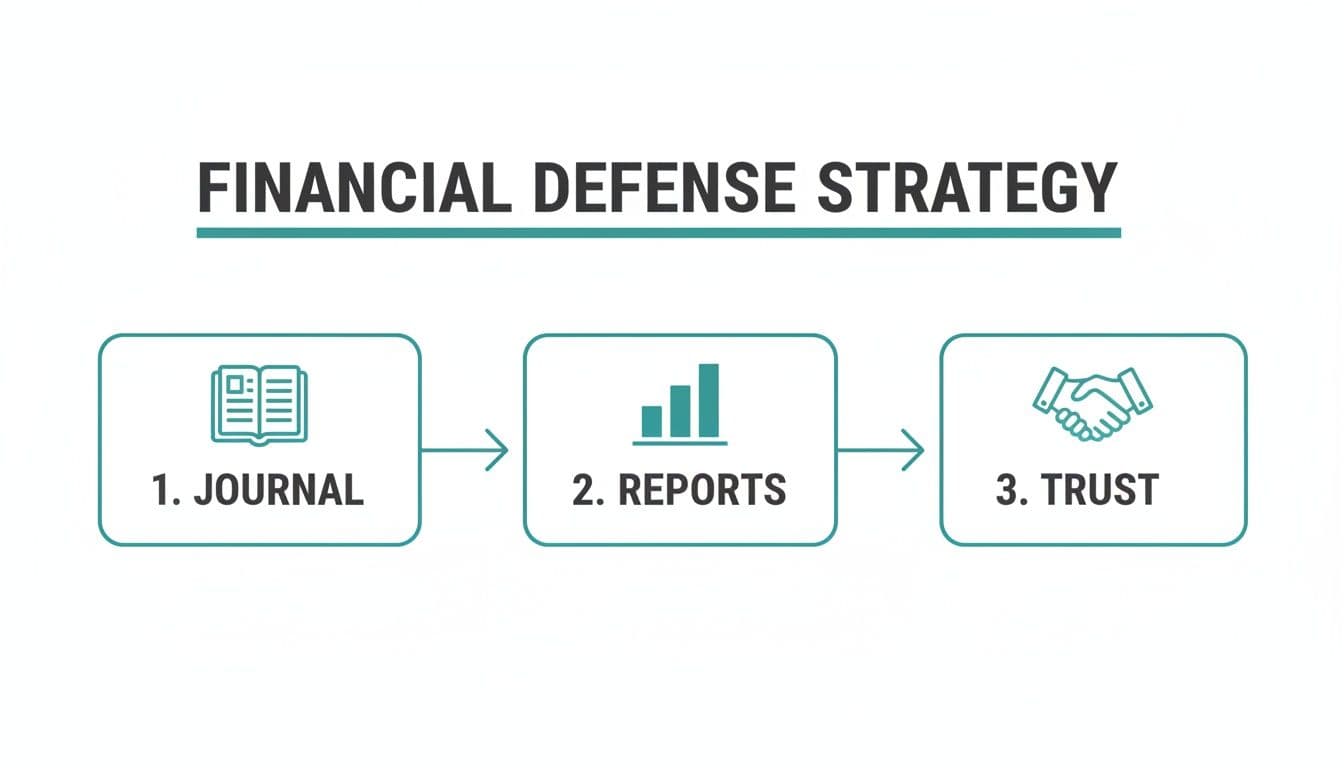
The key takeaway here is that your accurate records are the foundation for the transparent reports that donors expect and appreciate.
The Automated Approach with an All-in-One Platform
Today, you can get all the benefits of a cash disbursement journal without the manual data entry. Modern platforms designed for nonprofits, like AlignMint, handle this for you automatically. The system creates the journal for you behind the scenes.
When you use an integrated system, you're not just tracking expenses; you're building a reliable financial engine for your organization. The journal becomes an automatic byproduct of your normal daily activities, like paying bills.
When you pay a vendor through the platform, the system instantly logs the transaction. It records the details and ties the expense to the correct fund, updating your financial reports in real time. This gives you the strict control of a traditional journal without the risk of a spreadsheet.
Because we know many smaller nonprofits operate on tight budgets, we offer a free tier for organizations under $100K in annual revenue. This gives you access to donor management, giving pages, fundraising tools, Minty, and My Workspace from day one. Fund accounting starts on Plus when your finance workflow needs the full accounting system.
Real-World Examples of Journal Entries
Theory is great, but seeing how this works in the real world makes it all click. Let's walk through a couple of day-to-day transactions. These examples show how a proper journal entry captures the details you need for true fund accounting.
Imagine you run a community arts center. You have a handful of common expenses every month that need to be tracked perfectly.
Example 1: Paying for General Operating Costs
Let's start with a simple one. It's the first of the month, and rent is due. You need to pay $1,500. This is a general operating cost, not tied to any specific grant.
Your cash disbursement journal entry would look something like this:
- Date: 01/Month/Year
- Check Number: 1045
- Payee: City Properties LLC
- Description: Monthly office rent
- Debit: Rent Expense ($1,500)
- Credit: Cash ($1,500)
This entry does more than just show money going out. It correctly categorizes the payment as a "Rent" expense. This makes pulling together your Statement of Activities clean and easy.
Example 2: Purchasing Supplies for a Restricted Grant
Now for a more complex - and very common - nonprofit scenario. You recently received a $5,000 grant from the Smith Family Foundation for your after-school arts program. These are restricted funds, meaning they can only be used for that program.
This week, you buy $300 worth of art supplies. Your journal entry must connect this expense back to that specific Smith Family Grant.
Here's how you'd record it:
- Date: 05/Month/Year
- Check Number: 1046
- Payee: Creative Supply Co.
- Description: Art supplies for after-school program
- Debit: Program Supplies Expense ($300)
- Credit: Cash ($300)
- Fund: Smith Family Grant (Restricted)
This single entry not only records the $300 expense but also instantly reduces the available balance of the Smith Family Grant to $4,700. This makes it impossible to accidentally overspend your restricted funds. You can report back to the foundation with total precision.
You can learn more about the mechanics of these entries in our guide on fund accounting for nonprofits.
This simple fund tag is the critical difference between true fund accounting and the workarounds required in general business software. It's not just an accounting detail; it's the mechanism that protects your relationship with your funders.
This is a key area where many nonprofits get tripped up using software like QuickBooks. While it's a solid tool for small businesses, it relies on "classes" to approximate fund tracking. This often leads to messy reports and hours of manual spreadsheet work.
Comparing Manual Spreadsheets and All-in-One Platforms
The difference between managing this process in a spreadsheet versus a dedicated nonprofit platform is huge. One requires constant manual effort, while the other handles the details for you.
An integrated platform like AlignMint is built for exactly these scenarios. When you pay that bill for art supplies, the system automatically creates the complete journal entry. It also tags the Smith Family Grant and updates its balance in real time.
Let's break down the practical differences side-by-side.
| Feature | Spreadsheet Method | AlignMint Platform |
|---|---|---|
| Data Entry | Entirely Manual You must enter every detail for every transaction by hand. | Automated The system creates the journal entry when you pay a bill or run payroll. |
| Fund Tracking | High Risk of Error You have to manually link expenses to funds, often in a separate worksheet. | Built-In Every transaction is linked directly to a fund, with real-time balance updates. |
| Reporting | Time-Consuming You must manually compile data from the journal to create financial reports. | Instantaneous Reports like the Statement of Functional Expenses are generated with one click. |
| Audit Trail | Vulnerable Easy to alter entries without a trace, creating potential audit issues. | Secure & Clear Every transaction is logged with a timestamp and user ID, creating a solid audit trail. |
Ultimately, a cash disbursement journal is much more than a simple list of payments. It's a strategic tool that, when automated, gives you airtight financial control. It also frees up your time to focus on your mission.
Strengthening Your Internal Controls for Peace of Mind
As a nonprofit leader, one of your most critical jobs is to protect your organization's assets. Strong internal controls around how you spend money are your first and best line of defense. They're what let you sleep at night.
The bedrock principle of strong controls is the segregation of duties. Put simply, no single person should ever control a payment from start to finish. It's a system of checks and balances that protects everyone involved.
The Power of Separating Duties
Ideally, you have one person who approves an invoice for payment. A different person prepares the check, and a third person reconciles the bank statement. This simple separation dramatically cuts down the risk of errors and fraud.
I know what you're thinking - many of us run lean teams. It's easy to think you can't do this with a small staff. But you absolutely can get creative.
Adopting these practices isn't about a lack of trust; it's about responsible stewardship. It protects your team, your resources, and your organization's hard-earned reputation.
Even with just a couple of people, you can make it work. Maybe a board member has to co-sign any check over $500. Or perhaps your board treasurer reviews the monthly bank reconciliation. These small adjustments make a huge difference.
How Technology Reinforces Strong Controls
This is another area where ditching manual journals pays off. Modern nonprofit platforms are designed with these internal controls built right into the workflow. They make them almost effortless to enforce.
With a system like AlignMint, you get an unchangeable audit trail. Every transaction is logged with a user ID and a timestamp, so you always know who did what and when. This creates a level of transparency that's impossible to replicate in a spreadsheet.
For executive directors facing the annual Form 990 filing, this is a game-changer. Research from accounting firms shows that proper segregation of duties can slash fraud risks significantly. You can explore the research on nonprofit controls at Hawkins Ash.
The monthly reconciliation process also goes from a chore to a quick check-in. Instead of manually ticking off transactions, you can review and approve everything in minutes. Our guide on nonprofit financial reporting within an integrated system makes this even easier.
Strong internal controls are about building a resilient, trustworthy organization. Donors, board members, and auditors can believe in your work.
Gaining Back Your Time with Automated Reports

You can close your books every month without getting lost in spreadsheets. That's the real-world outcome when you adopt an all-in-one platform. You reclaim your most precious resource: time.
When your accounting, donor management, and volunteer data all live in the same place, reporting becomes almost effortless. Every payment is automatically categorized and tied to a fund, so the system does the hard work.
One-Click Reporting for Confident Decisions
With an automated system, the reports you need are always just a click away. Need a Statement of Functional Expenses for your upcoming Form 990? Done. Need to show a major donor exactly how their grant money was spent? That report is ready.
This instant access gives you the confidence to answer tough questions from your board on the spot. It transforms reporting from a chore into a proactive tool for strategic planning. You simply make better decisions with live, accurate data.
The real goal of automation isn't just to be faster; it's to be smarter. When your system handles the tedious work of compiling data, you're free to focus on what that data actually means for your mission.
You can even ask our built-in AI assistant, Minty, simple questions in plain English. Asking, "How much have we spent from the community health grant this quarter?" gets you an immediate answer. This is how modern technology should serve nonprofit leaders.
Proving Your Impact with Precision
Transparent financial reporting is the bedrock of donor trust. The U.S. social sector is a massive economic force, spending around $3.5 trillion each year according to data from Candid.org. Every dollar needs to be managed meticulously.
Proving fiscal responsibility has become more critical than ever. This is especially true for smaller organizations who often feel the funding squeeze the most.
This is where a unified platform offers a huge advantage over tools like Xero or FreshBooks. While they are good accounting products, they lack the integrated donor management piece. In AlignMint, a donor's contribution and the spending from their restricted fund are all part of a single record.
- This lets you create reports that show the full lifecycle of a gift.
- It takes the pain out of grant reporting and helps you tell a powerful story.
- Our marketing suite can even help you share this story through email and online giving pages.
By connecting every dollar spent directly back to its source, you deliver the transparency that donors crave. Check out our post on donor stewardship software for more on this.
A Few Common Questions
As an executive director, you're expected to have all the answers. Here are a few questions we hear all the time from nonprofit leaders, framed in a way that makes sense for your daily work.
What's the Difference Between a Cash Disbursement Journal and a General Ledger?
Think of it like this: your cash disbursement journal is a detailed diary for one specific activity - all the cash going out. It lists every single payment chronologically.
The general ledger, on the other hand, is the master financial book for your entire nonprofit. All the daily details from your cash disbursement journal get summarized and posted there. The journal gives you the play-by-play, while the ledger gives you the final score.
Can't I Just Use My Bank Statement Instead?
This is a great question, but the answer is a firm no. Your bank statement is a critical tool, but it only shows what left your account. It doesn't tell the whole story you need for proper nonprofit accounting.
A cash disbursement journal is where you categorize each payment into specific expense accounts. Most importantly, it connects the expense to the correct fund or grant. That level of detail is essential for creating accurate financial statements.
Your bank statement tells you that you spent the money. Your cash disbursement journal tells you why you spent it, which is the story your donors and auditors need to hear.
Think of your bank statement as a tool for reconciliation, not as a substitute for the journal itself. You can read more on building good financial habits in our post on nonprofit bookkeeping software.
How Does AlignMint Replace a Manual Journal?
This is where the real magic happens. An all-in-one platform like AlignMint makes the entire process automatic. Instead of you manually typing each transaction, the system records it for you whenever you pay a bill.
It instantly categorizes the expense, links it to the proper fund, and updates all your financial reports at the same time. This means your Statement of Functional Expenses and grant spending reports are always accurate.
You get the strict control of a perfect journal without any of the tedious manual work. It's about getting the right financial outcome without having to become a full-time bookkeeper.
Ready to get back hours of your week and gain complete confidence in your financial reporting? AlignMint brings your fund accounting, donor management, and marketing into one platform designed for nonprofits like yours.
Frequently Asked Questions
Ready to try AlignMint with your nonprofit?
Start free — set up donor tools, giving pages, and Minty. Upgrade when you need accounting.