


Quick Answer: How to Start a Nonprofit Organization: Your 2
Learn how to start a nonprofit organization in 2026. Step-by-step guide on incorporation, 501(c)(3) status, board formation, and financial setup.
You may be sitting with a clear sense of purpose and a legal pad full of notes, but still unsure where to begin. That's normal. Starting a nonprofit organization can feel like a stack of forms, rules, and financial decisions that were written for someone with more time than you have.
The good news is that the path is manageable when you take it in the right order. This guide shows you how to start a nonprofit organization in a way that supports long-term survival, not just legal formation, so you can build a mission-driven organization that is ready to raise funds, track money properly, and stay compliant from day one.
Clarifying Your Mission and Proving the Need
Strong nonprofits usually start with conviction. They last because they test that conviction against reality.
A lot of founders begin with the cause closest to their heart. That part matters. But before you file anything, you need proof that your organization fills a real gap and does it in a way others are not already doing.
Start with the need, not the name
The first discipline is a needs assessment. That sounds formal, but it can begin in a basic way.
Look at who you want to serve, what problem they face, and what help already exists. Talk to people in the community. Speak with referral partners. Review local service directories. Ask one hard question over and over: What still isn't being handled well?
According to LivePlan's guide to starting a nonprofit, 70-80% of new nonprofits fail within 5 years when they don't validate demand and differentiate their work. The same source notes that a detailed nonprofit business plan can boost first-year funding success by 25%.
That's why this step isn't academic. It protects you from building an organization around assumptions.
Practical rule: If you can't explain why your nonprofit must exist alongside current providers, donors will struggle to see it too.
A simple needs assessment often includes:
- Community conversations with people you hope to serve, so you hear the problem in their words.
- Service mapping of nearby nonprofits, churches, schools, and agencies already active in the same area.
- Gap testing to identify what is missing. It may be access, hours, language support, transportation, or follow-up care.
- Feasibility checks with likely supporters such as local foundations, civic leaders, and major donors.
Write a mission statement that can guide decisions
Your mission statement should be short enough to remember and clear enough to use in board meetings. If it sounds noble but vague, it won't help you choose programs, staff, or budgets.
A useful mission statement answers three things:
- Who you serve
- What you do
- Why it matters
If you're stuck, reviewing strong nonprofit mission statement examples can help you hear the difference between broad language and language that drives action.
Here's the standard I use. A mission statement should help you say no.
If a future opportunity doesn't fit the mission, your board should be able to decline it without a long debate. That clarity becomes even more important when early funders offer money for programs outside your core work.
Build a business plan you will actually use
Many founders either skip the plan or overbuild it. Neither works well.
You do need a written plan. You do not need a document that reads like a graduate thesis. The plan should help you make decisions, recruit board members, and present a believable case to funders.
At minimum, include these elements:
- Your mission and community need
- Programs and services you'll offer first
- Who you will serve and how people will find you
- A startup budget with your likely first-year costs
- Revenue assumptions from donations, grants, or events
- Early success measures that show whether the programs are helping
A good early plan is practical. It names your first program, your first audience, your first fundraising goal, and your first operating risks.
The founders who struggle most are often the ones who try to serve everyone immediately. Start narrower than your ambition. You can expand later.
Test your idea before you formalize it
Before incorporation, try small forms of validation. Host an interest meeting. Run a pilot activity with a partner. Ask potential donors whether they would support your exact model, not the general cause.
This step often saves months of effort. It also sharpens your case for board recruitment and tax-exempt status later.
If the response is weak, that's useful information. It doesn't mean the cause is unimportant. It may mean your model needs to change, your target group is too broad, or another organization is already better positioned to lead.
When people ask how to start a nonprofit organization, they often expect a legal checklist. Yet, the starting point is simpler and harder. You need a mission people can understand, a need you can prove, and a plan that holds up when someone asks the next question.
Building Your Legal and Governance Foundation
Once the mission is clear, your next job is to turn the idea into a legal entity with real oversight. Many founders often feel intimidated during this process. It helps to think of it as building a frame, not jumping through hoops.
The legal structure matters because donors, grantmakers, banks, and state agencies want to see that your organization has rules, accountability, and a governing body that can act in the public interest.
Choose a name that can survive first contact
Start with your nonprofit name, but don't get sentimental too early. A name has to be practical.
Check your state's business registry. Search online. Look for similar nonprofit names in your service area. You want a name people can remember and a name that won't be confused with another charity.
A good name usually does three things well:
- Signals the mission without needing a long explanation
- Avoids confusion with another organization
- Works on a donation page, event flyer, and grant application
If your preferred name is already taken or too close to another organization, move on quickly. Founders waste time here.
Recruit a working board, not an honorary board
Your first board is one of the most important decisions you'll make. You need people who will govern, read documents, and show up, not people whose interest is only in the idea.
According to Kindful's nonprofit startup guide, you should assemble a working board of 5-15 diverse members, and boards with fewer than 5 members face a 45% higher failure risk. The same source notes that bylaws gaps contribute to 25% of state rejections.
That tells you two things. Size matters, and quality matters more.
Look for a mix of strengths:
- Mission knowledge from someone who thoroughly understands the community or issue
- Financial judgment from someone comfortable reading reports and asking hard questions
- Legal or governance awareness from someone who respects process
- Fundraising reach from people willing to open doors and make introductions
If you recruit only friends, you'll often get loyalty without enough challenge. If you recruit only prominent names, you may get prestige without effort. Neither is enough.
A strong founding board is willing to review budgets, approve policies, and help raise money before the organization is comfortable.
File your Articles of Incorporation carefully
Your Articles of Incorporation create the nonprofit corporation at the state level. This filing is usually straightforward, but the wording matters.
Kindful notes that filing costs generally range from $50-$200 and processing often takes 1-4 weeks through the state filing process. Those numbers are manageable. The bigger issue is accuracy.
Your articles typically include your nonprofit name, registered agent, address, and purpose statement. For organizations planning to apply for 501(c)(3) status, the purpose language should align with IRS expectations. If your state provides sample language for charitable corporations, read it closely.
Common mistakes include:
- Using vague purpose language that doesn't clearly support charitable status
- Leaving out required clauses your state or the IRS expects
- Filing before your board structure is settled, which creates cleanup work later
Draft bylaws that govern real behavior
Bylaws aren't just a formal document you file away. They are the operating rules your board will rely on when conflict, turnover, or uncertainty appears.
Your bylaws should define:
- Board powers and duties
- Officer roles
- Terms and elections
- Meeting rules
- Quorum and voting standards
- Committee structure
- Conflict and removal procedures
If your bylaws are thin, confusion arrives quickly. People disagree about who can vote, how long someone serves, or what happens when an officer leaves unexpectedly.
A practical set of bylaws should match the organization you are starting, not a fantasy version of the organization five years from now. Keep them clear. Keep them usable.
Keep governance simple in the first year
You don't need a maze of committees in your first months. You need discipline.
For most startups, a small board with regular meetings, clear minutes, and a handful of core policies will do far more good than a complicated governance structure nobody understands.
A simple early governance checklist looks like this:
| Governance item | Why it matters |
|---|---|
| Board roster | Shows the organization has accountable leadership |
| Signed bylaws | Prevents confusion about authority and voting |
| Conflict of interest policy | Protects the organization from self-dealing concerns |
| Meeting calendar | Creates rhythm and accountability |
| Board minutes | Documents decisions for banks, auditors, and filings |
The founders who get through this phase best usually treat legal formation as a serious administrative task, not a symbolic milestone. The corporation is only useful if it is governable.
Securing Federal Tax-Exempt Status with Form 1023
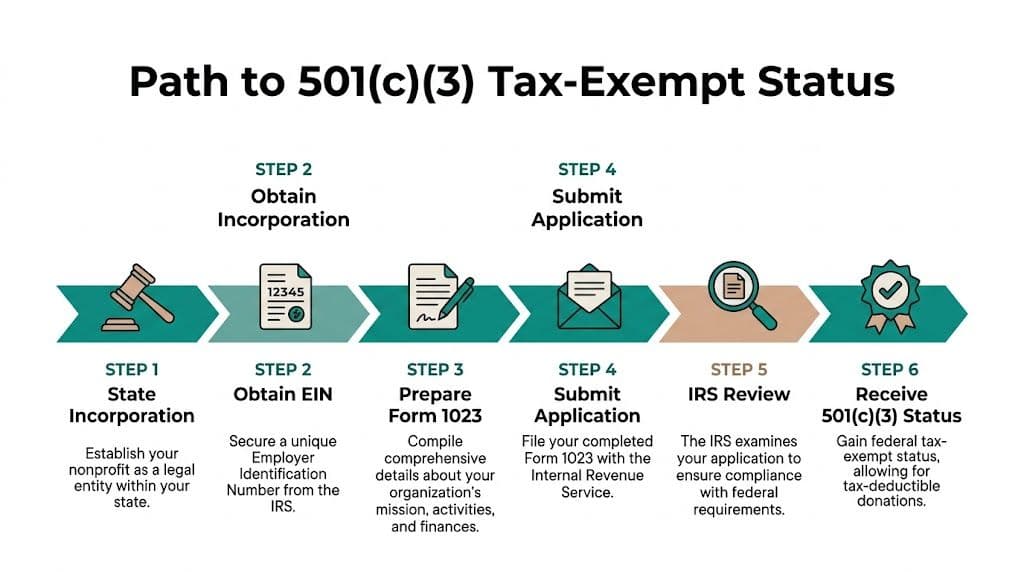
A founder usually reaches this stage with incorporation papers signed, a board in place, and a strong sense of momentum. Then the IRS application lands on the desk and the filing suddenly feels more real. That reaction is normal.
Federal tax-exempt status is the step that lets donors treat gifts as tax-deductible and gives foundations and grantmakers confidence that your organization is set up correctly. It also forces an early test of whether your nonprofit is built on a clear operating plan or only a good idea.
Get your EIN first and keep your records consistent
Your Employer Identification Number, or EIN, is the organization's federal tax ID. You need it before you can file Form 1023, open a bank account, hire staff, or set up payroll.
Get it early.
Then check every core document against it. Your legal name, mailing address, incorporation date, and state filing details should match everywhere. Small inconsistencies slow approvals, create bank issues, and make later compliance harder than it needs to be.
Choose the right application, not just the faster one
The IRS offers two main paths for 501(c)(3) recognition: Form 1023-EZ and the full Form 1023.
The shorter form works for some startups, but it is only a good choice when your organization clearly qualifies and your activities are straightforward. A simple scholarship fund or small educational program may fit well. A nonprofit with multiple programs, planned grantmaking, international work, or unusual revenue streams usually needs the full application.
I tell founders to make this decision based on explainability. If an IRS reviewer, a bank officer, or a future funder asked you to explain your programs and budget in detail, could your filing hold up without gaps? If the answer is no, the full form is often the safer route even if it takes more effort.
If you want a practical preparation tool, this Form 1023 checklist for gathering your documents and activity descriptions can help you organize the application before you submit it.
Treat the narrative as an operating plan
Founders often focus on getting the form filed. The stronger approach is to use the application to pressure-test how the organization will run.
Your program narrative matters because the IRS is evaluating purpose and activity, not branding. It wants to see what you will do, who you will serve, how often the programs happen, who oversees it, and how the spending supports the mission.
Good narratives are specific. Weak ones are full of broad promises.
A useful draft usually answers four questions:
- What activity will the nonprofit carry out
- Who benefits from it
- How the activity is delivered
- How the activity advances the exempt purpose
That same discipline helps after approval. The language you write here will shape grant applications, board reporting, donor communications, and compliance records. If the narrative is vague now, confusion shows up later in operations.
Build a budget you can actually manage
The budget in your Form 1023 is not a formality. It is an early public statement of how the organization expects to earn and spend money.
Keep it realistic. If the first-year revenue assumes large grants with no identified prospects, reviewers may question the plan. If expenses are grouped so loosely that nobody can tell what supports programs versus administration, the filing looks unfinished.
This is also the right moment to decide how you will classify revenue and expenses once money starts coming in. Founders who do that work early avoid painful cleanup later. Even a technical resource on setting up your chart of accounts can be useful here because the underlying issue is the same: your accounts should match how you plan, report, and explain the programs.
Write the budget as if a careful treasurer will review it next week.
Because one will.
Approval helps, but it does not create a sustainable nonprofit
The IRS determination letter matters. It opens doors with donors, grantmakers, and public agencies. It does not fix weak administration.
A nonprofit that files successfully still needs clean bookkeeping, donor tracking, restricted fund oversight, state charitable registration where required, and a process for annual filings such as Form 990. Founders who treat Form 1023 as a paperwork finish line often spend the next year correcting preventable mistakes.
That is the larger point in this guide. Legal approval and operational readiness need to be built together. A sound filing should reflect the systems you intend to use from day one, not just your mission statement.
A simple way to decide
Use this comparison if you are weighing both filing paths:
| Question | 1023-EZ | Full 1023 |
|---|---|---|
| Simple structure and limited activities | Often a fit | Also possible |
| Complex programs or unusual revenue | Usually a poor fit | Better fit |
| Shorter application | Yes | No |
| Room to explain details | Limited | Much better |
| Strong choice for long-term clarity | Sometimes | Often |
The best filing choice is the one your organization can support with clear documents, a credible budget, and a believable plan for operating after approval.
Establishing Your Financial and Donor Systems
Nonprofits often establish themselves either for clarity or for chronic cleanup. The legal filing work matters, but your financial system is what keeps the organization trustworthy.
If I had to pick one area where founders should be more deliberate, it would be this one. Weak systems create confusion around grants, donor intent, reporting, and board oversight. Those problems often arrive subtly, then all at once.
Start with financial structure, not software brand names
Before you choose a platform, decide how your money needs to be tracked.
New nonprofits usually handle some combination of unrestricted gifts, restricted gifts, grants, events, and program expenses. Churches and schools often add designated funds and separate activities. Fiscal sponsors have another layer entirely because they may need reporting by sponsored project.
That means your accounting system - ideally one built around fund accounting - must answer practical questions like these:
- How much restricted money is still available
- Which expenses belong to which program
- What your board should see each month
- What you'll need later for Form 990 and functional expense reporting
If you skip that design work, even a familiar product becomes a poor fit.
A helpful outside reference on setting up your chart of accounts explains the logic behind clean account structure. The examples are not nonprofit-specific, but the discipline is the same. Good reporting starts with a chart of accounts that reflects how the organization operates.
Why general business accounting tools create extra work
QuickBooks is well known, and many bookkeepers know it well. That's a real strength. For a standard business, it may be enough.
For a nonprofit, the issue is not whether it can record transactions. It can. The issue is whether it handles true fund accounting without forcing staff into workarounds.
Using classes and spreadsheets to mimic restricted funds usually means someone is checking balances by hand, reconciling donor restrictions outside the accounting record, or rebuilding reports for the board. That works for a while, then becomes a burden.
The financial stakes are not abstract. According to CapinCrouse on nonprofit outcomes and ratios, a program expense ratio of 65% or higher signals efficiency to donors, and top-performing organizations average 82%. The same source notes that acquiring a new donor costs 5-7 times more than retaining one, and high overhead can increase donor attrition by over 40% annually.
That means messy systems hurt in two directions. They raise administrative effort and weaken donor confidence.
The best time to set up nonprofit accounting correctly is before your first grant report is due.
Connect donor records to financial records early
Founders often separate accounting from donor management because that seems cheaper at first. In practice, it creates duplicate entry and inconsistent records.
You want donor history, acknowledgments, pledges, campaign responses, and gift restrictions to connect cleanly to the accounting record. If they live in different systems that don't speak well to each other, your team starts exporting lists, correcting receipts, and reconciling gifts manually.
An all-in-one nonprofit platform can make sense if it includes accounting, donor management, volunteer records, events, giving pages, and communications in one database. We built nonprofit accounting software at AlignMint around that model, with donor tools on Free and true fund accounting, volunteer management, built-in marketing, online giving pages, and team communication on paid plans. For organizations under $100K in revenue, we also offer a free tier.
You don't have to choose one product family for everything. Bloomerang, DonorPerfect, QuickBooks, and other familiar tools each have strengths. The question is whether your setup reduces manual reconciliation or creates more of it.
A practical first-month setup list
Don't wait until the first audit question or board meeting. Set these up immediately:
- Conflict of interest policy approved and signed
- Bank account controls with clear approval authority
- Chart of accounts aligned to funds, grants, and programs
- Donor acknowledgment process so every gift is receipted properly
- Restricted gift tracking that lives inside the accounting system
- Monthly close routine with reconciliations and board-ready reports
Here's a simple view of what matters most:
| System area | What good looks like |
|---|---|
| Fund accounting | Restricted and unrestricted balances are visible without spreadsheets |
| Donor management | Gifts, pledges, and receipts stay tied to the donor record |
| Volunteer records | Hours, roles, and availability are tracked in one place |
| Marketing | Appeals, event outreach, and follow-up happen from the same system |
| Team communication | Staff and board can see the same current information |
If you build this backbone early, fundraising gets easier because trust is easier to maintain.
Your Launch Checklist for Fundraising and Operations
A new nonprofit needs an opening move, not a perfect master plan. Once your legal and financial basics are in place, your next job is to make it easy for people to give, volunteer, and understand what you do.
Scattered tools can start causing trouble. If your donation page lives in one place, your email list in another, your volunteers in a spreadsheet, and your event RSVPs in someone's inbox, the launch will feel heavier than it needs to.
Open with one campaign people can understand
Your first fundraising effort should be concrete. Don't ask the public to fund "general support" unless they already know you well.
Choose one specific early goal. It might be a pilot program, a scholarship fund, a food distribution launch, or startup supplies for a tutoring program. The clearer the ask, the easier it is for supporters to say yes.
Your launch setup should include:
- An online giving page that is easy to complete on a phone
- A short appeal email that explains the need and the first objective
- A basic donor acknowledgment flow so supporters hear back quickly
- A small contact list strategy starting with people closest to the mission
A built-in marketing suite helps because your donation page, donor records, and campaign outreach stay connected. That makes follow-up easier and gives you a clearer picture of who responded.
Build a volunteer path before you announce one
Many organizations invite volunteers before they know how to place them. That frustrates people quickly.
Create a simple volunteer process with role descriptions, a sign-up form, scheduling notes, and a way to track hours. If you run a school support group, church outreach, or event-heavy nonprofit, this matters even more because volunteer participation often grows before staffing does.
A sound volunteer setup includes:
- Role clarity so people know what they're saying yes to
- Availability tracking so shifts can be assigned sensibly
- Background check steps where appropriate
- Hour logging so you can report and recognize service
When volunteers have no clear next step, they drift away. When they feel expected and informed, they usually return.
Make accessibility part of the launch
Your website, donation forms, and event pages should be accessible from the start. This is not just a compliance issue. It is part of being welcoming.
If you need a practical reference, WebAbility's WCAG compliance checklist is a helpful way to review page structure, readability, and common access barriers before launch.
That's especially important if the people you serve include older adults, people with disabilities, or families using phones as their main device.
Keep your first operational checklist visible
The best launch plans are not long. They are visible and used.
| Area | Task | Status |
|---|---|---|
| Fundraising | Publish online donation page | ☐ |
| Fundraising | Draft first appeal email and text message | ☐ |
| Donor management | Set up gift receipts and donor records | ☐ |
| Volunteers | Create volunteer roles and sign-up process | ☐ |
| Events | Build registration process if hosting a kickoff event | ☐ |
| Programs | Define first service workflow and participant tracking | ☐ |
| Marketing | Prepare welcome message and follow-up communications | ☐ |
| Team communication | Decide who owns responses, approvals, and updates | ☐ |
You'll also want practical guidance for your first campaign and volunteer structure. These related posts can help with that work: nonprofit fundraising strategies and volunteer management best practices.
Keep the first launch modest. You are building repeatable habits, not trying to impress everyone at once.
Your Partner from Day One
A new nonprofit often looks organized from the outside while the back office is still held together by spreadsheets, inbox searches, and memory. That setup works for a month or two. Then the first donor asks for a receipt, a board member wants a report, and nobody is fully sure which numbers are current.
The fix is to choose operating systems early, before habits get messy. I have seen founders lose time cleaning up donor records, reconciling gifts by hand, and chasing volunteer information across separate tools. Starting with one system for money, donor history, communications, events, and volunteer activity makes oversight easier and board reporting more reliable.
AlignMint was built for that day-to-day nonprofit work. It combines accounting, fundraising, volunteers, events, and marketing in one platform, which helps new organizations keep cleaner records from the start. For nonprofits under $100K in annual revenue, there is also a free plan.
Good formation work is not only about getting approved. It is about setting up an organization you can run.
Frequently Asked Questions About Starting a Nonprofit
Can I pay myself as the founder
Yes, if compensation is reasonable, documented, and approved through a proper board process.
Founders sometimes avoid paying themselves because they do not want to raise concerns about self-dealing. That usually creates a different problem. An organization built around unpaid labor from one person often falls behind on reporting, donor follow-up, bookkeeping, and board communication.
Treat founder pay as a governance decision, not a personal one. Define the job, compare compensation to similar roles, document the discussion in board minutes, and review it again as the budget and workload change. The point is to support stable leadership while avoiding private benefit issues.
Should I start under a fiscal sponsor instead of forming a new nonprofit
Sometimes, yes.
Fiscal sponsorship makes sense when you need to test a program before building a full organization around it, or when fundraising needs to start sooner than incorporation and IRS approval would allow. It can also be the smarter choice if the program is narrow in scope and the administrative burden would pull too much time away from serving people.
There is a real trade-off. You gain speed, administrative support, and an existing tax-exempt structure. You also give up some control over funds, reporting, and decision-making. If the sponsor's oversight feels too restrictive for the kind of organization you want to build, separate formation may be the better path.
What do I need to keep doing after approval
Tax-exempt status is the start of operations, not the end of setup.
The organizations that stay healthy over time build a steady rhythm early. They close the books monthly, keep board records current, separate restricted gifts from general operating funds, send donor acknowledgments on time, and track filing deadlines before they become urgent. Those habits protect trust with donors, reduce board confusion, and make grant reporting much easier later.
A practical monthly checklist includes:
- Reconcile bank and credit card accounts
- Review actual results against the budget
- Track restricted and unrestricted funds separately
- Confirm donor receipts and acknowledgments went out
- Store board minutes, filings, and key financial records in one place
Small cleanup issues rarely stay small. A missed restriction, an unreconciled account, or incomplete donor records can become expensive to fix once grants, larger donations, or outside review enter the picture.
What if I'm starting a church, school, or sponsored project
The legal steps overlap, but the operating systems need to fit the programs.
Churches often need tighter controls around designated giving and clearer separation between general offerings and ministry funds. Schools usually need stronger processes for tuition assistance, events, volunteer coordination, and program-level reporting. Sponsored projects need clean reporting by project so both the host organization and the project lead can see how funds are used.
I would not use a generic setup for any of these. The chart of accounts, approval rules, donor records, and reporting process should match how money and information move in practice through the organization day to day.
How long does it take to start a nonprofit organization
It depends on your state, your board's readiness, and whether you file Form 1023 or 1023-EZ.
Many delays happen before anything is submitted. I see time lost when the mission is still too broad, board members have not reviewed the governing documents, or the budget does not line up with the proposed programs. Organizations move faster when the legal paperwork and the operating plan support each other from the beginning.
If you want one system to manage fund accounting, donor records, volunteers, events, marketing, and day-to-day administration after formation, AlignMint is built for that work. Nonprofits under $100K in annual revenue can also use a free plan at https://www.getalignmint.org.
Frequently Asked Questions
Ready to try AlignMint with your nonprofit?
Start free — set up donor tools, giving pages, and Minty. Upgrade when you need accounting.