

Quick Answer: Nonprofit Bylaws Template Free
Get a free nonprofit bylaws template and learn how to customize it. This guide helps directors draft, adopt, and use bylaws that fit real operations.
For governance-ready nonprofit records, see fund accounting.
You may be sitting with incorporation papers in one folder, board names on a notepad, and a blank bylaws document you don't want to touch. That moment is common. Bylaws feel legal, abstract, and easy to get wrong.
They don't have to stay that way. A good nonprofit bylaws template free option gives you a working draft, and the right edits turn it into a practical operating guide your board can follow.
From Blank Page to Board-Ready Bylaws
Most executive directors don't struggle because they lack judgment. They struggle because bylaws ask you to make governance decisions before daily operations have settled down.
That's why starting from a blank page is a poor use of time. A template gives you structure first, then asks you to make a short list of real choices about board authority, meetings, voting, officer roles, and conflicts.
Start with decisions, not wording
Before you edit any template, write down the answers to these questions:
- Will you have members or only a board? Many early nonprofits don't need a membership structure.
- Who has authority to sign contracts and approve spending? Vague authority creates avoidable friction.
- How often can your board realistically meet? Pick a rhythm your board will keep.
- What happens when a director resigns mid-term? Vacancy language matters more than people expect.
- How will you handle conflicts of interest? This needs a process, not a slogan.
Those decisions shape the document. The wording comes after.
Practical rule: If your board can't follow the bylaws during a busy month, the document is too complicated.
A strong startup checklist helps at this stage because bylaws don't sit alone. They connect to incorporation, tax exemption, your first board meeting, and your recordkeeping setup. If you want that broader sequence laid out plainly, this nonprofit startup checklist is a useful place to keep yourself organized.
Use outside models carefully
Free templates can save time, but they also carry assumptions. Some assume voting members. Others assume a committee-heavy board, formal parliamentary procedure, or meeting schedules that don't fit a small working board.
That issue gets sharper if your organization operates outside the U.S. or plans to. If you're working across borders, state-focused U.S. templates won't answer every governance question. For Australian founders, this guide on how to start a nonprofit organisation in Australia is worth reading alongside any U.S.-style bylaws model because local incorporation and charity requirements can shape what belongs in your governing documents.
Aim for board-ready, not perfect
A board-ready draft does three things well. It matches your actual operating model, it avoids internal contradictions, and it gives directors a clear process for making decisions.
You don't need elegant legal prose. You need a document your board can adopt, your secretary can maintain, and your leadership team can use when questions come up six months from now.
Your Starting Point A Free Nonprofit Bylaws Template
The fastest way to get traction is to start with a structured draft and make focused edits. That's especially important because the IRS requires submission of bylaws as a core governance document when nonprofits apply for 501(c)(3) tax-exempt status, and that requirement helps show the organization has structured operations aligned with charitable purposes. For smaller groups, a template matters even more because 80% of U.S. nonprofits operate on budgets under $500K yearly, so reducing setup cost and standardizing core sections is practical, not cosmetic, as noted by Form 1023 guidance on nonprofit bylaws templates.
If you'd rather begin with a guided draft than a blank document, a nonprofit bylaws generator can help you produce a cleaner first version.
What a useful template should already include
A workable free template should cover the clauses most boards need to approve early:
- Purpose language that explains why the nonprofit exists and keeps the mission broad enough for future programs.
- Board structure that states the number of directors, how they're elected or appointed, and how vacancies are filled.
- Officer roles that clarify who serves as chair, secretary, treasurer, or similar positions, and what each role does.
- Meeting rules covering notice, quorum, regular meetings, and special meetings.
- Conflict procedures that require disclosure and recusal when a director has a personal interest.
- Amendment language so the organization can revise the bylaws without confusion later.
- Dissolution language so the board knows what happens to assets if the organization closes.
When one of those pieces is missing, boards tend to improvise. Improvisation is fine for planning a fundraiser. It's a poor method for governance.
What free templates do well, and where they fall short
Rocket Lawyer, Legal Templates, and similar providers are useful because they make legal forms accessible. They can give you a clear starting shape, and for many founders that's enough to move from paralysis to progress.
The trade-off is that generic legal forms often stop at formal structure. They may not help you think through how your bylaws connect to budget approval, restricted gifts, volunteer roles, church governance, school oversight, or fiscal sponsorship.
A better nonprofit bylaws template free option doesn't just fill blank lines. It helps you answer operational questions such as:
| Clause area | What works | What usually fails |
|---|---|---|
| Board size | A number or range you can actually maintain | An ambitious size you can't fill |
| Meeting cadence | A schedule your board can honor | Monthly meetings for an already overcommitted board |
| Officer duties | Clear authority tied to real tasks | Titles with no practical distinctions |
| Conflicts | Disclosure, recusal, and minutes | A broad ban with no process |
| Amendments | Notice and board vote | Last-minute changes from the floor |
A template should reduce uncertainty, not hide it. If a clause leaves your board asking, "What do we do in real life?" it needs editing.
Read the template as an operating document
The best way to review a template is to picture actual moments. A treasurer resigns. A donor gives money for a specific program. A church board wants virtual meetings. A school nonprofit needs clean approval of event spending. A fiscal sponsor needs clearer lines between sponsored projects and central oversight.
If the template helps your board act calmly in those moments, you're on the right track.
Customizing Key Clauses for Your Mission
Templates help you start. Custom clauses make the bylaws worth keeping.
Many organizations either over-lawyer the document or leave it too vague to guide anyone. The middle ground is better. You want language that protects the mission, fits your board's habits, and gives future leaders a clear map.
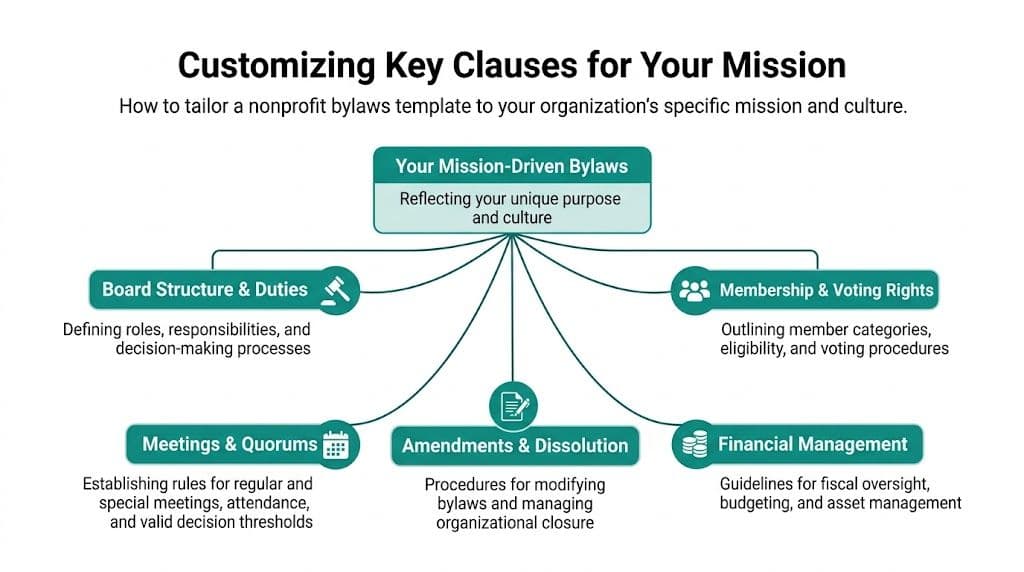
One structural benchmark is straightforward. Templates from societ.com highlight core governance elements such as a minimum of 3 directors in most states and quarterly meetings as a standard cadence, and their cited BoardSource survey says organizations with formal bylaws were 40% less likely to face an IRS audit. You can review that framing in this nonprofit bylaws template reference from Societ. If you also need a refresher on board makeup, this guide to nonprofit board of directors requirements pairs well with bylaw drafting.
Write a purpose clause that gives you room to grow
A weak purpose clause causes trouble in two directions. It can be so broad that it says almost nothing, or so narrow that every new program feels outside scope.
Good purpose language names the charitable mission in plain English and leaves room for normal growth. If you serve students today, don't define yourself so tightly that you can't add family support, mentoring, or teacher training later.
A practical pattern looks like this:
The corporation is organized for charitable and educational purposes, including programs that support student learning, family stability, and community engagement.
That kind of statement gives direction without boxing you in. If you're faith-based, school-based, or a fiscal sponsor, name that identity clearly enough that the board and outside reviewers can understand how decisions should align with the mission.
Set board size for reality, not aspiration
Founders often write bylaws for the board they hope to have in three years. You should write them for the board you can reliably maintain now.
If your current network supports five committed directors, don't set a complicated structure that assumes twelve. A smaller board with defined duties usually governs better than a larger board with uneven participation.
Consider these trade-offs:
- Smaller boards move faster and usually communicate better.
- Larger boards can broaden reach and oversight, but scheduling gets harder.
- Fixed board numbers create clarity.
- A range gives flexibility if recruiting takes time.
A simple clause often works best. State a minimum, a maximum, and how the board changes that number by vote.
Define terms and vacancies before you need them
Boards rarely worry about term language until turnover begins. Then the absence of clear rules becomes obvious.
You need answers to ordinary questions. How long does a director serve. Can they be reappointed. What happens if someone stops showing up. Who fills the seat, and for how long.
Use direct language. Avoid ornamental wording. If a rule affects succession or authority, write it so your secretary can apply it without calling an attorney for every step.
Board habit worth keeping: Review your vacancy and removal clauses when relationships are calm, not when conflict has already started.
Clarify officer roles so decisions don't drift
Titles alone don't govern anything. Duties do.
Many bylaws list a president, secretary, and treasurer, then stop there. That leaves too much room for assumption. In practice, your officers should have responsibilities tied to recurring work.
A concise breakdown might look like this:
| Officer | Useful responsibility | Common drafting mistake |
|---|---|---|
| Chair or President | Presides over board meetings and supports board accountability | Acting as if the chair can make all decisions alone |
| Secretary | Keeps minutes and maintains official records | Giving the title but not the recordkeeping duty |
| Treasurer | Oversees financial reporting to the board | Treating the role as day-to-day bookkeeper |
If you also have an executive director, distinguish governance from management. The board governs. Staff operate. Bylaws should support that boundary, not blur it.
Make meeting rules easy to follow
Meeting clauses should reflect how your board really works. If the board can only gather quarterly, write quarterly. If your directors are spread across regions, include virtual meeting language where allowed.
The basics usually include regular meetings, special meetings, notice, quorum, and voting. The mistake is making any of these too rigid.
For example, a high quorum can make formal action difficult. But a quorum set too low can weaken trust in board decisions. Your document should strike a balance your board can sustain.
A practical meeting section often addresses:
- Notice requirements that are clear and reasonable.
- Remote participation if your board uses video calls.
- Special meetings for urgent approvals.
- Written consent if your state and structure permit it.
- Minute approval so records stay current.
Decide whether membership belongs in your model
Some nonprofits need members with voting rights. Many don't.
Membership can make sense for associations, faith communities, or organizations built around constituent representation. It can also create administrative work that a lean staff doesn't need.
If you aren't operating as a membership organization, don't borrow those clauses from a generic template. Remove them. A mismatch between paper governance and lived practice causes confusion later.
Build a conflict process your board will actually use
Every board says conflicts matter. Fewer boards write a usable procedure.
Your conflict clause should answer four things. What must be disclosed. Who reviews it. When the interested person steps out. How the decision gets recorded.
That doesn't require pages of legal text. It requires order.
A plain approach often works better than a formal one:
- A director discloses the potential conflict before discussion.
- The disclosure is noted in the minutes.
- The director doesn't vote on the matter.
- The remaining board members decide the issue independently.
- The minutes reflect the recusal and action taken.
That process protects both the organization and the individual director.
Tie financial clauses to real oversight
This is the point many templates underplay. Financial governance shouldn't float in a generic article near the end. It should connect directly to how money is approved, tracked, and reviewed.
Your bylaws don't need a full accounting manual, but they should identify who approves the budget, who receives financial reports, who can authorize bank access, and how restricted funds are respected. If your organization runs grants, scholarship funds, church designations, school activity funds, or sponsored projects, that clarity matters.
Good bylaw language supports practical routines such as:
- Board review of financial reports at regular meetings.
- Approval authority for major contracts or non-routine spending.
- Separation of duties where possible.
- Documented handling of restricted gifts according to donor intent.
- Clear fiscal oversight when one entity sponsors multiple projects.
Bylaws evolve from a filing requirement into a management tool. They shape how finance staff report, how board members ask questions, and how leaders avoid ad hoc decisions.
Add amendments without inviting chaos
Amendment clauses deserve more attention than they usually get. If changing bylaws is too hard, outdated rules stay in place. If it's too easy, governance can change with little warning.
A sound amendment clause usually requires prior notice and a board vote. That's enough structure to protect stability without freezing the document forever.
Keep amendment rules firm enough to prevent surprise changes, but simple enough that the board will update outdated provisions when it should.
Adapt special clauses for churches, schools, and fiscal sponsors
Some missions need extra drafting care.
Churches may need language that reflects denominational oversight, ministry leadership roles, or how designated gifts are treated. Schools often need clearer lines around event approvals, scholarship decisions, and board oversight of educational programs. Fiscal sponsors need bylaws that support oversight across multiple projects while preserving the sponsor's legal authority.
Those are not edge cases. They are ordinary governance realities in nonprofit work. A template is the frame. Mission-specific clauses are what make the frame hold.
The Adoption Process and Staying Compliant
A draft isn't official until the board adopts it properly. This part is less dramatic than people expect, but it does need order.
The cleanest process is to circulate the draft before the meeting, give directors time to review it, discuss only material issues in the meeting itself, and then vote. If your board approves the bylaws, record the action in the minutes and keep the final signed copy with your corporate records.
A clean adoption checklist
Use a simple sequence:
- Review the final draft against your articles of incorporation. The two documents shouldn't contradict each other.
- Check state law requirements. Meeting rules, remote participation, and member provisions often come from state law first.
- Send the draft before the meeting. Directors need time to read it.
- Bring a board resolution to adopt the bylaws. Keep the motion clear.
- Record the vote in the minutes. Include the date and the version approved.
- Have the secretary maintain the official copy. Keep it with permanent records.
- Store a digital copy in one secure location. Don't scatter versions across email threads.
Keep your records consistent
A bylaw problem often starts as a recordkeeping problem. One board packet has an old version. Another director has a revised draft with tracked changes. The secretary's file says one thing, while practice says another.
That confusion is avoidable. Keep one final signed version, one amendment history, and one clear record of adoption in the minutes. If your board reviews governance annually, note that review even if no amendments are made.
A compliance routine should also connect to your annual filings and reporting calendar. If your board needs a practical reminder of what external reporting requires, this Form 990 checklist is a helpful companion to your internal governance records.
Know what bylaws can and can't do
Bylaws govern internal operations. They do not override state law, and they do not replace your articles of incorporation.
That means three documents must work together:
| Document | Main job | Common mistake |
|---|---|---|
| Articles of incorporation | Establish the legal entity | Treating them like an internal policy manual |
| Bylaws | Govern board process and internal authority | Writing rules that conflict with the articles |
| Board policies | Handle specific practices and controls | Trying to force every policy into the bylaws |
If a rule changes often, it may belong in a board policy, not in the bylaws.
That's especially true for procedures like staff reimbursement steps, internal approval thresholds, or document retention details. Keep the bylaws stable. Put more flexible practices in separate policies the board can update more easily.
Bringing Your Bylaws to Life in Daily Operations
Bylaws earn their keep after adoption. If they only live in a PDF folder, they won't help you much.
The better approach is to let the bylaws shape recurring work. They should influence financial approvals, donor stewardship, volunteer boundaries, meeting records, and how teams communicate decisions upward.

Turn governance language into operating habits
A few examples show what this looks like in practice.
If your bylaws assign budget oversight to the board, your finance workflow should produce board-ready reports on a regular schedule. If the bylaws say restricted gifts must be handled according to donor intent, your accounting setup should separate those funds clearly from general operating money. If officer duties include maintaining minutes and records, your meeting process should make that easy every time, not only during annual meetings.
The same goes for fundraising and volunteers. A conflict clause should guide gift acceptance decisions when donor relationships overlap with board relationships. A volunteer role clause should support who supervises volunteers, what authority they have, and where incidents get reported.
Connect each clause to a recurring task
This simple map helps:
- Board meeting clauses should drive your calendar, agenda approvals, and minute retention.
- Financial oversight clauses should guide how budgets, reports, and restricted funds are reviewed.
- Officer authority clauses should shape signature rules and contract approval practices.
- Membership clauses should determine who receives notice and who votes.
- Amendment clauses should control how governance changes are introduced.
When boards do this work well, governance becomes less emotional. People aren't arguing from memory or personality. They're reading the agreed rule and applying it.
Good bylaws reduce unnecessary debate. They don't remove judgment, but they give judgment a structure.
Watch for the international gap
If your work crosses borders, standard templates need extra scrutiny. Many free bylaws templates are U.S.-centric and don't address the needs of international nonprofits, even though there are over 10 million organizations worldwide outside that narrow frame. They often miss adaptation guidance for places such as Canada, the UK, or Australia, which creates compliance risk for globally operating groups, as discussed in this review of nonprofit template limitations.
That matters in operations, not only in legal review. Data privacy expectations, charity registration rules, and board procedures can shape how your organization stores member records, documents consent, manages cross-border fundraising, or approves project activity in another country.
Use bylaws to settle recurring questions faster
When a board member asks whether a committee can approve event spending, the bylaws should point to delegated authority. When a donor restricts a gift to a scholarship program, the bylaws should support disciplined oversight rather than informal interpretation. When a volunteer leader acts outside their role, your governance documents and related policies should make the response consistent.
This is especially valuable for churches, schools, and fiscal sponsors. Those organizations often juggle designated funds, layered approvals, and multiple stakeholder groups. Bylaws help keep those moving parts from colliding.
Good Governance Is Within Your Reach
Most nonprofits don't need more complexity. They need a governance document that says what matters, fits how the board operates, and holds up when decisions get difficult.
That's what a good nonprofit bylaws template free resource should help you build. Not a legal ornament. A working rulebook that protects the mission, clarifies authority, and keeps your organization from reinventing basic decisions every quarter.
The strongest bylaws usually share a few qualities. They're plain enough for directors to follow, disciplined enough to prevent drift, and flexible enough to survive leadership transitions. They also connect to daily operations instead of sitting apart from them.
If you're reviewing your broader compliance practices, this collection of nonprofit compliance articles is a useful next step.
A final practical point matters here. Software won't fix weak governance. But weak governance becomes easier to spot when your reports, records, donor data, volunteers, and board processes live in separate systems that don't agree. That's one reason many executive directors eventually move away from patching together QuickBooks, spreadsheets, donor databases, event tools, and email platforms. Each tool may be good at its own job. The burden shows up in the handoffs.
For teams that want fewer handoffs, an all-in-one approach can make governance easier to live out. The benefit isn't novelty. It's clarity. True fund accounting supports board oversight of restricted money. Unified donor management keeps contribution records and finance data aligned. Built-in volunteer tracking, online giving pages, marketing tools, team communication, and AI support all reduce the number of places staff have to check before acting.
That kind of operational setup is especially helpful for small nonprofits, churches, schools, and fiscal sponsors that need one system to support finance, fundraising, people, and reporting without adding per-seat costs.
If you want your governance and day-to-day operations to pull in the same direction, take a look at AlignMint. We built it as an all-in-one platform for nonprofit accounting, donor management, volunteer management, events, marketing, team communication, fiscal sponsorship, and online giving. You get true fund accounting instead of class tracking, built-in marketing tools, Minty assistance, plan-based user allowances (1 on Free, up to 10 on Plus, up to 25 on Pro, and unlimited on Enterprise), and a free tier for nonprofits under $100K.
Frequently Asked Questions
Ready to try AlignMint with your nonprofit?
Start free — set up donor tools, giving pages, and Minty. Upgrade when you need accounting.