

Nonprofit Compliance, Reporting & Tax Guides
Nonprofit compliance isn't optional - it's what keeps your tax-exempt status intact and your donors confident. These guides cover FASB accounting standards, Form 990 filing, restricted fund compliance, financial reporting requirements, and audit preparation. Written by people who've actually sat through nonprofit audits.
| Guide Title | Summary |
|---|---|
| 7 Functional Expense Allocation Methods | Match the functional expense method to the cost, then write the rule down. Seven methods, and when to stop using each one. |
| Who Must File Form 990? Threshold Guide | Who must file Form 990 depends on organization type, receipts, and assets. The $50,000, $200,000, and $500,000 tests do not settle every exception. |
| Donating Appreciated Stock: The Tax Rules | Appreciated stock given to a public charity generally supports a fair-market-value deduction, and the gain is not taxed. This is the transfer and records guide. |
| Form 990-N e-Postcard for Small Nonprofits | Form 990-N is the short IRS e-Postcard for small organizations. It confirms you are still operating. It does not prove the books. |
| Cost Allocation Plan: Methods and Examples | A cost allocation plan records the method, the steps, and an example so shared bills follow the benefit each program received. |
Show all categories (+9 more)
Explore compliance.
7 Functional Expense Allocation Methods
Match the functional expense method to the cost, then write the rule down. Seven methods, and when to stop using each one.
Read the guide
Who Must File Form 990? Threshold Guide
Who must file Form 990 depends on organization type, receipts, and assets. The $50,000, $200,000, and $500,000 tests do not settle every exception.
Read the guide
Donating Appreciated Stock: The Tax Rules
Appreciated stock given to a public charity generally supports a fair-market-value deduction, and the gain is not taxed. This is the transfer and records guide.
Read the guide
Form 990-N e-Postcard for Small Nonprofits
Form 990-N is the short IRS e-Postcard for small organizations. It confirms you are still operating. It does not prove the books.
Read the guide
Cost Allocation Plan: Methods and Examples
A cost allocation plan records the method, the steps, and an example so shared bills follow the benefit each program received.
Read the guide
Claude Cowork for Nonprofits: Safe Workflows
Desktop AI tools like Claude Cowork can read local folders to draft grant narratives and summarize board packets. Here is how nonprofits can use them safely without exposing donor records or fund balances.
Read the guide
Nonprofit AI Policy & Data Privacy Checklist
Staff and board members are already using AI tools. Use this practical nonprofit AI policy and data privacy checklist to protect donor trust, keep financial records accurate, and set clear guardrails in one page.
Read the guide
Modified Cash Basis of Accounting Guide
Modified cash basis accounting explains a healthy bank balance that still sits next to unpaid bills, if the policy is written down.
Read the guide
Form 990 for Churches: Who Files in 2026
A church that meets the federal definition usually skips Form 990, but the related entity beside it may still have to file.
Read the guide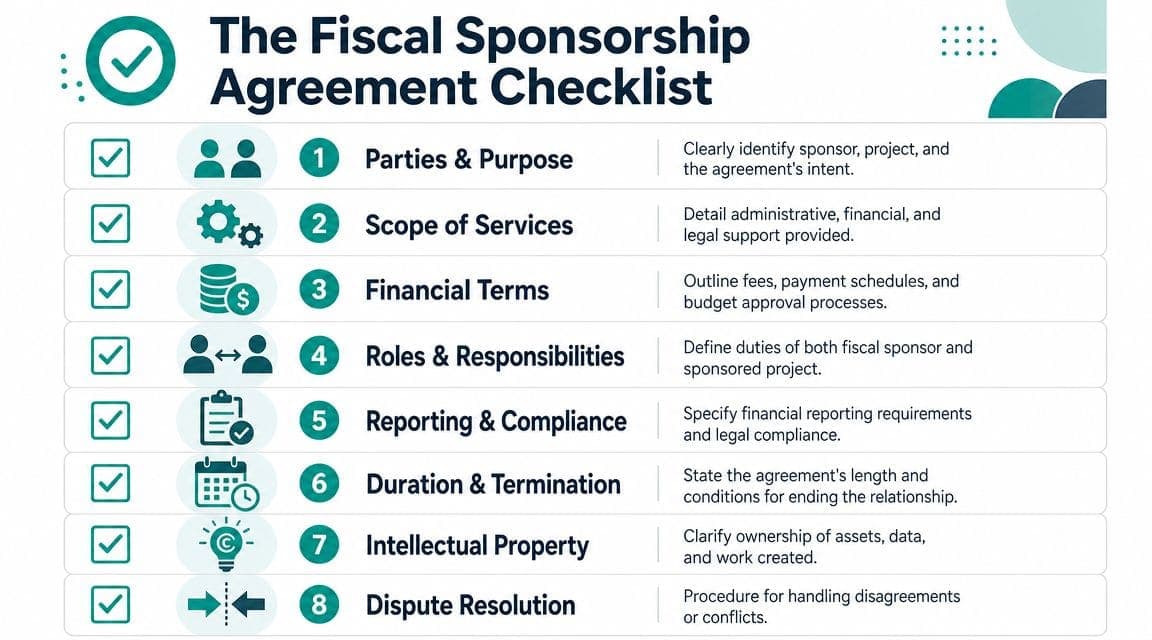
Fiscal Sponsorship Agreements: Key Clauses
Complete guide to fiscal sponsorship agreements for Model A and Model C: the 10 clauses every contract needs, sample IRS variance power wording, allocation and IP rules, and how to structure a clean spin-out clause.
Read the guide
7 Sample Volunteer Forms for Nonprofits
Sample volunteer forms work when each document matches one step, has an owner, and is reviewed before the next assignment.
Read the guide
Fiscal Agent vs. Fiscal Sponsor: Key Differences
Why a fiscal sponsor is not the same as a fiscal agent, how IRS conduit rules and FASB ASC 958 treat each relationship, and how to make sure donor gifts stay tax-deductible.
Read the guide
Donation Receipt Requirements for Nonprofits
Donation receipt requirements cover gift type, thresholds, timing, and wording that matches your accounting records.
Read the guide
Nonprofit Payment Processing Explained Simply
Understand nonprofit payment processing from checkout to deposit, receipts, fund coding, fees, and month-end reconciliation.
Read the guide
Nonprofit Operations Management Guide 2026
Build nonprofit operations management around finance, people, technology, compliance, and service delivery with metrics and a practical roadmap.
Read the guide
Texas 501(c)(3) Filing Fees: $25 + IRS
Texas 501(c)(3) formation starts at $300: $25 Secretary of State filing, $275 Form 1023-EZ, a free EIN, and no charitable solicitation registration fee.
Read the guide
501c7 Nonmember Income Rules: Guide (2026)
Plain-language guide to 501c7 nonmember income rules, member support, public-use income, social club records, and advisor review.
Read the guide501c7 Accounting Software for Social Clubs
A plain-English guide to 501c7 accounting software, social club records, dues, nonmember income, events, and advisor-ready reports.
Read the guideFrequently Asked Questions: Compliance
It means restrictions are recorded correctly, expenses have support, and the statements and Form 990 numbers can be traced back to the ledger.
FASB sets how nonprofit statements present net assets with and without donor restrictions. Those rules are what keep board reports and Form 990 from telling two different stories.
Start during the year. Reconcile cash monthly, tie restricted balances to the ledger, and keep grant support with the expenses it funds.