
Quick Answer: Grant Management Best Practices
Strong grant management starts with three habits: track every restricted dollar in true fund accounting, keep one compliance calendar for every funder deadline, and connect grant spending to program outcomes before the report is due.
| Practice | What to do first | Why it matters |
|---|---|---|
| Restricted fund tracking | Name each grant fund to match the award letter | Prevents spending the wrong dollars on the wrong purpose |
| Compliance calendar | Set internal deadlines two weeks before funder due dates | Stops last-minute report scrambles |
| Grant accounting reconciliation | Reconcile grant balances weekly, not at year-end | Catches drawdown and procurement timing issues early |
| Grant governance | Assign one owner per grant for spending approvals | Creates an audit-ready approval trail |
| Central grant files | Store applications, awards, and reports in one profile | Keeps program and finance teams aligned |
| Drawdown automation | Code expenses to the grant when they happen | Speeds reimbursement and reduces errors |
| Program-based budgets | Link each grant to the program it funds | Makes proposals and reports easier to defend |
| Close-out protocol | Start final reporting 90 days before grant end | Protects renewals and funder trust |
| Donor and funder CRM | Log every program officer touchpoint | Improves stewardship and future applications |
| Grant analytics | Review fund balances and cost per outcome monthly | Turns reporting into strategy |
If your team is searching for grants management best practices, grant governance, or restricted fund reconciliation, start with fund accounting and the compliance calendar. Everything else gets easier once those two systems are reliable. For a deeper foundation, read fund accounting for nonprofits and CRM with accounting integration. Grants are also a key part of your broader fundraising strategy.
Related resources: Grant proposal budget template · Grant Finder · Free tools hub · Fund accounting
Managing grants can feel like a constant battle against paperwork and deadlines. You're trying to prove your impact while juggling compliance rules and disconnected spreadsheets. It drains your time and pulls focus from your actual mission. It doesn't have to be this way. A clear system can bring confidence and order to your funding process.
We understand this frustration. Many leaders use tools like QuickBooks, which weren't built for the complexities of restricted funds. That's why we've compiled these essential grant management best practices. These are practical steps to help you regain control, satisfy funders, and build a sustainable financial foundation.
1. Get Financial Clarity with True Fund Accounting
You can gain instant clarity on every grant by using a true fund accounting system. This specialized method, designed for nonprofits, tracks restricted funds correctly. It ensures money designated for a specific grant is only spent on that purpose. This is a core grant management best practice.
Unlike QuickBooks classes, true fund accounting handles restricted funds from the start. Our platform was built specifically for this, so you can track a federal grant separately from general funds. Fiscal sponsors can manage dozens of projects without confusing workarounds. To get a deeper understanding of this principle, you can explore the fundamentals of fund accounting for nonprofits.
How to Implement Restricted Fund Tracking
- Establish Clear Fund Names: Create a consistent naming system for each fund that matches your grant agreements. For instance, use "2024-DHHS-Youth Program" instead of a generic name.
- Automate Fund Allocations: Set up your system to automatically assign revenue to the correct fund. When a grant payment arrives, it goes directly into its designated fund.
- Conduct Weekly Reviews: Briefly review your fund balances each week. This simple habit helps you monitor spending and prevent overspending.
- Train Your Team: Make sure everyone who handles finances understands how to code transactions to the correct fund. This prevents errors that are difficult to fix later.
2. Bring Everything Together with a Centralized Workflow
You can eliminate the chaos of scattered information by creating a centralized workflow. This brings all grant activities, from research to final reports, into one organized place. This approach reduces administrative work and improves your team's effectiveness.
This unified method means all your grant information lives in one place. Your whole team can access what they need, when they need it. An environmental organization can manage grants from various sources, seeing a complete picture. This integrated structure, also used by platforms like Grants.gov, moves you from reactive crisis management to proactive oversight. For a full breakdown of what to look for, see our guide to grant tracking software for nonprofits.
How to Implement a Centralized Workflow
- Create a Grant Profile Template: Design a standard template for every grant. Include key information like the funder, award amount, and reporting dates.
- Set Up Automatic Deadline Reminders: Configure your system to send automatic alerts to your team before key deadlines. This simple step prevents last-minute scrambles.
- Store All Grant Documents Together: Upload all related documents directly to the grant's profile. This includes the application, award letter, and all correspondence.
- Establish a Monthly Grant Review Meeting: Schedule a recurring meeting to assess progress and review upcoming deadlines. This keeps your entire team aligned.
3. Connect Your People and Your Money in One System
You can build stronger funder relationships by connecting your donor information with your grant data. Our all-in-one system lets you track foundation officers, funding history, and communications in one place. This creates a complete view that connects funders, grants, and individual donations.

When your donor management (CRM) and financial data are connected, stewardship becomes much simpler. You can see how a corporate donor's individual giving relates to the grants their foundation awarded. This unified view prevents missed opportunities and ensures consistent communication. For more detail, you can read about the benefits of a CRM with accounting integration.
How to Implement Integrated Grant and Donor Data
- Create Custom Funder Fields: Go beyond standard contact information. Add custom fields to track a foundation's strategic priorities and key decision-makers.
- Log Every Interaction: Establish a firm rule for your team to log every call, email, and meeting with a funder. This creates an institutional memory that outlasts staff changes.
- Set Relationship Reminders: Use your system to schedule future touchpoints. Set reminders to check in with a program officer before a grant deadline.
- Generate Funder-Specific Reports: Create reports that show a funder the direct impact of their investment. Connect their grant dollars to specific program outcomes.
4. Get Paid Faster with Automated Reimbursement Requests
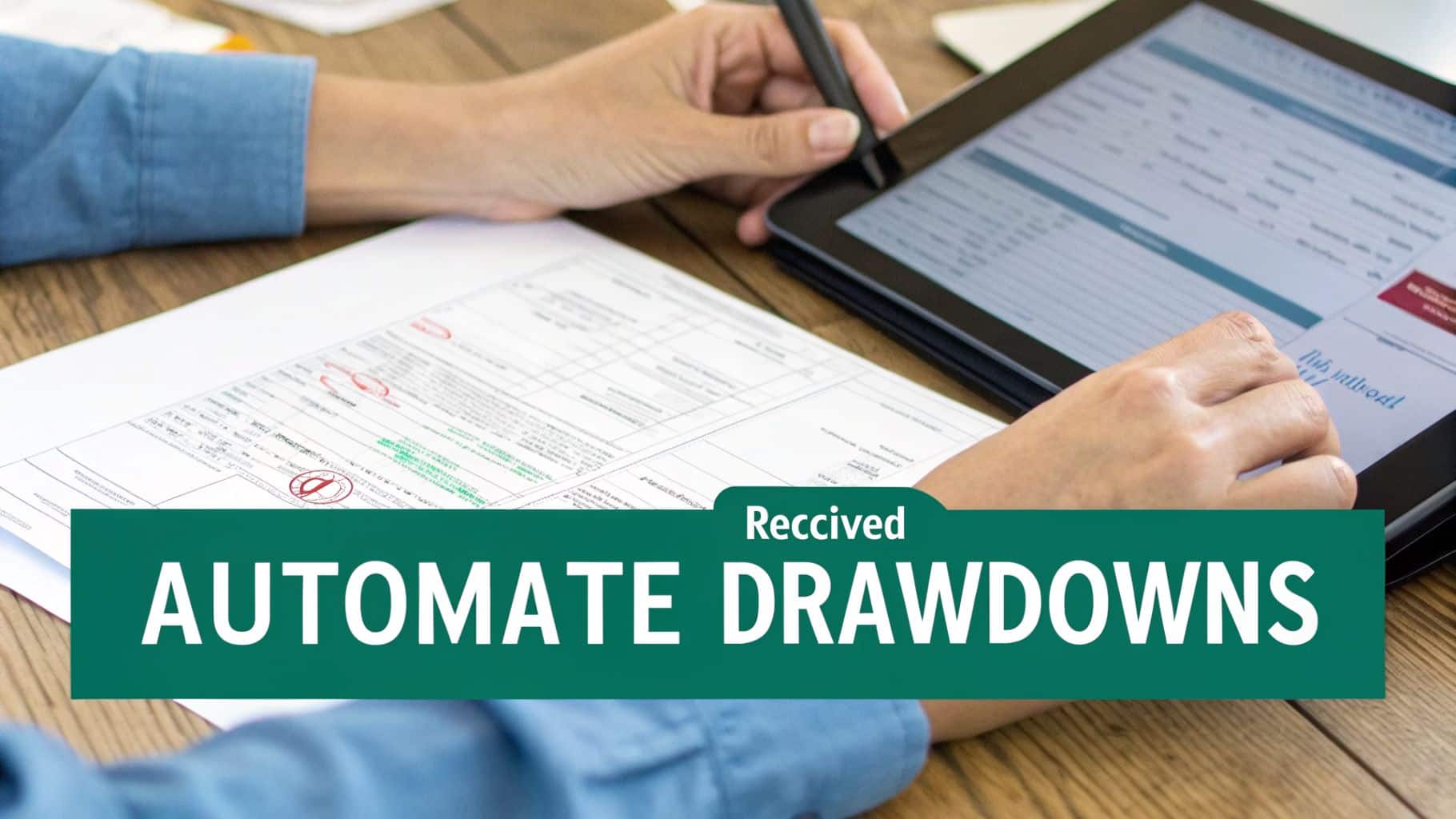
You can improve your cash flow by automating your grant drawdown and reimbursement process. This approach connects expenses directly to their funding source in your accounting system. It then generates the necessary reports for reimbursement requests almost instantly.
This system is especially helpful for organizations managing multiple funding streams. Imagine you have a federal grant and a foundation grant with different reporting needs. Automation ensures each expense is correctly coded, so you can produce a compliant report in minutes. This speeds up your cash receipts and reduces the risk of compliance errors.
How to Implement Automated Drawdowns
- Code Expenses Upon Entry: The most important habit is to code every expense to its proper grant fund when it occurs. This is the foundation of an automated system.
- Create Grant Profiles: Set up a profile for each grant in your system. Include the funder's specific requirements, reporting deadlines, and drawdown schedule.
- Reconcile Balances Monthly: Regularly compare your internal grant balances with the funder's statements. This monthly check-in catches discrepancies early.
- Build Reimbursement Templates: Create pre-built reimbursement request templates for your major grants. Your system can then populate these templates with the correct data.
5. Never Miss a Deadline with a Central Compliance Calendar
You can transform grant management from a scramble to an organized process. A centralized compliance calendar maps every deadline and audit requirement across all your grants. This simple tool is one of the most effective grant management best practices.
A well-structured calendar provides a single source of truth for your entire team. You can easily track a federal grant's annual report and a foundation's quarterly narrative in one place. This approach eliminates last-minute stress and ensures all documents are prepared in advance.
How to Implement a Grant Compliance Calendar
- Set Internal Deadlines: Always schedule your internal due dates two weeks before the funder's official deadline. This buffer provides ample time for review and revisions.
- Assign Clear Ownership: Designate a specific staff member as the lead for each grant's compliance tasks. This direct responsibility ensures accountability.
- Create Compliance Checklists: For each major grant, develop a simple checklist of required documents and steps. This helps standardize your process.
- Build in Advance Reviews: Schedule 30-day review cycles for major reports. These check-ins allow your finance and program teams to align on progress.
6. Improve Accuracy with Integrated Bank Reconciliation
You can ensure your grant balances are always accurate by connecting your bank accounts to your accounting system. Direct bank feed reconciliation automatically imports transaction data. This eliminates hours of manual data entry and dramatically reduces reconciliation time.
By linking your bank feeds directly to your restricted funds, you maintain precise and timely accounting. For instance, a fiscal sponsor can create separate bank accounts for its largest projects. With automated bank feeds, every transaction is pulled in daily, providing an accurate view of each project's cash position.
How to Implement Bank Feed Reconciliation
- Consider Separate Bank Accounts: For major restricted grants, open a dedicated bank account. This creates a clean separation and simplifies reporting.
- Establish Auto-Categorization Rules: Create rules in your accounting system to automatically categorize recurring transactions. This saves time and improves consistency.
- Review Unmatched Transactions Daily: Spend a few minutes each morning reviewing transactions the system couldn't automatically match. This prevents a backlog and keeps your books clean.
- Use Feeds for Reporting: Pull data directly from your reconciled bank feeds to populate grant balance reports. This ensures your reports reflect the true cash status of each grant.
7. Tell a Clearer Financial Story with Program-Based Budgets
You can gain a clearer view of your costs by shifting to a program-based budget model. This approach organizes income and expenses around your specific programs. It aligns perfectly with how most grants are awarded.
This method brings immediate clarity to your financial story. A social service agency can create distinct budgets for its counseling, job training, and food pantry programs. When a grant is awarded for job training, its funds are tracked directly within that program's budget. This shows you how much is covered and what funding gap remains.
How to Implement Program-Based Budgeting
- Clearly Define Your Programs: Start by creating clear, written definitions for each of your programs. Ensure every team member understands these definitions.
- Establish a Cost Allocation Plan: Develop a fair method for allocating shared costs, like rent, across your programs. This is essential for understanding the true cost of each program.
- Link Grants to Programs at Setup: When you receive a new grant, immediately link it to the specific program it funds. This ensures all related activity is tracked together from day one.
- Use Program Budgets in Grant Proposals: Build your grant application budgets around your established program costs. This shows funders you have a deep understanding of your financial needs. To help, you can use a nonprofit budget template or our grant proposal budget template.
8. Protect Your Funding with Multi-Level Spending Approvals
You can reduce financial risk by establishing multi-level approval workflows for grant spending. This ensures every expense complies with funder requirements and your internal policies. It creates an automatic, audit-ready paper trail for every transaction.
These workflows provide critical internal controls. For instance, a federal grant might require supervisory approval for all expenses. Automating this process means requests are routed to the right people without manual follow-up. This approach, rooted in principles from the COSO Internal Control framework, is fundamental to sound financial governance.
How to Implement Approval Workflows
- Create Clear Spending Policies: Document your policies with defined approval limits. For example, a Program Manager can approve up to $500.
- Document Grant-Specific Rules: Note any special approval requirements directly within each grant's profile. This makes it easy for staff to reference the specific rules.
- Automate Routing: Configure your software to automatically route expense requests based on the grant type and dollar amount. This eliminates bottlenecks.
- Train Your Approvers: Ensure everyone with approval authority understands how to verify budget availability and check for compliance before signing off.
9. Strengthen Funder Trust with Formal Close-Out Procedures
You can protect your reputation and strengthen funder relationships with a formal close-out process. This involves submitting final reports, reconciling all funds, and documenting lessons learned. A thoughtful close-out is a critical grant management best practice that sets the stage for future funding.
Properly closing a grant demonstrates accountability and professionalism. Federal grants often require a detailed financial reconciliation. By formalizing your process, you move from a last-minute scramble to an organized workflow that solidifies funder trust.
How to Implement Grant Close-Out Protocols
- Create Funder-Specific Checklists: Develop a unique close-out checklist for each major funder type. This list should detail every required report and deadline.
- Start the Process 90 Days Out: Begin your close-out activities at least 90 days before the grant's end date. This provides ample time to gather data and write narratives.
- Reconcile All Finances First: Before drafting final reports, ensure every dollar is accounted for. Reconcile all grant expenses against your budget.
- Archive All Documentation: Once the final report is accepted, archive all grant-related documents. This includes the proposal, award letter, and all reports. You can learn more about this in our guide to nonprofit compliance.
10. Make Smarter Decisions with Grant Data Analytics
You can make better strategic decisions by using your data to inform your grant strategy. Strategic data analysis helps you understand funding patterns and program performance. This replaces static spreadsheets with real-time, actionable intelligence.
For example, our platform's Minty assistant can analyze success rates to identify your most effective proposals. A nonprofit could use data to show a funder the precise cost per person served. This insight, often highlighted by organizations like Candid, transforms reporting from a task into a strategic asset. If you are still looking for funding opportunities, see our list of available grants for nonprofits. For the complete grant lifecycle, from finding opportunities to closeout, see our nonprofit grant management guide.
How to Implement Data-Driven Grant Strategy
- Create a Grant Metrics Dashboard: Establish a simple, one-page dashboard with your key grant metrics. Review it monthly to track your success rates and funding pipeline.
- Connect Programs to Funder Priorities: Regularly compare your program outcomes to the stated priorities of your key funders. This helps you tailor your proposals and reports.
- Track Cost Per Outcome: Use your financial data to calculate the cost to achieve a specific outcome. This powerful metric demonstrates your organization's efficiency.
- Share Impact Stories with Data: When you communicate with funders, combine compelling stories with hard data. For example, share a success story alongside a chart showing the program's impact.
Top 10 Grant Management Best Practices Comparison
| Practice | Implementation complexity | Resource requirements | Expected outcomes | Ideal use cases | Key advantages |
|---|---|---|---|---|---|
| Implement True Fund Accounting with Restricted Fund Tracking | High - system configuration and policy setup | Fund-accounting software, trained finance staff, initial configuration time | Accurate restricted/unrestricted balances, compliance, faster reporting | Nonprofits with multiple restricted grants, fiscal sponsors, campaign funds | Ensures compliance, prevents misuse, simplifies audits |
| Establish a Centralized Grant Management Workflow | Medium - data migration and process redesign | Grant management platform, staff training, document consolidation | Fewer missed deadlines, unified records, improved application quality | Organizations with many grants or distributed teams | Eliminates silos, improves collaboration, better deadline management |
| Develop a Donor-Centric CRM Integrated with Grant Data | Medium–High - integrations and data cleanup | CRM system, data migration, privacy controls, staff training | 360° funder view, automated receipting, improved stewardship | Orgs with major donors and foundation relationships | Enhances retention, enables personalized outreach, supports audits |
| Automate Grant Drawdown and Reimbursement Processes | High - rule configuration and approval workflows | Automation tools, accurate grant setup, reconciliation processes | Faster cash receipts, fewer errors, stronger compliance | Organizations with complex draw schedules and many reimbursements | Speeds cash flow, reduces admin, improves audit trails |
| Establish Clear Grant Compliance and Reporting Calendar | Low–Medium - setup and ongoing maintenance | Central calendar, alert system, assigned owners | Timely reports, fewer missed deadlines, audit readiness | Federal/state grants and multi-report grants | Prevents missed deadlines, reduces last-minute work, ensures consistency |
| Integrate Bank Feed Reconciliation with Grant Accounts | Medium - secure connections and mapping | Accounting software with bank feeds, IT/security, account setup | Real-time cash visibility, faster reconciliations, fewer errors | Grants with dedicated bank accounts or high transaction volume | Automates reconciliation, improves accuracy, accelerates close |
| Create Program-Based Budgeting Aligned with Grants | Medium - program definitions and allocation methods | Budgeting tools, cross-team coordination, allocation methodology | Clear program costs, aligned grant budgets, better decision-making | Program-heavy nonprofits and multi-program organizations | Improves financial clarity, supports planning, strengthens proposals |
| Implement Multi-Level Approval Workflows for Grant Spending | Medium–High - workflow design and policy enforcement | Workflow system, defined approval policies, approver training | Reduced unauthorized spending, accountability, audit-ready approvals | Compliance-sensitive grants, multi-site organizations | Controls misuse, creates audit trail, enforces policy |
| Develop Grant Close-Out Procedures and Final Reporting Protocols | Low–Medium - process creation and coordination | Templates, reconciliation procedures, archival system | Complete final reports, reconciled accounts, documented lessons learned | Multi-year grants and funders requiring close-outs | Ensures compliance, strengthens stewardship, enables renewals |
| Use Data Analytics and Reporting to Drive Grant Strategy and Funder Relations | Medium–High - data consolidation and analytics capability | BI tools, quality data, analysts, dashboards | Data-driven funding strategy, improved proposal targeting, impact insights | Organizations pursuing growth and strategic funder engagement | Informs strategy, demonstrates impact, optimizes resource allocation |
Unify Your Grant Management in One Simple System
We have walked through the essential grant management best practices. Each step is designed to bring more clarity and control to your funding. Adopting these practices is about creating a smarter, more resilient financial foundation for your mission.
The challenge is that these best practices are nearly impossible to implement when your information is scattered. You might have grant proposals in one folder, budgets in a spreadsheet, and financials in QuickBooks. This separation creates errors and consumes valuable time just trying to connect the dots.
The Power of a Unified View
Imagine seeing the complete picture for every grant on a single screen. This is where a truly integrated system makes a profound difference. When your donor CRM, fund accounting, and grant tracking all speak the same language, your work becomes simple.
- Fund Accounting Clarity: You can see how much of a restricted grant is left without running complex reports. This is the power of true fund accounting, not the class-based system in QuickBooks.
- Confident Reporting: When a funder asks for an update, you can pull a report in minutes that shows spending and impact. This builds trust and strengthens your relationships.
- Streamlined Compliance: A centralized calendar with automated reminders ensures you never miss a deadline. This protects your funding and your reputation.
An all-in-one platform removes the friction between your departments. Your development team's fundraising data flows directly into the finance team's accounting records, giving you a real-time view of your organization's financial health.
Making Best Practices Your Daily Reality
Mastering these grant management best practices is not a theoretical exercise. It's about building a system that works for you, not against you. This happens when your tools are designed specifically for the way nonprofits work. For example, our platform automatically tracks grant spending against your budget.
This is why we built AlignMint. We are nonprofit people who grew tired of patching together software that wasn't made for us. We believe you should have one simple system for your accounting, donors, grants, volunteers, and marketing. We also believe you shouldn't be penalized for growth, so our platform includes plan-based user allowances (1 on Free, up to 10 on Plus, up to 25 on Pro, and unlimited on Enterprise). For organizations under $100K, our platform is completely free.
By unifying your operations, you create a single source of truth. This empowers you to make better decisions and reclaim your time to focus on your mission.
Frequently Asked Questions
Ready to try AlignMint with your nonprofit?
Start free — set up donor tools, giving pages, and Minty. Upgrade when you need accounting.