

Grant Proposal Budget Template (2026 Free Download)
Quick Answer: Grant Proposal Budget Template
A grant budget has three core sections: personnel costs (staff time dedicated to the project), direct costs (supplies, travel, consultants), and indirect costs (overhead like rent and utilities). List every expense, show your math, and justify each line in a budget narrative. Funders want to see that you have a realistic, well-researched plan before they invest.
As an executive director, you know a powerful budget is more than numbers on a spreadsheet. It's the financial story of your mission in action. This guide gives you a practical grant proposal budget template you can use immediately. We will also show you how to build a budget that gives funders absolute confidence in your work.

Build a Grant-Winning Budget Without the Headaches
You can build a grant budget funders trust without pulling you away from programs that truly matter. You need a clear and repeatable process, not one that forces you to reinvent the wheel with every application. Think of it less as accounting and more as strategic storytelling.
To build a budget without the usual headaches, it helps to adopt a structured approach. A good comparison is a guide to construction bid writing. The core principle is identical: every single line item must be justified and clearly linked to the final outcome.
Our goal is to equip you with the knowledge to:
- Justify every cost and connect it directly to your program's outcomes.
- Tell a compelling financial story that complements your grant narrative.
- Present your budget with confidence, knowing it meets funder expectations.
You are not alone in finding this process difficult. Two-thirds of U.S. nonprofits get government grants, but the complexity of applications is their top challenge. This diverts precious time away from their core missions.
We have seen how a well-crafted budget can be the deciding factor in a competitive grant cycle. A clear financial plan signals to funders that you are a responsible steward of their investment. This is where you prove you have thought through every detail.
You can make this process much easier with an all-in-one system. When your fund accounting, donor management, and program data all live in one place, pulling accurate numbers is simple. You can say goodbye to hunting through separate spreadsheets and wrestling with software like QuickBooks that was not designed for your world.
Downloading and Using Your Grant Budget Template
You can get a solid, proven foundation to build on with our free grant proposal budget template. It is ready for you in both Microsoft Excel and Google Sheets, so you can work in your preferred tool. This template is designed to make the entire process less of a headache.

You get a financial roadmap for your proposal, not just a blank spreadsheet. We have pre-built the essential categories that every funder expects to see. This helps you organize the numbers in a way that is crystal clear to reviewers.
Inside Your Budget Template
When you open the template, you will see it is a tool for telling your project's financial story. Here is a look at the key components and how to approach them:
-
Personnel Costs: This is for all staff expenses directly tied to the grant project. You will break down each role, their salary, and the percentage of time they will dedicate to this work.
-
Direct Program Costs: These are the tangible expenses you need to run the program. This covers everything from supplies and materials to project-related travel or software.
-
Indirect Costs (Overhead): This section is for shared organizational costs that keep the lights on. This includes things like rent, utilities, and administrative salaries that support the entire nonprofit.
Each category has columns for the item, the calculation, and the total. This structure makes you show your work, which is exactly what builds a funder's confidence.
Your budget should answer a funder's questions before they even have to ask them. A well-organized template ensures you provide the detail they need to see how their investment directly translates to impact.
Customizing the Template for Your Project
You can easily customize our template to fit your project's unique needs. You can add or remove line items within each category to perfectly match your project's reality.
For instance, you might add a line for volunteer management costs if your program relies heavily on volunteers. This could include expenses like background checks or training materials. An all-in-one platform like AlignMint, which includes volunteer management, makes tracking these expenses simple.
If you are creating a budget for your entire organization, our dedicated guide might be more helpful. You can get a different perspective on building a complete financial plan in our article on creating a nonprofit budget template in Excel. The goal is always to create a document that truly reflects the real costs of your mission.
Crafting Your Budget Narrative to Tell Your Story
You can breathe life into your line items and connect every dollar back to your mission with a budget narrative. Your budget spreadsheet lays out the numbers, but the narrative is where you tell the real story. A great narrative shows a funder you have thought through every detail.
Think of it this way: the spreadsheet is the skeleton, and the narrative is the heart and soul. It proves you have a concrete, mission-focused plan for putting the money to work.
From Line Item to Impact Statement
You can transform your budget from a simple list of costs into a compelling financial story. A common mistake is a narrative that just repeats what is in the spreadsheet. Your job is to translate each number into a powerful action.
Let's look at a real-world example:
- Weak Narrative: "Marketing - $2,000. For program outreach."
- Strong Narrative: "$2,000 is budgeted for a targeted social media and community newsletter campaign. This will recruit 50 new volunteers for our youth mentorship program, addressing a critical volunteer shortage."
The second version shows you have done your homework. It connects the cost to a specific activity, a measurable goal, and the ultimate impact. That level of detail builds a funder's confidence in your plan.
Your budget narrative is your best opportunity to prove you are a responsible steward of a funder's investment. It should leave them with no doubt that you have a clear plan for turning their money into measurable results.
Justifying Personnel and Program Costs
This same principle applies to every part of your budget. When it comes to personnel, explain why that person's time is essential for the grant's success.
- Instead of: "Program Director (50% FTE) - $30,000"
- Try: "This covers 50% of the Program Director's salary. They will dedicate 20 hours per week to overseeing project implementation, managing coordinators, and reporting on grant outcomes."
For your program costs, show the funder your math.
- Instead of: "Program Supplies - $5,000"
- Try: "Program supplies are budgeted at $5,000. This is based on a cost of $50 per participant for art supplies for our after-school program, serving 100 children."
Explaining Restricted Funds and In-Kind Support
Your narrative is the perfect place to clarify specific financial situations. If you have restricted funds from another source, explain what they are for. This shows transparency and financial savvy, something our fund accounting system makes effortless.
Do not forget to highlight your in-kind contributions. Listing donated rent or significant volunteer hours proves you have community buy-in and are resourceful.
A platform with a built-in marketing suite allows you to connect spending to results like new volunteer sign-ups. This gives you hard data for future grant narratives. You can find more on this in our guide to grant management best practices. Grants are one piece of a larger fundraising strategy that should include individual donors, events, and recurring giving.
Navigating Direct Versus Indirect Costs
You can build your next budget with confidence by clearly sorting direct and indirect costs. Getting this wrong is a common mistake that can signal to funders you lack a firm grip on your finances. Let's clear up the confusion.
Think of it this way: direct costs are expenses that exist only because of this specific project. Indirect costs, or overhead, are the shared expenses that keep your entire organization running.
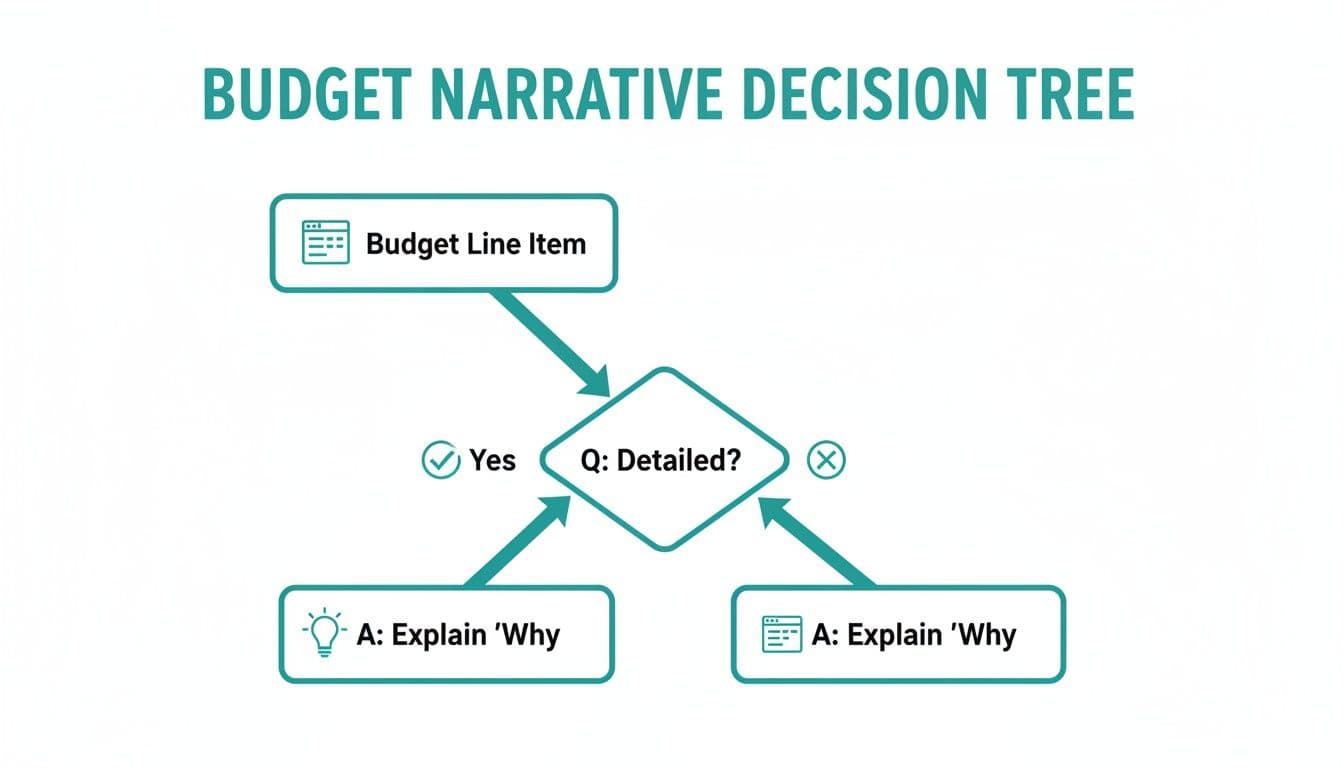
This simple chart shows how to justify each cost in your narrative. Every line item needs a "why" that connects it straight back to your project's goals.
Let's look at some real-world examples to make this crystal clear. The table below breaks down common expenses and how you'd justify them in a grant budget.
Direct vs Indirect Costs Examples
| Expense Item | Cost Type | Justification Example |
|---|---|---|
| Program Manager Salary (50%) | Direct | 50% of the Program Manager's time will be dedicated solely to the planning, execution, and reporting of this project. |
| Executive Director Salary | Indirect | A portion of the Executive Director's time is spent on general oversight that benefits all programs, including this one. |
| Workbooks for Tutoring | Direct | 100 workbooks at $15/each are required for the 100 students participating in the after-school tutoring program. |
| General Office Supplies | Indirect | General supplies like paper and toner are used by all staff and support the organization's overall operations. |
| Mileage for Home Visits | Direct | Reimbursement for staff travel is calculated for an estimated 50 home visits specific to this program's client services. |
| Office Rent and Utilities | Indirect | This grant's share of the rent and utilities for our shared office space, which houses all our programs and staff. |
This distinction is all about traceability. If you can point to an expense and say, "This is for the grant project and nothing else," it is a direct cost.
Understanding Direct Costs
You can easily trace direct costs back to the grant-funded project. They are the specific resources you will use exclusively for the program's activities. You will list them as individual line items in your budget spreadsheet.
Common examples of direct costs include:
- Personnel: The salaries and benefits for staff working directly on the project. For instance, if a program manager dedicates half her time, you would list 50% of her salary as a direct cost.
- Program Supplies: Any materials needed for your activities, like art supplies for a youth workshop or food for a community pantry.
- Consultants: Fees paid to external experts you hire for a specific, project-related task, like a curriculum developer.
- Project-Specific Travel: Costs for staff to travel for program delivery, such as mileage for client home visits.
- Equipment: The purchase of an item, like a tablet, that is 100% necessary for and dedicated to the project's activities.
Tracking these costs accurately is absolutely essential. Funders will want to see exactly how their money was spent.
Demystifying Indirect Costs
Indirect costs are just as real and necessary, but they are harder to pin to a single project. They represent a fair share of the central operating expenses that all your programs benefit from. Think of them as the strong foundation that allows your direct program work to happen.
Examples of indirect costs include:
- Rent and utilities for your office space.
- The salary of your Executive Director or bookkeeper.
- Your organization's general liability insurance.
- Office supplies used by everyone on the team.
- The fee for your annual financial audit.
Funders know these costs are real. The challenge is presenting them in a way that is fair and transparent.
A common point of confusion is how to handle administrative staff. If your bookkeeper spends 10 hours a month only processing invoices for this specific grant, that time could be a direct cost. But their general work supporting the whole organization falls under indirect costs.
Calculating Your Indirect Cost Rate
Your goal is to have the grant cover its fair portion of your organization's overhead. The simplest method is usually the best for most nonprofits. You will present this as a single line item in your budget.
The 10% De Minimis Rate
Thankfully, the federal government created a simple, standard option. You can charge a flat 10% de minimis rate on your Modified Total Direct Costs (MTDC). Most private foundations also accept this rate because it is so well-established.
MTDC is simply your total direct costs minus a few rare exceptions. It is an easy, defensible way to cover your overhead without a painful calculation.
Using a True Fund Accounting System
You can gain a huge advantage by using the right tools. A system with true fund accounting, like AlignMint, tracks direct and indirect expenses automatically. It separates restricted grant funds from your general operating funds from the moment money comes in.
This is fundamentally different from using workarounds in software like QuickBooks, which relies on "classes." Those methods demand extra manual work and are prone to error. With AlignMint, you can generate an accurate report in a few clicks, not a few weeks.
What Funders Actually Look For in a Budget
Your budget is where your credibility is put to the test. Grant reviewers are trained to see through fluff. What separates an approved budget from a rejected one often comes down to small details.
From our experience, we know what makes a program officer nod in approval versus what raises a red flag. It is all about presenting a budget that is realistic and fully justified. This is where you prove you are a trustworthy partner for their investment.
Align Your Budget with Reality
Your budget must make sense for an organization of your size and capacity. If you are a small team of three, a budget for a multi-million dollar national expansion will seem far-fetched. Your numbers must align with your real-world ability to deliver.
Grant reviewers want to see a story that makes sense. A budget grounded in reality, with well-researched costs, is far more compelling than a plan you cannot realistically support.
This is also why showing other sources of funding is so powerful. When funders see you have support from other foundations or individual donors, it signals sustainability. It tells them their investment is part of a healthy, diversified financial plan.
Show You Have Done Your Homework
Precision sends a powerful message. It shows you have done the research, gotten quotes, and thought through every line item. This small detail has a huge impact on your credibility.
- Avoid Round Numbers: Instead of budgeting a round $1,000 for software, a specific figure like $1,250 shows you have researched the cost.
- Justify Personnel Costs: Do not just list salaries. Clearly explain the percentage of time each staff member will spend on the project. This proves you have thoughtfully considered your team's workload.
The competition for funding is incredibly fierce. For instance, the National Science Foundation recently reviewed 43,532 proposals but funded just 8,377. In such a competitive environment, a meticulously planned grant proposal budget template is essential.
Use the Right Financial Tools
You can prove your credibility more easily when you have the right financial systems in place. This is especially true when tracking restricted funds. If a funder asks for a report, you want to provide it instantly with complete confidence.
This is an area where true fund accounting provides the clear, trustworthy reports that funders expect. A system like AlignMint can generate a Statement of Functional Expenses or show how you are managing restricted funds with a few clicks. This capability is built-in, saving you from the manual work required by tools like QuickBooks. You can learn more by reviewing some grant management best practices. For software that handles post-award tracking, see our guide to grant tracking software for nonprofits.
How AlignMint Ends the Post-Grant Scramble
You can get back your time by bringing your most critical operations into one clear platform. The real test starts the moment the award letter arrives. Suddenly, you are on the hook for managing the funds and reporting it all back to the funder.
We have seen that chaos firsthand. It is why we built AlignMint. We want to stop the post-grant scramble for you.
From Budget Proposal to Final Report
You can simplify your work by pulling numbers for your grant proposal budget from a system that knows your finances. With AlignMint, your fundraising, donor data, and accounting are all part of the same conversation. This gives you a true, real-time picture of your financial health.
Private foundations are the top source of grant awards for 95% of nonprofits. But the complexity of applications is a massive hurdle, especially for mid-sized organizations.
Our platform is designed to cut through that complexity. Because all your data is in one place, you can confidently project your costs and justify every line item.
True Fund Accounting Without the Clunky Workarounds
You can track restricted funds correctly with a system designed for your world. One of the biggest headaches in grant management is tracking restricted funds. This is where AlignMint is fundamentally different from other tools. We built our platform with true fund accounting at its core.
This built-in capability changes everything. It means you can:
- Track Restricted Funds Effortlessly: AlignMint automatically puts a digital wall around grant funds. You always know exactly how much is available for each specific program.
- Generate Funder Reports in Clicks, Not Weeks: You can generate a Statement of Functional Expenses instantly instead of spending days piecing data together.
- Maintain Compliance with Confidence: Our system ensures your financial reporting is accurate and audit-ready, giving you and your board peace of mind.
We designed AlignMint so you can spend less time on administration and more time on your mission. Having true fund accounting built-in means no more wrestling with spreadsheets to figure out your restricted fund balances.
A Single, Unified View of Your Entire Organization
You get insights that are simply impossible when you are using separate tools. Because AlignMint is an all-in-one system, you can directly connect a donor's gift from your donor management system to the exact grant-funded program it supports. You can even track volunteer hours and associate them with specific projects.
Our platform also includes features designed for busy nonprofit leaders like you:
- Minty Assistant: You can get answers in seconds by asking Minty a question about a budget variance in plain English.
- Built-in Marketing Suite: You can track the results of your outreach efforts with our marketing tools. See exactly how many new volunteers or donors your campaigns attract.
- Plan-based user allowances (1 on Free, up to 10 on Plus, up to 25 on Pro, and unlimited on Enterprise): We believe in collaboration, so we publish user allowances by plan. Your entire team can access the information they need without driving up your costs.
AlignMint simplifies your work from the moment you start building your grant proposal budget to the day you submit your final report. You can see how our system provides the financial clarity you need by exploring our fund accounting features.
Related resources: Grant Finder · Grant budget template · Free templates & resources · Free tools hub · Grant management best practices · Grant tracking software
AlignMint brings your accounting, fundraising, and program data into one place, making grant budgeting and reporting simple. See how our all-in-one platform can give you back your time. Start for free.
Frequently Asked Questions
Ready to try AlignMint with your nonprofit?
Start free — set up donor tools, giving pages, and Minty. Upgrade when you need accounting.