

Statement of Functional Expense: A Director's Guide
Quick Answer: Statement of Functional Expense: A Director's Guide
A statement of functional expense shows what your nonprofit spent and why it spent it by separating costs into program services, management and general, and fundraising. The most useful version connects natural expense accounts, documented allocation methods, restricted funds, and Form 990 reporting so your board can see how spending supported the mission.
For related tools, see AlignMint's fund accounting and AI accounting feature pages.
You're probably meeting with your finance lead, staring at a report that technically balances but still doesn't answer the board's real question. They want to know how money moved your mission forward, not just where it was spent.
That's where the statement of functional expense earns its keep. If you've ever felt that this report is harder than it should be, you're not wrong. It mixes compliance, judgment, and a lot of messy real-world allocation. The good news is that it becomes much more manageable once you see what the report is trying to say.
Your Guide to Financial Storytelling
For many executive directors, this report triggers stress because it feels like accounting language for an operational story. You know your team is doing meaningful work. What's harder is showing that work through categories that satisfy auditors, board members, and donors at the same time.
The statement of functional expense is best understood as a financial storytelling tool. It shows how your spending supports your mission by grouping costs according to purpose, not just by vendor or account name. That shift matters because the people reading your financials are often asking a mission question, not an accounting question.
Why this report matters to people outside finance
Your board wants clarity. Donors want confidence. Grantors want evidence that resources were used as intended.
When your expenses are organized well, the report helps those groups see three things quickly:
- What went to mission work: Program services show the direct work your organization exists to do.
- What kept the organization running: Management and general covers governance, administration, and core operations.
- What supported future revenue: Fundraising shows the cost of bringing in contributed income.
Practical rule: A strong statement doesn't just prove compliance. It helps readers understand your choices.
If you've ever had to explain why overhead isn't waste, this report can help you do it calmly and credibly. It gives context to spending that might otherwise look disconnected on a general ledger.
A familiar way to read it
If you already know the basics of analyzing revenue and business expenses, you've got a useful starting point. The difference is that nonprofit reporting adds a second layer. It asks not only what you spent, but why you spent it.
That's why this report often belongs in the same conversation as your annual communications. If you're shaping a board packet or donor-facing summary, a practical companion is this guide to an annual report template for nonprofits. It helps connect the financial story to the public story your organization tells.
What is a Statement of Functional Expenses
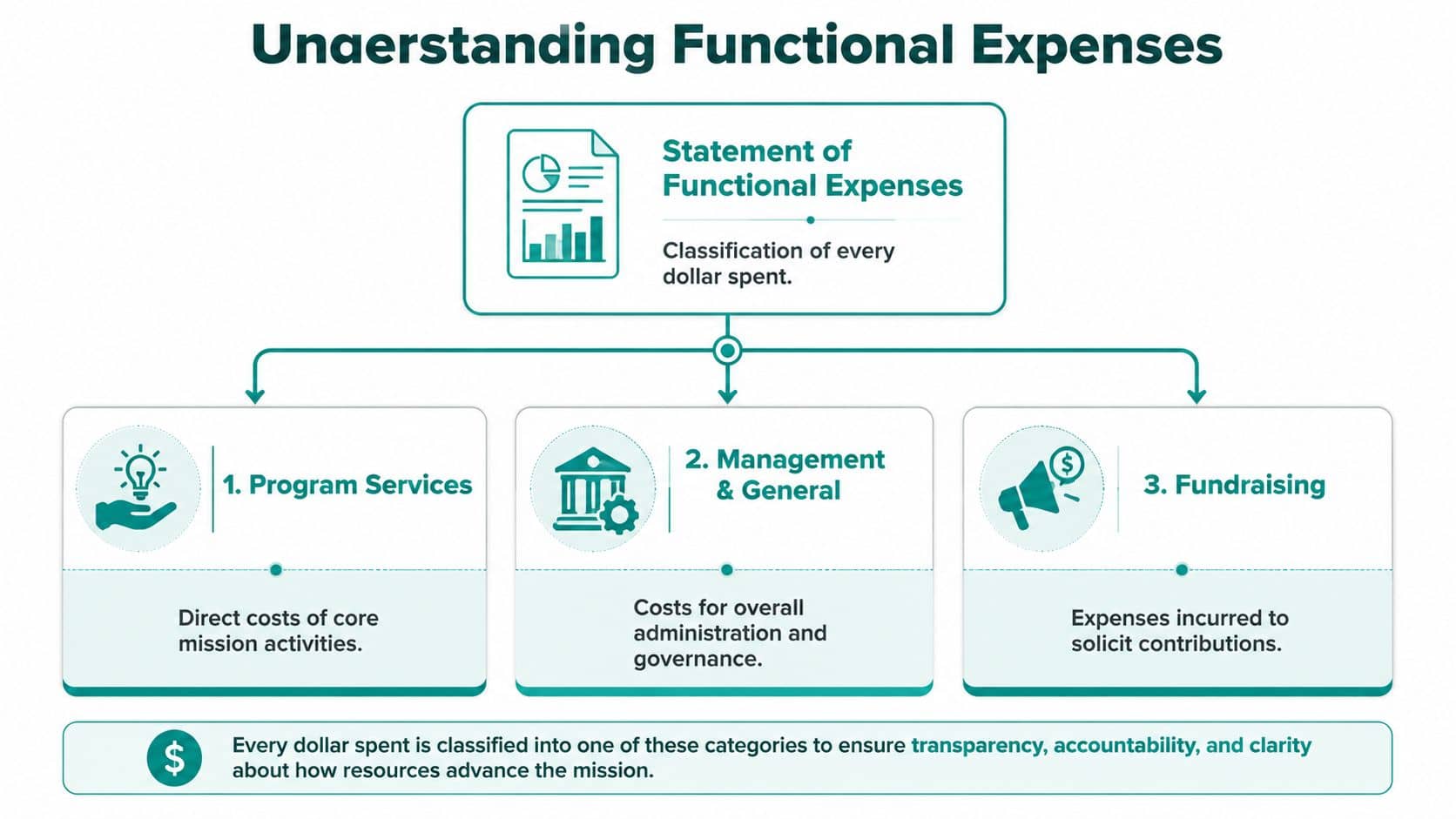
The statement of functional expense is a report that sorts every expense into one of three functional buckets. Those buckets are program services, management and general, and fundraising.
For nonprofits meeting specific thresholds, it's a required filing element. According to Aplos's explanation of the statement of functional expenses, nonprofits with gross receipts exceeding $200,000 or assets surpassing $500,000 are required to file this report, and ASU 2016-14 established that all not-for-profit entities must present the relationship between functional expenses and natural expenses.
The three categories in plain language
Program services are the costs tied to the programs your mission promises to deliver. If you run an after-school program, this includes the expenses directly connected to serving students.
Management and general covers the cost of keeping the organization operating properly. Think board support, finance, human resources, insurance, and general office oversight.
Fundraising includes the costs of asking for and receiving contributions. Development staff time, campaign costs, event-related solicitation work, and donor communications usually land here.
Confusion often arises because these categories sound moral, as if one is beneficial and the others are questionable. That is the incorrect perspective. All three functions are essential components of a healthy organization. The purpose of the report is not to criticize support costs. Its purpose is to classify them accurately.
Why this report exists at all
The statement exists because nonprofit stakeholders need more than a standard expense list. A salary line alone doesn't tell a reader whether that salary funded direct services, administration, or fundraising work.
That's why this report is often read alongside Form 990. If you want a practical companion to that filing process, this Form 990 guide for new nonprofits helps connect the dots between financial statements and annual reporting obligations.
When this report is done well, it answers a fair question from the outside world. How much of your spending directly supported the mission, and how much supported the organization around it?
A simple analogy
Think of your household grocery bill. One way to sort it is by what you bought such as milk, bread, and produce. Another way is by why you bought it such as school lunches, a holiday dinner, or supplies for a community event.
Nonprofit expense reporting works the same way. The statement of functional expense cares about purpose. It asks what each cost was for in the life of the organization.
Decoding Your Expenses Natural versus Functional
A finance manager closes the month, pulls the expense detail, and feels confident until the grant report and restricted fund schedule enter the picture. The payroll totals match. The rent total matches. Then the harder question appears. Which part of those costs supported the program, which part kept the organization running, and which part helped raise the next dollar? That is the moment this report starts to feel less like bookkeeping and more like translation.
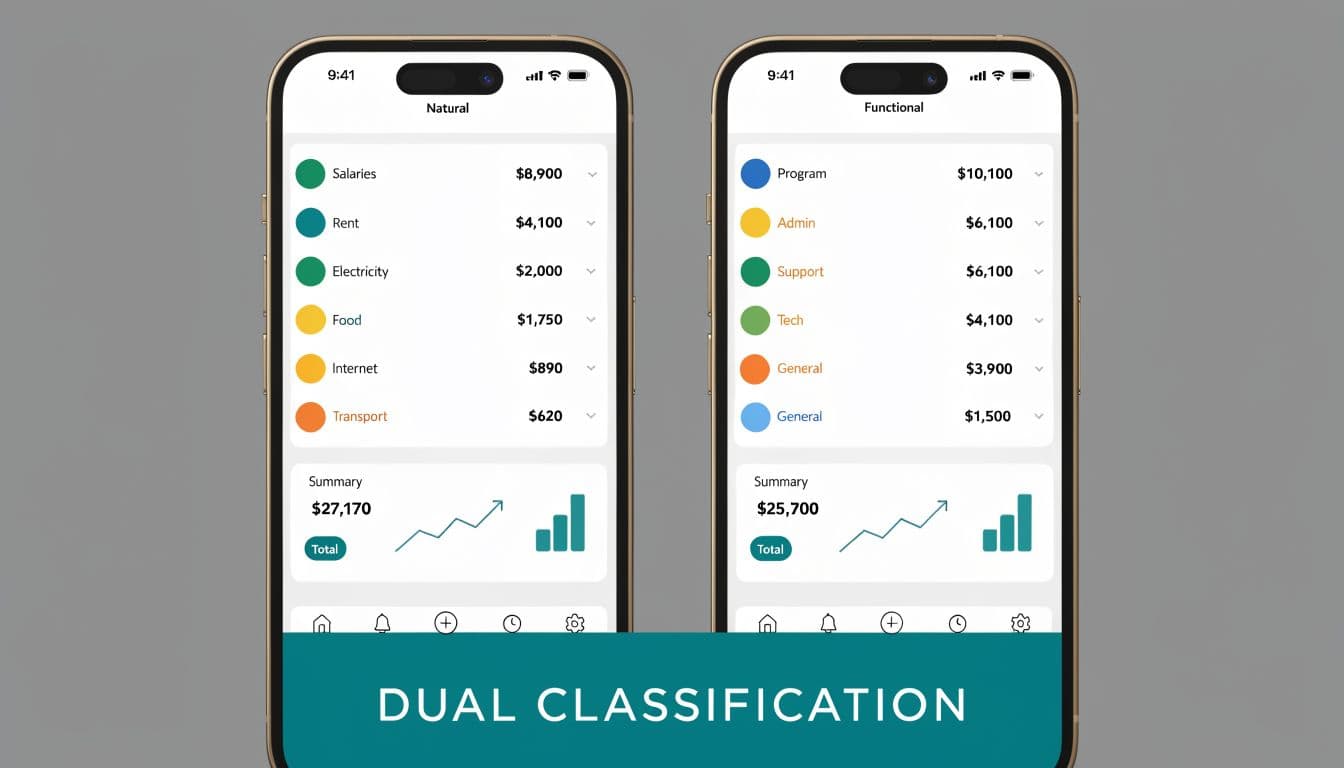
Every expense carries two labels.
The natural label tells you what you bought. Salary, occupancy, software, supplies, insurance. The functional label tells you why you bought it. Program services, management and general, or fundraising.
The easiest way to see the difference
Use printer paper as a simple example. On the natural side, it is office supplies every time. On the functional side, its purpose can change from one use to the next. Paper for participant packets belongs in program services. Paper for board materials belongs in management and general. Paper for donor appeal letters belongs in fundraising.
That is why one natural account can show up in several functional columns. Nothing is wrong with that. In fact, that is the point of the report.
What ASC 958 means in ordinary language
According to BRC's explanation of ASC 958 and functional expense reporting, nonprofits have to present expenses by both natural classification and functional classification. The same discussion explains that expenses shown differently on the Statement of Activities may need to be reorganized back into their natural categories for this report.
That requirement creates stress because your general ledger usually captures transactions in the way staff need to pay bills, close the month, and track budgets. The statement of functional expenses asks for a second layer of meaning. It asks finance to interpret purpose, not just record payment.
This gets even harder when restricted funds and grant budgets sit on top of the same transactions. A salary may be charged partly to a foundation grant, partly to an unrestricted program, and partly to general operations. Now you are not only classifying what the expense was and why it happened. You are also reconciling whether the treatment matches donor restrictions, grant reporting rules, and internal financial statements.
Direct costs are simple. Shared costs create the real workload.
Some expenses fit neatly into one function. A program coordinator working only on after-school services is a program cost. A consultant hired only for a capital campaign is a fundraising cost.
The friction starts with shared resources.
Rent supports multiple activities. Leadership salaries often span mission delivery, supervision, planning, and donor communication. Software can serve finance, development, and program teams at the same time. These are the expenses that create year-end spreadsheet tabs with too many color codes and not enough confidence.
Organizations usually feel that pain most sharply when systems are disconnected. One tool tracks the general ledger. Another tracks grants. A spreadsheet tracks restrictions. A separate report tries to rebuild functional allocations afterward. If your team is already wrestling with those layers, a stronger grasp of fund accounting for nonprofits helps explain why this report becomes so difficult when fund, grant, and functional data are not living in the same structure.
A practical mental model for your team
For each meaningful expense, ask two questions:
| Question | What it tells you |
|---|---|
| What did we buy | The natural classification |
| Why did we buy it | The functional classification |
Add a third question internally when restricted revenue or grants are involved. Which funding source is supposed to bear this cost?
That third question does not change the statement's format, but it often determines whether your numbers can be reconciled without a last-minute scramble. Once staff understand those distinctions, coding becomes more consistent, grant reporting gets cleaner, and the statement of functional expenses starts to reflect how the organization operates, not just how the ledger happened to be organized.
The Art of Allocation How to Assign Costs Correctly
If dual classification is the concept, allocation is the craft. This is the part that makes people groan, because it requires judgment, documentation, and consistency all at once.
The good news is that allocation isn't black magic. It's a reasoned method for assigning shared costs. The challenge is not inventing the perfect formula. The challenge is choosing a defensible one and applying it the same way over time.
Start with what belongs clearly to one function
Some costs should not be allocated at all. They should be assigned directly.
According to the practitioner guidance summarized in this discussion of direct and indirect allocation methods, direct allocation is used when a cost is readily identified as benefiting one specific program, while indirect costs such as administrative salaries or rent require methods like headcount ratios, square footage, or time percentages. The same guidance notes that organizations must document their methodology and apply it consistently.
That means your first question should be simple. Can this expense be tied clearly to one function without splitting it? If the answer is yes, don't complicate it.
Then handle the shared costs with a written method
Most organizations struggle with the expenses that support more than one function. These are the costs that create late-night spreadsheet sessions before the audit.
Common examples include:
- Occupancy costs: Rent and utilities usually support multiple functions, so many organizations allocate them by square footage.
- Leadership salaries: Executive and senior staff often divide time across program oversight, administration, and fundraising. A documented time-based approach is common.
- Technology and office support: Shared systems may need a usage-based method, a headcount method, or another reasonable basis.
A defensible allocation method is one you can explain without squinting.
What consistency looks like in practice
Consistency doesn't mean your numbers never change. It means your reasoning doesn't drift from convenience to convenience.
If you use square footage to allocate rent this year, you should have a clear reason before changing to another basis next year. If your executive director's time is allocated based on a written estimate, that estimate should reflect reality and be reviewed when responsibilities change.
A short written policy often helps more than a complicated workbook. It can state:
- Which expenses are direct and assigned fully to one function.
- Which expenses are indirect and require allocation.
- What basis you use for each type of shared cost.
- Who reviews the method and when updates are made.
If you need a cleaner structure underneath all of that, a well-built nonprofit chart of accounts template can reduce confusion before allocation even begins.
Why manual systems make this harder than it should be
Allocation gets messy when your accounting setup treats nonprofit reporting as an afterthought. You end up exporting payroll data, matching it to staff estimates, splitting facility costs in a spreadsheet, then checking whether the total still reconciles to the ledger.
That's frustrating enough on its own. It becomes much worse when the same expense also needs to satisfy a grant report or a restricted fund schedule.
Here's where many leaders feel the actual pain. The allocation might be reasonable, but the underlying system doesn't connect programs, restrictions, and reporting views in one place. So finance staff create crosswalks, side schedules, and year-end workpapers to bridge gaps that software never solved.
A practical example without the math gymnastics
Suppose your office rent supports direct services, administration, and development. Rent is the natural category. The functional split depends on how your space is used.
If most of the office is dedicated to client-serving teams, more of that rent may belong in program services. If part of the office is reserved for development staff and another part for finance and HR, those portions should be reflected too. The point is not precision down to the inch. The point is a reasonable basis that matches how the organization operates.
That same logic applies to staff time, software subscriptions, and general support costs. Write the rule. Follow the rule. Review the rule when the organization changes.
Why This Report Is So Hard And Why It Does Not Have to Be
The hard part isn't understanding the categories. Most leaders can grasp program, administration, and fundraising quickly enough. The central problem is that the same dollar often has to answer several questions at once.
One expense may need to show up properly in a functional expense report, a restricted fund report, and a grant report. That's where otherwise capable teams get buried.
Three views of the same money
A finance system might tell you the expense account. A grants file might tell you which award paid for it. A donor restriction schedule might tell you whether the spending honored the purpose of a gift.
Those are not separate realities. They are three views of the same transaction.
Current guidance does not fully address that combined reporting burden. As noted in SingerLewak's discussion of functional expense reporting challenges, organizations often face a "reconciliation nightmare" when trying to satisfy functional expense analysis, restricted fund accounting, and grant compliance reporting simultaneously, especially when systems cannot connect the data.
Many finance teams are not struggling because they lack discipline. They're struggling because their tools split one financial story into disconnected pieces.
Why common setups break down
QuickBooks is familiar, and many organizations have gotten real mileage out of it. Its strength is broad business accounting. Its limitation for nonprofits is that functional reporting, fund restrictions, and grant logic often require workarounds rather than native structure.
Aplos has helped many smaller nonprofits handle fund accounting needs more directly. Blackbaud products support larger and more complex environments. Both can be good fits in the right setting. But many organizations still end up stitching together accounting, donor records, event activity, volunteer systems, and marketing data across separate tools.
That's when everyday work becomes re-entry work. Staff key the same information twice. Finance exports to spreadsheets. Development keeps a different version of donor truth. Program leaders wait for reports that require cleanup before they can be trusted.
Fiscal sponsors feel this pressure sharply
If you oversee sponsored projects, the complexity compounds. Each project may carry its own restrictions, grant conditions, and reporting expectations, while your consolidated reporting still has to classify expenses by function.
That's not just a bookkeeping nuisance. It affects board reporting, grant stewardship, and your confidence at year-end. What should be one coherent financial picture turns into a set of manually reconciled views.
The report itself isn't the primary villain. Disconnected data is.
From Manual Mess to Automated Clarity with AlignMint
It is late in the month. Finance is closing the books, a grant report is due Friday, and someone on the board wants a clean view of program, management, and fundraising costs before the meeting. The numbers all exist, but they live in different places. Payroll sits in one system. Grant restrictions live in a spreadsheet. Event costs are tracked somewhere else. The statement of functional expenses becomes less of a report and more of a reconciliation exercise.
That strain is familiar to many nonprofit leaders. The hard part is rarely the math alone. The hard part is keeping one expense connected to all the meanings it carries at once. A salary line might belong to a program, be partially covered by a restricted grant, and still need a defensible functional allocation. If those dimensions are tracked separately, your team spends its time translating records instead of using them.
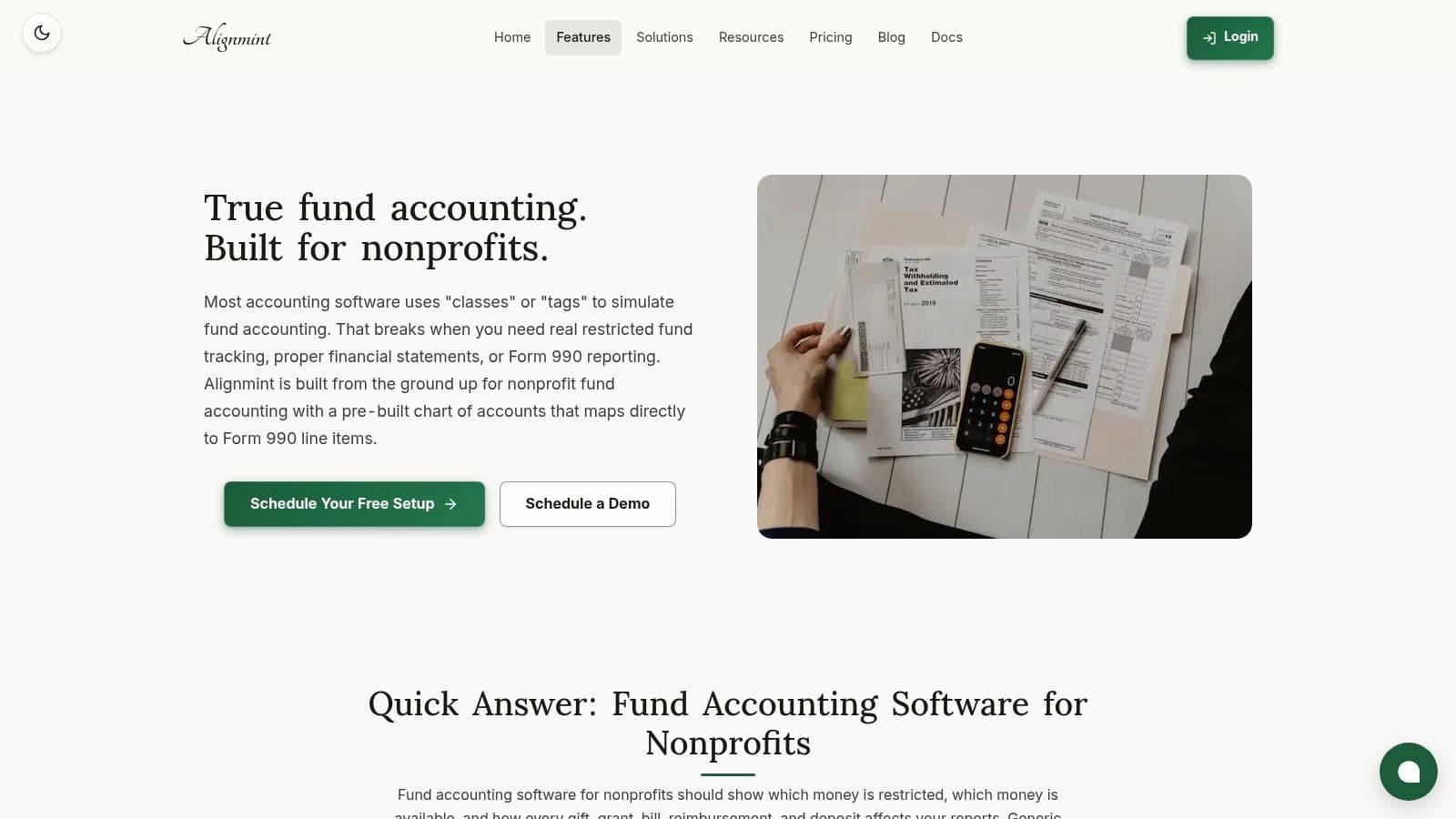
AlignMint addresses that problem by keeping functions, funds, grants, and programs connected inside the same system. Its functional expense documentation shows how expenses can carry the context they need at the point of entry, instead of relying on a spreadsheet crosswalk at month-end.
Why does that matter so much? Because the statement of functional expenses is not an isolated compliance task. It has to agree with restricted fund activity, support grant reimbursement or reporting, and still make sense to leadership, auditors, and the board. If one report says an expense belongs to Program A but the grant schedule treats it differently, confidence drops fast. Staff then spend hours explaining differences that should not exist in the first place.
A connected setup improves the daily work behind the report:
- One record can serve several reporting needs: The same transaction can support financial statements, grant tracking, and internal program reporting without being rebuilt in separate files.
- Restricted funding stays tied to the expense logic: You can see not only what was spent, but whether that spending lines up with the fund or grant that supported it.
- Allocation methods become repeatable: Shared costs such as payroll, rent, or software can follow written rules consistently from period to period.
- More teams can work from the same information: Finance, development, and program staff can review the same underlying records instead of passing spreadsheets back and forth.
That last point matters more than many organizations expect.
A statement of functional expenses is often treated as finance-only work, but the inputs come from across the organization. Development knows the purpose of campaign costs. Program leaders know how staff time was used. Operations knows which shared costs shifted this month. Software helps when it gives those teams one place to contribute to the same financial story.
This is especially helpful in grant-heavy environments and fiscal sponsorship structures. In those settings, every transaction can carry multiple questions at once. What was purchased? Which program used it? Was it allowable under the grant? Was it restricted by donor intent? How should it appear by function? Disconnected tools force staff to answer those questions over and over. An all-in-one system reduces that repetition because the answers stay attached to the transaction.
Smaller nonprofits feel this too. Early habits tend to stick. If coding is vague at the start, cleanup becomes a recurring year-end project. A nonprofit-specific structure gives a growing team a clearer path before those workarounds become standard practice.
Software does not replace judgment. It gives your judgment a stable place to live.
Good habits still matter, and they matter more when the circumstances are critical. Teams usually gain the most confidence when they do four things consistently:
- Set allocation rules before deadlines hit: Shared salaries, occupancy, and support costs are easier to handle when the method is written down early.
- Code expenses with full context: Function alone is not enough if the same expense also needs fund, grant, or program reporting.
- Review exceptions while details are fresh: Special events, pass-through activity, and unusual vendor bills are easier to classify in real time than weeks later.
- Keep finance and operations in regular contact: Clean reporting depends on shared understanding, not just clean bookkeeping.
Boards will still ask about ratios. Auditors will still ask how costs were assigned. Grantors will still expect reports to match the underlying records. The difference is that your team is no longer rebuilding the story from fragments. You are pulling it from a system that was set up to reflect how nonprofit work happens.
Best Practices and Your Next Steps
Year-end closes, the grant report is due, and your finance team has one version of salary allocations while your program team has another. The statement of functional expenses is suddenly not just a filing requirement. It is the place where every inconsistency shows up at once.
That pressure is real. It also gets easier once you treat this report as part of daily operations, not a one-time accounting exercise.
A strong statement of functional expenses does two jobs at the same time. It explains how resources supported the mission, and it holds together under grant restrictions, board questions, and audit review. If those pieces do not agree, the report becomes hard to trust, even when the totals are technically correct.
Practices that make the report easier to trust
- Use the report as an operating tool: Review it as a management report, not only as a year-end output. That habit helps problems surface while the details are still clear.
- Train for two dimensions of coding: Staff need to understand both what was purchased and which function it served. For many nonprofits, they also need to know the related fund or grant at the same time.
- Document allocation logic in plain language: A method is more reliable when a program leader, finance manager, and auditor can all follow it without translation.
- Be careful with overhead ratios: Benchmarks can prompt useful questions, but they do not replace context. A temporary staffing change, a new grant requirement, or investment in infrastructure can shift percentages without signaling weak stewardship.
Where organizations usually make the biggest gains
Progress usually starts with one practical decision. Stop treating functional reporting, restricted funds, and grant reporting as separate stories.
If payroll, payables, events, donor activity, and grant tracking live in disconnected tools, your team has to reconcile the same expense over and over in different formats. That is where confidence drops. People are no longer deciding what is correct. They are trying to keep multiple versions of correct in sync.
A connected system reduces that strain because the coding travels with the transaction. AlignMint is built for that kind of nonprofit workflow. It keeps fund accounting, CRM, volunteers, events, marketing, online giving pages, team communication, and Minty in one platform, so the statement of functional expenses can line up more cleanly with restricted funding and grant reporting.
If you want to keep building your understanding, a useful companion read is this guide to nonprofit audits.
The goal is not a perfect spreadsheet. The goal is a reporting structure your team can explain with confidence, month after month, without rebuilding the story at year-end.
If you want a simpler way to produce a statement of functional expense without juggling accounting files, donor systems, volunteer records, event tools, and spreadsheets, take a look at AlignMint. It combines fund accounting, CRM, volunteers, events, marketing, online giving pages, team communication, and Minty in one platform, with a free tier for nonprofits under $100K.
Ready to try AlignMint with your nonprofit?
Start free — set up donor tools, giving pages, and Minty. Upgrade when you need accounting.