


Quick Answer: Annual Report Template for Nonprofits
A strategic annual report template for nonprofits that helps you tell your story, present.
For related tools, see AlignMint features. A good annual report template for nonprofits is a strategic tool, not just a layout. It helps you tell your story and build trust with your supporters. You can turn this yearly chore into a powerful way to keep donors and secure next year's funding.
Your Annual Report Is More Than a Requirement
As a nonprofit director, I understand the annual report can feel like another task on a full plate. But it's also one of our best tools for building donor trust. A great report does much more than just check a compliance box.
It shares the story of your impact and reassures supporters their money was well spent. It also proves to foundations you are a responsible steward of their grants. This is your chance to turn dry numbers into a compelling story about the lives you have changed.
A Cornerstone for Your Fundraising Strategy
This is not about creating a glossy brochure. It is about building a foundation for your fundraising that shows your organization's health and vision. Your annual report pulls your mission, results, and financial accountability into one place.
Many donors will not read your Form 990, but they will look at a well-designed report. It gives you the power to shape the narrative around your most important successes.
"A strong annual report doesn't just report on the past year; it builds the foundation for the next one. It's your single best opportunity to make a comprehensive case for continued support."
Remember, this document serves multiple audiences at once.
- Major Donors and Foundations: They look for fiscal responsibility and proof of impact before committing large sums.
- Recurring Individual Donors: They want to feel a personal connection and see the stories of change they helped create.
- Board Members: They use it for governance, review, and strategic planning for the year ahead.
- Potential Supporters: They see it as a test of your organization's credibility and professionalism.
A thoughtful report speaks to all of them. For more ideas on keeping your supporters engaged, our guide on donor stewardship has some great tips.
Turning Data Into a Compelling Story
The magic of an annual report happens when you connect financial data to human impact. A basic system like QuickBooks can track expenses using "classes," but it often falls short for nonprofits. True fund accounting is a different and better approach.
When your accounting system is built for nonprofits, it correctly tracks restricted funds and program spending. This makes pulling accurate numbers for your report incredibly simple. You can confidently show how a specific grant funded a particular outcome.
An all-in-one platform like AlignMint connects your financial data to your donor management and volunteer activities. This means you can report on key metrics without wrestling with spreadsheets. This is how you build a report that inspires confidence and generosity.
Structuring Your Report for Maximum Impact
Getting the structure of your annual report right is more than half the battle. A clear, logical flow helps everyone find what they need and connect with your story. A proven structure removes the guesswork and ensures you hit all the essential notes.
Think of it as a guided path for your reader. Your goal is to move them from your organization's 'why' to your 'how' and finish with a clear reason to give again.
A Proven Framework for Your Annual Report
We recommend a flow that balances a compelling narrative with the hard data your funders need. This approach respects your reader's time while providing expected depth. You can think of this as a practical checklist for your annual report template for nonprofits.
Here is a simple, effective structure to follow:
- Opening Letter from the Executive Director: Your personal message sets the tone, expressing gratitude and framing the year's achievements.
- Mission and Vision Recap: A concise reminder of why your organization exists and what you aim to achieve.
- Program Highlights and Impact Stories: This is the heart of your report, where you show your work through powerful stories and key metrics.
- Financial Overview: Present your financial data in a transparent, easy-to-understand format to build credibility.
- Donor Recognition: A dedicated section to thank the people and foundations who made your work possible.
- Board and Staff Listing: Showcases the strong leadership and dedicated team behind your mission.
- A Clear Call to Action: Tell readers exactly what you want them to do next, whether it's donating or volunteering.
This structure moves the reader from an emotional connection to a logical one. It starts with your personal letter and then provides concrete proof of impact and the financial data to back it up.
Presenting Financials That Build Trust
The financial section can feel intimidating, but it doesn't have to be complicated. Transparency is the goal, not a dense accounting lecture. You need to present your numbers in a way that non-accountants can understand.
Use simple charts and graphs to visualize key data, like your revenue sources or how you allocated expenses. One of the most important reports to include is a summary of your Statement of Functional Expenses.
"The Statement of Functional Expenses breaks down your spending into three simple categories: Program Services, Management & General, and Fundraising. This shows donors exactly how much of their support goes directly to the mission."
This is where having the right system makes a huge difference. Platforms that use "classes" to track funds, like QuickBooks, can make creating this report a manual, time-consuming task. They simply weren't built for how nonprofits operate.
In contrast, a system with true fund accounting automates this process. Because AlignMint is designed for nonprofits, it generates this statement and others with just a few clicks. You get accurate numbers presented in a format that funders expect to see.
To make sure your reporting lines up with tax requirements, you can learn more about getting started with your nonprofit Form 990 filing.
Writing a Narrative That Connects with Donors
The numbers in your annual report are critical, but they are not what people remember. Your donors connect with stories of lives changed and communities strengthened. This is where your mission comes to life, turning data into powerful narratives that build loyalty.

A well-told story makes a supporter feel like a genuine partner in your work. That feeling is everything for keeping donors engaged year after year.
Crafting a Compelling Executive Director's Letter
Your opening letter sets the entire tone for the report. Think of it as a personal note of gratitude from you to your supporters. It is your best chance to speak to them with warmth and confidence.
Start by thanking your donors directly for making the year's work possible. Then, frame the year by sharing one or two key achievements you are proud of. Keep your language simple, direct, and heartfelt.
Turning Outcomes Into Authentic Stories
Your programs generate incredible results every day. The challenge is turning those results into stories that resonate emotionally. Instead of just stating "we served 500 meals," tell the story of one person who received those meals.
Here are a few ways to gather these powerful narratives:
- Interview Beneficiaries: Ask someone who has benefited from your services if they would be willing to share their experience. A direct quote is often the most powerful element in a report.
- Talk to Your Frontline Staff: Your program staff and volunteers see your mission in action every day. They have a wealth of stories about challenges overcome and lives transformed.
- Showcase a Program in Action: Walk the reader through a day in the life of one of your key programs.
Remember to always get explicit consent before sharing someone's story or image. Protecting the dignity of the people you serve is your absolute top priority.
Weaving in Data to Reinforce Impact
Stories create the emotional hook, but data provides the proof. The most effective narratives pair a personal story with a key statistic. This combination satisfies both the heart and the mind of your reader.
For example, after sharing a powerful testimonial, you can follow it up with a hard number. "This year, with your support, we provided safe housing for 42 families, including 78 children."
An all-in-one platform like AlignMint makes finding these numbers simple. Because your donor management and volunteer management data live in the same place as your financials, you can quickly pull accurate metrics.
"You can ask our AI assistant, Minty, a simple question like, 'How many total volunteer hours were logged last quarter?' The answer appears in seconds, giving you a powerful statistic for your story."
This is a stark contrast to other tools where volunteer data is often in a separate system. When your data is unified, you can easily showcase impact with both human stories and key metrics. You can explore more strategies for building these relationships in our guide to improving donor stewardship.
The Critical Role of Storytelling in Donor Retention
The need for compelling storytelling is more urgent than ever. With service demand rising for most nonprofits, your annual report must work harder to build trust. Studies show that only a small percentage of first-time donors give a second time.
An annual report template for nonprofits that prioritizes narrative can directly address this problem. It reminds supporters of the real-world impact their gift made. This emotional connection is your best defense against donor attrition.
Presenting Your Financials with Confidence
The financial section is often the most intimidating part of an annual report. Let's be honest, most of our supporters do not speak the language of accounting. But this is where you build the most credibility with your funders and board.
Your job is to present your financials in a way that proves you are a responsible steward. It's time to take control of your numbers and present them with confidence.
The Key Financial Statements Donors Expect
To show a complete and transparent picture, you will need to include a few standard reports. These documents answer the key questions every donor has. Where did the money come from, and how was it spent?
Think of these statements as the foundation of your report's credibility. A strong annual report template for nonprofits will have dedicated space for them.
Here's a breakdown of what donors are looking for and why each report is so important.
Essential Financial Statements for Your Annual Report
| Financial Statement | What It Shows | Why It Matters to Donors |
|---|---|---|
| Statement of Financial Position | A snapshot of your assets (what you have), liabilities (what you owe), and net assets (the difference) at a specific moment in time. | It answers the question, "Is this organization on solid ground?" |
| Statement of Activities | The story of your finances over the entire year - your revenue sources and how your expenses are broken down. | This is where donors see their contributions in action and whether you operated with a surplus or deficit. |
| Statement of Cash Flows | How cash moved in and out of your organization, broken down into operating, investing, and financing activities. | It helps funders understand your organization's ability to generate and use cash to meet its obligations. |
| Statement of Functional Expenses | Your spending broken down into three buckets: Program Services, Management & General, and Fundraising. | It directly answers the donor's most pressing question: "How much of my donation is going directly to the mission?" |
These reports might sound technical, but they don't have to be overwhelming. When you have the right system, generating them becomes straightforward.
"The Statement of Functional Expenses is unique to nonprofits and is essential for accountability. It provides a level of transparency that savvy donors and grantmakers have come to expect."
True Fund Accounting versus QuickBooks Classes
For years, many of us used tools that were not built for us. We tried to track restricted funds and program spending in systems like QuickBooks using "classes." It was a clunky workaround that required manual effort and left room for error.
True fund accounting is different. It's designed from the ground up for the way nonprofits work.
A system like AlignMint has true fund accounting built into its core. It natively understands the difference between unrestricted and restricted funds. It's not a workaround; it's the entire structure. You can learn more about this in our guide to the Income Statement.
Aligning Your Report with Your Form 990
Consistency between your annual report and your Form 990 is non-negotiable. Grantors and savvy donors will compare the two documents. Any major discrepancies can raise red flags and erode trust.
This is another area where an all-in-one platform provides peace of mind. Because AlignMint generates your key financial reports from a single source of data, the numbers naturally align with your Form 990. No more late nights trying to reconcile numbers from different spreadsheets.
Financial pressures are mounting for many nonprofits. With high staff turnover rates, having a system that ensures Form 990 readiness is critical for stability. By presenting clear and consistent financials, you build a powerful case for your organization's competence.
Make Data Collection and Reporting Effortless
Imagine pulling every metric for your annual report in minutes, not weeks. That is the difference it makes when your data lives in one place. It can completely change how you approach building your annual report template for nonprofits.
This is what happens when you use an all-in-one platform like AlignMint. It brings your fund accounting, donor management, and volunteer data together. You can finally stop the painful process of piecing together information from separate systems.
Get Accurate Numbers Without the Manual Work
You can get accurate, up-to-the-minute numbers for your report with just a few clicks. Because all your data is connected, the system already knows your total donations and volunteer hours. No manual data entry is required from your team.
This integrated approach helps with a major challenge in our sector. Many nonprofits have been slow to adopt modern tools. When you have high staff turnover, a single source of truth for your data is critical for stability.
The diagram below shows how simple automated fund accounting can be.
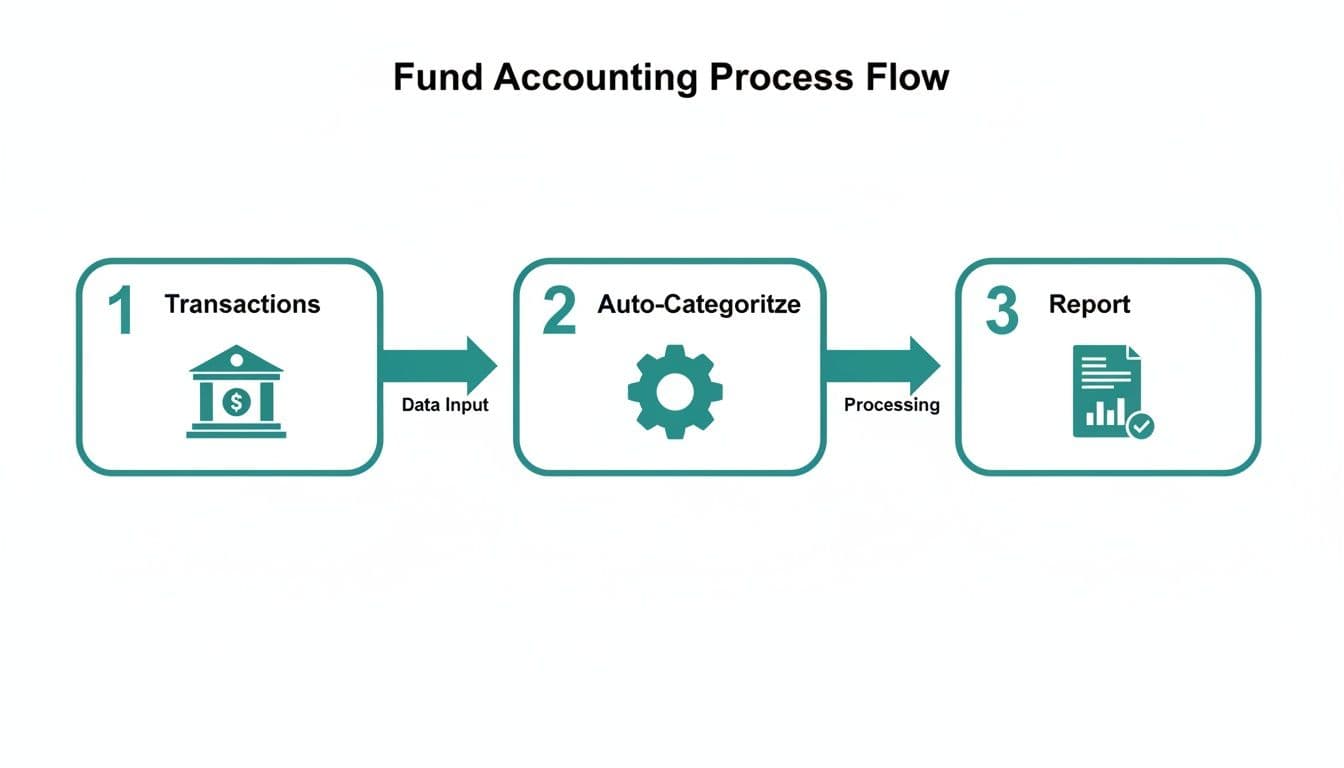
When your financial transactions are automatically categorized, generating accurate reports becomes an instant task. It is no longer a monthly fire drill.
Ask Questions, Get Instant Answers
You can find key data points just by asking a question in plain English. We built our AI assistant, Minty, to help busy directors find information without digging through reports.
For example, you can simply ask Minty, "Show me our top 10 donors from last year." It pulls the list directly from your donor data. This saves you from having to run a report, giving you back precious time.
"Think of it as having a data analyst on your team who is available 24/7. You can get powerful statistics for your report's narrative without ever leaving the platform."
Distribute Your Report with Purpose
Once your report is finished, getting it into the right hands is just as important. A generic email blast often gets ignored. A more targeted approach shows your supporters you value their specific contributions.
Our built-in marketing tools let you send personalized emails to different supporter groups.
- Major Donors: Send a personal email thanking them for their significant impact and linking to the report.
- Recurring Givers: Create a group for your monthly donors and acknowledge their consistent support.
- Volunteers: Thank them for their time and highlight the section on volunteer impact.
This personalization is only possible when your donor segments and email tools are part of the same system. Separate platforms require manually moving lists, which is time-consuming and prone to errors. With AlignMint, your contact lists are always current.
You can also feature the report on your online giving pages. This reinforces trust at the exact moment a donor is considering a gift. You can even learn how to set up automatic email reports to keep your board informed.
Your Annual Report Questions, Answered
Even with a solid plan, creating an annual report always brings up a few questions. As a leader, you want to be sure you are spending your time on what actually matters. Here are straightforward answers to some common questions we hear.
How Long Should Our Nonprofit's Annual Report Be?
There is no magic number; clarity and impact matter more than length. For most nonprofits, a report between 8 to 20 pages is the sweet spot. A shorter, focused digital report can be just as powerful.
The goal is to be concise while providing enough detail to prove your fiscal responsibility. Focus your energy on quality photos, compelling stories, and easy-to-read financial summaries. You want to engage your reader, not bury them in data.
"Many donors will only skim your report. Make your key achievements pop with clear headings, pull quotes, and strong visuals so your main points land."
What Is the Difference Between an Annual Report and a Form 990?
Think of it this way: the Form 990 is a legal document for the IRS. The annual report is a strategic conversation with your supporters. They serve completely different purposes, even though they pull from the same financial data.
- The Form 990 is a standardized, data-heavy tax document built for compliance, not connection.
- The annual report takes that same core data and wraps it in a compelling narrative with stories and photos.
While your report's financials must align with your 990, its main job is storytelling. It's your chance to translate financial data into a story of real-world impact. For a deeper dive, our article on Form 990 filing software can be a helpful resource.
Can We Create a Good Annual Report on a Small Budget?
Absolutely. A powerful report is about substance, not slick production. You do not need to hire an expensive design agency to create a document that builds trust. In fact, authenticity is what truly resonates with supporters.
User-friendly tools like Canva offer many excellent annual report templates for nonprofits. Focus your resources on what matters: quality photos, a clean design, and clear, heartfelt writing. The stories you tell and the transparency you provide will always be more impactful than expensive paper.
How Can We Get Donors to Actually Read the Report?
The key is to make it engaging and easy to access. You have to meet your supporters where they already are. Send an email from your marketing suite with a link to a digital version on your site.
In that email, pull out one powerful story or a key achievement to grab their attention. You can also break the report into bite-sized pieces for social media.
- Post a compelling statistic as a shareable image.
- Share a short video testimonial from a beneficiary.
- Feature a powerful quote from your executive director's letter.
Each piece of content should link back to the full report on your website. When you use an all-in-one platform like AlignMint, your marketing tools are already connected to your donor data. This lets you send targeted communications to specific groups. For more ideas, check out our strategies for improving donor stewardship.
Putting together a professional, compelling annual report does not have to be a yearly fire drill. With AlignMint, you can pull all your financial, donor, and volunteer data in minutes, not weeks. Our true fund accounting and built-in reporting tools give you the numbers you need, while our all-in-one platform makes it easy to share your story.
Frequently Asked Questions
Ready to try AlignMint with your nonprofit?
Start free — set up donor tools, giving pages, and Minty. Upgrade when you need accounting.