

Your 2026 Guide to Volunteer Background Screening
Quick Answer: Volunteer Background Screening Guide for 2026
Volunteer background screening for nonprofits: FCRA basics, role-based checks, vendor questions, fair decisions, and integrated tracking with volunteer management. The sections below walk through practical steps, examples, and what to watch for.
For related tools, see AlignMint features. As a nonprofit leader, your people are the heart of your mission. But protecting that mission requires a smart approach to volunteer background screening. This guide is not about creating barriers; it is about building a foundation of trust and safety for everyone.
Why Volunteer Screening Is Essential for Your Nonprofit
Not long ago, you probably knew most of your volunteers by name. A handshake and a good feeling were often enough. But the reality for nonprofits has changed. Properly screening volunteers is now a standard practice for safeguarding your organization.
Think of it like having good insurance or a solid fund accounting process. It is a critical step that quietly works in the background to protect your reputation, reduce liability, and ensure a safe environment for your community.
Protect Your Mission and People
You can ensure a safe environment for your staff, volunteers, and the people who depend on you. At its core, volunteer background screening is about one thing: protection.
- Vulnerable Populations: If you serve children or seniors, screening is a non-negotiable part of your duty of care. It is your first and most important line of defense.
- Your Team: A safe environment helps you attract and keep dedicated staff and volunteers. People want to be part of an organization they know values their safety.
- Your Reputation: A single incident involving an unscreened volunteer can harm the reputation you've worked so hard to build.
This is not a hypothetical risk. Recent data on volunteer screening trends shows a consistent need for thorough vetting. A consistent screening process helps mitigate the real, measurable risks that nonprofits face.
Reduce Liability and Build Trust
A formal screening process shows your board and donors that you take your responsibilities seriously. This level of professionalism can attract more dedicated volunteers who appreciate your commitment to a secure environment.
When you formalize your approach, you create a fair and consistent standard for everyone. It removes guesswork from the equation, ensuring every applicant is evaluated against the same criteria. This is a key part of building an effective volunteer program that lasts.
Understanding Your Legal and Privacy Responsibilities
Let's talk about the legal side of volunteer background screening. For many leaders, this is where anxiety can set in. You can protect your organization and treat your volunteers fairly by understanding a few key principles.
The most important federal regulation to know is the Fair Credit Reporting Act (FCRA). Even though it sounds like it’s for banks, the FCRA sets the national standard for how you use background reports from a third-party company.
What the FCRA Requires From You
Think of the FCRA as your roadmap for a fair and consistent process. Following its rules is your best defense against legal challenges and shows volunteers you respect their privacy.
Your main responsibilities under the FCRA are straightforward:
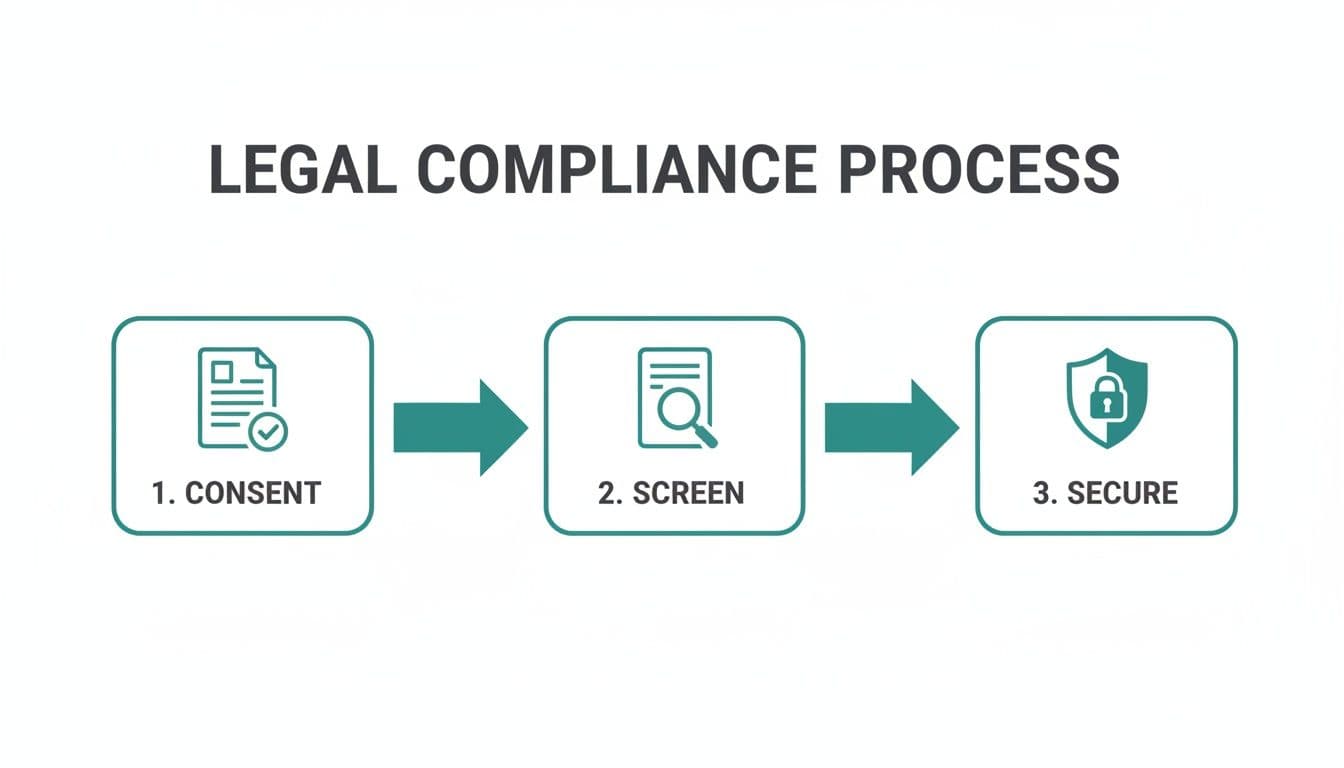
- Get Clear, Written Consent: You must tell the volunteer you plan to run a background check. This must be on a separate document, and you need their written permission to proceed.
- Follow the "Adverse Action" Process: If you disqualify a volunteer based on their report, you must follow a two-step process. First, send a "pre-adverse action" notice with a copy of their report. After a reasonable time, you can send the final "adverse action" notice.
State and Local Laws Can Add Layers
While the FCRA gives you a federal baseline, it is not the whole story. Many states and cities have their own laws that add another layer of requirements. These rules often get specific, especially for nonprofits working with children or the elderly.
For example, some state laws require fingerprint-based checks for volunteers with regular contact with kids. These state laws are typically non-negotiable and more detailed than federal guidelines.
The Critical Importance of Data Privacy
You can stay compliant without piling on more work by using an integrated system. When your volunteer management software is part of an all-in-one platform like AlignMint, the process is much simpler. Volunteers submit consent electronically through a secure portal.
Completed reports are stored with our vetted screening partner, not on your local computer. This dramatically reduces your data security risk. You see the final status in the volunteer's profile, giving you the information you need without creating a filing cabinet of liability.
Building Your Volunteer Screening Policy
A clear, written policy is the foundation of a solid volunteer screening program. It ensures every volunteer is treated fairly and your team knows exactly what to do. Your policy needs to answer two questions: who gets screened, and what kind of checks do we run?
This removes subjectivity and protects both your organization and the volunteers you rely on. A good policy makes your entire volunteer management effort more effective.
Define Who and How You Screen
The first step is to think about your volunteer roles in terms of risk. Not every volunteer needs the same level of screening. Your policy should define risk levels and connect them to specific background checks.
- Low-Risk Roles: Volunteers with limited interaction with vulnerable populations and no access to your finances. A basic national criminal database search may be sufficient.
- Medium-Risk Roles: Individuals with some unsupervised contact with program participants or who handle small amounts of cash. A broader search, like county-level criminal records, could be appropriate.
- High-Risk Roles: Volunteers with unsupervised access to children, those who drive vehicles, or those who manage finances.
For high-risk roles, you'll need specific checks like a motor vehicle record (MVR) check or a National Sex Offender Registry search. This tiered approach protects everyone without creating unnecessary hurdles. Aligning your screening with your volunteer management strategy from the start creates a secure program.
Screening Types Based on Volunteer Role Risk
This table helps you decide which background checks are appropriate for different types of volunteer responsibilities in your nonprofit.
| Volunteer Role | Risk Level | Recommended Screening Types |
|---|---|---|
| One-Time Event Helper (supervised) | Low | National Criminal Database Search |
| Office Admin (no financial access) | Low | National Criminal Database Search |
| Program Assistant (supervised contact with clients) | Medium | National Criminal & County Criminal Search |
| Cash Handler (e.g., at events) | Medium | National Criminal & County Criminal Search |
| Youth Mentor (unsupervised) | High | National Criminal, County Criminal, National Sex Offender Registry |
| Van Driver | High | National Criminal, County Criminal, Motor Vehicle Record (MVR) |
| In-Home Senior Visitor | High | National Criminal, County Criminal, National Sex Offender Registry |
| Volunteer Treasurer/Board Member | High | National Criminal, County Criminal, Credit Report (if applicable) |
Use this table as a starting point for building a consistent and defensible policy.
Develop a Practical Workflow
Once you have defined who gets screened, you need to map out the process. Your goal should be a smooth workflow that does not slow down recruitment. A confusing process can cause great volunteers to drop out.
The growth of this field shows how central screening has become. The U.S. background check market is projected to hit $5.1 billion by 2026. This trend is a clear signal that structured screening is the standard. You can find more on these industry trends to understand the shifting landscape.
You can manage this entire flow within AlignMint's volunteer management tools. Send screening invitations from a volunteer’s profile and track their status in one place. This saves you administrative time and keeps your records secure.
Choosing the Right Screening Service

Finding the right background screening partner has a huge impact on your mission. It is about finding a partner that delivers accurate results without burying your team in administrative work. A great partner protects your people and your time.
Why Not All Screening Services Are the Same
When you start looking, you will find two different paths. The first is large, standalone screening companies. Names like Sterling or Verified Volunteers are specialists, and their compliance expertise is a strength.
The trade-off is that you are managing another piece of software. It means exporting lists, uploading them to a separate portal, and manually tracking clearances. This works, but it is one more login to juggle.
The other path is an integrated service, where volunteer background screening is built into your nonprofit software. This is how we designed it in AlignMint. There is no separate account to manage, which is a huge time-saver.
Your Vendor Selection Checklist
As you compare options, treat it like hiring a critical team member. You need someone reliable, affordable, and easy to work with. Here are the questions to ask any potential partner:
- Do they get nonprofits? A vendor focused on our world will offer packages and pricing that fit a nonprofit budget.
- What is the real cost? Ask about setup fees, monthly minimums, or extra charges for specific searches.
- How long will I be waiting? A standard check should come back in 24 to 72 hours.
- Do they help me stay compliant? Your partner must provide FCRA-compliant consent forms and a clear adverse action process.
- How does it connect to my other software? A built-in solution saves you from managing separate systems.
Studies of employment and volunteer screening routinely find meaningful discrepancies between self-reported histories and verified records - another reason to run a consistent, documented process.
The Power of an All-in-One Platform
You can manage your entire process without leaving our software. Imagine a volunteer applies and their profile is automatically created in your volunteer management system. From that profile, you invite them to a background check.
The system handles consent and tracks progress, and the "Clear" status appears on their profile when it is done. This is the benefit of an all-in-one platform connecting screening to your donor management and fund accounting. AlignMint's fundraising tools also help you recruit the volunteers you need.
Because AlignMint includes nonprofit volunteer background check software, you manage recruitment and screening in one place. It makes a compliant, secure process feel effortless.
Reviewing Reports and Making Fair Decisions

The background check report has arrived. This is the most sensitive part of the process. Your goal is to make a fair, informed decision about whether a candidate is a good fit for a specific role.
A criminal record does not automatically mean someone is a poor fit. The context of that record is everything. This is where you apply careful judgment to protect your mission while treating applicants with respect.
The Individualized Assessment
You can make a fair, defensible decision by looking at the specifics of an offense. The law encourages an individualized assessment for any report that comes back with a flag.
Consider three key factors:
- The Nature of the Offense: What was the actual crime? A traffic violation is different from a recent conviction for theft.
- How Long Ago It Occurred: Time matters. An issue from 15 years ago carries less weight than one from last year.
- Its Relevance to the Role: This is the most critical question. A past conviction for financial fraud is a red flag for a volunteer treasurer but may be irrelevant for other roles.
This thoughtful approach ensures you do not lose a wonderful volunteer over a past mistake.
Navigating the Adverse Action Process
If you believe a volunteer is not a suitable fit, you must follow the FCRA’s adverse action process. This procedure is mandatory and protects both your organization and the applicant.
- Pre-Adverse Action Notice: Before making a final decision, send the volunteer a notice. This includes a copy of their report and a summary of their FCRA rights.
- Final Adverse Action Notice: After waiting a reasonable period (usually five business days), you can send your final decision.
This process gives the volunteer a chance to correct any errors on their report. For program structure ideas, see our volunteer management best practices guide.
Secure and Simple Record-Keeping
You can keep compliance data secure without extra effort by using integrated software. An all-in-one platform like AlignMint simplifies your work. When a background check is completed, you see the status - like "Clear" - on the volunteer’s profile.
The sensitive report is stored securely with our screening partner, not on your servers. This gives you the information you need without creating a data security headache. Our nonprofit background check features are a core part of this simple process.
How AlignMint Simplifies Volunteer Screening
As a leader, you need tools that give you back time. Managing a separate screening website on top of everything else is a headache you cannot afford. That is why we built volunteer background screening directly into AlignMint’s all-in-one platform.
This gives you a single place to manage your people from application to active service. It ends the need to juggle multiple logins or manually update spreadsheets with sensitive information.
A Single Click to Start a Screening
You can invite a new volunteer to a background check with a single click from their profile. It makes the experience simple for them and for you.
You can see their screening status right next to their contact info, skills, and logged hours. It gives you a complete, at-a-glance view of every person helping your mission.
Connecting Screening to Your Entire Organization
You get a complete picture of your operations when all your data lives in one place. Our unified view connects your volunteer program directly to your donor management and true fund accounting data. You can easily see if a major donor is also a cleared volunteer.
These connections are only possible with an all-in-one platform. AlignMint gives you a complete picture of your operations, and our built-in fundraising tools help you recruit the volunteers you need. We even offer a free tier for nonprofits under $100K with plan-based user allowances (1 on Free, up to 10 on Plus, up to 25 on Pro, and unlimited on Enterprise).
Frequently Asked Questions About Volunteer Screening
When it comes to volunteer screening, a lot of questions come up. We hear them from fellow nonprofit leaders trying to get this right. It is normal to have questions as you work to protect your people and your mission.
Most leaders worry about how often to re-screen, who should cover the cost, and what to do with minor offenses. Let’s walk through some straightforward answers.
How often should we re-screen volunteers?
A good rule of thumb is to run a new check on long-term volunteers every two to three years. For anyone in a high-risk role, you should consider screening them annually.
The most important thing is to get this down in writing in your volunteer policy. This ensures everyone is treated fairly and you have a consistent process.
Can we ask a volunteer to pay for their check?
Yes, you can ask, but weigh the decision carefully. Requiring payment can be a barrier for people with limited means. Some states even have laws that restrict this practice.
A more welcoming approach is to frame it as an optional donation. You can use online giving pages if you want a simple way for supporters to help cover screening costs.
What if a great volunteer has a minor offense?
This is where your individualized assessment is critical. You have to look at the whole person. Consider the nature of the offense, when it happened, and its relevance to the role.
Have a confidential, respectful conversation with the volunteer to understand the context. Then, document your decision-making process carefully.
Does our insurance require volunteer screening?
It is highly likely. Many insurance providers now require or strongly recommend volunteer background screening. Failing to screen could jeopardize your coverage or cause your premiums to go up.
We always advise leaders to review their liability insurance policy carefully. Better yet, have a direct conversation with your provider to understand their specific requirements.
Ready to make volunteer screening simple and secure? With AlignMint, you can manage background checks, track volunteer hours, and communicate with your team all in one place. Explore how AlignMint can save you time and protect your mission.
Frequently Asked Questions
Ready to try AlignMint with your nonprofit?
Start free — set up donor tools, giving pages, and Minty. Upgrade when you need accounting.