

How to Register a Nonprofit Organization: A Director's Guide
Quick Answer: How to Register a Nonprofit Organization
Learn how to register a nonprofit organization with a step-by-step guide to incorporation, 501(c)(3) status, state registration, and first-year setup. The sections below walk through practical steps, examples, and what to watch for.
For nonprofit financial records after formation, see fund accounting.
Starting a nonprofit usually begins with urgency. You see a need, people are asking for help, and the paperwork feels like the part standing between your mission and real impact.
The good news is that how to register a nonprofit organization becomes manageable when you handle it in the right order. The better news is that the legal filing is only half the job. The stronger path is to build your governance, finance, and fundraising setup at the same time, so you don’t end up fixing preventable problems later.
Laying the Groundwork Before You File
Most registration mistakes happen before anyone submits a form. They happen when the mission is vague, the name is rushed, or the founders assume every nonprofit should be a 501(c)(3).
That early thinking matters because your mission, structure, and name will flow into your state filing, your IRS application, your board recruitment, and your fundraising message. If those pieces don’t line up, you create drag from day one.
Start with the mission, not the form
A useful mission statement does three jobs. It tells the public why you exist, tells the state what you do, and tells the IRS whether your purpose fits an exempt category.
If the mission is broad enough to mean anything, it won’t help you make decisions. If it’s so narrow that you box yourself in, you’ll regret it when programs evolve. Aim for a statement that is specific about the problem and plain about the programs.
A practical test helps here:
- Need: What problem are you solving that isn’t already being addressed well enough?
- Public benefit: Who benefits from your work?
- Activities: What will you do in your first year?
- Boundaries: What work will you not take on yet?
Practical rule: If a board candidate or donor can’t understand your purpose in one reading, tighten the language before you file anything.
Confirm that 501(c)(3) is actually your lane
Many founders use “nonprofit” and “501(c)(3)” as if they mean the same thing. They don’t. The IRS recognizes multiple tax-exempt classifications, and 501(c)(3) is the most common, covering religious, educational, charitable, scientific, and literary organizations, along with several other public-benefit purposes. The IRS also recognizes other primary classifications, including 501(c)(4) for social welfare organizations, 501(c)(6) for business leagues such as chambers of commerce, and 501(c)(7) for social clubs. GuideStar can search across 1.8 million IRS-recognized tax-exempt organizations and thousands of faith-based nonprofits, which shows how varied this field really is, as reflected in the IRS tax-exempt organization statistics.
That matters because the wrong classification creates trouble later. If your main purpose is charitable and you want donations to be tax-deductible, 501(c)(3) is often the right fit. If your work centers on member benefits, civic activity, or social functions, another classification may fit better.
Choose a name you can live with
Founders often get attached to a name before they test it. That’s backwards. Your name needs to work legally, practically, and publicly.
Here’s what I’d check before getting too far:
- State availability: Make sure another organization in your state isn’t already using it.
- Public clarity: Avoid names that sound like a program, slogan, or church ministry unless that’s exactly what you are.
- Longevity: Pick a name that can survive leadership changes and program growth.
- Board comfort: Your directors should be able to say it confidently to a banker, grantmaker, and city clerk.
Shorter and clearer usually wins. Clever names often need explanation, and explanation is expensive when you’re new.
Decide whether to start from scratch at all
Some groups should form a new nonprofit. Some shouldn’t. If your idea is still early, a fiscal sponsor or partnership with an existing organization may be the wiser first move.
That’s not a retreat. It’s discipline. A separate corporation and IRS filing create a permanent compliance obligation. If your mission could fit within an existing charitable organization, it’s worth having that conversation before you build another structure to maintain.
If you are moving ahead, keep a written launch file. Include your mission draft, working name options, board candidate list, planned activities, and a rough first-year budget. A simple planning document will save you time when you’re completing later filings and answering questions from advisors.
For a practical planning worksheet, use this nonprofit startup checklist.
The Legal Steps for State Incorporation
A founder rushes to file because a donor wants a receipt, the board wants momentum, and everyone is tired of planning. Two weeks later, the state has approved the corporation, but the articles are missing the right purpose and dissolution language, the bank is asking for cleaner records, and the IRS filing is already harder than it needed to be.
That is a common mistake. State incorporation creates the legal entity, but it also sets the foundation for tax exemption, banking, board authority, and recordkeeping. Treat the filing like an operating document, not a formality.
Draft articles that work for both the state and the IRS
Most states ask for the same core information: your legal name, registered agent, address, incorporator, and a statement of purpose. The problem is not the basic fields. The problem is drafting language that gets accepted by the state but creates trouble later.
I recommend writing the articles with federal review in mind from the start. Your purpose clause should clearly fit charitable or other exempt purposes, and your dissolution clause should direct remaining assets to another qualifying exempt use if the organization closes. If those clauses are sloppy, you may end up amending the articles during the 501(c)(3) process. That means more signatures, more filing fees, and more delay.
If you want a model to compare against your draft, this guide to nonprofit articles of incorporation is a useful reference.
File in the state where the organization will actually operate
For a new community-based nonprofit, the right state is usually the one where programs, records, meetings, and staff activity will happen. Founders sometimes overcomplicate this after hearing that another state is more favorable on paper.
In practice, compliance is easier when your legal home matches your real operations. Your annual reports, charitable registration work, bank setup, and board records all go more smoothly when they are tied to the state where the organization functions.
Approve the filing the way a real board would
Before you submit anything, make sure the board or incorporator has approved the final version you are filing. Keep the signed consent or meeting minutes with the exact draft that went to the state. That habit matters early because the same documents often get requested later by banks, grantmakers, accountants, and the IRS.
New nonprofits lose time here more often than they expect. One founder has the signed draft, another has a slightly different version in email, and no one is certain which copy was filed.
Use outside help for the parts that can create long delays
Many startups can file without hiring a law firm, but that does not mean the process should stay informal. A careful review before submission is usually cheaper than cleaning up a bad filing after approval.
Some groups use attorneys for this stage. Others work with experienced Legal assistants to organize signatures, prepare clean filing packets, and keep the incorporation process on schedule. That support is especially useful when the same small team is also recruiting directors, setting up financial controls, and preparing for bank account opening.
Build your records system at the same time
Incorporation is also the right moment to decide where permanent documents will live and who can access them. Do not leave the filed articles, approval notice, and resolutions in one person’s inbox.
Keep these records together from day one:
- Filed articles of incorporation: Save the final stamped version.
- State approval and receipt: Keep proof of acceptance and payment.
- Board or incorporator approval: Store the signed consent or minutes tied to the final filing.
- Access and backup: Make sure at least two officers can retrieve the documents.
That small discipline pays off quickly. Clean records make the EIN process, banking, insurance applications, and the federal exemption filing much easier.
Applying for Federal 501(c)(3) Tax-Exempt Status
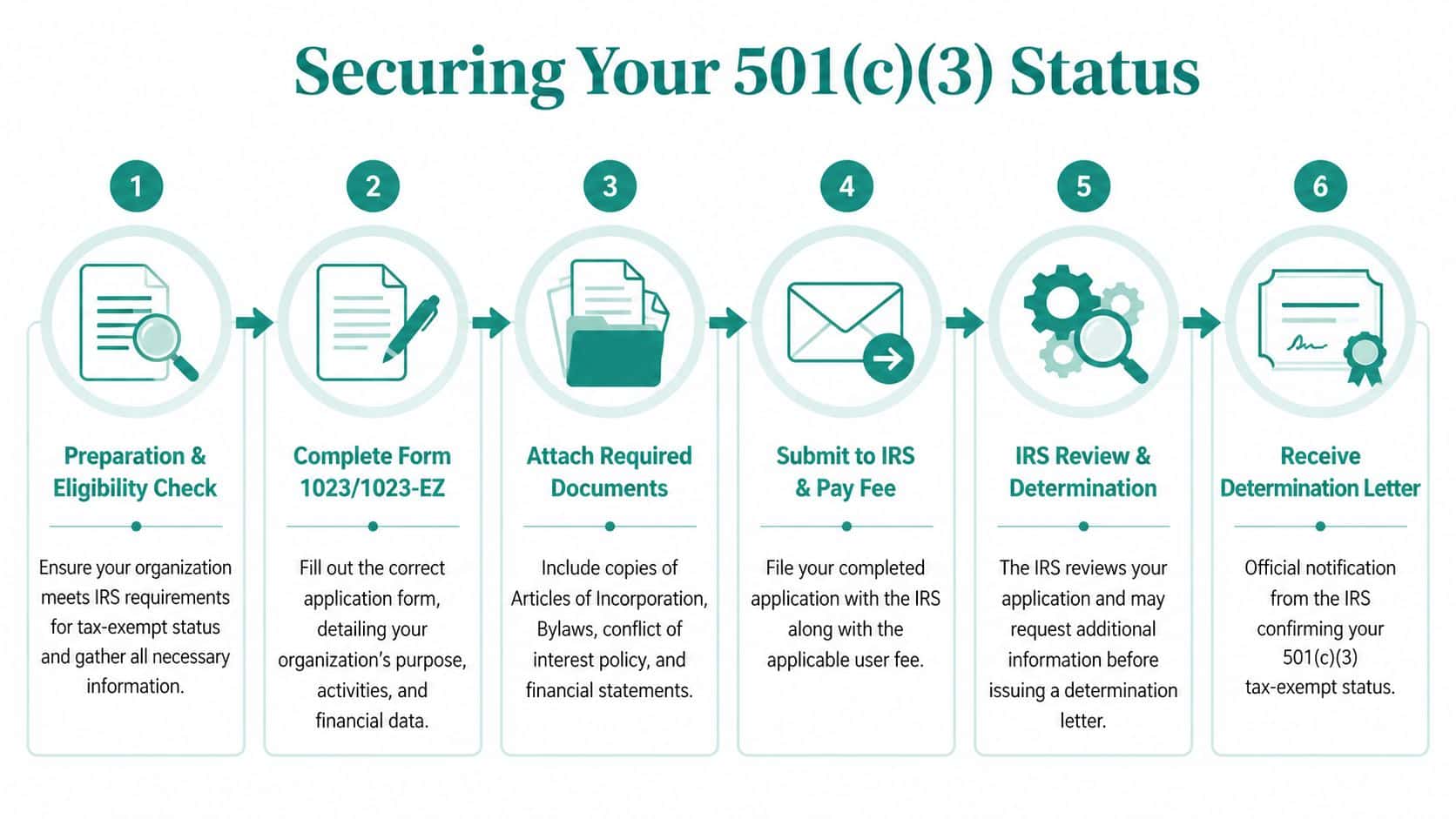
A lot of founders hit this step and feel the pressure all at once. The IRS is not just asking for a form. It is asking for proof that your organization has a charitable purpose, a workable structure, a realistic budget, and controls that match what you say you plan to do.
That is why I treat the 501(c)(3) application as both a legal filing and an operating test. If your program plan, board structure, and financial setup are still fuzzy, the application will expose it.
Get your EIN before you start the exemption filing
You need an Employer Identification Number, or EIN, before you file for exemption. You will also need it for banking, payroll setup if you hire, vendor forms, and basic financial administration.
Get it early. Then make sure the legal name, address, and responsible party information match across your records. Small mismatches create avoidable cleanup later, especially when banks, grantmakers, and the IRS are all looking at different documents.
Choose the right IRS application form
This is your first real judgment call.
According to the Donorly guide to starting a nonprofit, Form 1023-EZ costs $275 and is generally used by smaller organizations that meet the eligibility rules, while the full Form 1023 costs $600. Donorly also notes that organizations should file within 27 months of incorporation if they want tax-exempt status to be recognized retroactively, and that weak filings often run into trouble because of missing financial detail or organizing language that does not satisfy IRS standards.
Here is the practical distinction:
| Form | Best fit | Cost | Typical processing |
|---|---|---|---|
| Form 1023-EZ | Smaller organizations that clearly meet IRS eligibility rules and have straightforward activities | $275 | Shorter |
| Form 1023 | Organizations that do not qualify for EZ, expect more complexity, or want to fully explain their structure and plans | $600 | Longer |
The cheaper form is not automatically the better form. A short application can save time, but only if the organization qualifies and the mission, activities, and revenue model are simple enough to describe cleanly.
I have seen founders rush toward the EZ form because they want approval fast. That can be fine. It can also be shortsighted if the organization expects unusual programming, related-party transactions, complicated revenue, or rapid growth. In those cases, the full filing often gives you more room to present the facts clearly.
What the IRS is actually reviewing
The IRS wants a coherent story backed by documents.
Your narrative should explain what you will do in the first year, who benefits, how you will raise money, how funds will be spent, and how the board will prevent private benefit or insider control. Those answers need to line up with your articles, bylaws, conflict policy, and projected budget.
Strong applications are specific. Weak applications rely on broad mission language and vague promises about future programming.
A solid draft usually answers these points clearly:
- Programs: What services, events, grants, or educational activities will you run first?
- Funding: Will revenue come from donations, grants, program fees, sponsorships, or something else?
- Compensation and relationships: Will any founder, director, or related party be paid, reimbursed, or contract with the organization?
- Governance: How will the board approve decisions and address conflicts of interest?
- Use of funds: How will spending support exempt activities instead of private interests?
Working advice: Clear, consistent detail carries more weight than ambitious language.
Where applications usually break down
The pattern is familiar. A founder writes a charitable mission statement, copies generic governance language, guesses at a budget, and assumes the rest will sort itself out.
It usually does not.
Applications draw follow-up questions when the budget does not match the activity description, the organization promises several programs but shows no staffing or delivery costs, or the board structure looks independent on paper but not in practice. Another common problem is treating governance as a formality. If one person controls the bank account, drafts all contracts, and dominates the board, that concern tends to surface sooner or later.
Purpose clauses also matter. If your incorporation filing used language that worked for the state but did not clearly support federal exemption, you may need to amend documents before the IRS file is ready. That is a frustrating delay, but it is easier to fix before submission than after an IRS question letter arrives.
Plan for the waiting period
Federal approval often takes longer than founders expect. The exact timeline varies, and it can affect decisions about grant applications, major gifts, hiring, and public fundraising.
Treat that delay as part of the launch plan, not as an interruption. If a foundation requires a determination letter before it will review your proposal, that affects your cash flow. If you plan to start soliciting broadly right away, state charity registration may also come into play before your IRS approval arrives. The filing sequence matters because legal status, fundraising activity, finance setup, and board decisions all interact.
Build the full packet before you submit
Do not fill out the application a page at a time with supporting documents scattered across email threads. Assemble the packet first, then complete the filing from a single set of approved records.
Your preparation file should include:
- Filed articles of incorporation with exemption-ready language
- Bylaws that match how the board will operate
- Conflict of interest policy and board roster so governance answers stay consistent
- Program descriptions based on real launch plans, not placeholder language
- Financial projections tied to expected donations, grants, staffing, and operating costs
If you want a practical way to organize that work, use this Form 1023 preparation checklist.
That preparation step saves time twice. It makes the filing cleaner, and it gives you the operating documents you will need right after approval.
Establishing Your Governance and Initial Operations
On paper, your nonprofit may be approved. In practice, it is not ready until the board can make decisions, money can be handled cleanly, and basic controls are in place.
That gap catches founders all the time. They finish the filings, then realize they still need rules for voting, bank access, recordkeeping, gift tracking, and who is allowed to approve what. Registration creates the entity. Governance and operations make it usable.

Write bylaws that fit the board you have
Bylaws should match your actual operating model. If you have a three-person founding board that meets monthly and handles a lot of startup work directly, say that clearly. Do not adopt a generic template built for a mature organization with committees, rotating classes of directors, and layers of delegated authority you do not have.
Good bylaws answer the questions that tend to create friction later. How many directors serve. How directors are elected or removed. What quorum is. How meetings can be called. What officer roles exist. How conflicts of interest are disclosed and handled.
Keep them usable. If a rule is so formal that your board will ignore it by month three, rewrite it before adoption.
If you need a practical starting point, this nonprofit bylaws generator can help you organize the core provisions before legal review.
Build a board that can govern
Early boards often include friends, close supporters, or people committed to the mission. That helps at the start, but belief is not the same as oversight. The board has to review budgets, approve policy, document decisions, and ask hard questions when cash is tight or a program is underperforming.
A better test for board candidates is simple. Will this person show up, read the materials, understand fiduciary duty, and speak candidly when something looks off?
Look for a mix of judgment and reliability:
- Attendance: A director who misses meetings weakens every approval process.
- Financial comfort: Every board needs people willing to read statements and ask follow-up questions.
- Independent thinking: Agreement is useful. Blind agreement is dangerous.
- Role clarity: Directors govern. Staff and founders manage day-to-day work.
If your nonprofit plans to run campaigns with a public-facing funding component, this essential resource for nonprofit creators is a useful reminder that fundraising strategy and compliance should be built together, not treated as separate projects.
Hold a first board meeting that creates a record
Your first board meeting should do more than confirm enthusiasm. It should produce the decisions outside parties will ask to see later.
A practical agenda usually includes adoption of the bylaws, election of officers, approval of a conflict of interest policy, authorization to open a bank account, designation of account signers, approval of the accounting approach, and confirmation of who is responsible for maintaining corporate records. If you are still waiting on one filing or document, note that in the minutes rather than leaving the record vague.
Minutes matter more than many founders expect. Banks ask for board authorization. Auditors and grantmakers may review governance records. State agencies may want proof that the board approved key actions. Clear minutes save time because they show who decided what, and when.
Set up finance correctly from the first dollar
A lot of cleanup work starts with one small shortcut. Someone opens the bank account, donations begin coming in, expenses get reimbursed informally, and the books live in a spreadsheet for six months.
That system breaks as soon as you receive a restricted gift, a grant with reporting terms, or board questions about how money was used by program. Nonprofits need clean separation between unrestricted revenue, restricted funds, operating expenses, and any liabilities tied to grants or payroll. If you delay that setup, the fixes are harder and more expensive later.
Choose financial tools based on nonprofit needs, not general familiarity. QuickBooks works for many organizations, but fund tracking, donor records, volunteer management, events, marketing, and online giving often end up split across several systems. We built AlignMint to handle true fund accounting, donor management, volunteer management, marketing, online giving pages, AI assistance through Minty, and plan-based user allowances (1 on Free, up to 10 on Plus, up to 25 on Pro, and unlimited on Enterprise).
The larger point is operational fit. Pick a system your treasurer, staff, and future bookkeeper can use, and set the chart of accounts and approval process before transaction volume grows.
Open the bank account with proper controls
Before you open the account, make sure you have your EIN, filed formation documents, and board authorization ready. Banks often ask for the articles of incorporation, the EIN confirmation, bylaws, and signed meeting minutes that identify authorized signers.
Keep access tight from the beginning. Limit the number of signers. Separate approval from reconciliation if your team size allows it. Do not let one person receive funds, record them, deposit them, and reconcile the account without review. In a very small startup, you may not have perfect segregation of duties yet, but you can still require monthly board review of statements and a documented approval process for payments.
Personal accounts should never be used, even briefly. That shortcut creates tax, audit, and credibility problems you do not want to explain later.
Navigating State Fundraising and Local Compliance
Many founders think the IRS determination letter is the finish line. It isn’t. It’s one major milestone, and an important one, but it doesn’t give you automatic permission to solicit donations everywhere.
This is one of the most overlooked parts of how to register a nonprofit organization. Federal approval and fundraising compliance are related, but they are not the same thing.
Your IRS letter does not cover state solicitation rules
If you plan to ask for donations, you need to understand charitable solicitation registration. According to the Colorado Nonprofit Association guidance, 39 states plus DC require separate charitable registration before soliciting donations. The same source notes that online fundraising triggers this requirement universally, and that nonprofits can face fines up to $25,000 for non-compliance.
That catches many new directors off guard. They assume a website donate button is passive. States often do not see it that way.
Online fundraising creates a wider footprint
The internet makes every small nonprofit look national before it is operationally ready to be national. You launch a donation page, send emails, post on social media, and suddenly your appeal is reaching beyond your home state.
That reach creates compliance questions. If you are soliciting broadly, you need to know where registration is required before the campaign goes live.
A practical sequence looks like this:
- Home state first: Confirm your own state’s charitable registration rules.
- Campaign footprint next: Review where your fundraising messages will be directed.
- Digital tools review: Donation pages, email appeals, and social posts all matter.
- Renewal calendar: Registration is rarely one-and-done. Track renewals carefully.
If your fundraising is national, your compliance planning can’t stay local.
Local rules still matter
State charitable registration gets the attention, but local compliance matters too. Depending on where you operate, you may need a municipal business license, occupancy approval, or local permit tied to programming, events, or office use.
This is one of those low-drama tasks that protects you from very avoidable headaches. Call the city or county office and ask what a newly formed nonprofit needs before opening, holding events, or operating from a physical location.
Don’t let fundraising tools outrun your compliance
Many donor platforms make it easy to start taking gifts quickly. That speed is useful, but it can also lull a founder into thinking setup equals readiness.
If you’re planning peer-to-peer fundraising, donation pages, or campaign-based online giving, it helps to study examples built for nonprofit creators before you launch. This overview from PledgeBox is an essential resource for nonprofit creators who are thinking about early fundraising mechanics and campaign structure.
The practical takeaway is simple. Build your fundraising engine with the same care you gave your incorporation paperwork. A campaign that raises money but creates compliance exposure is not a clean win.
Your First 90 Days as a Registered Nonprofit
Once the legal work is done, your focus should shift from formation to rhythm. You need a working board calendar, a live donation path, a simple donor acknowledgment process, and a clean way to track money and activity.
Keep your first fundraising effort modest. A small launch campaign, a board-led outreach push, or a targeted community appeal is usually better than a sprawling event that drains your attention. At the same time, begin recruiting volunteers for defined roles rather than asking people to “help however they can.”
Your first quarter should also include regular board reporting. Even if the organization is tiny, get in the habit of sharing cash position, restricted funds, program activity, and upcoming compliance dates. That discipline pays off later.
If you’re comparing software at this stage, start with the accounting question because it affects everything else. This guide to nonprofit accounting software is a good place to begin.
For organizations raising under $100K per year, we offer a free tier that includes donor management, giving pages, fundraising tools, Minty, and My Workspace. Fund accounting starts on Plus, so new teams can begin with clean donor records and upgrade when they need accounting and reporting.
Your nonprofit doesn’t need more complexity. It needs a clean start, reliable records, and tools that match how charities work. If you want one place for fund accounting, donors, volunteers, events, marketing, and AI help, take a look at AlignMint.
Ready to try AlignMint with your nonprofit?
Start free — set up donor tools, giving pages, and Minty. Upgrade when you need accounting.