


Quick Answer: Crafting Impactful Donation Acknowledgement L
Write effective donation acknowledgement letters. Meet IRS rules and build donor loyalty with templates, tips, and best practices for nonprofit thank-you letters.
You're probably dealing with this the same way most executive directors do. A gift comes in, someone sends a quick thank-you, and the formal receipt gets handled later when there's time.
That approach works until it doesn't. Donation acknowledgement letters sit at the intersection of donor trust, IRS compliance, and internal recordkeeping, so the cost of a sloppy process shows up in more than one place. The good news is that a clean system isn't hard to build once you know what belongs in the letter, when it needs to go out, and how to keep fundraising and accounting in sync.
Why Your Thank You Letter Is More Than Just a Receipt
Most nonprofits treat acknowledgement letters as back-office paperwork. That's understandable. You have campaigns to run, staff issues to solve, and a board that wants answers yesterday.
But the letter isn't just proof of payment. It's often the donor's first direct signal that your organization is careful, grateful, and trustworthy.
The letter does two jobs at once
First, it protects the donor. Second, it shapes the relationship.
That second piece matters more than many teams realize. Only 19% of new U.S. donors give a second time without effective thanks, and monthly donors are 9x more likely to give over three years, while organizations offering recurring options saw a 21% revenue increase in 2024 according to 11FiftySeven's donor recognition analysis.
If you're trying to improve donor retention, this is one of the simplest places to start. A prompt, clear letter tells the donor, "We noticed your gift, we recorded it correctly, and it matters."
Practical rule: If your acknowledgement process feels like clerical work, you'll write clerical letters. Donors can feel that.
A good letter also lowers anxiety. Donors want to know their card processed, their stock transfer arrived, their restricted gift was coded correctly, and their tax documentation won't become a problem later.
What works in real life
The strongest letters sound like they were written for a person, not produced by a machine. They are still compliant, but they don't read like legal boilerplate.
That usually means the letter does three things well:
- Confirms the facts: It states what was given, when it was given, and whether any goods or services were received.
- Reflects donor intent: It names the campaign, fund, school program, church ministry, or sponsored project the donor chose.
- Shows human awareness: It thanks the donor in language that sounds normal, respectful, and specific.
Short beats clever here. If the donor gave to your scholarship fund, say so. If the gift supports a church outreach effort or a school program, name it. If it was the donor's first gift, welcome them.
A donor doesn't need a long letter. They need an accurate one that feels sincere.
This is also why generic templates disappoint. "Thank you for your support of our mission" is technically polite. It's also forgettable. The donor already knows your mission statement. What they want to know is whether you know what they did.
If you want a thoughtful companion piece on the relationship side of stewardship, Stobbe Design offers a helpful take on how to thank donors and build real relationships. It's worth reading alongside your compliance checklist.
Why directors should care personally
This process lands on your desk eventually, even if someone else drafts the letters. When a donor can't claim a deduction, when a grant payment gets posted to the wrong fund, or when finance and development disagree on what was promised at an event, the issue becomes a leadership issue.
That's why I'd treat donation acknowledgement letters as a management system, not a correspondence task. Done well, they improve retention, reduce audit risk, and save staff from avoidable cleanup later.
The Non-Negotiable IRS Requirements for Every Letter
The legal baseline is straightforward. If you keep a simple checklist, you can audit every template you use.
What the IRS requires
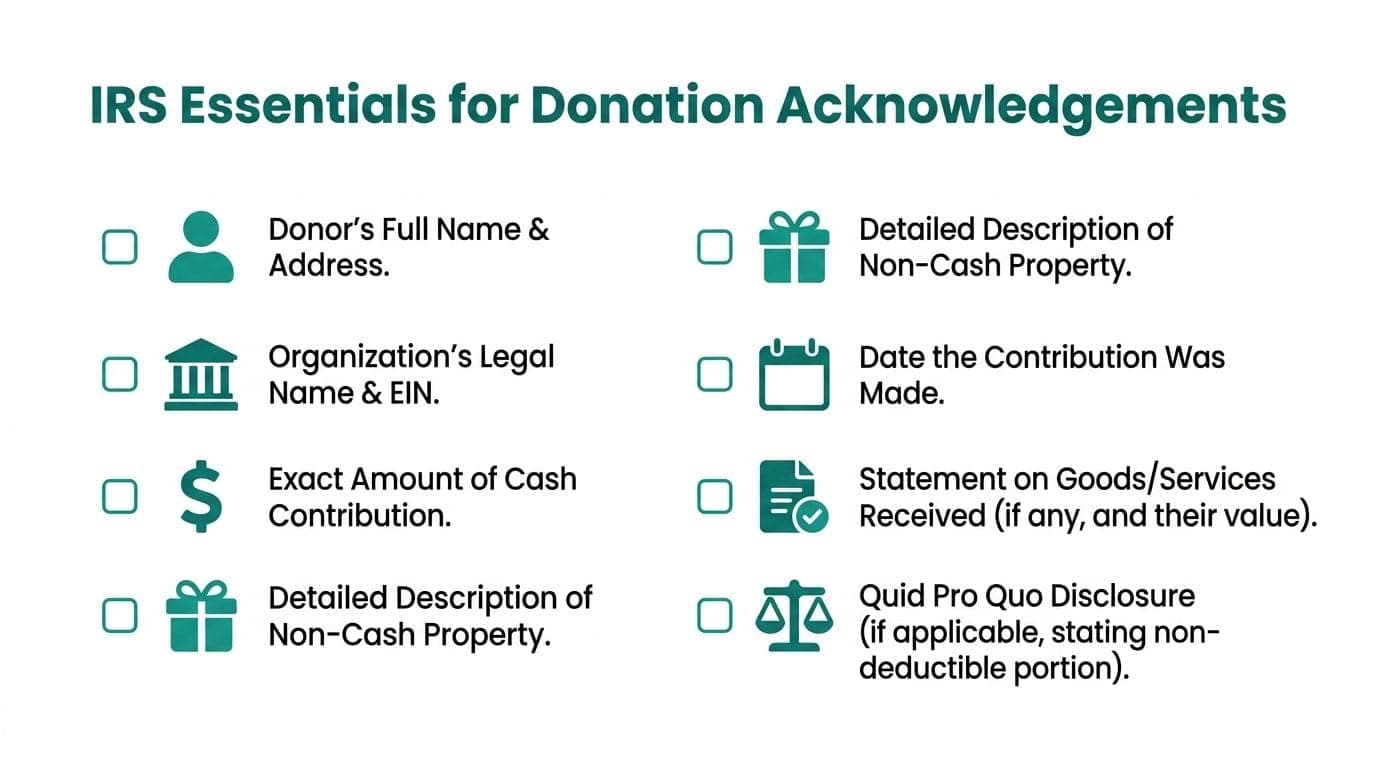
For any single charitable contribution of $250 or more, the IRS requires a written acknowledgment from the charity. The letter must include the organization's name, the exact amount of any cash contribution, a description of any non-cash property, and a statement about whether goods or services were provided in return, or a good faith estimate of their value if they were. That rule comes from IRS Publication 1771 and is outlined on the IRS page for charitable contributions written acknowledgments.
That's the floor. Many organizations send acknowledgement letters for all gifts because it's cleaner for donors and easier for staff.
The practical checklist
Use this as a working standard for every donation acknowledgement letter.
- Organization identity: Include your legal organization name. Many nonprofits also include EIN and address because it helps donors and staff match the record later.
- Donor information: Include the donor's name, and use the correct household or business format.
- Gift amount for cash: State the exact cash contribution amount.
- Property description for non-cash gifts: Describe the property, but do not assign fair market value.
- Gift date: Include the date the contribution was made.
- Goods or services statement: Say either that no goods or services were provided, or describe what was provided and give a good faith estimate of value.
- Quid pro quo language when needed: If the donor received something in return, make the deductible portion clear.
If your team wants a reference point for receipts and required fields, our documentation on donation receipts is a useful operational checklist.
The part teams miss most often
The biggest compliance mistakes usually happen when a gift involves benefits. Gala tickets, sponsorship packages, auction purchases, and donor events create confusion because the payment may include both a charitable portion and a benefit portion.
If your letter skips that disclosure, the donor's tax deduction can be at risk. That's not a technical issue. It affects donor confidence.
Compliance note: The thank-you language can be warm. The tax language must be exact.
This is why I prefer separate internal review of event-related templates. Standard annual giving receipts and event acknowledgements are not the same document, even if they look similar.
Keep one approved template set
A lot of problems start when every department writes its own version. Development has one template. Finance has another. The school office has a third. The church administrator has a fourth saved on a desktop from three years ago.
That's how required language disappears.
A better approach is to maintain one approved set of templates by gift scenario. Review them on a schedule, not only when something breaks. If your organization runs multiple programs, sponsored projects, ministries, or campuses, keep the legal core identical and allow only the program language to vary.
Timing matters too
The IRS requirement is about written substantiation, but timing still matters operationally. A late letter creates donor frustration and year-end staff stress.
In practice, many organizations issue an immediate receipt and then follow with a fuller acknowledgement if the relationship calls for it. That keeps the paper trail clean and still leaves room for a more personal note from leadership.
When in doubt, keep the compliance language simple, accurate, and consistent. You can always add warmth. It's much harder to repair a missing disclosure after the fact.
Crafting Acknowledgment Letters for Different Gift Types
A cash gift is easy. The trouble starts when the gift doesn't fit the standard mold.
Churches receive designated offerings. Schools manage grants and scholarship funds. Fiscal sponsors receive money on behalf of multiple projects. Development teams process stock, in-kind items, event sponsorships, and recurring gifts. Each one needs slightly different treatment.
A quick reference table
| Gift Type | What to Include | Key Consideration |
|---|---|---|
| Cash gift | Exact amount, date, organization name, goods/services statement | Keep the wording plain and accurate |
| Non-cash gift | Description of property, date received, goods/services statement if relevant | Describe the item, but don't state fair market value |
| Event sponsorship or benefit gift | Payment details, date, description of benefits, good faith estimate of value | Separate charitable and non-deductible portions clearly |
| Stock gift | Description of shares or securities, date received, organization details | Donor determines value for tax purposes |
| Recurring gift | Amount and date for each installment, or year-end summary if you issue one | Keep installment records consistent across the year |
| Restricted gift | Gift details plus the exact restriction or designated fund | Match donor intent to accounting records |
| Grant payment | Amount, date, fund or grant name, restriction language if applicable | Tie the acknowledgement to the grant terms and fund tracking |
| Fiscal sponsorship gift | Gift details, sponsored project name, fiscal sponsor identity, restriction if applicable | Make clear who received the gift and where it is designated |
Restricted gifts deserve special care
Often, nonprofits become less precise at this point. They thank the donor warmly but fail to record the donor's intent in the letter.
That's a mistake. A 2025 GuideStar analysis of 5,000 Form 990s found that 22% of audit flags were tied to inadequate restricted gift documentation, and small nonprofits were 3x more affected. The same analysis stresses that letters should specify the restriction, such as "This gift is restricted to Program X," to support compliance and fund accounting, as summarized by the Council of Nonprofits gift acknowledgments guidance.
If a donor gives to a scholarship fund, building campaign, benevolence fund, or missionary support account, say that plainly in the acknowledgement. Don't leave the restriction implied.
If the donor chose a restricted purpose, the letter should echo that choice in words your finance team can stand behind later.
This matters even more for organizations with real fund complexity. Schools, churches, and fiscal sponsors often have more restricted activity than the average small nonprofit. A vague thank-you creates cleanup later when development says one thing and accounting records another.
For a deeper look at the accounting side, our guide to Fund Accounting for Nonprofits is worth keeping nearby.
Sample wording by scenario
Here's the kind of language that tends to work.
Cash donation
"Thank you for your contribution of $500 received on March 12, 2026. No goods or services were provided in exchange for this contribution."
That's simple and sufficient for the legal core.
Non-cash donation
"Thank you for your generous donation of office furniture received on March 12, 2026. No goods or services were provided in exchange for this contribution."
Notice what's missing. There is no valuation.
Restricted gift
"Thank you for your contribution of $1,000 received on March 12, 2026. This gift is restricted to the Scholarship Fund. No goods or services were provided in exchange for this contribution."
That single sentence about restriction does a lot of work.
Grant or sponsored program payment
"Thank you for your grant payment of $5,000 received on March 12, 2026. This gift is restricted to the After-School Literacy Program in accordance with donor intent. No goods or services were provided in exchange for this contribution."
This wording helps both stewardship and audit readiness.
Keep the writing clear
The best acknowledgement letters are not trying to sound impressive. They are trying to be unmistakable.
If your team struggles with concise writing, these writing website content tips from Four Eyes are surprisingly useful for letters too. The same principle applies. Clear beats ornate.
One more caution for fiscal sponsors
If you serve as a fiscal sponsor, don't let the project name replace the legal charity name. The acknowledgement must still identify the receiving organization correctly, while also naming the sponsored project or designation clearly enough for donor intent and internal fund tracking.
That sounds small. It isn't. It's the difference between a letter that merely thanks someone and a letter that stands up when finance, development, and auditors all look at it later.
How to Personalize and Automate Your Process
Many teams think they must choose between warmth and efficiency. They don't.
The better answer is a two-step rhythm. Send the factual confirmation right away, then send a more personal acknowledgement while the gift is still fresh. That keeps you compliant without turning your staff into full-time mail merge operators.
The timing that tends to work best
A structured process matters. According to Touchwall, a multi-tiered acknowledgment process can increase donor retention by 25-30%. That process starts with an immediate automated receipt in 0-5 minutes, followed by a personalized letter within 48-72 hours, using donor-centric language and a handwritten note where appropriate in the Touchwall acknowledgment template guide.
That timing makes practical sense. The receipt confirms the transaction. The second message builds the relationship.
What personalization means
Personalization doesn't mean writing a fresh letter from scratch every time. It means including details that prove your organization noticed the donor's action.
Useful fields include:
- Gift purpose: Reference the campaign, fund, ministry, scholarship, or project supported.
- Giving history: Note if this is a first gift, recurring gift, or anniversary gift when appropriate.
- Preferred name: Use the donor's chosen name or household style, not whatever was imported badly.
- Relevant impact line: Include a short sentence about what this area of support makes possible.
- Real sign-off: Use a real staff or leadership signature, especially for larger or strategic gifts.
What works: "Your gift to the music program helps students access instruction and instruments." What doesn't: "Your donation helps us continue our important work."
The first line tells the donor you paid attention. The second could go to anybody.
Automation should handle the routine part
The routine part is where staff time disappears. Pulling gift amount, date, donor name, appeal code, restriction, and goods/services language from different places is where errors creep in.
A sound system should generate standard letters from one source of truth. That usually means your donor record, accounting record, and campaign data need to agree with each other before the letter is produced.
If you're setting up templates and segmented sends, our documentation on letter campaigns gives a practical starting point.
Where to keep the human touch
Automation should not replace leadership attention. It should protect it.
Use automation for these:
- Immediate receipts: Fast confirmation after online gifts or mailed gift entry.
- Standard legal language: Consistent compliance wording across every template.
- Fund and campaign merges: Correct insertion of program, fund, or project names.
- Year-end summaries: Consolidated records for recurring donors where your policy calls for them.
Keep human effort for these:
- Major gifts: Add a short personal note or signed letter.
- First-time donors: Welcome them with language that invites trust.
- Memorial and tribute gifts: Check names and acknowledgements carefully.
- Complicated gifts: Review stock, grants, sponsorships, and restricted funds before sending.
This split is what saves time without making your organization sound canned.
Donor-centric language still matters
One practical writing rule is worth keeping. Put the donor at the center of the message.
That means more "you" and "your," and less institutional throat-clearing. Donors don't need two paragraphs about your strategic plan in a receipt letter. They need reassurance that their gift was received, respected, and directed properly.
When teams adopt this habit, letters get shorter and better. They also become easier to approve, because they stop trying to do five jobs at once.
Choosing the Right Tools for Your Acknowledgement Workflow

The software question usually shows up after a mistake. A donor's receipt is wrong. The gala benefit value never made it into the letter. Development says a gift was restricted. Finance says it wasn't.
That isn't usually a staff problem. It's a systems problem.
The trade-off with separate tools
Many organizations run fundraising in one product and accounting in another. That can work. QuickBooks is familiar to many bookkeepers. Bloomerang is well liked for donor management. Little Green Light, DonorPerfect, and Neon CRM each have strengths too.
The gap appears when acknowledgement letters need both fundraising context and accounting accuracy. A donor CRM may know the campaign. Accounting may know the class or ledger entry. Event software may know the benefit details. Staff end up reconciling by hand.
That creates avoidable risk.
According to Donor Database Experts, missing quid pro quo disclosure can lead to 100% disallowance of the donor's deduction in an IRS audit, and using separate, non-integrated tools raises the chance of those compliance mistakes because gift and benefit details are not unified in one system. Their guidance also notes that built-in compliance checks in an all-in-one approach can prevent these errors in the Donor Database Experts article on donor acknowledgment letters.
A side-by-side look
| Approach | What it does well | Where it gets hard |
|---|---|---|
| QuickBooks plus a separate CRM | Familiar bookkeeping and specialized fundraising tools | Staff must re-enter or reconcile gift details, restrictions, and benefits |
| CRM plus event platform plus email tool | Strong outreach and campaign flexibility | Acknowledgement data lives in several places |
| All-in-one nonprofit platform | Gift, donor, fund, event, and communication records stay together | Requires one shared process across teams |
This is why disconnected setups often produce decent donor emails but weak official letters. The communication looks polished, but the legal and financial details depend on manual handoffs.
Software doesn't create discipline. It does remove the places where disciplined staff are most likely to make avoidable errors.
What matters more than feature lists
For donation acknowledgement letters, I'd evaluate tools on five practical questions.
-
Can the system store donor, gift, and fund details together If not, your staff will keep chasing data across screens.
-
Can it handle restricted gifts natively Schools, churches, and fiscal sponsors need more than generic tagging.
-
Can event benefits flow into receipt language If sponsorship perks and gala values sit outside the donor record, letters will be wrong.
-
Can multiple staff work without extra seat fees Acknowledgements touch development, finance, executive leadership, and sometimes program staff.
-
Can you see the final letter before it goes out Automation is useful. Review is still necessary.
If you're comparing systems, our donor management feature overview shows the kind of unified record that makes acknowledgements easier to trust.
You may also want to read our guide on nonprofit accounting software if your current workflow still depends on exporting data back and forth.
Why this matters for smaller teams
Small and mid-sized nonprofits often manage complexity internally. One person in finance knows where the event values live. One person in development remembers how to code grants. One administrator knows which template is the "real" one.
That works until someone is out sick, retires, or leaves.
The best acknowledgement workflow is the one your team can repeat without heroics. If the right data is already connected, the letters become easier to approve, easier to trust, and much less likely to turn into year-end cleanup.
A Director's Checklist for a Stress-Free System
A strong acknowledgement process doesn't depend on heroic staff effort. It depends on simple rules, clear ownership, and a system your team can repeat every time.
Here's the checklist I'd keep in front of any executive director, finance lead, or development manager.
Standardize the templates
Keep one approved set of donation acknowledgement letters by gift type. Review them quarterly, especially if you run events, grants, restricted funds, sponsored projects, church designations, or school campaigns.
Make sure old versions are removed from shared drives. "Close enough" templates create the most annoying mistakes.
Assign one owner and one reviewer
Somebody should own the process. Somebody else should spot-check it.
That doesn't need to be a large team structure. It just means one person is responsible for the workflow, and another confirms the right template and language are being used for unusual gifts.
A good system is one that still works when your most experienced staff member is out for a week.
Segment donors in ways that matter
Not every donor should receive the same message. Segment by first-time donor, recurring donor, major donor, restricted gift, grant payment, event donor, and memorial or tribute gift.
Those categories affect both tone and content. They also help your team personalize without rewriting every letter.
Train beyond the development office
Acknowledgements touch more than fundraising. Finance, advancement, school administration, church office staff, volunteer coordinators, and executive leadership may all play a role.
Walk each group through the basics:
- What must never be changed: Legal and tax language
- Elements that can change: Program language, signatory, and short impact sentence
- What needs review: Restricted gifts, grants, sponsorships, and non-cash contributions
Build a simple exception process
Most gifts can run on templates. A few should pause for review.
Set clear rules for gifts that need human eyes before sending. That usually includes non-cash donations, event-related gifts, stock, major gifts, and anything with a restriction that isn't standard.
Keep the donor record and the accounting record aligned
If the donor letter says a gift was restricted to a scholarship fund, your books should say the same thing. If the event receipt lists a benefit, that value should be reflected consistently across systems.
That alignment is what protects your organization later. It also saves your staff from having the same argument twice.
Use your time where it counts
Your staff should not spend their best hours copying gift data between platforms, fixing mail merges, or hunting for old template language. They should spend those hours calling donors, meeting funders, supporting programs, and leading the organization.
This is the true value of a calm acknowledgement system. Better donor experience, cleaner records, fewer surprises.
If you want one place to manage the letter, the donor record, the restricted fund, the grant, the event details, and the accounting entry, take a look at AlignMint. We built it as an all-in-one platform for nonprofits that need donor management, true fund accounting, volunteers, events, marketing, team communication, and AI help in one system. There's a free tier for nonprofits under $100K, plan-based user allowances (1 on Free, up to 10 on Plus, up to 25 on Pro, and unlimited on Enterprise), and practical tools built for churches, schools, fiscal sponsors, and growing nonprofit teams that don't have time for disconnected software.
Frequently Asked Questions
Ready to try AlignMint with your nonprofit?
Start free — set up donor tools, giving pages, and Minty. Upgrade when you need accounting.