For related tools, see AlignMint features.
Nonprofit Donation Management for 2026
Quick Answer: Nonprofit Donation Management: A Director's Guide for 2026
Nonprofit donation management is the operating system that connects each gift to the donor record, receipt, fund assignment, stewardship touch, and financial report. When fundraising and finance share one source of truth, your team spends less time reconciling and more time serving your mission.
For related reading, see donation management and nonprofit donor management.
You probably know this feeling already. Donations come in through one tool, acknowledgments happen in another, restricted gifts live in a spreadsheet, and your finance report still needs hand-checking before anyone sees it.
That isn't a staffing failure. It's usually a systems problem. Good nonprofit donation management gives you one clear view of the gift, the donor, the fund, and the follow-up, so your team spends less time reconciling and more time serving people.
Moving Beyond Spreadsheets and Disconnected Tools
Most executive directors I talk with aren't asking for more software. They're asking for fewer moving parts.
The usual setup looks harmless at first. QuickBooks handles the books. A donor CRM tracks gifts. Mailchimp sends appeals. Event registrations sit somewhere else. Volunteer notes live in a shared document. Then a board member asks a simple question about donor follow-up or restricted balances, and three people go hunting through five systems.
That patchwork creates more than inconvenience. It slows receipting, muddies reporting, and makes it harder to see which donor relationships need attention now.
That matters because fundraising is getting more demanding. In 2024, U.S. charitable giving reached $592.50 billion, yet Q1 2025 fundraising reports showed dollars raised were up 3.6% year over year while donor counts fell 1.3%, and average donor retention slipped to 18.1% according to Kindsight's fundraising statistics summary. More money is moving through the sector, but keeping donors is getting harder.
When retention is under pressure, disconnected systems stop being a nuisance and start becoming a real risk. If your thank-you process is late, if your staff can't see the full donor history, or if campaign and finance records don't match, the cracks show quickly.
Practical rule: If your team has to export, reformat, and re-enter gift data every week, your donation process is too fragmented.
A better approach starts with one decision. Stop treating donation management as a fundraising side task. Treat it as an operating system for gifts, reporting, stewardship, and accountability.
If you're still untangling years of spreadsheet habits, this guide on moving nonprofit data out of spreadsheets is a useful place to start. And if you need a plain-English reminder of why reducing manual work matters across the whole organization, Up North Media's guide to automation ROI for businesses is worth a read.
What Is Nonprofit Donation Management Really
Nonprofit donation management is the full chain of work around a gift. It starts when someone donates and ends when that gift is recorded correctly, acknowledged promptly, reported accurately, and tied back to a real relationship.
That's why I don't define it as "software for tracking donations." That's too narrow. A better definition is this. Nonprofit donation management is the system that connects money, people, and accountability in one place.
It's more than a donor list
A spreadsheet of gifts tells you what came in. It usually doesn't tell you what fund the gift belongs to, whether a receipt went out, whether that donor attended your spring event, or whether your finance records agree with development records.
A real donation management process ties those pieces together so staff aren't reconstructing history every month. It acts more like a cross-referenced filing system than a box of receipts.
The practical test is simple:
- Can you see the full donor story: gift history, communications, events, volunteer involvement, and notes in one record.
- Can you trace the money clearly: from donation form to deposit to fund balance to financial report.
- Can you prove stewardship happened: acknowledgments sent, restrictions honored, and follow-up assigned.
If the answer is no, you don't have donation management yet. You have disconnected recordkeeping.
Why centralization matters
Discerning donors, board members, and charity evaluators care about efficiency, not only gross revenue. The Giving Institute notes that CharityWatch's methodology highlights fundraising efficiency by measuring how much a charity spends to generate each $100 in public cash donations, as described in its overview of how nonprofits use data to manage operations.
That kind of accountability depends on clean, centralized data. You can't demonstrate efficient fundraising if gift records, campaign costs, and constituent activity sit in separate places with conflicting labels.
Clean donation data does two jobs at once. It helps your staff work faster, and it gives outside stakeholders confidence in your reporting.
What strong donation management includes
At a practical level, strong nonprofit donation management should cover:
| Function | What it should do |
|---|---|
| Gift intake | Record online, offline, recurring, and pledged gifts accurately |
| Donor records | Keep one reliable profile for each constituent |
| Acknowledgment | Support timely receipts and stewardship touches |
| Financial connection | Tie gifts to the right fund, campaign, or restriction |
| Reporting | Show what was raised, from whom, and for what purpose |
Once those pieces are connected, operations get calmer. Staff stop arguing about whose report is right. Donors get more thoughtful follow-up. Finance and development start looking at the same truth.
The Core Workflows of a Unified System
A unified system earns its keep by removing repeat work. Not by adding more dashboards.
The heart of it is a single donor record. Industry guidance stresses that one donor record should unify contact data, donation history, event participation, and volunteer activity so every interaction stays tied to the same person. That's what makes receipting, segmentation, and stewardship more accurate, as explained in Double the Donation's overview of nonprofit data management practices.
Get thank-yous and receipts out without chasing paper
The first benefit of a connected system is speed. When a gift enters the system once, the receipt can go out right away, the donor history updates, and the finance side reflects the transaction without a second round of typing.
What doesn't work is batching everything manually at the end of the week. That approach creates delays, missed acknowledgments, and small mistakes that pile up.
A healthier workflow looks like this:
- The gift is entered once through a giving page, imported feed, or staff entry.
- The donor record updates immediately with the amount, date, campaign, and any note.
- A receipt or acknowledgment is triggered based on your rules.
- The transaction appears in finance under the right fund or restriction.
That sounds basic. It isn't. Many nonprofits still split those steps across separate tools and then wonder why year-end gets messy.
Make online giving pages feed the rest of your work
A donation form shouldn't be a dead end. It should start a process.
If a donor gives through your website, your team shouldn't need to copy that information into a CRM, then tell finance what happened, then start a separate thank-you. The page should feed the donor record, the campaign reporting, and the accounting side.
That's especially important when you run school, church, or program-specific appeals. The giving page has to capture enough structure so the gift lands in the right place later.
Here's where many generic tools fall short:
- They collect the gift but not the context: campaign, restriction, event, or designation gets lost.
- They send a payment notice, not real stewardship: donors get a transaction email but no meaningful acknowledgment path.
- They sit outside the books: finance still has to reconcile by hand.
Keep pledges, recurring gifts, and events connected
Pledges and recurring gifts are where disconnected systems really show their age. A pledge isn't just a promise. It affects forecasting, stewardship, reminders, and fund expectations.
Events create similar issues. If attendance, sponsorships, donations, and follow-up live in separate places, staff never get a full view of engagement.
The strongest fundraising teams don't simply track gifts. They track commitments, participation, and response in the same record.
That's why your donor CRM matters so much. If you're evaluating how these records should work in practice, this overview of a nonprofit donor CRM is a good benchmark.
Connect fundraising to true fund accounting
This is the part that often gets skipped in software demos. A donor record is only half the story. The money also has to land correctly in the books.
QuickBooks is familiar, and many organizations have made it work for years. But classes and workarounds are not the same thing as nonprofit fund accounting built around restricted funds, grants, and programs. If development records say one thing and finance records say another, the executive director ends up in the middle.
An all-in-one platform can solve that if it combines CRM, fund accounting, volunteers, events, marketing, and team communication in one system. AlignMint is one example of that approach. It includes true fund accounting, a built-in marketing suite, volunteer tracking, online giving pages, Minty, and plan-based user allowances (1 on Free, up to 10 on Plus, up to 25 on Pro, and unlimited on Enterprise). For organizations under $100K in annual revenue, it also offers a free tier.
The point isn't that every nonprofit needs one vendor. The point is that your workflows should share the same underlying data.
Keeping Your Organization Compliant and Accountable
Compliance gets easier when good process is built into daily work. It gets harder when reporting depends on memory, side spreadsheets, and heroic effort in April.
That's why integrated nonprofit donation management matters to finance leaders as much as fundraisers. One properly entered gift can update the donor history, issue a receipt, post to the right fund, and support later reporting without extra handling.
Accountability should come from the system
When your system is set up well, accountability becomes the default. Staff don't need to remember three separate steps for every gift. The record itself drives the outcome.
That helps with ordinary tasks, such as donor receipts and restricted gift tracking. It also helps with the less glamorous work that keeps directors awake at night, including audit prep, board packets, and annual tax reporting.
Here's what strong integration usually improves:
- Restricted fund tracking: gifts land in the right place without manual side calculations.
- Documented stewardship: receipt history and donor communications are easier to verify.
- Cleaner reporting: finance and development pull reports from the same underlying records.
Audits and filings stop being a scramble
Most annual reporting pain comes from reconstruction. Staff go back through exports, compare spreadsheets, fix naming differences, and search email trails to explain transactions.
A nonprofit-specific system reduces that scramble because the original gift record carries the needed context forward. Form 990 preparation, fund reporting, and internal reviews become much less dependent on one staff member remembering how things were done.
If your team is tightening annual reporting practices, this Form 990 checklist for nonprofits is a practical companion.
For organizations dealing with charitable trust administration or related oversight questions, this expert guide for Texas charitable trusts is also a useful reference point.
Good compliance is rarely about doing more paperwork. It's about entering information once, correctly, and keeping it connected.
Measuring What Matters for Growth
A good dashboard should answer real management questions. It shouldn't force you to become a data analyst.
Once your donation data and finance data live together, you can stop looking only at totals and start asking better questions. Which campaigns are producing repeat donors. Which channels bring in gifts that continue. Which donor groups are engaged in more than one way.
Look for decisions, not just reports
I'd focus first on a short list of questions your leadership team needs answered:
- Which first-time donors are showing signs of returning
- Which campaigns are producing meaningful follow-up activity
- Which funds or programs are drawing broad donor interest
- Where finance and fundraising trends are moving together, or apart
That's where many reporting setups disappoint. They give you pages of output but very little guidance.
A useful reporting system should let you sort donors by behavior, campaign response, communication history, and giving patterns without jumping between tools. If you want a sense of what that reporting should include, this overview of nonprofit donor reports covers the basics.
Use AI carefully and practically
AI can help here, but only if it sits on top of real operational data. Otherwise it just summarizes the same messy exports you already distrust.
The practical use case is simple. Let the tool surface patterns, flag oddities, or answer plain-language questions about your donor and finance records. That's more helpful than a flashy prediction score nobody on staff can explain.
A built-in assistant such as Minty can be useful for this kind of work because it gives nontechnical staff faster access to answers hidden in the data. The test is whether it helps your team act with more confidence, not whether it sounds impressive in a demo.
Growth comes from clarity
Growth in fundraising usually looks gradual from the outside. Internally, it often comes from a handful of disciplined habits. Cleaner segmentation. Faster follow-up. Better visibility into which relationships deserve more attention.
If your reports only tell you what happened last month, you're still driving by the rearview mirror.
The right measures help you decide where to invest staff time next. That's its main value.
Choosing Your Donation Management Platform
Directors often spend months on this step. Every vendor promises simplicity. Every demo looks tidy. Then the essential question appears. Do you want one platform that covers your core work, or do you want to assemble separate tools and manage the handoffs yourself?
Both models can work. The right choice depends on your size, your tolerance for complexity, and how much internal discipline you have for data cleanup and process control.
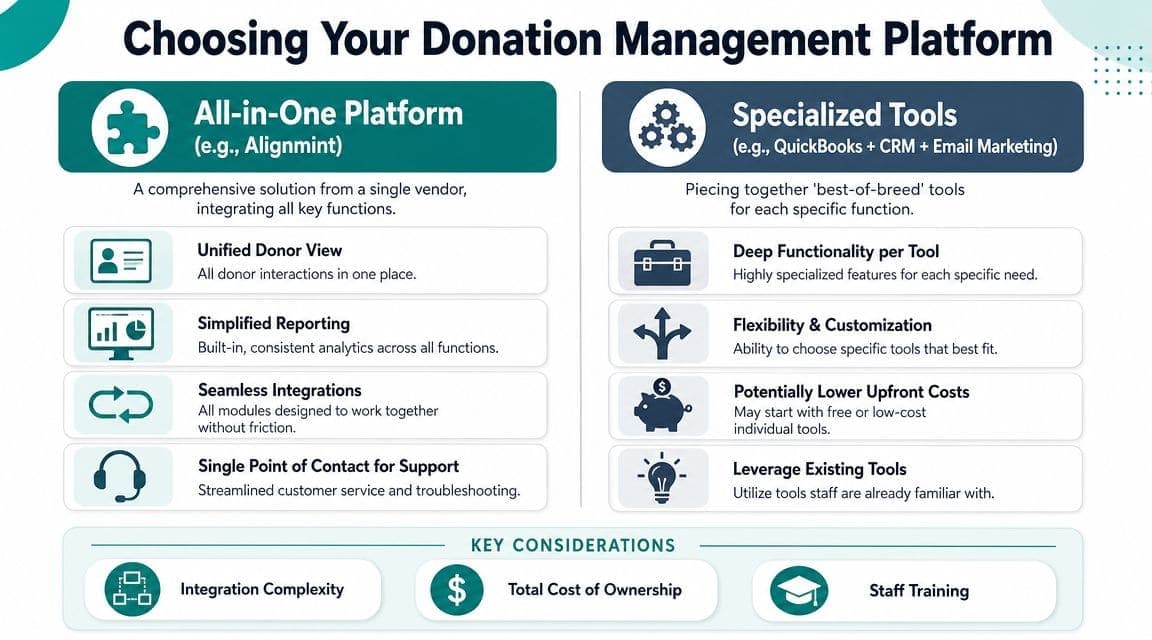
The all-in-one path versus the patchwork path
Here's the plain version.
| Approach | Where it shines | Where it gets hard |
|---|---|---|
| All-in-one platform | One record set, simpler reporting, fewer handoffs | You need confidence that the accounting and CRM both fit your needs |
| Specialized tools | Strong depth in each category, easier to keep existing favorites | Integration work, duplicate entry, conflicting reports, extra training |
Specialized tools deserve a fair hearing. Blackbaud has deep capabilities for larger and more complex organizations. DonorPerfect remains a familiar option for many fundraising teams. QuickBooks is widely known and easier to hire around. Mailchimp is common for email. None of those are weak products.
The challenge is cumulative. Once you connect accounting, CRM, events, email, volunteers, and forms across vendors, your staff becomes the integration layer.
Ask governance questions before feature questions
A flashy demo can hide a messy database. That's why I'd ask about data rules early.
Guidance on nonprofit data quality stresses that clean databases are centralized and deduplicated, and that platforms should support consistent data entry because duplicate and inconsistent records weaken reporting and donor segmentation, as outlined in FormAssembly's guide to donor data collection and CRM management.
Ask vendors questions like these:
- How do you prevent duplicates: not just find them later, but stop them during entry and import.
- How do you enforce consistent fields: dropdowns, controlled values, and validation matter.
- How do fundraising and finance records connect: is it one shared data model or a sync between tools.
- How do user permissions work: especially if finance, development, and program staff all need access.
- What happens as more staff need access: per-seat pricing can unintentionally punish collaboration.
What matters for small and midsize nonprofits
For many small and midsize organizations, the winning choice is often the platform that reduces complexity fastest. Not the one with the longest feature list.
I'd pay close attention to these decision points:
-
True fund accounting If your accounting tool treats nonprofit structure as an afterthought, you'll feel it every month.
-
Built-in donor and marketing tools If outreach lives outside your donor records, stewardship gets thinner over time.
-
Plan-based user allowances (1 on Free, up to 10 on Plus, up to 25 on Pro, and unlimited on Enterprise) Directors, finance staff, development staff, and program leads all need visibility. Seat limits discourage that.
-
Migration path from spreadsheets Most nonprofits aren't starting clean. Your next system has to absorb history without chaos.
-
Price risk Small groups need room to grow without adding a fee every time another staff person needs access.
If you want a side-by-side look at what nonprofit buyers usually compare, this article on donation management software is a useful shortcut.
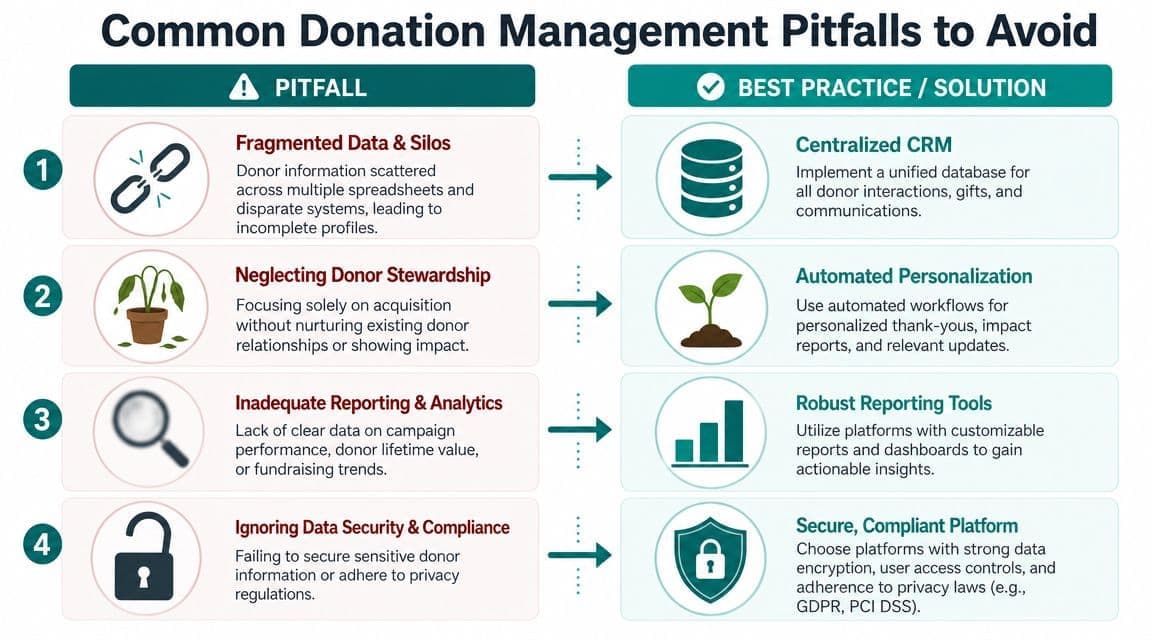
Common Donation Management Pitfalls to Avoid
The software choice matters. The habits matter more.
I've seen organizations buy a decent platform and still struggle because they carried old practices into the new system. If you want nonprofit donation management to work, watch for the mistakes that undo good tools.
Messy data at the start
Bad records don't become good records because you imported them into nicer software.
If names are inconsistent, households are duplicated, campaign labels vary, and key fields are half empty, your reporting will stay shaky. Good data management depends on regular audits, standard entry rules, validation, deduplication, and clear definitions for what belongs in each field. In practice, organizations should keep records centralized, updated, consistently formatted, and deduplicated, as explained in NetSuite's overview of nonprofit donor management considerations.
A few practical fixes go a long way:
- Lock down naming rules: pick one format for campaigns, appeals, funds, and constituent records.
- Use controlled fields: dropdowns beat free text for common categories.
- Review imports before they spread errors: small mistakes multiply fast.
Collecting more donor data than you need
This one gets ignored all the time. Staff often assume that if a field can be collected, it should be.
That's risky. Modern fundraising systems can combine giving history, email engagement, event activity, and volunteer participation into detailed profiles. But stronger personalization also raises harder questions about consent, opt-outs, retention periods, and vendor access.
Respectful donor management asks two questions at once. What information helps us serve this donor well, and what information should we leave alone?
Small organizations feel this especially sharply because they want better segmentation but may not have dedicated compliance staff. Simpler rules help. Collect what you can justify. Keep only what you need. Make opt-outs easy to honor.
Sending more appeals instead of making better asks
When giving gets tight, many nonprofits respond by increasing volume. More emails. More letters. More asks.
That usually isn't the actual fix. A better question is whether the ask matches the donor.
The Hand-Head-Heart model is a useful corrective. A donor's capacity to give, intellectual interest in the mission, and emotional desire to help all need to align before a gift is likely, as described in Blue Avocado's piece on approaching donors through Hand, Head, and Heart.
That model matters because it changes how you use your data:
- Hand: look for signals of capacity and readiness.
- Head: understand what part of the mission holds the donor's interest.
- Heart: speak to the human reason they care.
If your CRM only tracks activity, you'll miss that. If your staff connects records to motive and message, stewardship improves.
Treating finance and fundraising as separate worlds
This is the quietest problem of all. Development wants flexibility. Finance wants control. Each side builds its own process, and the director becomes the translator.
That split causes preventable friction. A gift is both a relationship event and an accounting event. Your process should reflect that from the start.
The strongest teams agree on shared definitions, shared reports, and shared ownership of data quality. Once that happens, donation management stops feeling like an administrative burden and starts working like infrastructure.
Gain Clarity and Get Back to Your Mission
You don't need a bigger patchwork. You need a clearer system.
Good nonprofit donation management gives you one trusted record of the donor, the gift, the fund, and the follow-up. That clarity saves time, reduces compliance stress, and helps your team treat donors like people instead of transactions.
If you want to see what that looks like in practice, AlignMint offers one place for fund accounting, donor records, volunteers, events, marketing, and team communication. If your nonprofit raises under $100K, you can start with the free plan, or you can schedule a simple, no-pressure conversation to see whether an all-in-one approach fits your organization.
Ready to try AlignMint with your nonprofit?
Start free — set up donor tools, giving pages, and Minty. Upgrade when you need accounting.