
Donation Management Guide for Nonprofits
For related tools, see AlignMint features.
Quick Answer: Donation Management Guide for Nonprofits
Donation management is the operating discipline that connects each gift to the donor record, receipt, fund, campaign, report, and follow-up action. The strongest process helps fundraising and finance trust the same numbers without duplicate entry or spreadsheet cleanup.
You probably know the feeling. A donor asks whether last year's scholarship gift has been fully spent, your board treasurer wants updated numbers by tomorrow, and your staff is checking three different systems that don't quite agree.
That's why donation management matters so much. Done well, it gives you one clear line from the gift itself to your thank-you, your accounting, your reports, and your decisions.
What Good Donation Management Feels Like
Good donation management feels like confidence.
You open a report and trust it. You know which gifts are restricted, which dollars are available, and what still needs follow-up. You're not chasing numbers across spreadsheets, inboxes, and a donor database that finance doesn't fully trust.
The outcome comes before the definition
Most leaders don't wake up wanting better gift entry screens. You want fewer surprises.
You want to walk into a board meeting knowing the numbers are current. You want your development director and your finance lead to stop debating which report is right. You want to answer a donor's question without pulling three staff members into a search project.
That's the practical meaning of donation management. It's not just recording gifts. It's the operating system that connects fundraising, finance, and stewardship.
Good donation management gives the same answer to the donor database, the finance office, and the executive director.
I think of it as the central nervous system of a nonprofit. A gift comes in through a page, a check, an event, or a pledge payment. Then that information needs to travel correctly to the donor record, the acknowledgment, the fund ledger, the campaign report, and the financial statements.
When that chain is intact, your organization gets calmer. When it's broken, every month-end close turns into detective work.
Why this matters more now
The volume and variety of giving make this a core discipline, not an admin sideline. In the United States, total charitable giving reached $592.50 billion in 2024, according to the Lilly Family School of Philanthropy, as cited by Kindsight's fundraising statistics roundup.
That scale matters because gifts don't arrive in one tidy category. You're likely handling individual donations, grants, recurring gifts, event revenue, maybe bequests, and sometimes in-kind support. If your systems can't classify those properly and keep them tied to the right purpose, the pressure lands on staff.
A lot of executive directors live with a low-grade sense of uncertainty around money. Not because they're careless, but because the tools underneath them were assembled piece by piece over time.
If that sounds familiar, it helps to look at donation management through the broader lens of donor management. The donor relationship and the financial record shouldn't live in separate worlds.
The Five Core Processes of Donation Management
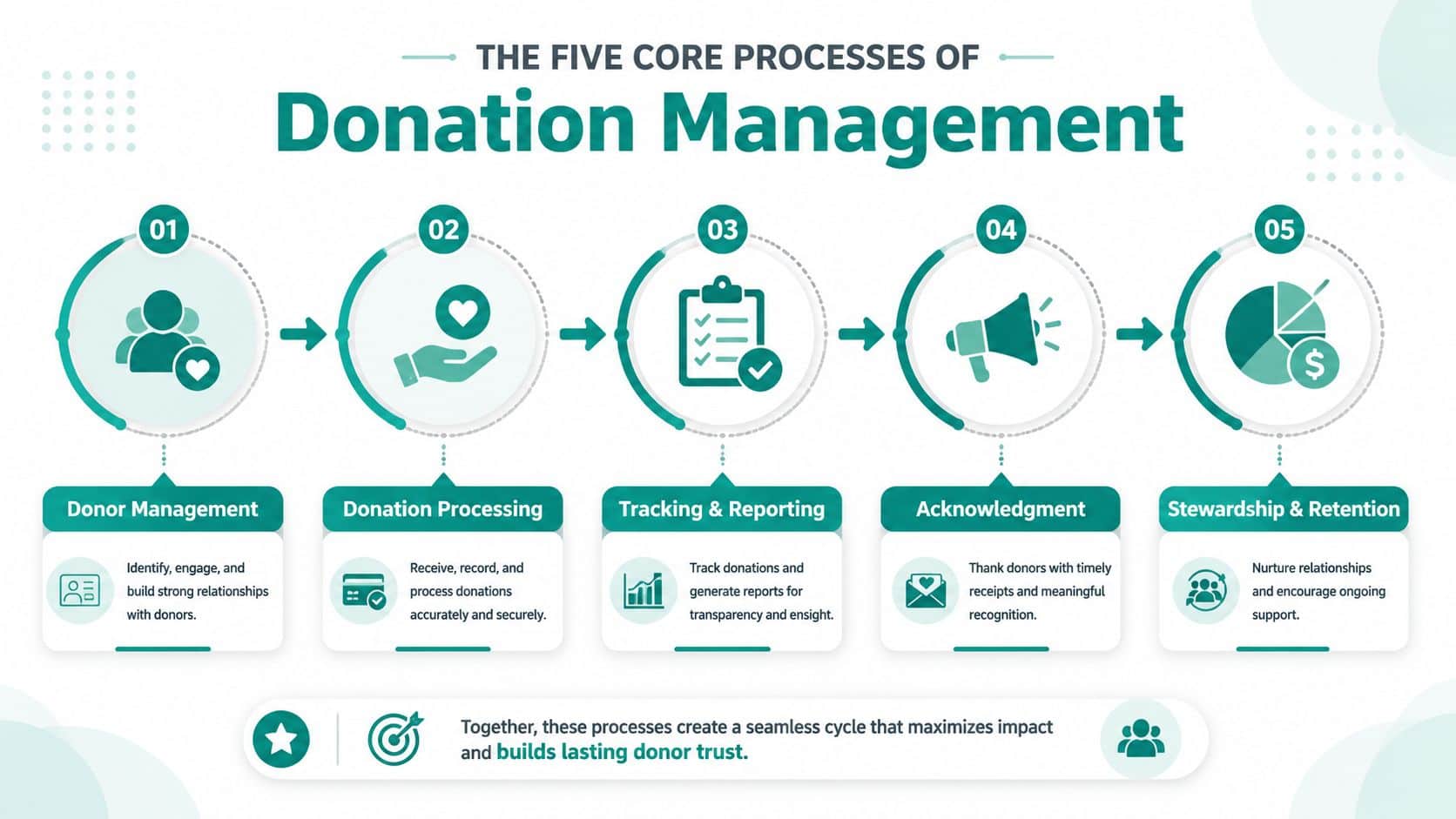
There are five processes that determine whether donation management works in real life or falls apart under pressure. If one is weak, the whole system gets shaky.
Receipting and acknowledgment
This is the first trust test.
When a donor gives, the receipt needs to go out promptly and correctly. That includes the donor name, amount, date, and any language your finance team needs for tax acknowledgment. If staff are sending those manually, mistakes creep in fast. Names get misspelled, gifts get missed, and duplicate thank-yous happen.
An integrated process records the gift once, then creates the acknowledgment from the same record. That matters because the thank-you isn't just a courtesy. It's part of your financial discipline.
Fund assignment at receipt
Many nonprofits struggle at this stage.
A donation should be tied to the right fund when it arrives, not weeks later during cleanup. Donation management works best when it sits on top of fund accounting. A gift should be assigned to a specific fund at receipt and tracked like a separate mini-ledger, which reduces the risk of donor-intent violations and supports accurate grant or mission fund reporting, as explained in this fund accounting guide from Tangicloud.
Practical rule: If staff have to remember fund restrictions later, the system is already asking too much of them.
That's one reason many organizations outgrow basic accounting workarounds. Classes and tags can be helpful, but they don't replace true fund structure.
For a closer look at the accounting side, this guide on fund accounting for nonprofits is worth reading alongside your donation workflow.
Reconciliation and deposit matching
This is the part nobody brags about, but everyone feels.
You need bank deposits, donor records, and accounting entries to agree. In a patchwork setup, development records the gift in one tool, finance sees the deposit in another, and someone manually tries to prove they match. That's where time disappears.
A better process lets the transaction flow through once, then ties it back to the deposit and the books. If your team wants a step-by-step look at the mechanics, AlignMint's documentation on recording donations shows what a connected workflow looks like.
Pledges and recurring commitments
Promises need structure. Otherwise, they become hopeful notes in a spreadsheet.
Pledge management means recording the commitment, scheduling expected payments, following up on missed installments, and separating what has been promised from what has been received. Recurring gifts need similar discipline. You want staff to see status clearly without building side lists.
The donor record as the single source of truth
Everything comes back to this.
Your CRM should hold the history of gifts, pledges, communications, restrictions, and key interactions in one place. If your accounting system knows one version of a donor and your fundraising system knows another, staff start making judgment calls instead of informed decisions.
Here's the short version:
- Receipt it well: Thank donors quickly and accurately from the same gift record.
- Code it early: Assign the right fund when the gift is entered.
- Match the money: Reconcile gifts to deposits and books without spreadsheet gymnastics.
- Track commitments: Keep pledges and recurring gifts visible until fully received.
- Keep one record: Let one donor history drive stewardship and reporting.
Staying Compliant and Keeping Your Board Happy
Boards rarely ask for fancy dashboards. They ask for reliable answers.
They want to know what's available to spend, what's restricted, whether reporting is current, and whether the organization can stand behind its numbers. A lot of compliance anxiety comes from weak process, not weak intent.
Clean records reduce stress
Strong donation management starts with capturing the right details for every contribution, not just the amount. Nonprofits are advised to record donor identity, donation date, donation type, and restriction status. Modern platforms connect donor databases with accounting so transaction data flows across systems and reduces reporting gaps that undermine trust and compliance, as noted in Momentive Software's donation management guide.
That standard data set does more than tidy up your files. It creates a usable audit trail. If a board member asks where a restricted gift went, you should be able to trace it from receipt to fund to report without reconstructing the story by hand.
What your board actually notices
Your board notices whether reports arrive late. They notice when finance and development present conflicting totals. They notice when explanations sound improvised.
A unified system changes the tone of those conversations. You're no longer saying, "We think this is right, but we're still reconciling two reports." You're saying, "Here is the current position, here are the restricted balances, and here is the activity behind them."
That confidence also matters when legal and governance questions come up. If you want a plain-English overview of how a formal compliance mindset works across organizations, Kons Law's compliance guidance is a useful outside reference.
A board doesn't need perfection. It needs evidence that your controls make sense and your records can be followed.
Why true fund accounting matters
Many nonprofit teams hit the limits of general business tools at this point.
QuickBooks is familiar, and many organizations start there for good reason. But familiarity isn't the same as fit. When restricted gifts, grants, and program reporting get more complex, you need fund accounting that reflects nonprofit reality rather than asking staff to build workarounds.
If you're reviewing options, start with the basics of fund accounting software. Then test whether your current setup can produce clean donor acknowledgment records too. A practical aid is this donation acknowledgment letter template, which helps teams standardize one of the most visible parts of compliance.
Knowing What Is Working with Key Metrics
Total dollars raised tells you what happened. It doesn't tell you why.
That's the difference between basic recordkeeping and strategic donation management. If you only watch the top-line number, you can miss serious changes in donor behavior until they become a retention problem.
The small group of metrics that matter
Modern nonprofit teams track donation volume, gift recency, gift frequency, average gift size, and donor lifetime value to understand donor behavior and improve retention, according to Dataro's fundraising analytics guide.
In plain English:
- Donation volume tells you how much giving activity is happening.
- Gift recency tells you how recently a donor gave.
- Gift frequency shows how often a donor gives over time.
- Average gift size helps you spot shifts in giving level.
- Donor lifetime value helps you understand the full value of a donor relationship, not just one transaction.
A lot of leaders don't need more metrics. They need fewer metrics that guide action.
What these numbers help you decide
If recency is slipping, your stewardship rhythm may be weak.
If frequency is strong but average gift size is flat, you may have a loyal base that needs better upgrade pathways. If lifetime value looks low, your acquisition and stewardship may be disconnected. These are management questions, not just fundraising questions.
That's why I'm cautious when people talk about analytics as if it belongs only to development staff. Finance, fundraising, and leadership should all be looking at the same donor patterns.
The useful metric is the one that changes what your team does next week.
This is also where plain-language reporting matters. Staff shouldn't need exports and pivot tables every time they want to answer a simple question, such as which donors gave last year but not this year.
If your reporting is still difficult to access, start with a cleaner reporting habit and a standard set of views. AlignMint includes donor reporting tools and a built-in AI assistant called Minty that can surface answers from your live data in plain language. If you want to see the reporting side first, the donor reports documentation is a practical place to start.
Don't confuse more data with better insight
Some organizations collect every possible field and still can't answer basic questions.
The issue usually isn't volume. It's connection. If donation pages, accounting records, email history, and donor notes all live in separate tools, your team spends more time assembling context than acting on it.
Good metrics should help you make decisions about follow-up, stewardship, campaign timing, and resource allocation. If your system can't support those decisions, it's giving you storage, not management.
Evaluating Your Tools and Finding a Better Way
If your current setup feels clunky, there's usually a reason. The pieces weren't designed to think together.
Many nonprofits wind up with a familiar accounting tool, a donor CRM, an email platform, maybe an events app, and a volunteer system somewhere else. Each product may be decent on its own. The problem shows up in the handoffs.
Where separate tools still make sense
It's fair to acknowledge the strengths.
QuickBooks is widely known, and many bookkeepers can work in it comfortably. Bloomerang is well known for donor records and engagement workflows. Mailchimp is familiar for email. None of those are bad products. They solve different problems.
The trouble starts when your staff becomes the integration layer.
A gift arrives through one system. Development logs a note somewhere else. Finance re-enters the transaction. Marketing exports a list for a thank-you campaign. Then someone discovers the donor name differs slightly between systems, and now the report is off.
The real test is workflow, not features
For small and mid-sized nonprofits, the key question isn't whether a tool has a donor profile or an email builder. It's whether the workflow is connected enough to support targeted treatment and impact reporting without a complex stack. That integrated workflow gap is exactly what NonProfit PRO's discussion of cultivating mid-level donors points to.
Use this comparison when you assess your current setup:
| Criteria | All-in-One Platform (e.g., AlignMint) | Separate Tools (e.g., QuickBooks + CRM + Mailchimp) |
|---|---|---|
| Gift entry | One record can feed donor history and accounting | Staff often enter or verify data in more than one place |
| Restricted funds | Built into the accounting structure | Often handled through workarounds and manual checks |
| Reporting | Finance and fundraising can view connected data | Reports may conflict across systems |
| Marketing follow-up | Donor history can inform outreach inside the same platform | Lists often need exports and cleanup |
| User access | Teams can work from one shared system | Access is split across vendors and subscriptions |
| Operational risk | Fewer handoffs, fewer sync questions | More room for duplicate entry and mismatched records |
Questions worth asking before you renew anything
- Where does a gift get entered first: And how many times does staff touch it after that?
- How are restrictions tracked: In the accounting structure itself, or in side notes and memory?
- Can finance and development run reports from the same underlying record: Or are they reconciling separate truths?
- Does your email tool know giving history without an export: If not, personalization will always lag.
- What happens when a key staff member leaves: Is the process documented in the system, or trapped in that person's habits?
If you're actively comparing software paths, this roundup on donation management software can help frame the decision around operations, not just fundraising features.
A Practical Plan for Making a Change
Most nonprofits don't avoid change because they love their current systems. They avoid it because they can't afford disruption.
That's reasonable. Donation management touches money, donor trust, reporting, and staff routines. The answer isn't a dramatic switch overnight. It's a phased move that lowers risk and builds confidence.
Prepare
Start with your data, not the software demo.
Clean up duplicate donor records. Decide how you name funds and campaigns. Review which gifts are restricted, which are unrestricted, and which records are missing key details. If your team uses different terms for the same thing, settle that now.
This step is slower than people want, but it saves pain later. Bad data imported into a new system is still bad data.
Start by fixing your naming, your fund structure, and your donor records. The technology comes second.
Pilot
Don't move everything at once if your team is already stretched.
Pick one area where the cost of confusion is highest. That might be online giving and receipting. It might be restricted gifts. It might be a year-end campaign where you want donor records and accounting to stay aligned from the start.
A pilot gives staff proof. They can see whether the new process reduces duplicate entry, improves visibility, and shortens the time between gift receipt and usable reporting.
Proceed
Once the pilot is stable, expand in a planned order.
A sensible sequence often looks like this:
- Donations first: Get gift entry, receipting, and fund assignment right.
- Accounting next: Bring reporting and reconciliation into the same workflow.
- Outreach after that: Connect email, text, and campaign follow-up to actual donor history.
- Then adjacent operations: Volunteers, events, and team communication can follow once the core money flow is sound.
This is also the point where pricing structure matters more than people admit. Per-seat fees can discourage full team adoption, which is the opposite of what you want during a transition. Free or low-risk entry points matter too, especially if your organization is still growing.
For nonprofits that want one connected system, AlignMint is one option to evaluate. It combines accounting, donor CRM, volunteers, events, and marketing in one platform, includes true fund accounting rather than class-based workarounds, offers a free tier for nonprofits under $100K, and doesn't charge per-seat user fees.
That doesn't mean every organization should switch immediately. It does mean your next software decision should be based on how well the tools connect fundraising, finance, and mission operations, not on which product your staff happens to know best.
The deeper point is simple. Donation management isn't an isolated admin task. It's the system that lets your organization receive support, honor donor intent, report clearly, and make decisions without second-guessing the numbers.
If your current setup still feels patched together, it may be time to simplify the core workflow. AlignMint is built for nonprofits that want accounting, donor records, fundraising, volunteers, events, and marketing in one place, so your team can spend less time reconciling systems and more time running the mission.
Ready to try AlignMint with your nonprofit?
Start free — set up donor tools, giving pages, and Minty. Upgrade when you need accounting.