

For related tools, see AlignMint features.
Stewardship of Donors: Build Trust & Loyalty
Quick Answer: Stewardship of Donors: Build Trust & Loyalty
Stewardship of donors is the repeatable process for thanking supporters, showing impact, and staying in touch between appeals-not just sending a receipt. Prompt acknowledgment, finance-backed restricted-fund updates, and consistent follow-up protect retention when new-donor return rates are often under 20%.
You know the feeling. A donor gives with real enthusiasm, your team sends a thank-you, and then the relationship goes quiet while everyone scrambles to the next deadline.
A few months later, you need to report back on a restricted gift, the numbers live in one system, the donor notes live in another, and nobody feels fully confident that the story and the accounting match. That's where the stewardship of donors either becomes a trust-building discipline or a recurring source of stress.
Why Good Intentions Are Not Enough for Donor Retention
Most executive directors can describe the same cycle. You work hard to bring in new donors, a campaign lands well, first gifts come in, and then too many of those names never return. It doesn't mean your mission failed to connect. It usually means the follow-up process was too informal to hold the relationship together.
That gap matters more than many boards realize. The overall repeat donor retention rate is just 43.6%, and it plummets to a staggering 19% for new donors. This shows that without a clear stewardship process, organizations lose over 80% of their first-time supporters, according to Carnegie Investment Counsel's summary of donor stewardship retention data.
Goodwill helps. A good mission helps. A compelling appeal helps. None of those replace a system.
I see this most often when an organization is sincere but stretched thin. The executive director signs letters when time allows. Program staff send stories when asked. Finance closes the month and hopes someone else communicates impact. Each person is doing their part, but the donor experiences fragments instead of a relationship.
Practical rule: Donor loyalty rarely breaks in one dramatic moment. It fades when your follow-up depends on memory instead of process.
The stewardship of donors is what closes that gap. It gives you a repeatable way to thank people, show what happened with their gift, and stay in touch between appeals. Done well, it also reduces one of the biggest hidden costs in fundraising, the constant need to replace lapsed donors.
What's encouraging is that this doesn't require a giant advancement office. It requires a few decisions made clearly, then carried out consistently. When you put structure around post-gift communication and financial reporting, donors stop feeling like transactions and start feeling like partners. For practical templates, see our guide to donor letters for nonprofits.
Understanding Donor Stewardship Beyond the Thank You Note
A thank-you note is the start of stewardship, not the whole job. If the only communication after a gift is a receipt and the next appeal, you're running a transaction, not a relationship.
The simplest way to think about stewardship of donors is this. You are tending a garden, not dropping seeds onto hard ground and hoping something grows. Donors need evidence that their gift mattered, reassurance that you handled it carefully, and regular contact that isn't always another ask.
What stewardship actually includes
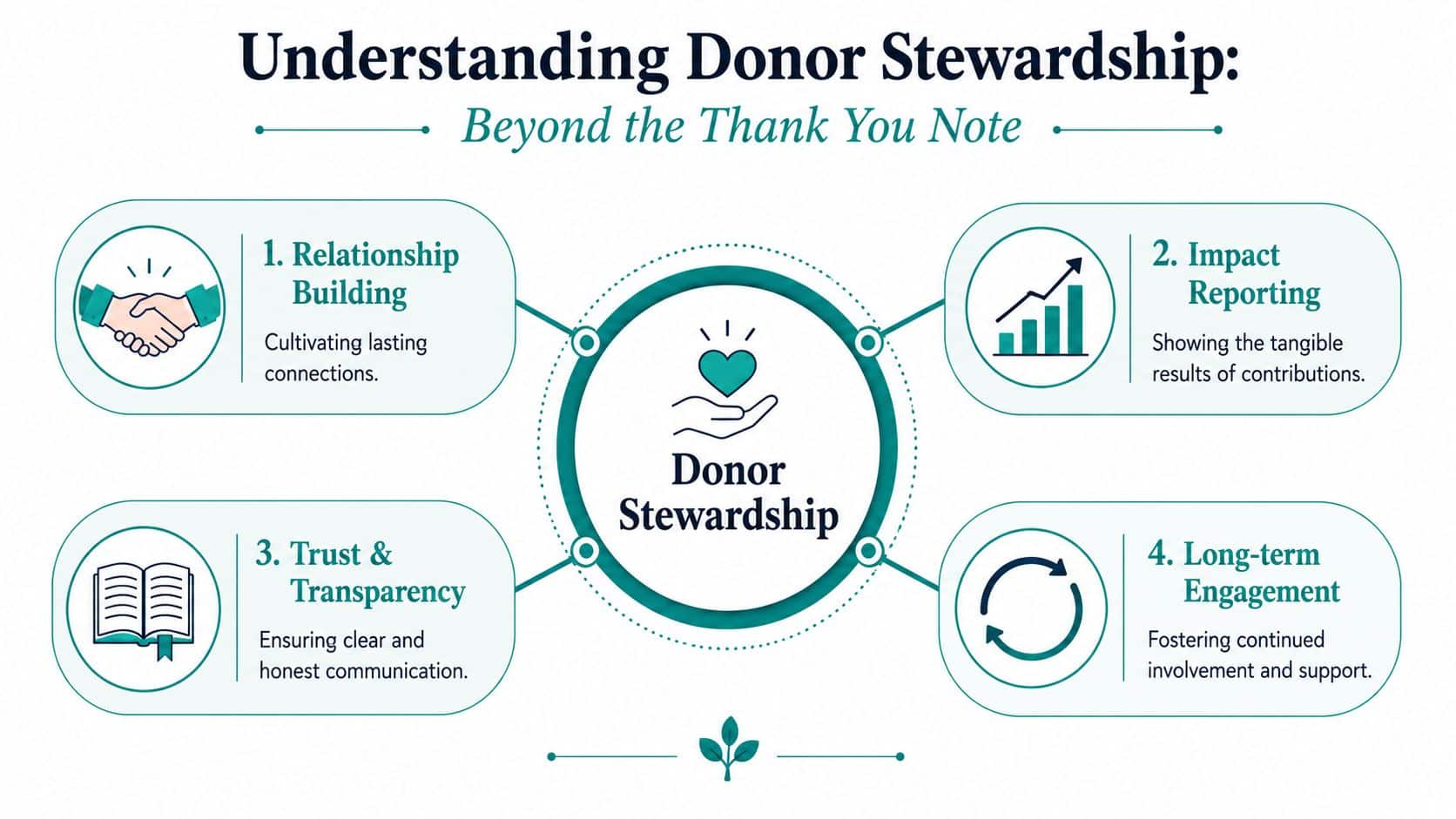
A practical stewardship rhythm usually has four parts:
- Prompt acknowledgment so donors know their gift was received and appreciated.
- Clear impact reporting so they can connect their support to real impact.
- Trustworthy communication so they don't wonder where the money went.
- Ongoing engagement so the relationship doesn't disappear between campaigns.
That first step matters more than many teams assume. Data shows that timely acknowledgment within 24-48 hours of a donation can increase donor retention by up to 30% compared to delayed or generic responses, as noted in Kindsight's donor stewardship guidance.
If your acknowledgment process needs work, a set of practical donation acknowledgment letter examples and guidance can save your team time and improve consistency.
What does not work
Many organizations still treat stewardship as a courtesy task. It gets delegated late, handled differently by each staff member, and dropped entirely during busy seasons. That approach creates three predictable problems.
| Common habit | What the donor feels | What your team experiences |
|---|---|---|
| Generic receipt only | "They processed my gift" | Short-term efficiency, weak connection |
| Updates only during campaigns | "They contact me when they need money" | Constant reacquisition pressure |
| Vague impact language | "I'm not sure what changed" | Harder future asks, more skepticism |
Stewardship is where your fundraising promise meets your financial proof.
That's especially true when gifts support a specific program, classroom, ministry, or sponsored project. In those cases, donors don't just want warmth. They want confidence. They want to know your organization can connect intent, spending, and reporting without guesswork.
The Core Components of an Effective Stewardship Plan
A strong stewardship plan doesn't need to be fancy. It needs to be clear enough that your staff can carry it out even during event season, audit prep, or budget meetings.
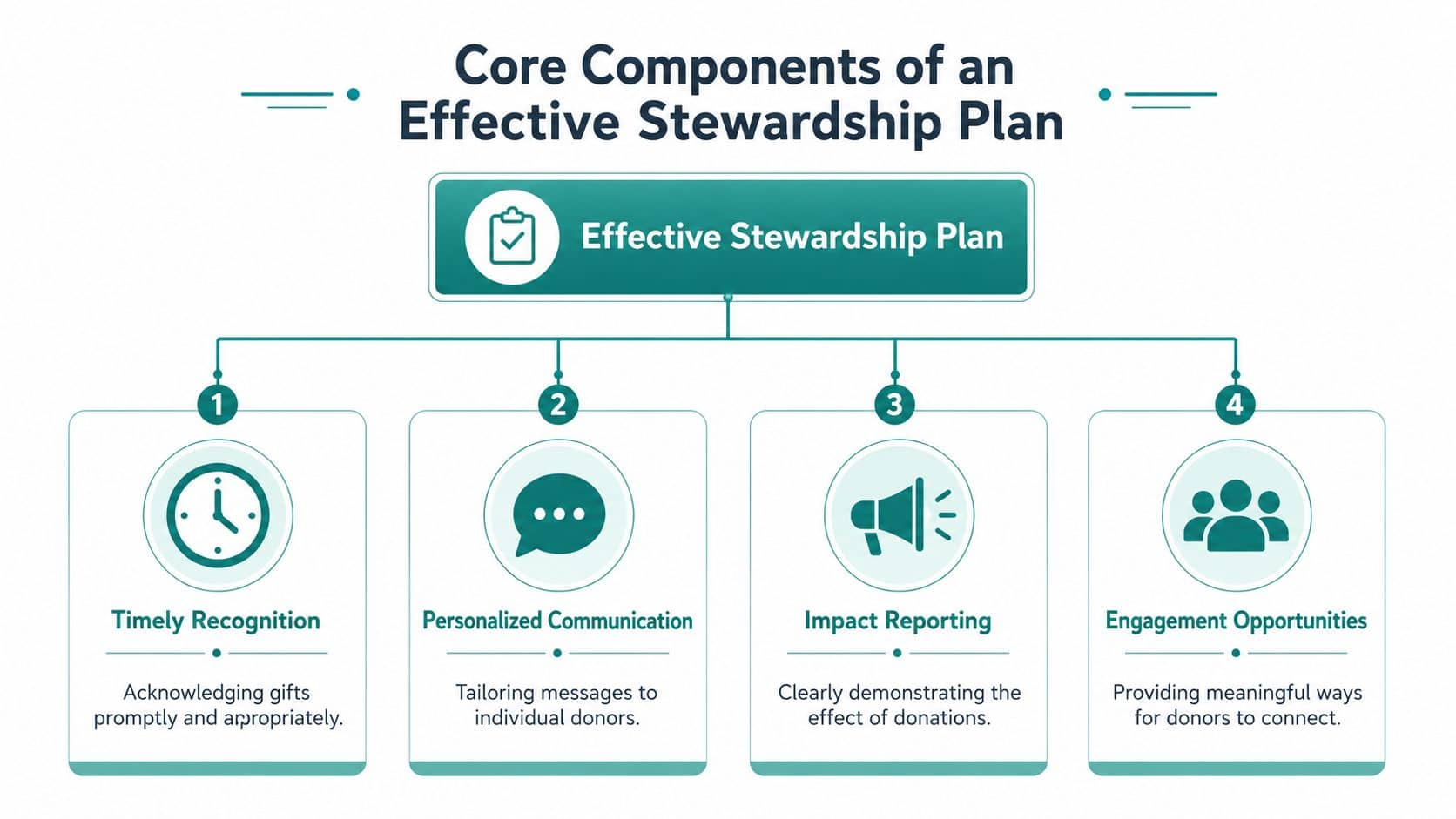
Timely recognition
This is the first proof that your organization pays attention. A quick, thoughtful acknowledgment tells the donor they weren't dropped into a processing queue.
That doesn't mean every donor needs the same treatment. A first-time donor may need a welcome message that explains what happens next. A recurring donor may need a warmer note that recognizes sustained trust. A major donor may merit a call from the executive director or board chair.
What matters is speed and fit. Your process should answer three questions immediately: who gave, what did they support, and who follows up.
Impact reporting
If recognition says thank you, impact reporting says your gift mattered. Many stewardship plans often become weak when teams default to broad language such as "your generosity helps us serve the community."
That line is fine once. It doesn't sustain confidence over time.
Try reporting with enough specificity that a donor can repeat the story to someone else. For unrestricted gifts, that may mean showing how support kept key programs running. For restricted gifts, it means connecting the donor's intent to actual activity, program costs, or progress against the purpose they funded.
Field note: Donors don't expect glossy reports every month. They do expect a credible line between the money they gave and the programs you carried out.
Consistent communication
The strongest donor relationships aren't built only during campaigns. They grow through ordinary contact. A short update from a school principal, a volunteer story from a church outreach program, or a note about a grant milestone often does more for long-term trust than another polished appeal.
Disconnected tools cause trouble. If donor history sits in one product, volunteer activity in another, and email in a separate platform, your team spends more time assembling context than communicating well. An integrated donor management system helps staff see giving history, notes, and outreach in one place so the communication stays relevant.
Meaningful connection
Some donors deepen because they give again. Others deepen because they get involved. A stewardship plan should make room for both.
Here are four good connection points that often get overlooked:
- Volunteer invitations that fit a donor's interests, not just your staffing gaps.
- Events with purpose where supporters can hear directly from program leaders.
- Advisory roles for donors who have expertise to offer, not only dollars.
- Simple check-ins that ask what they care about most right now.
When you connect fundraising, volunteer management, events, marketing, and team communication, stewardship becomes easier to maintain. Your staff isn't re-entering the same information in multiple places, and your donor gets a smoother experience.
Honoring Donor Intent with Restricted Fund Stewardship
This is the part many stewardship articles skip, and it's where some of the hardest problems begin. A donor gives to scholarships, benevolence, a building fund, a youth ministry, or a sponsored program. The relationship question is obvious. How will you thank them and report back. The compliance question is just as important. Did you record and spend that money exactly as promised.
Donor restrictions are legally binding conditions. If a nonprofit needs to re-purpose restricted funds, it must obtain written permission from the original donor to remove the restriction, according to Pacific ABS on restricted funds for nonprofit organizations.
Why this becomes a stewardship problem fast
When restricted gifts are tracked loosely, the donor experience suffers even if no one intended harm. Development says the scholarship fund is healthy. Finance says part of the cash was spent from the operating account and needs review. Program staff report outcomes from memory. By the time the donor asks for an update, everyone is trying to reconcile three versions of the truth.
This is why the stewardship of donors has to include fund accounting, not just thank-you language. If your accounting structure can't distinguish donor-restricted activity clearly, your reporting will always be late, cautious, or vague.
A lot of organizations try to solve this with general small business accounting software plus spreadsheets. QuickBooks is familiar and useful for many business tasks, but classes aren't the same thing as true nonprofit fund accounting. The issue isn't that QuickBooks is a bad product. The issue is that restricted gifts, grants, and program reporting place demands on nonprofit finance that generic structures don't always handle comfortably.
What better practice looks like
Stewardship improves when your finance and donor records speak to each other. You can see the original gift, the restriction, the balance remaining, and the related expenses without asking three people to assemble a manual report.
For restricted giving, I recommend a short discipline checklist:
- Define the restriction clearly when the gift is entered.
- Map the fund to the right program or project before spending begins.
- Report from accounting records rather than from memory or narrative alone.
- Resolve exceptions early if a gift purpose no longer fits current needs.
If your team is formalizing this process, guidance on restricted gift utilization can help clarify the operational side.
Why this matters in churches, schools, and fiscal sponsorship
These settings feel the pain quickly because funds are often purpose-driven. Church donors care whether a gift supported missions, benevolence, or facilities. School supporters want confidence around scholarships, tuition assistance, or special programs. Fiscal sponsors need clean separation across sponsored projects while still producing consolidated reporting for leadership.
Restricted fund stewardship isn't extra administration. It's how you prove that donor trust and financial discipline are the same commitment.
When that connection is strong, your donor update becomes easier to write and easier to believe.
How to Implement Your Stewardship Plan This Quarter
You don't need a year-long committee process to get started. You need a small plan your team can execute consistently for the next ninety days.
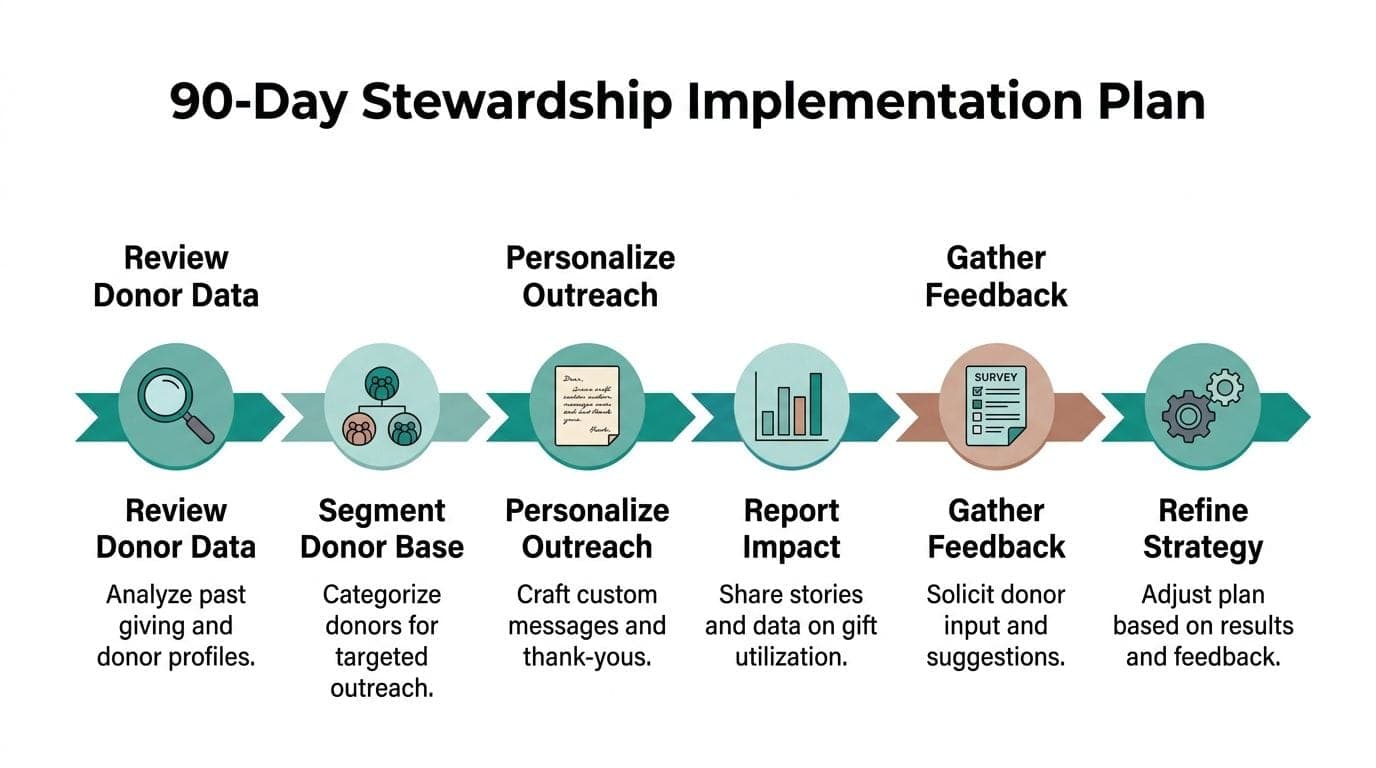
With first-time donor retention averaging only 18% nationally, a specific, structured plan for this group is not optional, it's essential for sustainable growth, as outlined by Double the Donation's donor stewardship overview.
Days 1 through 30
Start by sorting your donor file into a few simple groups. New donors, recurring donors, major donors, and restricted-fund donors are enough for most smaller teams.
Then build three templates per segment:
- Immediate thank-you with the right tone and tax language.
- Short follow-up from a real staff member or board member.
- Impact update tied to the kind of gift they made.
This doesn't need to be fancy. It needs to be ready before the next gifts arrive.
If your team also posts donor stories or campaign updates online, put an approval routine in place now. Simple tips for social media content approval can prevent the common problem of delayed posting because no one knows who signs off.
Days 31 through 60
Next, decide your contact calendar. The best calendars are boring in a good way. Everyone knows what happens and when.
A workable quarterly pattern looks like this:
| Timing | Action | Owner |
|---|---|---|
| Right after gift | Receipt and thank-you | Development or admin |
| Within one week | Personal note or call | ED, board, or program lead |
| Mid-cycle | Story, photo, or volunteer invitation | Marketing or program staff |
| Around day 90 | Impact report or next-step update | Development plus finance for restricted gifts |
This is also the point where software either reduces work or creates more of it. Blackbaud has strong capabilities and a long track record, especially for larger institutions with more specialized teams. For smaller and mid-sized nonprofits, though, complexity and price can make even basic stewardship harder to maintain. We built donor journeys in AlignMint so teams can map follow-up steps inside the same system they already use for accounting, CRM, volunteers, events, marketing, and team communication. That matters when you don't have extra staff to keep multiple products aligned.
Days 61 through 90
By the third month, look at what transpired. Did acknowledgments go out on time. Did restricted donors receive a finance-backed update. Did recurring donors hear from you without another ask attached.
Use that review to make small adjustments:
- Tighten one weak handoff between finance and development.
- Rewrite one generic template so it sounds like your organization.
- Add one engagement option such as volunteering, event attendance, or a brief survey.
- Flag one report you need faster for grant or restricted fund stewardship.
Stewardship improves when the process is easy enough to repeat. That's more important than building a perfect plan on paper.
Key Metrics to Track Your Stewardship Success
You don't need a dashboard full of vanity numbers. A short list will tell you whether your stewardship of donors is improving relationships or creating more activity.
Start with retention and interaction quality
Retention is still the clearest sign that donors want to stay connected. If people give once and disappear, something in the post-gift experience needs attention.
But don't stop there. Top-performing nonprofits track "meaningfully connected donor interactions" beyond just gifts, leading to 50% higher donor retention rates compared to organizations that don't, according to Prosper Strategies on data-driven stewardship.
That phrase matters because it shifts the focus from transactions to contact that builds trust. Calls answered. Personal notes sent. Visits completed. Volunteer involvement recorded. Program conversations logged. For tools that help track these interactions, see our donor management software comparison.
Three metrics worth watching
- Donor retention rate tells you whether supporters come back after the first or second gift.
- Donor lifetime value helps you see the value of a relationship over time, not just a single campaign.
- Upgrade rate shows whether donors are increasing their giving amount or frequency.
A good metric should help your staff decide what to do next. If it only creates more reporting work, it's probably the wrong metric.
If your team is still building reports in spreadsheets, start by standardizing where interaction data gets entered. If you already have an integrated system, use donor reports that tie gifts, communications, and balances together so finance and development are working from the same facts.
Building Lasting Relationships Not Just Transactions
The stewardship of donors turns fundraising from a series of asks into a pattern of trust. That's the payoff. You spend less time wondering whether supporters will return, and more time strengthening relationships that already have momentum.
The part many leaders miss is that stewardship isn't only a communications discipline. It's also a management discipline. When donor records, fund balances, volunteer history, events, online giving pages, marketing activity, and team communication live apart from each other, your staff has to reconstruct the donor story every time. When those pieces connect, stewardship gets simpler and the donor experience gets steadier.
If you're thinking about long-term organizational health, it can help to read outside the nonprofit bubble too. Some of the best lessons about consistency and audience trust show up in adjacent fields, including Contesimal on business growth, where the core idea is familiar: relationships strengthen when people hear from you with purpose and regularity.
For churches, schools, fiscal sponsors, and community nonprofits, this matters even more. Restricted gifts have to be honored. Grant reporting has to be clean. Donors need confidence that your warmth is matched by financial discipline. That's where real stewardship lives.
If you want a simpler way to connect donor management, true fund accounting, volunteer management, marketing, online giving pages, team communication, and AI help in one place, take a look at AlignMint. We built it for nonprofits that are tired of juggling separate systems, and the free tier for organizations under $100K gives you a practical place to start without adding per-seat costs for your team.
Ready to try AlignMint with your nonprofit?
Start free — set up donor tools, giving pages, and Minty. Upgrade when you need accounting.