

You're probably staring at a blank page with a campaign deadline closing in. You know your mission matters, but writing a letter asking for money can still feel uncomfortable, slow, and oddly uncertain.
The good news is that how to write a letter requesting donations isn't a mystery. The best letters follow a clear pattern, and they work even better when your donor data, giving history, and follow-up process are organized before you write a single sentence.
Starting Your Letter with Confidence Not Guesswork
Most donation letters fail before the first paragraph. The problem usually isn't weak writing. It's weak preparation.
If you don't know who you're writing to, why now is the right moment, and what action you want, the letter turns into a generic update with a soft request buried at the end. Donors feel that immediately.
A better approach is to decide three things first.
Know the person before you write
Start with the donor record, not the letter template. Look for past gifts, volunteer activity, event attendance, notes from board members, and anything that shows what this person already cares about.
That's why donor visibility matters. When your team can see a supporter's full history in one place, you can write to a real person instead of a list segment. A quick donor visibility check can help you spot where that context is missing.
Connected donor management tools make that context easier to keep current between appeals.
Decide the one outcome you want
Every letter should drive one clear next step. Usually that's making a gift, but sometimes it's renewing support, returning after a lapse, sponsoring a program, or joining a campaign.
A strong appeal is rarely trying to do five jobs at once. It picks one job and does it well.
If your campaign also includes peer-to-peer fundraising or event-based giving, it helps to review related ideas before you draft. Some teams use direct mail as the core message, then adapt it to email, events, or social posts to boost your crowdfunding campaign with a consistent story.
Gather the raw material first
Before writing, pull together:
- One real story: A single person, family, classroom, ministry, or project the donor can picture.
- One funding need: The specific program, service, or gap this appeal will support.
- One ask: The amount or giving options you'll present.
- One response path: Mail reply card, donation page, QR code, or phone call.
That small discipline changes the ask. You stop guessing what to say and start assembling a letter with a purpose.
The Anatomy of a High-Performing Donation Letter
A strong letter moves the reader from attention to belief to action. It doesn't wander. It guides.
Here's the structure I recommend most often.
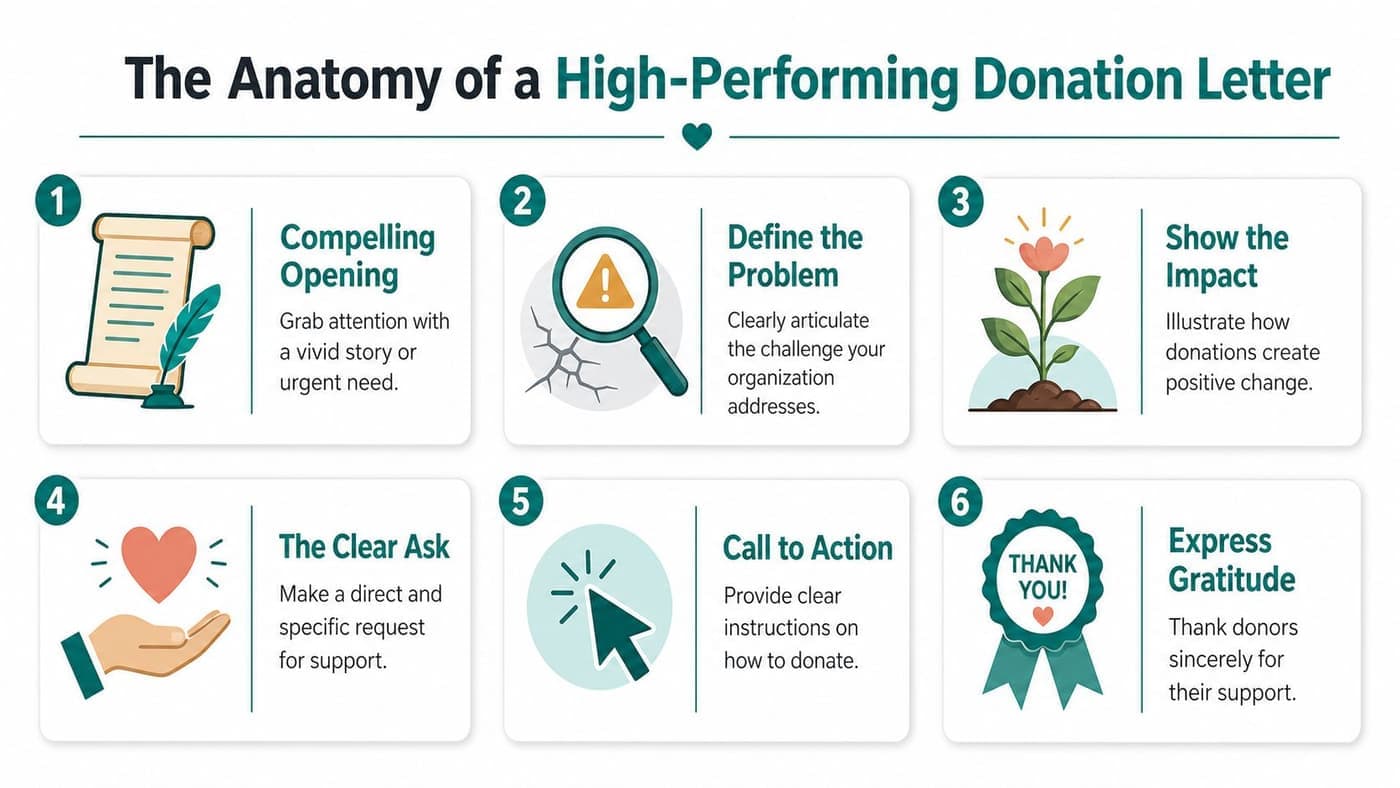
Open with something human
Your first lines need to earn the next few seconds. Don't begin with your founding date, mission statement, or a broad summary of the organization.
Open with a person, a moment, or an urgent need that puts the donor inside the story. If you're writing to a returning supporter, mention the relationship early.
Personalization is one of the strongest drivers of response. Letters addressed by name and tied to a donor's past involvement or recent giving see response rates 2 to 3 times higher than generic mass mailings, according to Bonterra's fundraising appeal guidance.
Show the problem clearly
Once you have attention, explain the gap your organization is addressing. Keep this concrete. Donors don't need a long strategic memo. They need to understand what's wrong and why it matters now.
A vague line like “Our community faces many challenges” doesn't help. A direct line about meals, tutoring, shelter, transportation, or student support does.
Practical rule: If the donor can't explain the need after one read, the letter is still too abstract.
Make the donor part of the solution
Many letters tend to drift into passive language. They describe good work, but they never clearly invite the donor to do something specific.
Move from problem to agency. Show that the donor has a direct role in what happens next. The donor isn't interrupting the story with a gift. The donor is how the story continues.
A simple flow works well:
- What's happening
- Why it matters
- What your organization is doing
- Where the donor comes in
State the ask plainly
Don't wait until the final line to ask. Put the request where a busy reader will see it.
Industry guidance consistently points to a simple truth. Appeals perform better when the ask appears early and the language sounds natural, not overly formal. That's one reason many teams also tighten their online follow-through using donation page best practices for nonprofits, so the transition from letter to gift feels consistent.
End with action and gratitude
Close with direct giving instructions and sincere thanks. Make the next step obvious.
A short closing checklist helps:
| Letter element | What it should do |
|---|---|
| Call to action | Tell the donor exactly how to give |
| Giving path | Point to the reply device, donation page, or QR code |
| Signature | Show real accountability from a person |
| Gratitude | Thank them for past and future support |
The best closings don't sound dramatic. They sound clear, respectful, and ready.
How to Ask for Money Without Feeling Awkward
The awkwardness usually comes from uncertainty, not from the ask itself. If you aren't clear about the amount, the purpose, or the timing, you soften the language and hope the donor fills in the blanks.
That doesn't help the donor. It makes the decision harder.
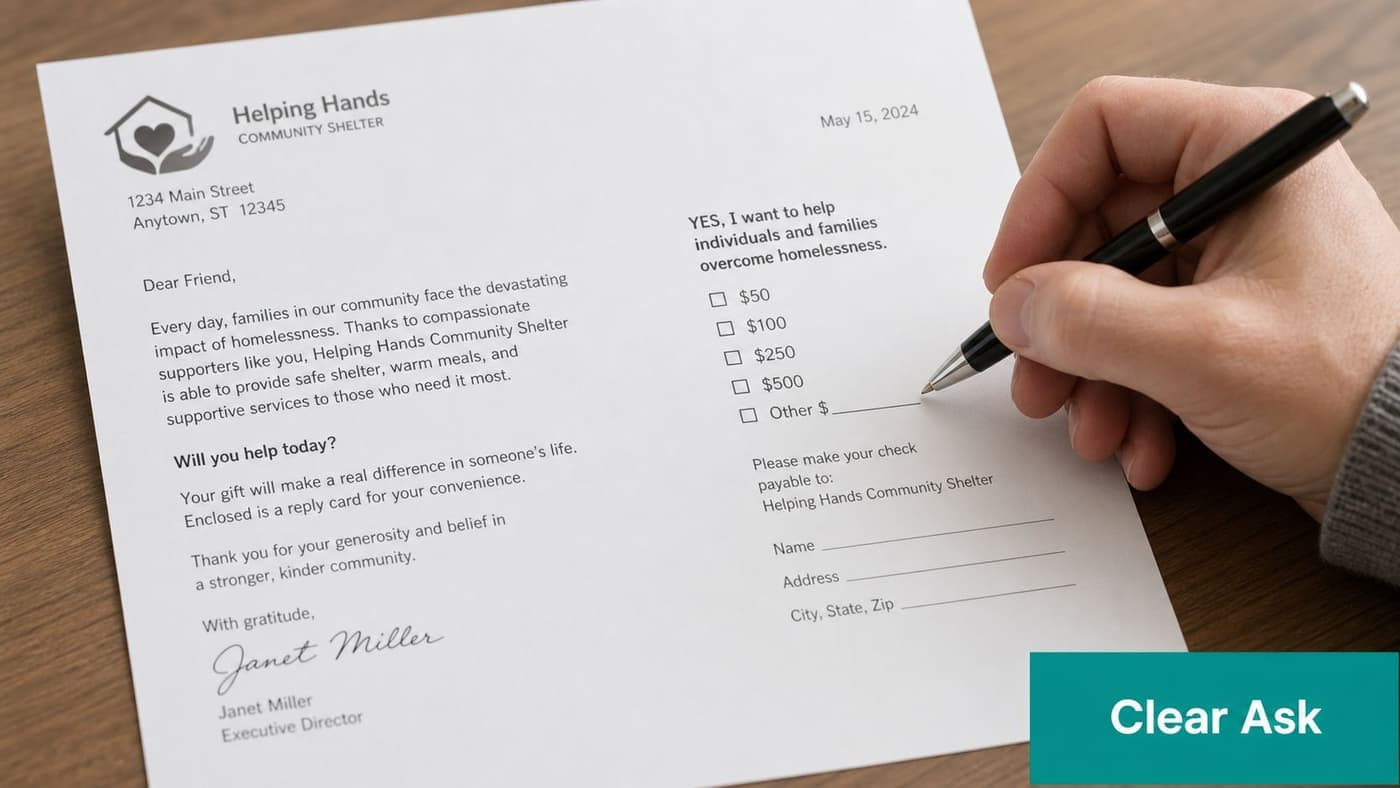
Specific beats vague
When you ask for “any amount,” you force the donor to do extra mental work. They have to decide what's appropriate, what's helpful, and whether their gift will matter.
That's why a specific ask performs better. Letters that include a concrete dollar figure can achieve response rates up to 30% higher than letters asking for “any amount,” according to Donately's donation letter research.
The principle is simple. A clear amount gives the donor an anchor.
Tie the amount to a result
The amount should never feel random. It needs a job.
If you ask for support for tutoring, meals, worship space repairs, classroom supplies, or transportation, connect the amount to a tangible outcome. The donor should be able to picture what their gift does.
Examples:
Would you consider a gift of $50 to support one month of tutoring for a student who needs extra reading help?
Please consider a gift of $50 so one family can receive the support they need this month.
That kind of language lowers friction. It also feels more respectful than a vague appeal because you're telling the truth about what funding is needed.
Offer options without losing focus
You don't need a long menu of giving levels. In fact, too many options can dilute the choice.
A short set of options often works best:
- Entry gift: A reachable amount for newer or cautious donors.
- Core gift: The amount that best matches the campaign need.
- Stretch gift: A larger option for donors ready to do more.
If you also run events or benefit campaigns, donation letters can support those efforts well when the messaging stays aligned. Teams planning a fundraising event alongside their appeal may also want to discover effective charity auction strategies that fit the same donor audience.
Use language that sounds like a person
Formal fundraising language often creates distance. Plain speech builds trust.
Instead of:
- “We humbly request your generous consideration.”
Try:
- “Would you consider a gift today?”
- “Can you help fund this work?”
- “Will you make a gift of $50?”
If you want stronger response over time, the ask also needs to connect to what happens after the gift. Good stewardship of donors begins in the appeal itself, with honest language, a clear purpose, and no guesswork.
Templates for Your Most Important Donor Groups
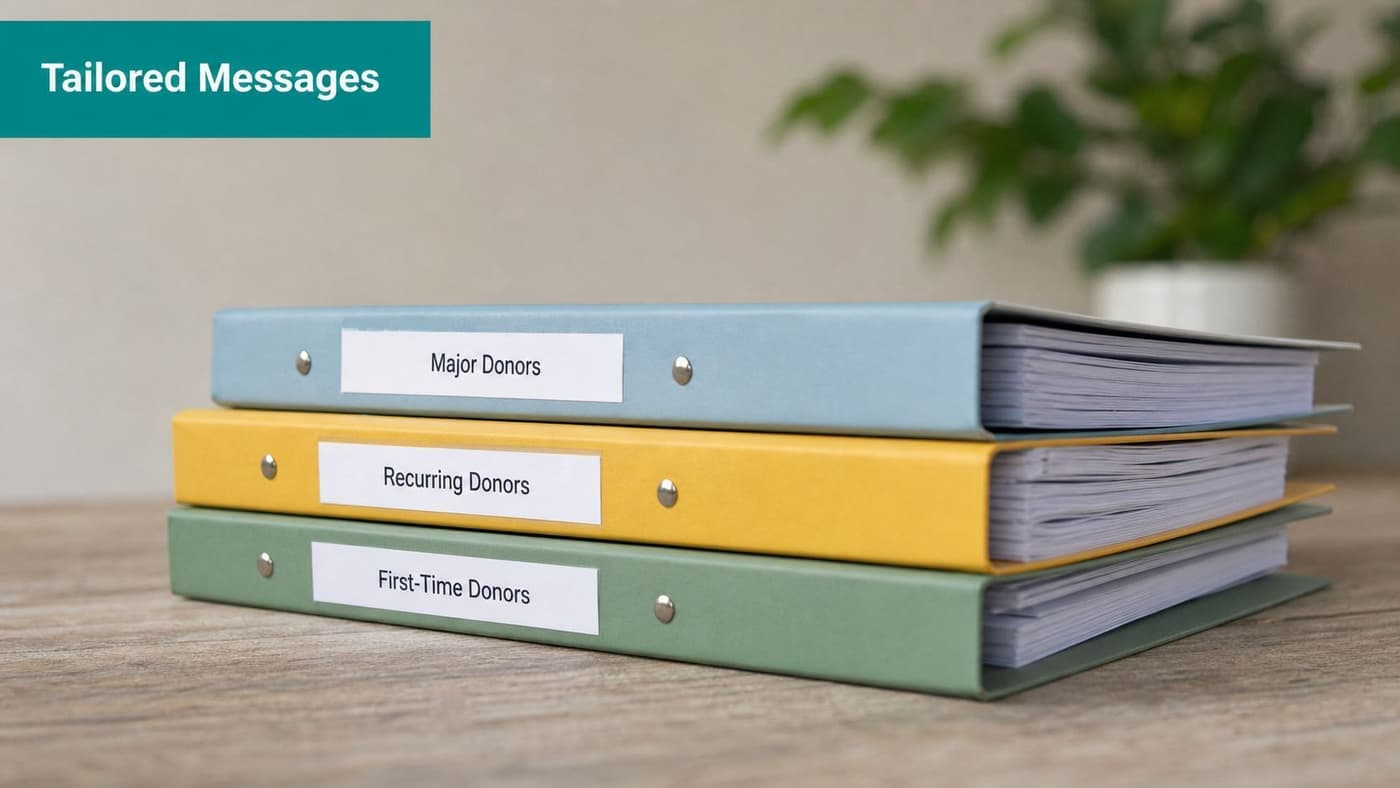
One letter for everyone is usually one letter that fits no one well. A first-time donor, a longtime annual supporter, a local business, and a foundation officer are reading through different lenses.
That's why segmentation matters. Industry benchmark guidance from Double the Donation indicates that personalized fundraising letters to past donors perform significantly better than generic blasts, and segmentation by donor history and engagement is a critical factor.
Individual donor template
This version should feel personal, warm, and direct. Reference past support if you have it. Keep the focus on shared purpose.
Dear [Name], Thank you for the care you've shown our community. Because of supporters like you, families can turn to us when they need help most.
Today, I'm writing to ask if you'd consider a gift of [amount] to support [specific need]. Your generosity will help [clear outcome].
Thank you for standing with us.
This is the letter most organizations should send most often. It respects the relationship and keeps the action simple.
Lapsed donor template
A lapsed donor needs a different tone. Don't act as if nothing happened, and don't use guilt.
The letter should acknowledge the gap with grace and reconnect the donor to their past impact.
We've missed having you with us, and I wanted to reach out personally. Your past support helped make meaningful work possible here, and we're grateful for that history.
If this mission still matters to you, we'd be honored to welcome you back with a gift of [amount] for [specific program].
That kind of language repairs trust better than a standard renewal appeal.
Corporate sponsor template
Businesses usually want clarity, local relevance, and a professional tone. They may care about visibility, but they also want to know the partnership is credible.
Dear [Contact Name], We're inviting [Company Name] to support [program or event], which serves [community or audience].
A contribution of [amount or sponsorship level] will help fund [specific use]. We'd also be glad to recognize your support in ways that fit the program and your preferences.
I'd welcome a brief conversation about whether this is a good fit.
Notice what this does not do. It doesn't oversell. It gives the business a concrete role.
Foundation letter framework
Foundation requests require more discipline. The tone should be respectful, concise, and grounded in mission alignment.
A good structure looks like this:
- Opening alignment: Why their funding priorities match this work.
- Program summary: What you are doing, for whom, and why now.
- Use of funds: The specific purpose of the request.
- Expected result: What the funding makes possible.
- Closing accountability: Reporting, stewardship, and next steps.
Foundations aren't looking for emotional excess. They're looking for fit, clarity, and confidence that your organization tracks what it promises.
Church and school letters need local specificity
Faith-based organizations and schools often have a natural story advantage. The readers already know the community. That means generic language feels even more out of place.
For churches, speak to ministry, service, and stewardship in everyday language. For schools, connect the request to students, teachers, classrooms, and the learning environment families already recognize.
If you want additional examples to adapt by donor type, these donor letters for nonprofits can help you compare tone, structure, and ask language.
After You Send Follow-Up and Measuring Success
Sending the letter is the midpoint, not the finish line. What happens next determines whether you get a one-time response or a stronger donor relationship.
That's especially true when someone gives, opens but doesn't give, or hasn't responded after supporting you in the past.
Thank quickly and personally
Every donor should receive prompt acknowledgment. The thank-you doesn't need to be elaborate, but it does need to feel specific.
Reference the campaign or purpose if possible. Confirm the gift clearly. If the gift was restricted, reflect that accurately in your receipt and records.
Watch for the donors who went quiet
Lapsed donors rarely come back because they received one more generic appeal. They return when the organization shows that the relationship still matters.
According to Nonprofit Point's guidance on donation request letters, 68% of lapsed donors say they didn't return because they felt like just another name in a mass list. The same source notes that a relational repair letter, one that acknowledges the giving gap without guilt and references the donor's earlier impact, can increase re-enrollment by 22%.
That's a useful reminder. Re-engagement is not just follow-up frequency. It's follow-up quality.
We're glad you were part of this work before. Your earlier support made a real difference, and I wanted to reach out personally to invite you back.
Track what your campaign actually did
You don't need a complicated analytics culture to improve your letters. You need a short list of practical questions.
Use a campaign review like this:
| Question | Why it matters |
|---|---|
| Who responded | Shows which donor groups connected with the message |
| Which message worked | Helps you compare appeals by segment or theme |
| Which channel converted | Reveals whether mail, email, or follow-up calls did the work |
| Who opened but didn't give | Identifies strong follow-up candidates |
Connect the letter to a longer relationship
A donation letter should feed your next touchpoint, not sit in a folder after the campaign closes. That means planning a thank-you series, a campaign update, and a re-engagement path for non-responders.
If donor retention is a concern, these nonprofit donor retention strategies are worth reviewing alongside your appeal plan.
The strongest fundraising teams don't treat the appeal as isolated copywriting. They treat it as one move in a longer conversation.
Keeping Your Records Clean and Compliant
Every donation letter creates an accounting consequence. If the letter invites support for a specific purpose, building repairs, scholarships, a ministry program, a sponsored project, or a restricted initiative, your finance records need to reflect that intent correctly.
Many organizations face difficulties. The fundraising message is specific, but the bookkeeping is loose.
Know what has to be tracked
Under GAAP standards (ASC 958), nonprofits report contributed income in two net asset classes: net assets with donor restrictions and net assets without donor restrictions. Unconditional contributions must be recorded immediately upon receipt of the gift or pledge, as explained in this overview of restricted funds under ASC 958.
That matters because your letter can create donor expectations that later need to be honored in both reporting and spending.
Document donor intent in writing
If a donor restricts a gift, keep the written evidence. That can include reply devices, donor notes, pledge forms, email instructions, campaign language, or grant agreements.
QuickBooks is a familiar tool, and many nonprofits start there for good reasons. But classes aren't the same thing as true fund accounting. When restricted gifts, grants, fiscal sponsorship activity, church funds, or school programs become more complex, generic bookkeeping setups can blur the line between what is available to spend and what is not.
If your appeal also connects to email outreach, privacy rules matter too. Teams sending campaign emails across different audiences should review the basics of understanding GDPR email regulations so donor communication stays respectful and compliant.
Keep fundraising and finance aligned
A clean handoff between development and finance prevents a lot of year-end stress.
Use a simple internal checklist:
- Match the appeal language: If the letter names a restricted purpose, code it that way.
- Save supporting records: Keep the donor's written intent with the gift record.
- Review release timing: Only release restricted amounts when the purpose or time condition is met.
That discipline protects donor trust. It also gives your board, auditor, and finance committee cleaner answers when they ask what funds are available.
Bring Your Fundraising and Accounting Together
The best donation letter is never just a writing exercise. It's the final expression of good donor history, clear segmentation, disciplined follow-up, and clean accounting.
That's why disconnected tools create so much extra work. When your CRM, fund accounting, volunteer records, events, marketing, online giving pages, and team communication live in separate systems, your appeal process gets slower and less reliable. An all-in-one approach gives you one source of truth, real fund accounting instead of QuickBooks classes, built-in marketing, Minty support, unlimited users, and a free tier if your nonprofit is under $100K in revenue.
If you want one place to manage donor relationships, true fund accounting, volunteers, events, church or school programs, fiscal sponsorship, online giving, and marketing without paying per-seat fees, take a look at AlignMint. We built it for nonprofit leaders who need clear numbers, better donor visibility, and less software sprawl. You can start free if your organization is under $100K in revenue, or schedule a conversation to see whether it fits your team.
Ready to try AlignMint with your nonprofit?
Start free — set up donor tools, giving pages, and Minty. Upgrade when you need accounting.