
For related tools, see AlignMint features.
Quick Answer: A Guide to Association Fundraising Professionals
Association fundraising professionals work best as one operating system: clear roles (development director, major gifts, grants, annual giving, donor relations), shared KPIs focused on retention and pipeline movement, and integrated tools so finance and fundraising share one source of truth.
You may be carrying fundraising on your back right now. One staff member writes grants, someone else runs events, your finance lead tracks deposits in one system, and donor notes live somewhere else entirely.
That setup can keep the lights on, but it rarely builds predictable growth. The simpler path is to treat association fundraising professionals as part of one operating system, where roles, goals, and tools work together instead of competing for your attention.
Building Your Fundraising Dream Team
Most executive directors don't wake up thinking, "What I need is a cleaner fundraising org chart." You wake up thinking about payroll, board expectations, program demand, and whether this year's revenue plan will hold.
That's why building a fundraising team has to start with the outcome, not the titles. You're not filling seats. You're building a repeatable way to bring in revenue, protect relationships, and reduce the chaos that comes from everyone improvising.
A common mistake is hiring the first person who seems able to "do fundraising." That usually creates a heroic generalist role with unclear priorities. The person gets buried in event logistics, donor acknowledgments, grant deadlines, and board requests. Then you wonder why strategy never happens.
Practical rule: Hire to remove a specific bottleneck, not to satisfy a vague feeling that fundraising needs help.
If major donor relationships are sitting untouched, that points to one kind of hire. If proposals are late and funder reporting is shaky, that points to another. If you're still sorting out who owns donor follow-up after meetings and appeals, your issue may be role clarity before headcount.
You'll make better decisions when you map the roles first, then match people to them. If you want a sharper view of one key role, this guide on the major gift officer is a useful starting point.
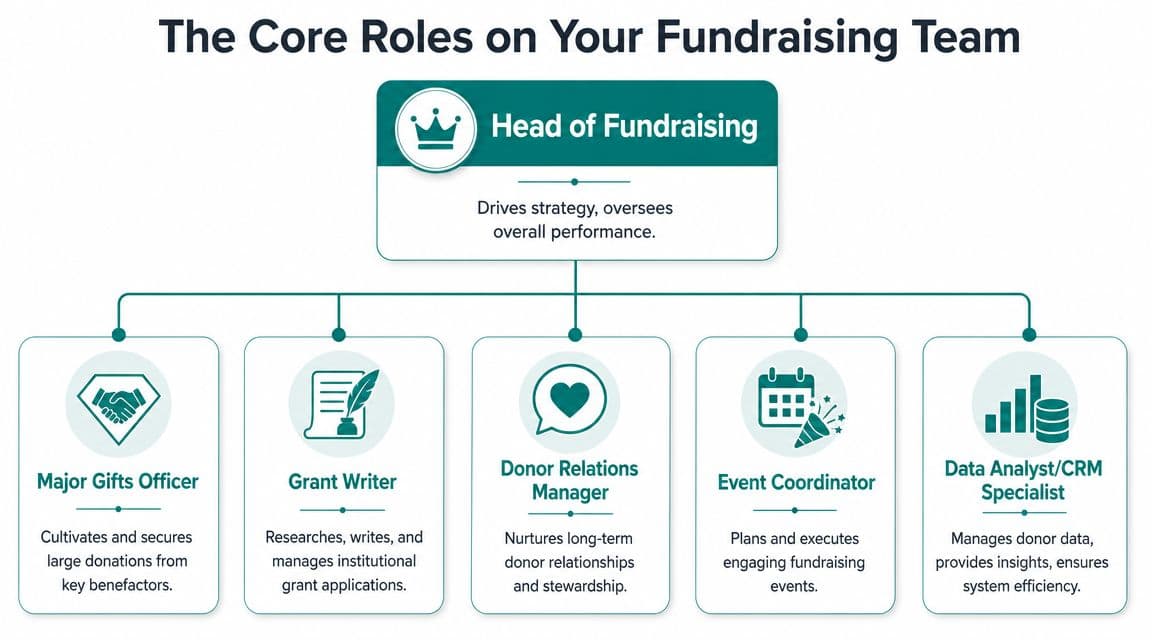
The Core Roles on Your Fundraising Team
A strong fundraising team works like a house build. One person designs the plan, one manages the structure, and others handle specialized work that keeps the whole thing sound. Trouble starts when you ask one person to pour the foundation, wire the building, and decorate the rooms.
The leadership role
Your head of fundraising or development director owns the plan. This person should connect board expectations, annual goals, campaign timing, staffing, and donor strategy into one calendar that your team can execute.
If you don't have this role yet, the executive director often covers it by default. That can work for a season, but not forever. At some point, someone must own prioritization, team management, and performance review across the whole function.
What matters most here isn't charm. It's judgment. A strong fundraising leader knows when to push for a major ask, when to slow down and steward, and when to say no to one more event that drains staff time without building durable donor value.
The relationship roles
A major gifts officer focuses on depth. This person builds trust with donors who want more personal contact, clearer impact reporting, and a real relationship with leadership.
The primary outcome is not "meet with people." It's moving the right donors from passive support to active partnership. That takes disciplined follow-up, good listening, and careful coordination with the executive director and board.
A donor relations manager or stewardship lead focuses on continuity. This role makes sure donors feel seen after the gift, not just before it. Thank-you workflows, impact updates, renewal reminders, and donor records usually live here.
When this role is missing, organizations often create accidental donor neglect. A donor gives, receives a receipt, and hears nothing meaningful for months. The relationship cools, even if your mission remains strong.
Donor care is not administrative cleanup. It is revenue protection.
The institutional funding role
A grant writer or grants manager brings discipline to institutional revenue. This role researches opportunities, coordinates internal input, writes proposals, tracks deadlines, and manages reports after awards are made.
Many leaders underestimate how operational this work is. Good grant professionals don't just write well. They gather program data, chase missing attachments, align budgets with narratives, and keep promises after funds arrive.
If your team has decent program stories but weak follow-through, this role can stabilize a lot quickly. If your association depends heavily on grants, this is often one of the first hires that pays off in reliability, even before it pays off in scale.
The broad-base fundraising roles
Annual giving and events build reach. They create the wider circle of support that keeps your pipeline alive and introduces future mid-level and major donors.
An annual giving manager handles recurring campaigns, segmented email appeals, online giving pages, donor renewals, and message timing across the year. This person helps your organization stop treating fundraising like a year-end sprint.
An event coordinator should be judged by more than whether the room looked good and the program started on time. Events matter when they deepen relationships, surface prospects, and create quality follow-up opportunities for the rest of the team.
Here's a simple way to think about hiring order:
| Organizational pressure | Role that usually helps first | Primary outcome |
|---|---|---|
| No clear plan, scattered effort | Head of fundraising | Direction and accountability |
| Grant deadlines are slipping | Grant writer or grants manager | Reliable institutional revenue process |
| Top donors lack consistent contact | Major gifts officer | Relationship growth and larger commitments |
| Retention feels weak after first gifts | Donor relations manager | Stewardship and repeat giving |
| Too much dependence on one gala or one campaign | Annual giving manager | Broader recurring donor base |
For a broader professional context, AlignMint's overview of the Association of Fundraising Professionals is helpful if you're thinking about standards, training, and career development for your team.
Competencies and KPIs for Modern Fundraisers
Titles don't tell you much by themselves. Two people can both be called development directors, and one will build a coherent fundraising system while the other stays busy.
The difference usually shows up in a few core competencies. Good fundraisers manage relationships, of course, but modern fundraising also requires judgment with data, comfort with systems, and the discipline to turn activity into follow-up.

What strong fundraisers can actually do
Look for evidence that a candidate can move between people, process, and numbers. Not every fundraiser needs advanced analytical skills, but every fundraiser should know how to read the story inside a pipeline.
A practical screen includes questions like these:
- Can they prioritize well: Do they know which donors need personal outreach, which campaigns can be automated, and which requests should wait.
- Can they document consistently: If a fundraiser leaves conversations in their head instead of in the CRM, your organization loses memory.
- Can they connect activity to outcomes: Anyone can report that they sent emails or held meetings. Better fundraisers can explain what changed because of those actions.
- Can they work across teams: Grants touch finance and programs. Major gifts touch leadership and the board. Events touch everyone.
One of the clearest indicators is whether a fundraiser can talk about trade-offs without sounding defensive. Serious professionals know every yes creates a no somewhere else.
The KPIs that matter most
You don't need a giant dashboard. You need a handful of measures that show whether relationships are growing, renewals are holding, and the team is moving work forward.
The Association of Fundraising Professionals runs the Fundraising Effectiveness Project, and in Q1 2025 it reported that the year-to-date donor retention rate was 18.1%, down from 18.3% in 2024 according to AFP's FEP reporting. That's a small shift on paper, but it's a useful reminder that retention deserves close attention.
For most associations, I'd watch these categories:
- Retention indicators: Are donors returning, lapsing, or needing reacquisition work
- Pipeline movement: Are prospects progressing toward asks and follow-up
- Proposal management: Are grants submitted on time, and are reports completed cleanly
- Stewardship execution: Are acknowledgments, impact updates, and pledge reminders happening when they should
- Campaign response quality: Which channels and messages are producing real donor engagement
A KPI should help a manager ask a better question. If it only creates more reporting, drop it.
If your current reporting process takes hours of spreadsheet cleanup, the team will resist it, and reasonably so. A good system should let you review donor behavior, campaign response, and task completion without asking staff to rebuild the same report every month. This article on AI-powered nonprofit donor analytics goes deeper on turning that information into action.
Smarter Fundraising Strategies for Associations
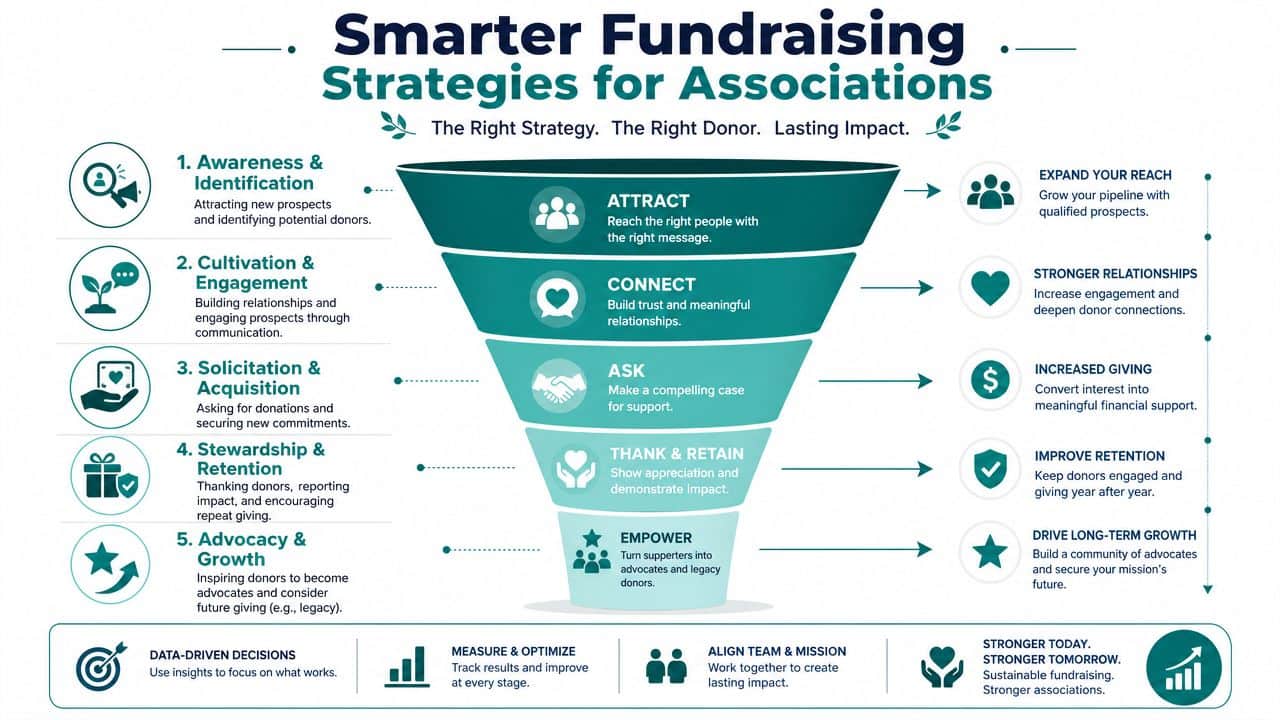
Smart strategy starts with a simple truth. Different donors need different kinds of contact, and your team needs one shared picture of that journey.
Too many associations still run fundraising as disconnected bursts. A spring appeal goes out. A luncheon happens. A board member introduces a prospect. A grant deadline appears. Each piece may be fine on its own, but without coordination, donors experience your organization as scattered.
Build around the donor path
The strongest associations treat fundraising as a managed flow. Awareness leads to engagement. Engagement leads to giving. Giving leads to stewardship. Stewardship leads to renewal, upgrades, and advocacy.
That sounds obvious, but many teams spend most of their energy on the ask and very little on what happens afterward. That's one reason retention matters so much in practice.
AFP's research has long shown that nonprofits often lose nearly as many donors as they gain. In its Q3 2022 reporting, donors were down 7.1% while dollars were up 4.7% according to AFP FEP resources. For executive directors, the lesson is clear. Annual revenue can look acceptable while the donor base weakens underneath it.
Match the strategy to the role
An annual giving manager should own broad communication rhythms. That includes segmented email, renewal timing, online giving pages, and a clear calendar that keeps supporters hearing from you regularly, not only when cash is tight.
A major gifts officer should work a smaller portfolio with more depth. The strategy there is slower and more personal. Notes matter. Follow-up matters. So does making sure program and finance information is available when donors ask detailed questions.
Events deserve a narrower role than many organizations give them. A gala, breakfast, or member gathering should create warm introductions, donor insight, and follow-up tasks for the team. If the event ends and nobody calls the interested table host, the event was a performance, not a fundraising strategy.
The right question after any campaign or event is not "Did people like it?" It's "What relationship moved forward?"
Use tools that support the flow
Integrated systems demonstrate their practical value. When donor records, campaign history, giving pages, and finance data live apart, staff spend too much time reconciling what happened.
That's why many teams move away from patchwork tools and toward platforms built for nonprofit operations. If you want a broader look at category options, this guide to nonprofit fundraising tools is a good place to compare approaches. For the accounting side of that decision, your fund structure matters just as much as your fundraising calendar.
Choosing the Right Team and Tech Structure
A fundraising team can only work as well as its handoffs. If one person enters donor data, another sends receipts, finance reconciles gifts later, and leadership asks for updates from a separate report, your process isn't just inconvenient. It creates delay, confusion, and avoidable mistakes.
That's why structure matters on two levels. First, you need the right mix of in-house staff and outside support. Second, you need technology that fits the way your team works.
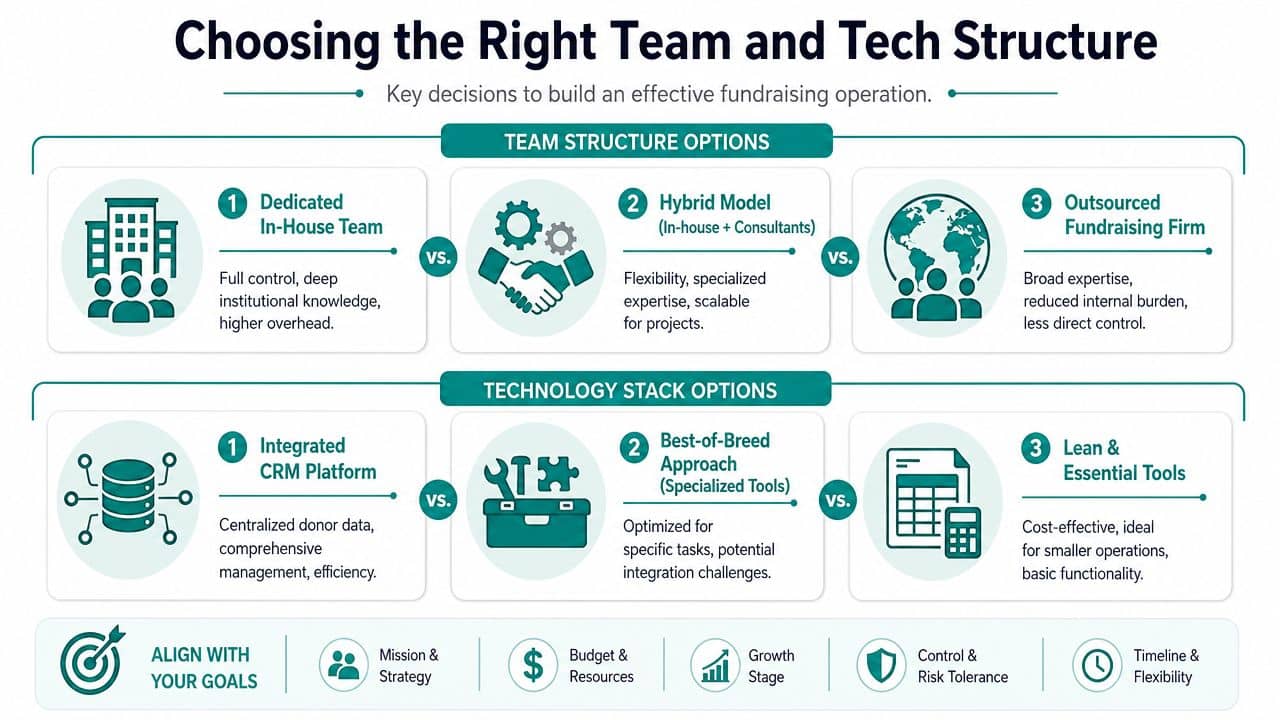
Team structure choices
There isn't one perfect staffing model. There is only the model that fits your stage, budget, and internal capacity.
A quick comparison helps:
| Model | Where it works well | Main trade-off |
|---|---|---|
| Dedicated in-house team | Stable organizations with ongoing fundraising volume | More fixed overhead and management responsibility |
| Hybrid team with consultants | Associations needing specialist help for campaigns, grants, or planning | Clear ownership can get fuzzy if roles aren't defined |
| Outsourced fundraising firm | Groups that need capacity fast or lack internal leadership | Less day-to-day control and less institutional memory |
For most small and mid-sized associations, a hybrid model works well for a while. You keep relationship ownership and internal knowledge close to the mission, then bring in outside help for targeted projects. The danger comes when consultants become permanent substitutes for internal process discipline.
The real cost of disconnected tools
Many nonprofits grow into a patchwork by accident. QuickBooks handles bookkeeping. A separate CRM holds donor records. Email lives elsewhere. Events use another platform. Volunteers may sit in a spreadsheet.
None of those tools is bad. QuickBooks is familiar and widely used. Blackbaud offers deep capability for larger organizations. Aplos is often considered by small and mid-sized nonprofits looking for simpler administration.
The issue is not that these products are flawed. The issue is that many organizations still end up with finance and fundraising separated across systems, which means staff re-enter data, reconcile reports manually, and debate which record is current.
That friction shows up in ordinary moments. A donor asks for a giving summary. Finance has one version. Development has another. Or your board wants a quick read on campaign progress by fund, and staff need to export data from multiple places before anyone can answer.
What to look for instead
If your goal is a manageable workflow, focus on these decision points:
- One source of truth: Can finance, fundraising, volunteers, and events work from shared records instead of duplicate lists
- True fund accounting: Can the system track restricted funds, grants, and programs natively, rather than forcing workarounds
- Built-in communication tools: Can staff send campaigns, receipts, and updates without bolting on another product
- Access for the whole team: Can program, finance, and development staff use the same system without per-seat penalties limiting adoption
One option in this category is AlignMint, which combines fund accounting, donor management, volunteer management, events, marketing tools, and an AI assistant called Minty in one system, with plan-based user allowances (1 on Free, up to 10 on Plus, up to 25 on Pro, and unlimited on Enterprise) and a free tier for nonprofits under $100K in revenue. The broader category is worth reviewing alongside your current stack, especially if your team is losing time to duplicate entry and disconnected reporting. This overview of association management software can help frame the decision.
How to Retain and Develop Your Fundraising Talent
Good fundraisers leave for predictable reasons. They burn out from carrying too much, they lose momentum inside unclear systems, or they get tired of doing clerical cleanup instead of the strategic work they were hired to do.
If you want to keep strong people, give them a setting where they can succeed. That means reasonable portfolios, clear goals, regular coaching, and tools that don't punish them for trying to stay organized.
Keep the role sustainable
A fundraiser can handle pressure. What they can't sustain is constant ambiguity. If no one knows who owns stewardship, who approves appeals, or who follows up after donor meetings, your team will spend its energy on internal friction.
Create role boundaries that are simple enough to remember. Then revisit them when the organization grows. This is especially important in associations where membership, sponsorship, donations, and events can blur together operationally.
Fundraisers stay longer when they can see progress, not just effort.
Professional development matters too. Encourage training, peer learning, and exposure to the broader field. The point isn't prestige. It's helping staff sharpen judgment so they can make better decisions without bringing every issue back to the executive director.
Cut the busywork that drains them
Administrative burden drives more frustration than many leaders realize. If staff must piece together donor history from emails, pull receipts manually, or rebuild the same monthly reports, they lose time and morale at once.
The best retention move is often operational, not cultural. Give fundraisers cleaner workflows, better visibility into donor activity, and shared systems with finance and programs. Then your thank-you process improves, your reporting gets faster, and your staff can spend more of their day on conversations that move revenue forward.
A strong culture still matters. So does compensation. But people are far more likely to stay when the job feels doable, purposeful, and professionally run.
If your fundraising team is outgrowing spreadsheets and disconnected tools, AlignMint gives you one place to manage fund accounting, donor records, volunteers, events, marketing, and team communication. You can start free if your nonprofit is under $100K, which makes it a practical way to test a more unified system before committing to another complicated software stack.
Ready to try AlignMint with your nonprofit?
Start free — set up donor tools, giving pages, and Minty. Upgrade when you need accounting.