

For related tools, see nonprofit fundraising software and donor management.
Quick Answer: Association of Fundraising Professionals: A Director's Guide
The Association of Fundraising Professionals (AFP) is worth it when a named staff member will use membership for peer learning, ethical standards, and certifications-not as a substitute for clean donor records and fund accounting. Judge ROI on follow-through: who owns it, what problem it solves, and whether your systems let the team execute what they learn.
You're probably looking at another professional membership pitch and wondering whether this one will help your organization raise more money, or just give your staff another login and a few webinars nobody watches. That skepticism is healthy. Most executive directors I know don't need more theory. They need something that helps their team make better decisions, avoid preventable mistakes, and turn good fundraising ideas into repeatable practice.
That's where the Association of Fundraising Professionals can be worth your attention. The short answer is this: AFP can be a solid investment if you want stronger fundraising judgment, ethical grounding, and peer access. It becomes far more valuable when you pair what you learn there with tools and processes that let your team follow through.
What Is the Association of Fundraising Professionals
If you've heard people refer to the "association of fundraising professional," they usually mean the Association of Fundraising Professionals, or AFP. Think of it as a professional guild for fundraisers. It exists to give the field a shared set of standards, training, relationships, and expectations.
For a busy executive director, that matters more than it may sound at first. Fundraising is full of opinions. One consultant says one thing, your board says another, and your development staff may be trying to piece together best practices from webinars, podcasts, and trial and error. AFP gives the profession a center of gravity.
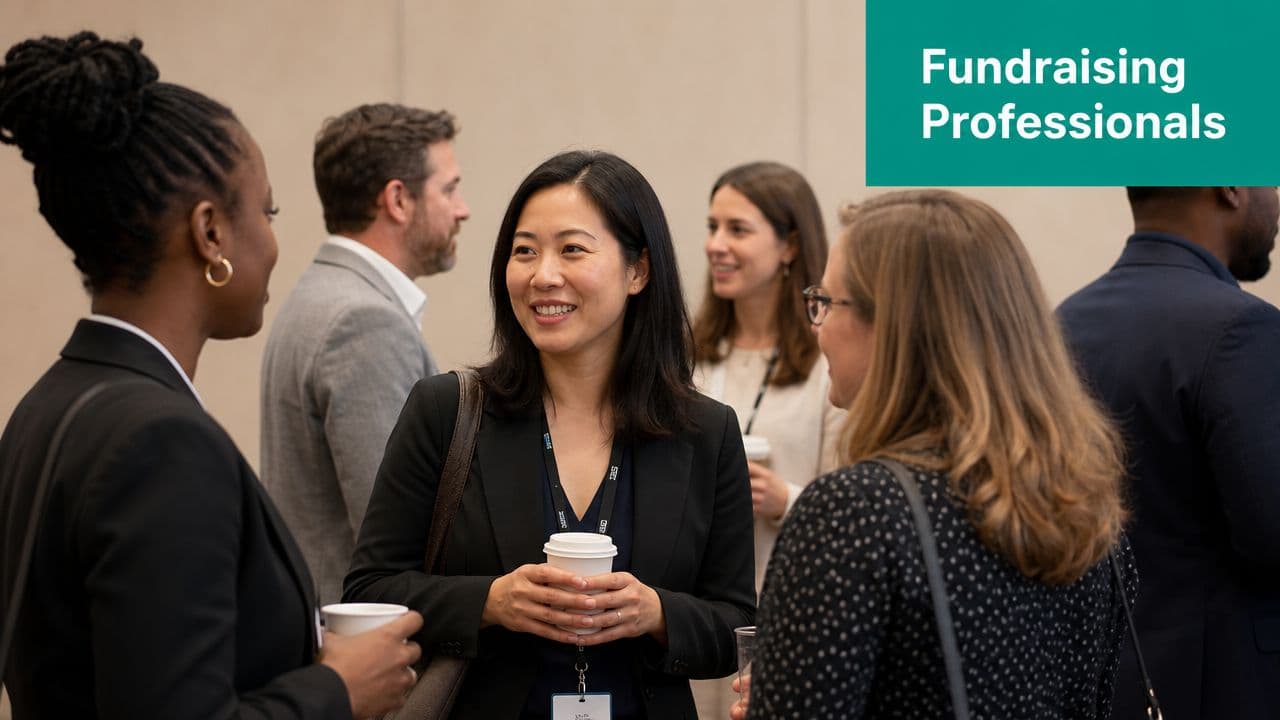
Why AFP carries weight
AFP isn't a small niche club. The organization represents approximately 33,000 members in more than 243 chapters worldwide, according to Cause IQ's profile of the Association of Fundraising Professionals. That kind of reach tells you something important. Fundraising has matured into a real profession with its own norms, not just a collection of personality-driven tactics.
That scale also means AFP tends to influence how people in the field talk about ethics, donor relationships, stewardship, and professional development. If your development director is active in AFP, they're less likely to operate in a vacuum.
A practical comparison helps. Your CPA has professional bodies. Attorneys have bar associations. Fundraisers have AFP. It doesn't mean every member is excellent, and it doesn't mean membership alone makes someone skilled. It does mean there's a recognized place where people learn the language and standards of the profession.
AFP is most useful when you treat it as professional infrastructure, not a prestige badge.
What AFP does in daily practice
At ground level, AFP helps with three things:
- Shared ethics: Your team gets a clearer framework for donor treatment, gift acceptance, and professional conduct.
- Professional education: Staff can learn methods that are broader than your organization's internal habits.
- Peer connection: When a campaign stalls or a board member pushes a bad idea, your team has peers to call.
If you oversee a membership organization yourself, you'll also recognize the pattern. Professional bodies work best when they combine standards with community. That's why it can be useful to understand the role of association management software more broadly. The same principle applies. Structure matters because people need a place to practice better habits together.
For most nonprofits, AFP isn't the thing that raises money by itself. It's the thing that helps your team become more disciplined about how fundraising should work.
Unpacking the Value of AFP Membership and Benefits
Membership only matters if it solves real problems. For most executive directors, those problems are familiar. Your fundraiser feels isolated. Your team needs better judgment. You need practical resources, but you don't have time to sort through noise.
AFP can help with that if you go in with realistic expectations.
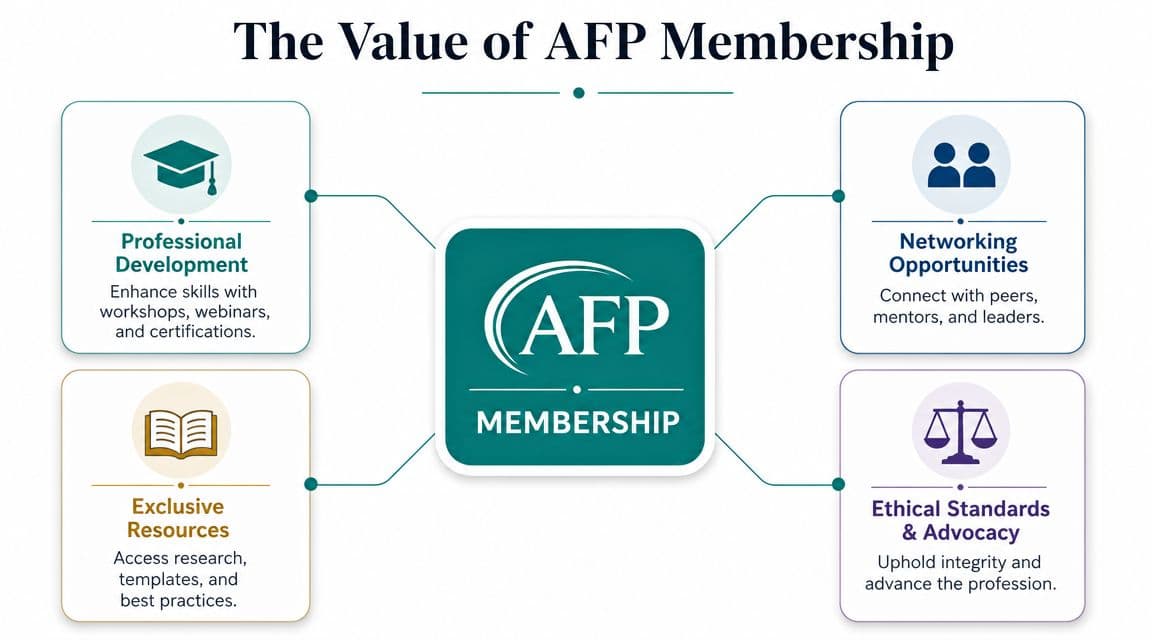
What you're really buying
You're not just buying access to events. You're buying proximity to people who do the same work under similar pressure.
AFP reports that it has 26,000 members across more than 240 chapters worldwide, and says its members raise over $115 billion annually, according to the AFP fact sheet. That doesn't tell you whether your specific membership will pay off. It does tell you AFP is one of the largest organized concentrations of fundraising practice in the sector.
That matters because fundraising is often a lonely function inside smaller organizations. Your development director may be the only fundraising specialist on staff. In that situation, peer access is not a luxury. It's one of the few ways they can test ideas before making expensive mistakes.
Where the benefits become tangible
The strongest value usually shows up in a few places.
- Problem-solving support: Staff can ask peers how they handle donor lapses, event fatigue, campaign planning, or board interference.
- Education that's closer to practice: Webinars, chapter sessions, and conference content can sharpen decision-making faster than general nonprofit content.
- Templates and frameworks: Resource libraries can shorten the time between "we should do this better" and "here's how we'll do it."
- Discounted access: If your team attends training anyway, member pricing can reduce the total cost.
Here's the trade-off. Membership has value only if someone uses it. A neglected AFP membership is no better than a neglected gym card.
Practical rule: Don't buy AFP because it sounds respectable. Buy it because one named person on your team will attend, ask, read, and apply.
Individual versus organizational value
In smaller shops, individual membership often makes more sense if one fundraiser carries most of the revenue responsibility. In a mid-sized nonprofit, broader participation can make sense if you want shared language across development leadership, advancement staff, and even the executive office.
The question I'd ask is simple: who will turn membership into action within the next quarter?
If the answer is nobody, wait.
If the answer is clear, AFP can become one of the more useful entries in your professional development budget, especially when paired with current thinking on nonprofit fundraising tools that help your team put those lessons to work.
Advancing Your Career with Certifications like the CFRE
Some certifications are mostly decorative. In fundraising, credentials can carry more practical weight because trust is part of the job.
AFP has operated for 60 years as a standard-bearer for fundraising professionalism, with an explicit focus on ethical fundraising, professional education, networking, research, and advocacy, according to AFP's main site. That long history is one reason credentials associated with the profession get attention from boards, hiring committees, and peers.
Why credentials matter to an executive director
If a staff member pursues a certification such as the CFRE, the ultimate value isn't the letters after their name. The value is what those letters signal. They tell others your organization takes fundraising seriously enough to invest in standards, not just activity.
That can help in a few practical ways:
- Board confidence: Trustees often don't know how to judge fundraising quality. A recognized credential gives them one signal they understand.
- Donor trust: Major donors may never ask about certification directly, but they do notice professionalism.
- Staff discipline: Preparing for certification usually sharpens core knowledge around ethics, planning, stewardship, and performance.
What certification does not do
It doesn't fix weak leadership. It doesn't replace a donor strategy. And it won't rescue a staff member who lacks relationship skills.
That's worth saying plainly because some organizations overread credentials. A certified fundraiser still needs a manageable caseload, decent data, and an executive director who won't undermine donor relationships by improvising.
A certification can validate competence. It can't substitute for institutional habits.
If you're considering whether to support a staff member through that path, look at their role. If they're leading major gifts, campaign planning, or overall advancement strategy, a credential can be a worthwhile investment in credibility and consistency. If they're early in their career, it may still be useful, but the bigger gain may come from mentoring and practical exposure first.
For executive directors, there's another quiet benefit. Certified staff often bring back more than knowledge. They bring a stronger sense of what good fundraising operations should look like. That can improve how your team handles portfolios, asks, stewardship, and reporting.
If your organization is building a more mature development structure, that discipline matters just as much as hiring a strong major gift officer. Titles help. Professional standards help more.
Finding Your Community in Local Chapters and Conferences
Local chapter events rarely look as glamorous as conference marketing photos. That's part of their value. Most of the time, they feel more like practical shop talk than formal instruction.
A good chapter meeting often includes someone wrestling with donor retention, another person trying to reset board expectations, and a room full of fundraisers who've seen some version of the same problem before. For an executive director or development lead, that kind of room can save weeks of second-guessing.
What local chapters are good for
Chapters tend to help most when you need grounded advice fast.
You might hear how another nonprofit reworked acknowledgment practices. You might learn what language peers use when a board member wants to push a transaction-heavy appeal. You may even discover that the frustrating issue on your desk is common, not a sign your team is failing.
Those conversations matter because fundraising problems are often operational before they become strategic. Teams don't always lose momentum from bad ideas. They lose it from inconsistent follow-up, weak reporting, and unclear ownership.
Why conference content still matters
The larger conferences matter for a different reason. They pull you out of your organization's habits and expose you to the bigger patterns shaping the field.
One useful example comes from AFP's Fundraising Effectiveness Project. In Q1 2025, the year-to-date donor retention rate was estimated at 18.1%, and AFP says nonprofits are losing nearly as many donors as they gain, according to the Fundraising Effectiveness Project update. That's not just an interesting statistic. It's a strategic warning.
If retention is that difficult across the field, then your organization can't afford to treat fundraising as a series of one-time asks. You need systems for stewardship, segmentation, follow-up, and recurring communication.
If your team comes home from a conference talking only about acquisition, they probably missed the most important lesson.
Turning conference ideas into practice
The challenge with conferences isn't learning. It's execution after everyone gets back to the office.
A simple post-event process helps:
- Choose one retention lesson your team will apply first.
- Assign ownership to a named staff member.
- Set a short review window so the idea doesn't die in someone's notebook.
- Use your events and donor systems to support the follow-up.
That last part is where many teams stumble. They hear a smart session on event conversion or stewardship but lack the internal workflow to act quickly. If event-based fundraising is part of your mix, your staff needs tools that connect attendance, outreach, and donor records in one place. That's why some teams start by tightening their nonprofit event management workflow before they add more tactics.
Calculating the ROI for Your Small or Mid-Sized Nonprofit
This is the key question. Not "Is AFP respected?" but "Will this help my organization enough to justify the money and the time?"
That answer depends less on the dues and more on your follow-through.
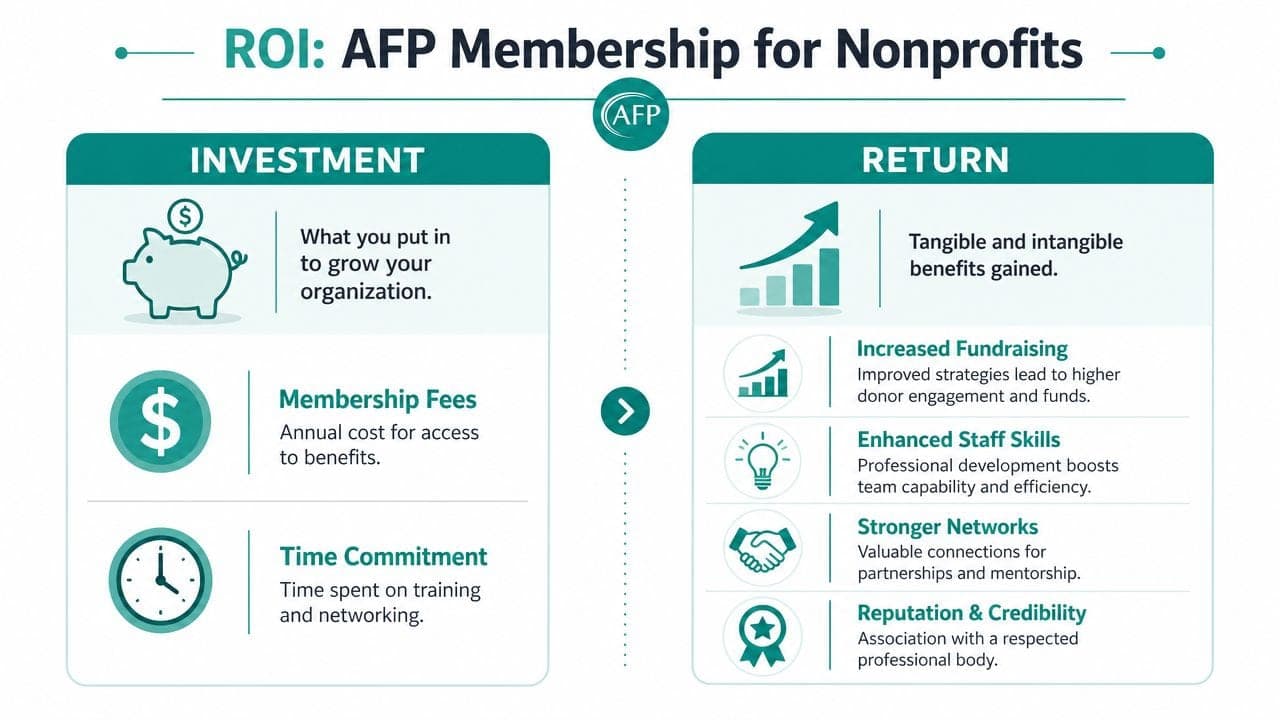
A practical way to judge ROI
I'd assess AFP membership on four questions.
| Question | What to look for |
|---|---|
| Who will use it? | A specific person, not "the team" in theory |
| What problem are we trying to solve? | Retention, major gifts, board behavior, staff growth, campaign planning |
| What will we stop doing? | A low-value webinar habit, scattered advice-seeking, preventable trial and error |
| Can we execute what we learn? | Working systems for donor data, communication, reporting, and follow-up |
That last question deserves more attention than it usually gets. A membership can produce good ideas. It cannot install discipline in your office.
Where many organizations miscalculate
They count the cost of dues but ignore the cost of fragmentation.
If your donor database lives in one place, your accounting in another, your event list in a spreadsheet, and your email tool on a separate subscription, then every new strategy costs extra staff time. The issue isn't that your team lacks knowledge. The issue is that the organization makes execution harder than it should be.
That's why operational tools belong in the ROI conversation. A platform like AlignMint's pricing and plan structure is relevant here because it combines fund accounting, donor management, volunteers, events, marketing, AI assistance, and team access in one system, with a free tier for nonprofits under $100K. That doesn't replace AFP. It helps your team carry out what AFP teaches without stitching together disconnected systems.
A realistic decision framework
Here's when AFP tends to be worth it:
- You have a staff member ready to apply what they learn
- Your organization needs stronger fundraising discipline
- You want outside perspective before making major changes
- Your team benefits from peer access more than from another generic course
Here's when I'd wait:
- No one has time to engage
- Your immediate problem is execution, not knowledge
- Leadership won't support changes that training reveals are needed
If you lead a church or faith-based nonprofit, this is especially important. Many teams already know the basics of donor care but need practical campaign structure. In that case, targeted resources such as effective church fundraising tips can complement AFP-style professional development without replacing it.
The cleanest way to think about ROI is this. AFP can improve judgment. Your internal systems determine whether that better judgment turns into better fundraising.
Considering Alternatives and Complementary Groups
AFP isn't the only useful professional home in the sector. It's one of the broadest.
If your team's work is heavily weighted toward grants, the Grant Professionals Association may be more directly relevant for that craft. If your organization lives in major campaigns, donor relations, or faith-based fundraising, more specialized communities may offer sharper tactical support in those areas.
When a specialist group makes more sense
A broad association helps with professional standards and cross-cutting fundraising practice. A specialist association helps when one discipline dominates your revenue plan.
That means the right question often isn't "AFP or something else?" It's "What gap are we trying to fill?"
- Choose AFP first if your staff needs broad fundraising grounding.
- Add a specialist group if your revenue model depends on a narrower skill set.
- Skip both for now if your team already knows what to do but can't execute consistently.
The same logic applies to software
The nonprofit software market has a similar pattern. Some tools are strong in one lane. Others try to cover operations more broadly.
Blackbaud has deep history and wide adoption in many nonprofits, especially larger and more established organizations. Aplos is familiar to many smaller nonprofits and churches, particularly for finance-focused needs. Those tools can fit the right organization well.
The gap some teams run into is not quality. It's fragmentation. One product may handle accounting, another donor records, another email, and another event registration. That setup can work, but it asks more of your staff.
For a time-poor executive director, this is the practical distinction that matters. A single-purpose product can be perfectly good at its job. An all-in-one platform is useful when your bigger problem is staff capacity and coordination across fundraising, finance, volunteers, and communications.
That's also why no professional association can solve operational drag. AFP can sharpen thinking. Your tool stack still determines how much friction your staff faces every day.
Your Next Steps for Joining and Getting the Most from AFP
If you're interested but not fully convinced, don't make this an all-or-nothing decision. Take a few low-risk steps and see whether AFP fits your reality.
If you're also building out your development function, our guide to association fundraising professionals covers team roles, KPIs, and the tech structure that helps staff act on what they learn.
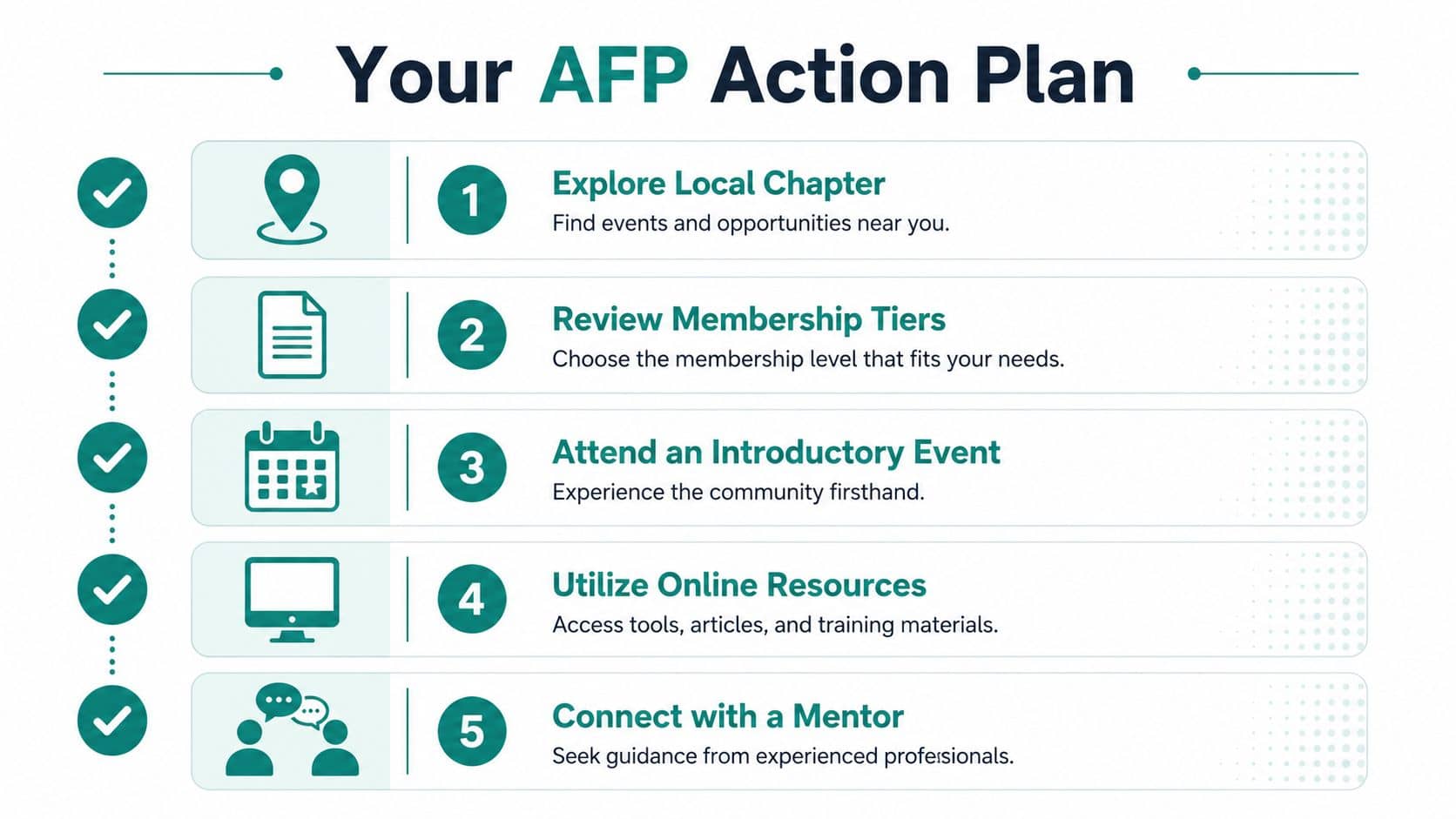
Start local. Look up your nearest chapter and review upcoming events. You're not looking for polished marketing copy. You're looking for signs of active programming, practical topics, and a community that feels alive.
A sensible first move
Before you join, talk to one current member in your region. Ask what they've gotten from it in the past year. Ask whether the chapter is strong, whether the programs are useful, and whether they'd pay for it again out of their own budget.
Then look inward.
Check your readiness to benefit
Use this short checklist:
- Name the staff owner: Who will attend events, read resources, and bring back recommendations?
- Pick one fundraising issue: Retention, stewardship, board behavior, pipeline management, or campaign planning.
- Audit your current systems: Can your team segment donors, track follow-up, connect gifts to accounting, and communicate without extra manual work?
- Set a review date: Decide in advance when you'll evaluate whether membership helped.
The value of AFP doesn't come from joining. It comes from joining with a clear use case and the internal ability to act on what you learn.
If your systems are messy, fix that in parallel. Professional development works best when your operational engine is ready. When your accounting, donor records, marketing, volunteer coordination, and team communication live in separate places, good ideas stall out fast.
That's the core decision. AFP can give you the map. Your internal setup determines whether the car starts.
If you want a cleaner way to act on fundraising ideas once your team learns them, AlignMint brings fund accounting, donor management, volunteers, events, marketing, and AI support into one nonprofit platform. It's worth a look if your staff is spending too much time moving data between systems and not enough time building donor relationships.
Ready to try AlignMint with your nonprofit?
Start free — set up donor tools, giving pages, and Minty. Upgrade when you need accounting.