


You're staring at a donor spreadsheet that doesn't quite match your bank feed, and year-end is closing in. One appeal went out, another got delayed, and you still can't tell which gifts are restricted, which are unrestricted, or how they'll show up in your books. A strong fundraising plan fixes that pressure by connecting donor communication, channel choice, and true fund accounting in one clear process.
Introduction
Most executive directors don't need more noise around fundraising. You need a cleaner way to turn attention into gifts, gifts into stewardship, and stewardship into reporting you can trust.
That's especially true when your team is small and every campaign touches finance, donor relations, and board reporting at once. A practical fundraising approach helps you raise money without losing track of donor intent, restricted funds, or year-end compliance.
Align the campaign plan with fundraising tools before launch so donation pages, receipts, donor follow-up, and reporting do not become separate clean-up projects.
If you're also looking for practical campaign ideas, this fundraising ideas guide is a useful companion. It pairs well with the bigger picture here, because good ideas only matter when they fit your operating reality.
Goals and Core Concepts
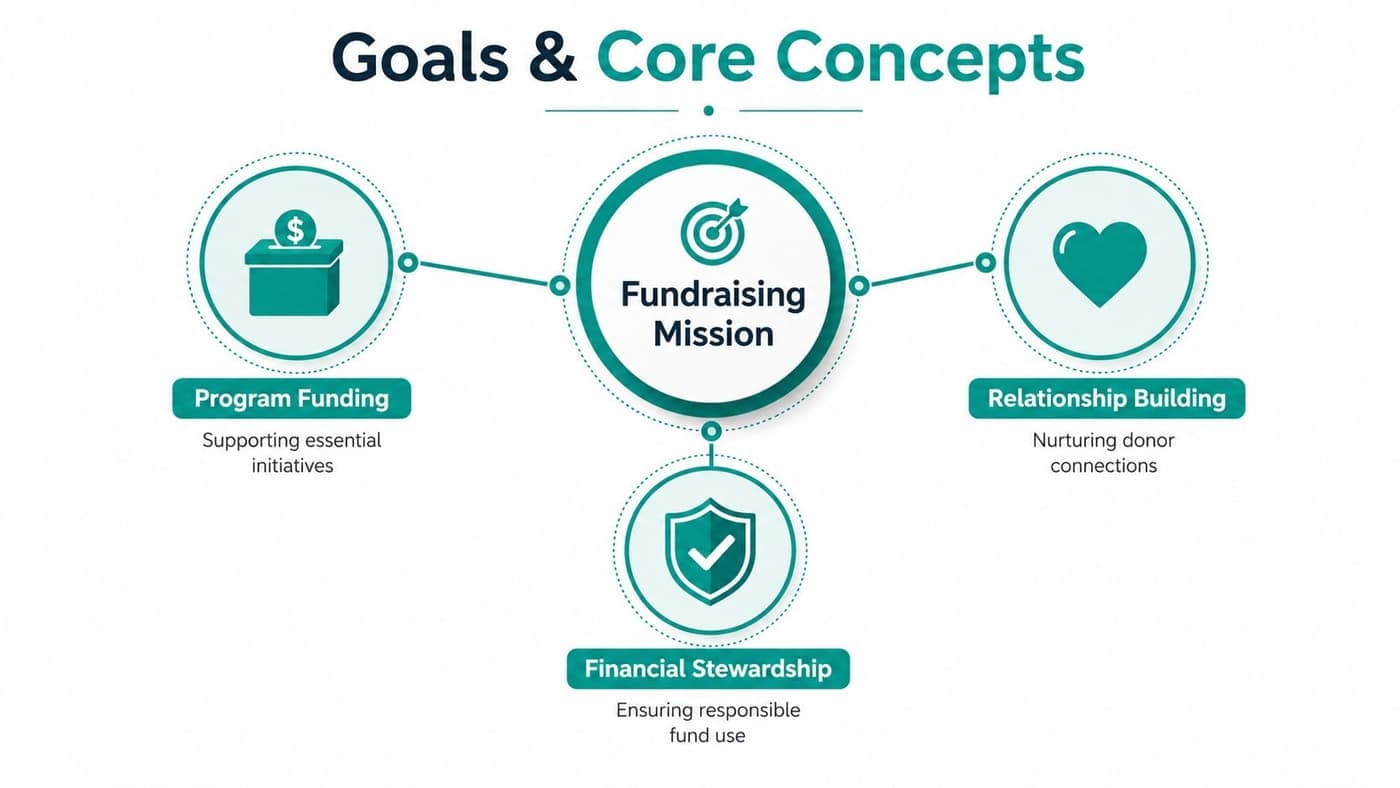
Fundraising gets easier when you stop treating it as one task and start treating it as a chain of outcomes. The first outcome is funding your mission, the second is building donor trust, and the third is proving that money was handled correctly.
That last point matters more than many boards admit. In 2024, total U.S. charitable giving reached $592.5 billion, with individuals accounting for 66%, foundations 19%, bequests 8%, and corporations 7% (Giving USA summary). The mix tells you that relationships with individual donors still carry the most weight, even though grants, sponsorships, and planned gifts still matter.
The core terms that keep teams aligned
Unrestricted funds are the most flexible. You can use them where the need is greatest, which makes them especially valuable for staffing, operations, and gaps that grants rarely cover.
Restricted funds come with donor intent attached. If a gift is designated for a program, scholarship, or capital need, your accounting has to track that separately. That is where fund accounting becomes a stewardship tool, not just a bookkeeping method.
Practical rule: if the donor expects a purpose, your ledger should reflect that purpose from the start.
That's also why channel choice matters. A gala, a church campaign, a school appeal, and a monthly giving program all create different reporting demands. If you can't trace the gift from first touch to final use, you'll spend too much time reconciling after the fact.
For a deeper look at the bookkeeping side, see fund accounting for nonprofits. It connects the money you raise with the money you report, which is where many teams get stuck.
Major Fundraising Channels
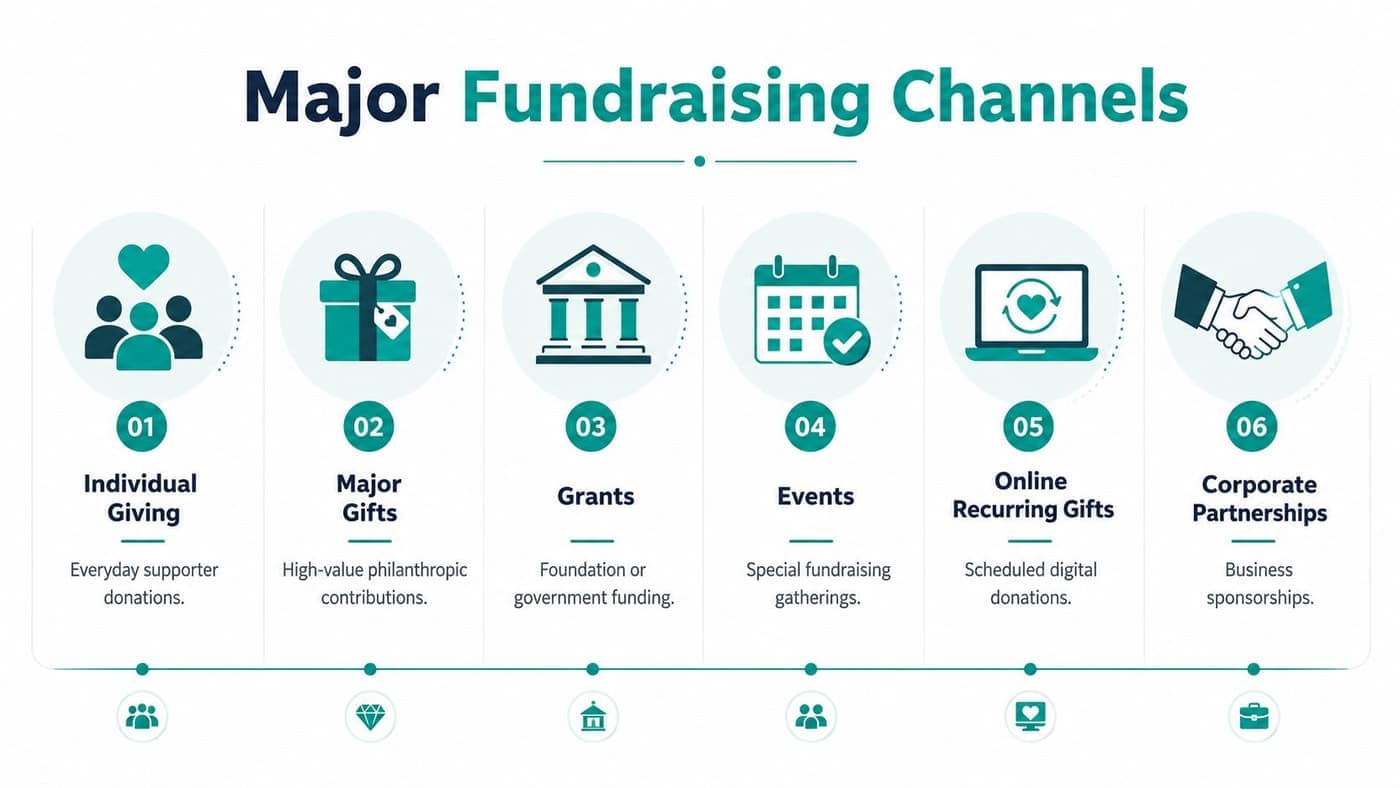
The best fundraising mix usually reflects your staff size, audience, and event capacity. Some channels are built for steady support, while others are better for large gifts, visibility, or sponsor relationships.
What each channel does best
Individual giving usually forms the base of most nonprofit revenue because it grows out of trust and repetition. It works well when you can keep donors informed, thank them quickly, and show impact clearly.
Major gifts need more staff attention, but they can anchor growth when your board and leadership can cultivate relationships well. These gifts often follow personal conversations, clear mission alignment, and careful stewardship.
Grants suit organizations that can document outcomes, manage deadlines, and track restricted spending cleanly. They're valuable, but they can also create reporting load if your systems aren't ready.
Events still matter when they create energy, donor contact, and sponsorship opportunities. If your team is planning an event, practical logistics matter as much as the cause, which is why a resource like finding your perfect event venue can help you think through space, flow, and attendance experience before you commit.
Online recurring gifts are useful for predictability. They're strongest when your donation page is simple, mobile-friendly, and tied to clear follow-up.
Corporate partnerships can include sponsorships, cause marketing, or workplace giving. They're usually strongest when the business sees community alignment, employee interest, or customer goodwill.
The 2024 giving mix reinforces that balance. Individual donors still account for the largest share of giving, while foundations, bequests, and corporations remain important for campaigns that need scale or continuity (Giving USA summary).
For donation pages, a practical next step is nonprofit donation page best practices. That's where many channels either convert or stall.
Donor Lifecycle and Stewardship
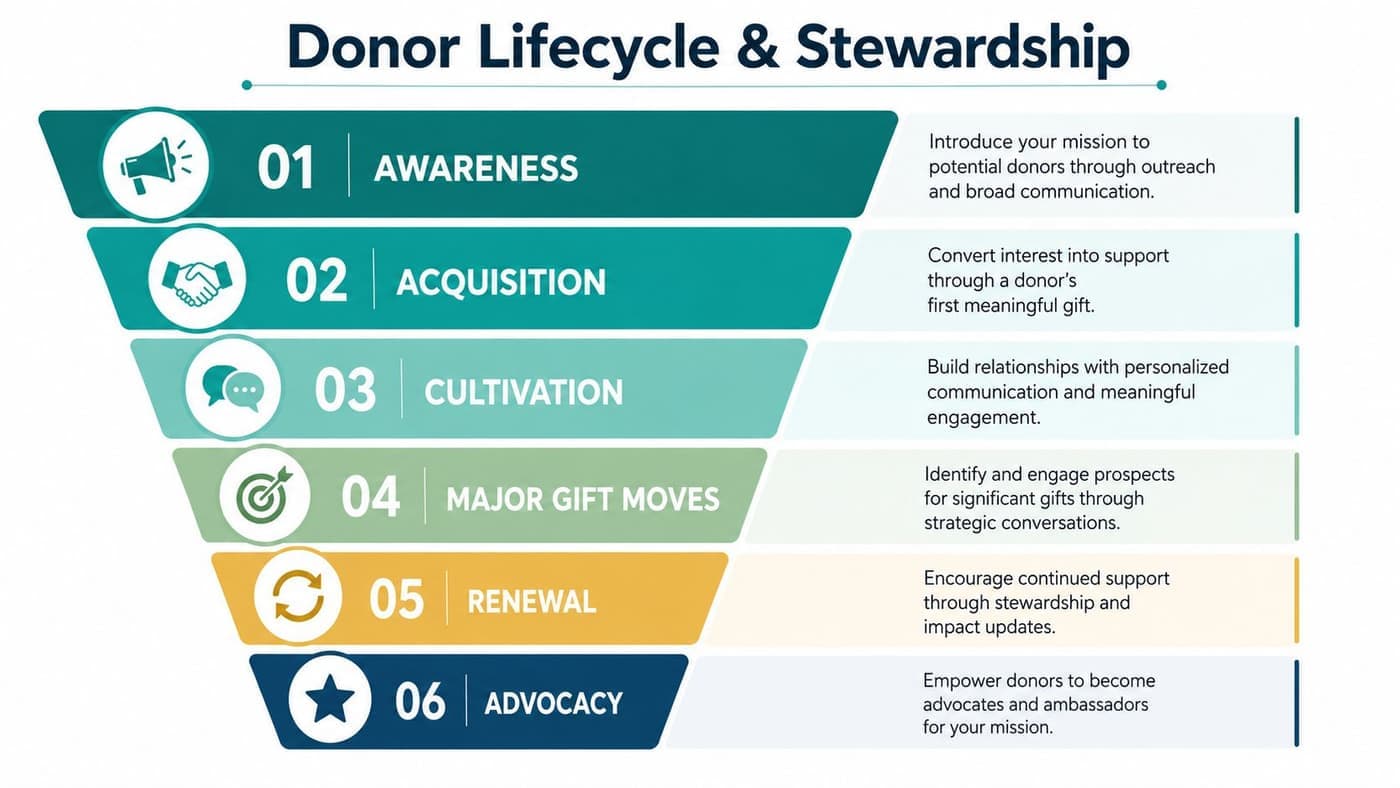
A first-time donor rarely starts as a first-time donor in their own mind. They usually begin as a reader, attendee, volunteer, parent, parishioner, or community member who needs a reason to trust you first.
From awareness to commitment
The early stage should feel like an invitation, not a demand. The strongest approach is to give people a small, safe next step, such as subscribing, attending, or registering interest before you ask for a gift.
Practical rule: don't ask for money until you've given someone a reason to believe you're organized, honest, and worth supporting.
That trust-building sequence matters for small organizations. One fundraising lesson that often gets missed is how to move people from awareness to opt-ins or event attendance before the first appeal, instead of rushing straight to a donation ask (trust-building sequence).
The journey after the first gift
Once someone gives, stewardship becomes the essential task. You should thank quickly, explain impact in plain language, and keep the next contact relevant to what they supported.
The next stages usually follow a simple pattern. Cultivation keeps the relationship warm, major gift moves match larger asks to stronger interest, renewal makes giving repeatable, and advocacy turns satisfied donors into people who refer others.
For retention-focused tactics, this nonprofit donor retention strategies guide is a solid follow-up. It pairs well with a lifecycle view because retention is often a discipline, not a campaign.
Metrics Reporting and Compliance
Good fundraising reporting answers two questions at once. Did we raise the money, and did we use it the way we said we would?
The reports boards actually need
Your board doesn't need a stack of disconnected exports. It needs a clear view of restricted balances, unrestricted cash, pledge status, and whether campaign promises match actual activity.
The right tracking method depends on the metric. Donor records usually live in your CRM, restricted balances belong in fund accounting, and grant spending should be tied to both budget and purpose. If those systems are split, the report is slower and more error-prone.
| Key Fundraising Metrics and Reports | ||
|---|---|---|
| Metric | Tracking Method | Reporting Purpose |
| Donor retention | CRM history and giving records | Shows whether supporters are staying engaged |
| Average gift size | Gift records in the donor system | Helps evaluate campaign performance |
| Restricted fund balances | Fund accounting by purpose | Supports donor intent and spending control |
| Grant drawdowns | Project or fund-level accounting | Confirms funds were used properly |
| Campaign revenue | Donation page and bank reconciliation | Measures campaign progress |
| Functional expenses | Chart of accounts and fund mapping | Supports board review and Form 990 preparation |
That same structure helps with Form 990 readiness. If restricted gifts, program costs, and administrative spending all live in separate systems, you end up reconciling by hand before filing. A better setup keeps the source data clean from the start, which is why nonprofit reporting software often becomes more than a convenience.
Compliance is donor trust
Compliance isn't just about avoiding mistakes. It signals that your organization can handle funds responsibly, which affects how boards, funders, and major donors judge you.
If your reports can't explain what came in, what stayed restricted, and what moved to programs, you'll feel that gap at audit time and at board time. The best systems make those questions easy to answer because the transaction data is already organized correctly.
Implementation for Small and Mid-sized Nonprofits
Small teams don't need a perfect plan. They need a workable one that protects staff time and keeps fundraising moving.
Start with roles, not software
Assign one person to donor communication, one to finance review, and one to calendar coordination if you have the staff. If you don't, then one person can own the process, but the handoffs still need to be clear.
Build your campaign around a few repeatable steps. Prepare the list, draft the ask, set the donation path, define the thank-you process, and decide how the gift will be coded before money arrives.
Budget for participation, not just promotion
Accessibility belongs in your fundraising budget, not as a late add-on. Fundraising events often overlook accommodations and compensation for disabled donors, speakers, and attendees, yet those choices affect trust and participation (Giving USA inclusion guidance).
Some of the strongest fundraising decisions are unglamorous. Clear seating, accessible communications, and a fair speaker budget can matter more than a polished theme.
For churches and schools, this matters even more because your audience often includes volunteers, parents, students, congregants, and program beneficiaries at the same time. A simple calendar and a clear approval process prevent confusion when multiple groups are involved.
If you're operating under a fiscal sponsor, make sure each appeal maps cleanly to the correct sponsored project. That keeps the giving story, the finance trail, and the reporting trail aligned.
Technology Workflows and Tools
The benefit of a good platform is not more screens. It's fewer places for the same gift to get lost.
An all-in-one setup can connect fund accounting, donor management, volunteer coordination, events, and marketing so your team doesn't retype the same record three times. In practice, that means a donor record, a pledge, a receipt, and a ledger entry can stay linked instead of drifting apart.

What the workflow should look like
A basic flow starts with your CRM, where constituent records live. Then your campaign page captures the gift, your receipting process confirms it, and your accounting layer posts it to the right fund or restriction.
That is where true fund accounting matters. You don't want a general ledger that forces you to fake nonprofit accounting with generic classes or workarounds. You want restricted funds, grants, and programs modeled directly so reporting reflects reality.
Digital giving patterns also shape the workflow. 72% of donor count comes from online gifts, and 67% of online donations occur on desktop (Eventgroove statistics). That means your donation page still needs to work cleanly on the screen many supporters use.
Where software should reduce friction
A free tier for organizations raising under $100K can help small nonprofits start without adding pressure. Clear user access by plan also matter, because fundraising, finance, and volunteer coordination usually involve more than one person.
One option in this category is AlignMint, which combines accounting, CRM, volunteers, events, and marketing in one platform. Its Minty assistant can answer questions about your real data, which helps busy leaders who don't want to export spreadsheets just to understand what happened.
For a closer look at digital giving setup, see nonprofit donation page best practices. That's where channel strategy becomes actual revenue.
Case Examples Templates and Conclusion
A small arts nonprofit I worked with had a familiar problem. Their online gifts lived in one tool, their grants in another, and the finance team spent too much time matching restricted donations to the right program.
After they tied fundraising channels to fund accounting from the start, the board could see revenue by purpose without waiting for month-end cleanup. A school foundation had a similar result when it paired campaign emails, event registration, and donor records into one process, which made stewardship easier for staff and clearer for families.
Starter templates that keep things manageable
A multi-channel campaign checklist should include list prep, appeal timing, donation page review, acknowledgement steps, and finance coding.
A donor stewardship calendar should map thank-yous, impact updates, renewal asks, and board touchpoints so communication doesn't depend on memory.
A metrics dashboard outline should show campaign revenue, restricted balances, donor retention, and open action items in one place.
The simplest next move is to pick one campaign and trace every gift from first contact to ledger entry. When that path is clear, fundraising stops feeling like a scramble and starts feeling like a repeatable operating system.
For your next campaign, review your channels, tighten your stewardship, and make sure your accounting can show the story behind every gift. If you want a single place to connect fundraising, finance, volunteers, and team communication, explore AlignMint and see how the pieces fit together.
A CTA for AlignMint.
Ready to try AlignMint with your nonprofit?
Start free — set up donor tools, giving pages, and Minty. Upgrade when you need accounting.