

End of Year Giving Playbook for Nonprofits
You've reached late December, your board wants the annual budget protected, and your finance team is already reconciling gifts. The campaign may look like a messaging problem, but end of year giving succeeds or fails through operations, from segmentation and payment processing to receipting and January stewardship.
This playbook connects the appeal to the work behind it. You'll get a practical campaign calendar, donor segments, channel decisions, message templates, compliance checks, and a January retention plan that keeps December revenue from becoming a one-time event.
Quick Answer: End of Year Giving
End of year giving succeeds when the appeal, payment processing, fund coding, receipts, and January thank-you share one record. December volume is too high to reconstruct gifts from spreadsheets after the fact.
Connect the campaign to fundraising and fundraising for nonprofits. For year-end records, see year-end giving statements.
Why End of Year Giving Demands Real Planning
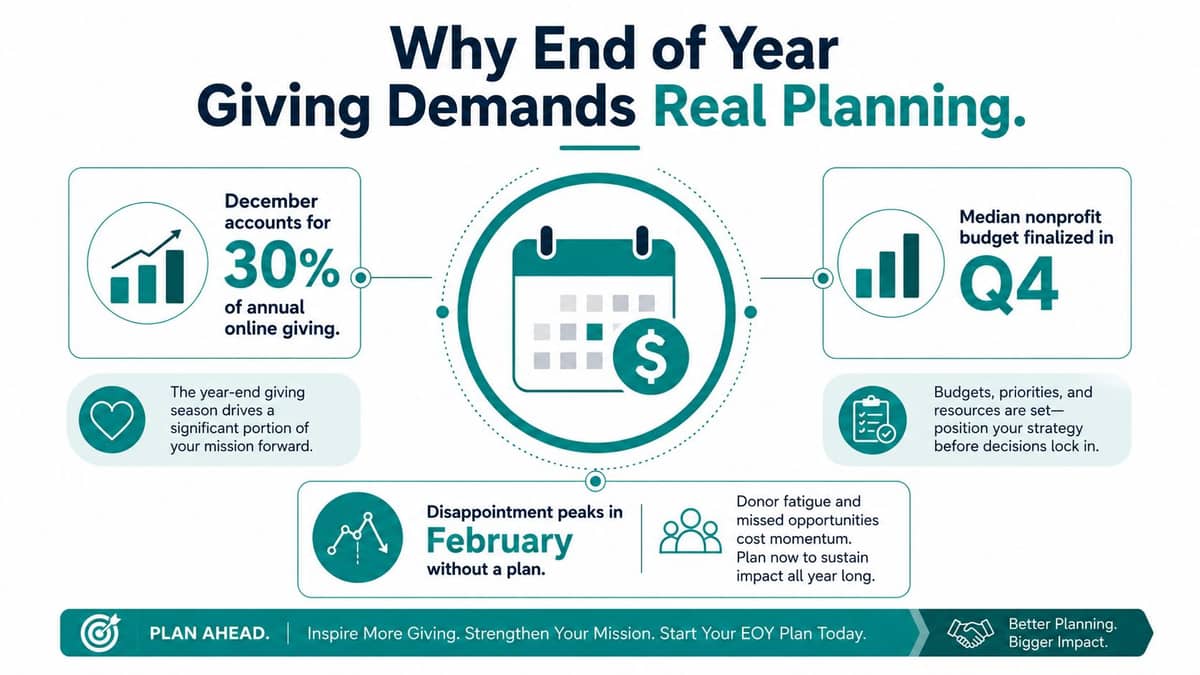
December isn't the month when nonprofits send more emails. It's the month when fundraising, finance, leadership, and donor care collide. One industry benchmark reports that roughly 30% of annual charitable donations arrive in December, with about 10% coming during the last three days and around 5% on December 31 alone (CAF America's holiday giving trends).
That concentration changes the workload. Your development team needs clear appeals, your finance staff needs accurate coding, and your donors need prompt acknowledgments. If one part lags, the entire campaign becomes harder to manage.
Giving USA estimated that charitable giving in the United States reached $592.50 billion in 2024, an increase of 6.3% from 2023 (Giving USA charitable giving statistics). That figure puts December in context. You aren't competing for attention in a small seasonal market. You're operating inside a major annual philanthropy economy with substantial volume compressed into a narrow period.
The campaign has three simultaneous jobs
A December appeal must accomplish three things:
- Raise revenue: Secure gifts that support the budget and assigned programs.
- Protect the records: Code restricted and unrestricted funds correctly, reconcile deposits, and issue accurate receipts.
- Strengthen relationships: Thank donors promptly and give them a reason to stay connected after January.
Those responsibilities shouldn't live in separate spreadsheets. A donor who gives to a restricted program needs the gift recorded correctly, acknowledged appropriately, and included in the right stewardship path.
Practical rule: Start planning before Thanksgiving, because December is too late for cleaning donor records, rewriting appeals, and testing payment workflows.
GivingTuesday can create useful momentum, but it shouldn't become the entire strategy. The final days often carry exceptional weight, which means a late campaign needs tested forms, clear ownership, and staff coverage before the calendar becomes urgent. Our fundraising guidance for nonprofits takes the same position. A campaign isn't finished when the donor clicks “submit.” It's finished when the gift is reconciled, receipted, thanked, and assigned a next step.
Your October to January Campaign Timeline
A workable timeline gives every person a defined deliverable. It also gives you permission to cut lower-value work before the final week becomes unmanageable.
August and September prepare the records
Start with the donor file, not the subject lines. Remove duplicate records, confirm mailing and email details, review recurring gifts, and identify donors whose acknowledgments were delayed during the previous campaign.
Write a short campaign brief that names the revenue goal, campaign theme, channels, decision-makers, and owners. If your team is small, assign one person to donor data and finance coordination, one to communications, and one to board and volunteer follow-up.
Review your gift acknowledgment process during this phase. Confirm that restricted gifts, recurring gifts, checks, online payments, and employer matches follow clear paths before new volume arrives.
October builds the machine
October is when you lock the creative, prepare the email series, confirm GivingTuesday partners, and test the donation page on mobile devices. Don't wait for the first December appeal to discover that the form asks unnecessary questions or that receipts aren't being delivered.
Create the calendar for your marketing plan for nonprofit organizations, then remove anything your team can't sustain. A useful full-funnel holiday marketing plan can help you think across awareness, conversion, and follow-up without forcing every nonprofit into the same channel mix.
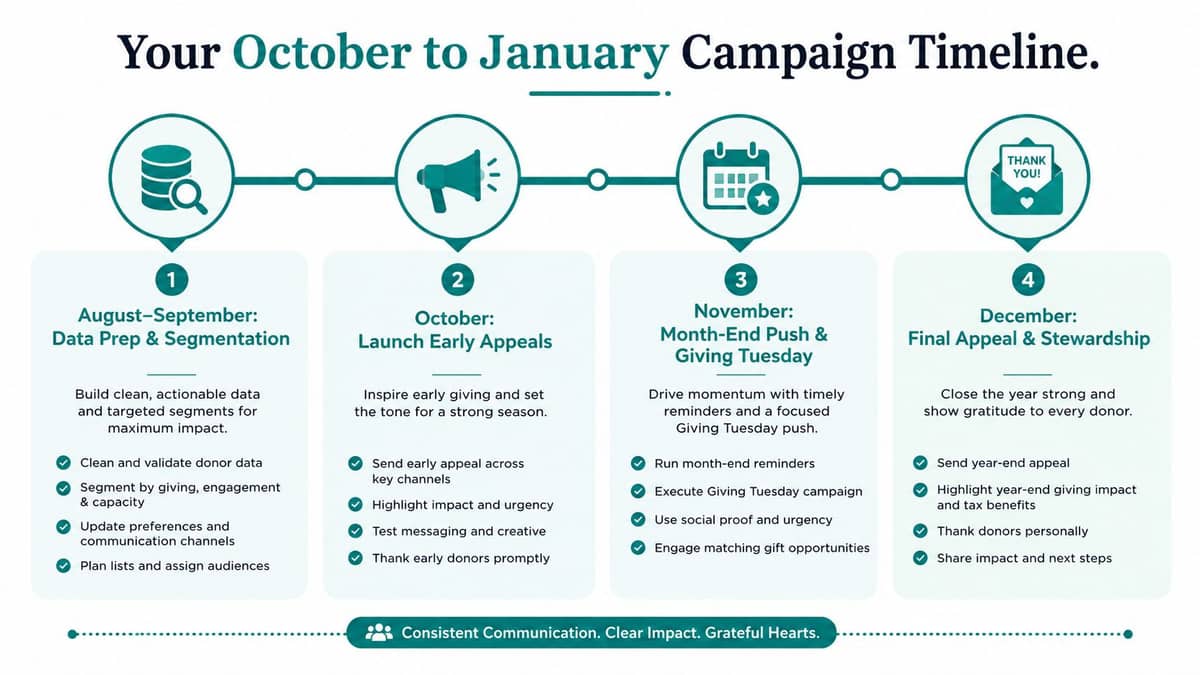
November creates early movement
Open with a soft appeal to major donors and loyal supporters. Ask board members to make personal calls before the public campaign reaches its busiest period.
Use GivingTuesday as a campaign event, not the finish line. Prepare a lapsed-donor track, confirm volunteer assignments, and stage the messages that will carry the story into December.
December needs three distinct windows
- December 1 through 10: Make the early ask and explain the campaign purpose.
- December 11 through 20: Share a specific story, progress update, or program result.
- December 29 through 31: Send concise reminders, monitor payments, and maintain same-day acknowledgment coverage.
January protects the result
January belongs to thank-you calls, receipt reconciliation, gift coding, and the first retention plan. Complete a short debrief while details remain fresh. Record what worked, what failed, and what your team should stop doing next year.
Segmenting Donors So Appeals Land Right
A flat donor list makes your staff do the donor's thinking. The result is usually a generic ask, an unsuitable amount, or a message that arrives after the relationship has gone quiet.
Use three practical dimensions: recency, capacity and frequency, and channel behavior. Recency tells you whether the relationship is active. Capacity and frequency help shape the ask. Channel behavior shows where the donor is most likely to respond.
Build five working groups
You don't need a complicated model to make useful decisions. Start with five segments:
| Segment | Definition | Recommended Ask | Primary Channel | Message Angle |
|---|---|---|---|---|
| Major donors | Highest capacity and strongest relationship | Personal amount based on prior conversation | Phone or personal email | Leadership, outcomes, and specific opportunity |
| Loyal mid-level | Repeated giving with meaningful history | Slightly above the recent typical gift | Email and phone | Continuity and measurable program support |
| First-time recent | Gave recently for the first time | Accessible next gift or recurring option | Welcome, gratitude, and belonging | |
| Lapsed 12–24 months | Previously gave but hasn't renewed | Prior gift or modest reactivation ask | Email and mail | What changed and why their return matters |
| Cold or acquired | Limited relationship or older record | Low-friction introductory ask | Email or social | Mission clarity and simple first action |
Here's a workable example. Suppose your file contains 2,500 names. First, sort by last gift date. Next, rank donors by lifetime giving and average gift, then separate those who have opted into text messages, attended events, or regularly engaged with email.
Set capacity tiers from your own distribution rather than importing arbitrary thresholds. A donor who gave repeatedly at a higher level should receive different treatment from someone who made one small introductory gift, even if both gave during December.
Prevent conflicts before launch
Suppress duplicate records before sending. If one household appears under two email addresses, decide which record owns the campaign history and preserve the other as an alias or inactive duplicate.
Your segments should sync back to the CRM after each gift. Otherwise, a donor may receive a renewal appeal after giving, a major donor may get a mass message, or finance may lack the context needed for acknowledgment.
For the retention work after December, use this nonprofit donor retention guidance as a reminder that the campaign continues after the payment clears.
Choosing the Right Channels and Timing Windows
Build the channel plan around staff capacity and gift-processing needs. Email and direct personal outreach deserve the largest share of attention because your team controls the list, the message, and the donor relationship.
Use SMS only for donors who opted in and only if someone can respond quickly. Organic social can reinforce the campaign story. Paid social should wait until the donation page, tracking, receipting, and follow-up process are ready.
| Channel | Best Send Window | Typical Open/Reach | Realistic Conversion | Staff Effort |
|---|---|---|---|---|
| Early December, mid-month, and final days | Measured through your list history | Strongest when segmented and repeated | Moderate | |
| SMS or text | Before key deadlines and early evening reminders | Direct delivery to opted-in donors | Useful for urgent, simple actions | Low to moderate |
| Organic social | Throughout December, especially around stories | Dependent on existing audience | Better for reinforcement than direct revenue | Moderate |
| Paid social | Before the campaign and during proven appeals | Depends on audience and creative | Uncertain without a tested page | High |
| Live or virtual events | Early or mid-December | Attendance-based | Strong when personal follow-up follows | High |
Use your own results by segment, message, and send time. Broad benchmarks for small nonprofit lists may describe 22% to 28% opens, 1% to 3% clicks, and 0.5% to 2% conversions, but those figures should not replace your organization's history or your finance team's record of completed gifts.
Match the channel to the calendar
Give Tuesday can support a focused early-December push. From December 10 through 20, maintain steady contact without repeating the same appeal. From December 29 through 31, shorten the message, state the deadline clearly, and monitor the donation form continuously.
Before sending HTML email, check rendering across common inboxes with an HTML Email Checker. Review these nonprofit donation-page best practices before each send window, then confirm that gifts flow into the right fund, trigger accurate receipts, and update donor records. A broken button or missed acknowledgment during the final window is an operations failure, not a copy problem.
A nonprofit with a $500,000 budget should concentrate staff effort on email and personal asks, using social content to support those messages. Events belong in the plan only when board members and volunteers can own attendance and follow-up without pulling finance staff away from gift processing. That discipline protects the December close and gives the retention team clean records for January.
Messaging That Works Without Sounding Desperate
Donors respond to clarity and respect. They don't need theatrical urgency, vague appeals, or images designed to make them feel ashamed.
Use one ask, one impact statement, and one next action. Adjust the amount and story for the segment instead of sending the same paragraph to everyone.
The late-November soft launch
Subject options: A first look at what your support will make possible, or Help us begin the year ready to serve
We're preparing for the year ahead, and your previous support helped keep [program or service] available to our community. Would you consider a gift of $100 to help us begin the new year with the resources our team needs? Your contribution will support [specific program outcome].
P.S. If December isn't the right time, you can still help by sharing this message with someone who cares about [mission].
The December 15 story nudge
Subject options: What your support changed this year, or One story from our community
[Name] came to [program] needing [challenge], and your support helped make [specific result] possible. A gift of $75 today will help another person access [program or service] in the coming year.
P.S. You don't need to wait for the final week. Giving now helps our staff plan responsibly.
The final 72-hour message
Subject options: Three days remain to support [mission], or Before December 31
We're approaching the end of the year, and we're asking you to make a gift of $50 before December 31. Your contribution will help fund [specific activity or outcome] when our community needs it most.
P.S. If you already gave, thank you. Please don't give again. Sharing this appeal is a meaningful way to help.
A short text message can be direct: “Your gift helps [program] serve [community] in the new year. Give by Dec. 31: [link]. Reply STOP to opt out.”
For a board call, use this script: “I'm calling because I've seen what [organization] made possible this year. Would you consider a gift of [amount] before December 31? I'd be glad to answer questions, and I'll send the giving information afterward.”
Receipting, DAFs, and Compliance Without the Headache
Finance staff shouldn't have to reconstruct the campaign after the last check arrives. Give them a written checklist, a clear cutoff policy, and one source of truth for gift records.
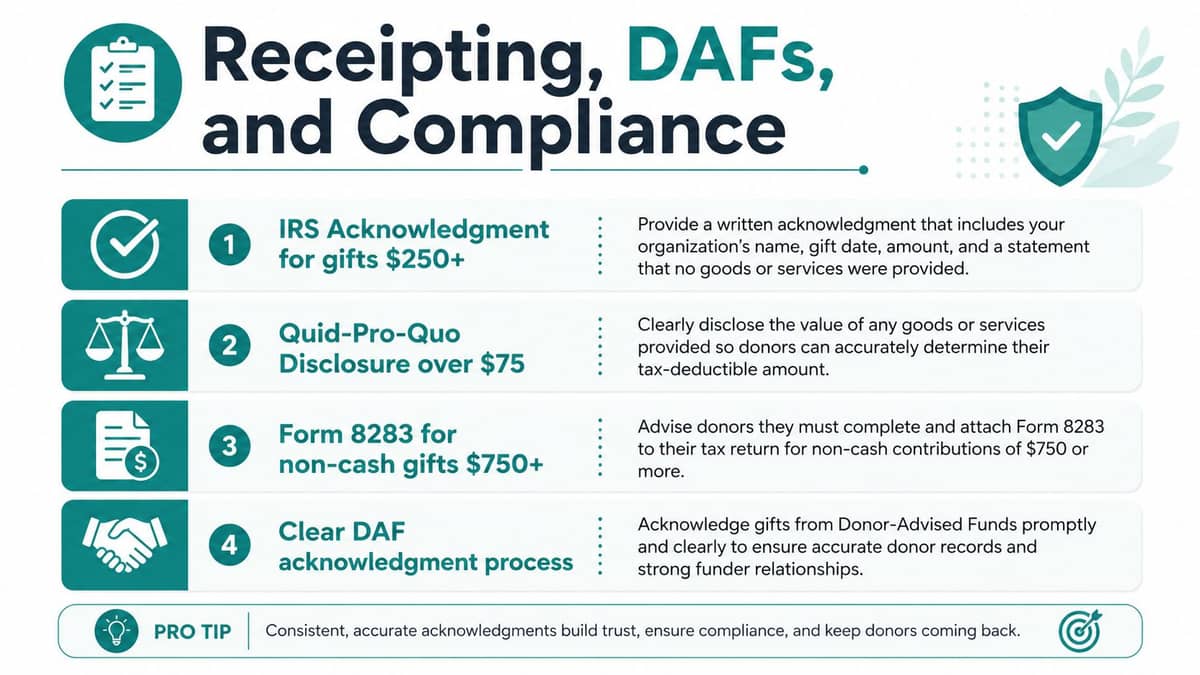
The IRS rules around acknowledgments and disclosures require careful handling. Confirm current requirements with your accountant or counsel, especially for unusual gifts, events, non-cash contributions, and state-specific obligations.
December 15 checklist
- Written acknowledgment: Review gifts of $250 or more and confirm the acknowledgment includes the information required for substantiation. The IRS explains donor-restricted endowments and related reporting in its Form 990 instructions.
- Quid-pro-quo gifts: Review payments where the donor received goods or services. Section 6115 disclosure requirements apply when the contribution includes a benefit, and your written process should identify the relevant threshold.
- Non-cash contributions: Flag non-cash gifts for the applicable reporting review, including Form 8283 requirements. Don't let staff make valuation judgments without qualified guidance.
- Restricted funds: Code donor restrictions at entry. Restricted and unrestricted money belong in separate fund categories, and restricted balances are released only when the donor purpose is satisfied (restricted funds and nonprofit accounting).
Handle DAF gifts deliberately
Donor-advised fund grants may arrive through a sponsoring organization rather than directly from the donor. Reconcile the sponsoring fund portal with bank deposits, preserve the grant documentation, and connect the gift to the donor record when the relationship is known.
DAF contributions reached roughly $89.6 billion to $90.6 billion in 2024 and 2025 reporting, with year-over-year increases of about 37% to 39%, according to HighGround Advisors' 2025 DAF report discussion. Treat that activity as an operational signal. Your team needs a DAF acknowledgment process, clear restricted-fund treatment, and a way to distinguish the sponsoring organization from the individual relationship.
Watch the calendar cutoff. A check dated December 31 may not be deposited until January 3, so don't promise a tax receipt based only on the date written on the check. Batch acknowledgments after deposits are confirmed, then complete a January pass for corporate match forms, coded acknowledgments, and state solicitation renewals.
For practical year-end statement preparation, review these year-end giving statements for nonprofits.
Tracking Results and Turning December Into Next Year
January shows whether December created donor relationships or only processed transactions. Review revenue alongside the actions that follow each gift. A campaign succeeds when new and returning donors continue participating after year-end urgency fades.
Track repeat gifts within 60 days, changes in average gift among upgraded donors, LYBUNT and SYBUNT groups, pledge fulfillment, and event-to-donor conversion. These measures connect giving behavior to the follow-up your team can deliver.
Set the January checkpoints
By January 10, record final revenue, channel attribution, and cost per dollar raised. Reconcile those figures with deposits and coded funds before presenting them to the board. Accounting records should support the campaign report, not sit in a separate file that staff must explain later.
By January 20, review messaging tests, board involvement, volunteer assignments, payment issues, and pledge fulfillment. Ask which tasks improved donor care and which consumed time without producing a clear operational benefit.
By January 31, refresh segments, assign stewardship journeys, and prepare a preview of the spring appeal. A donor who supported a restricted program should receive a relevant impact update, not a generic request for unrelated support.
The January thank-you is part of next December's campaign. Donors decide whether to return based on what happens after the gift, not only on the appeal that secured it.
Route every gift toward a next action
A first-time donor might receive a welcome message and program update. A recurring donor might receive a leadership thank-you call. A lapsed donor who renewed may need a personal acknowledgment that recognizes the return without overstating the relationship.
The operating requirement is a shared record across accounting, donor management, volunteers, events, and marketing. A platform that combines fund accounting, donor records, and year-end statement workflows can reduce manual reconciliation and keep receipting, restricted-fund tracking, and January follow-up connected. AlignMint is one option for this workflow, including tools that support year-end statements and acknowledgment processes.
The IRS Form 990 filing trigger for the full form commonly includes gross receipts of at least $200,000 or total assets of at least $500,000, while smaller organizations may qualify for Form 990-EZ or Form 990-N (nonprofit accounting and Form 990 guidance). Clean records make that filing work easier and help the board trust the campaign figures.
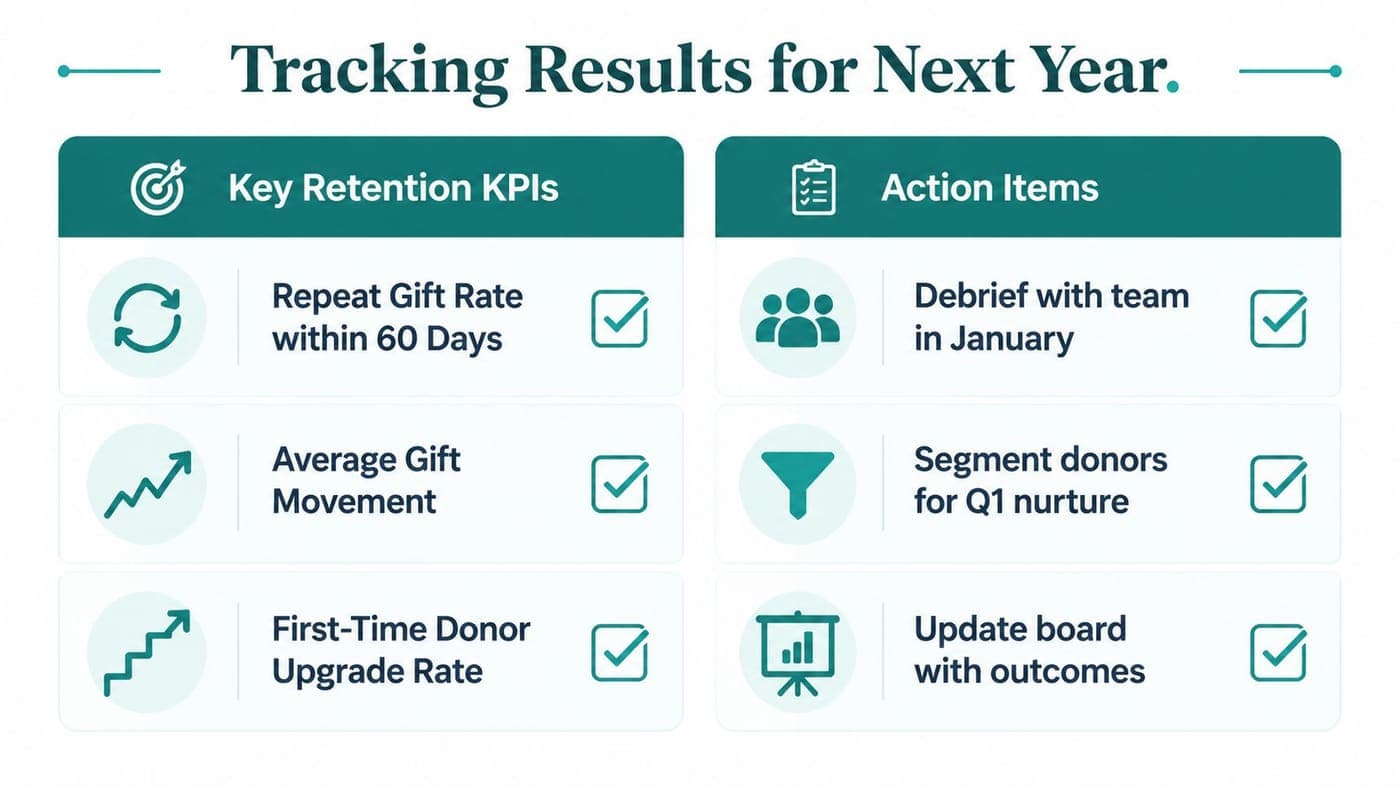
Your board report should show more than the final total. Explain which segments renewed, which channels produced qualified donors, which gifts remain unfulfilled, and what January stewardship happens next. That turns end of year giving into a repeatable operating discipline that survives the December rush.
Ready to try AlignMint with your nonprofit?
Start free — set up donor tools, giving pages, and Minty. Upgrade when you need accounting.