

Mastering the Art of the Ask for Fundraising Success
An executive director leads a thoughtful tour, answers every question, and senses genuine interest. Then the donor smiles, says they'll think about it, and leaves without ever hearing what their gift could accomplish.
Quick Answer: The Art of the Ask
The art of the ask is naming a specific gift at the moment a donor is ready. Research the prospect, match the amount to trust and capacity, then follow the commitment through a receipt and a next conversation.
Start with how to raise money for your nonprofit and fundraising. For timing, see donor life cycle.
Why the Ask Is Where Giving Actually Happens
You've probably lived this scene. You introduce a donor to your program, explain the need, share a moving story, and build real rapport. Then the conversation reaches its natural pause, and nobody names a gift.
That pause doesn't usually mean rejection. More often, the request was too vague, poorly timed, or never stated clearly. Donors can't respond to an invitation that remains hidden inside a general conversation about your mission.
The ask is the conversion moment. It's where a donor's interest, trust, and generosity become a financial commitment. A strong conversation matters, but it doesn't fund the program by itself.
The National Arts Council of Singapore describes the ask as a critical part of a well-designed fundraising scheme and frames it as part art and part science. Its fundraising toolkit recommends researching the prospect, reviewing donation history, setting a target, rehearsing the request, and then making a specific ask.
That sequence respects both sides of the exchange. You prepare carefully, then give the donor a clear opportunity to decide.
Practical rule: If the donor doesn't know what you're asking for, they can't give you a meaningful answer.
Good fundraising also leaves room for joy. A thoughtful resource on biblical joy in giving offers useful perspective on generosity as a willing response rather than a pressured transaction. Your job isn't to manipulate that response. Your job is to make the opportunity clear, credible, and easy to accept.
If you're refining your broader campaign plan, review this practical guide to how to raise money for your nonprofit. Then treat every ask as a designed journey, not a nerve-wracking final sentence.
The Five Stages Every Strong Ask Shares
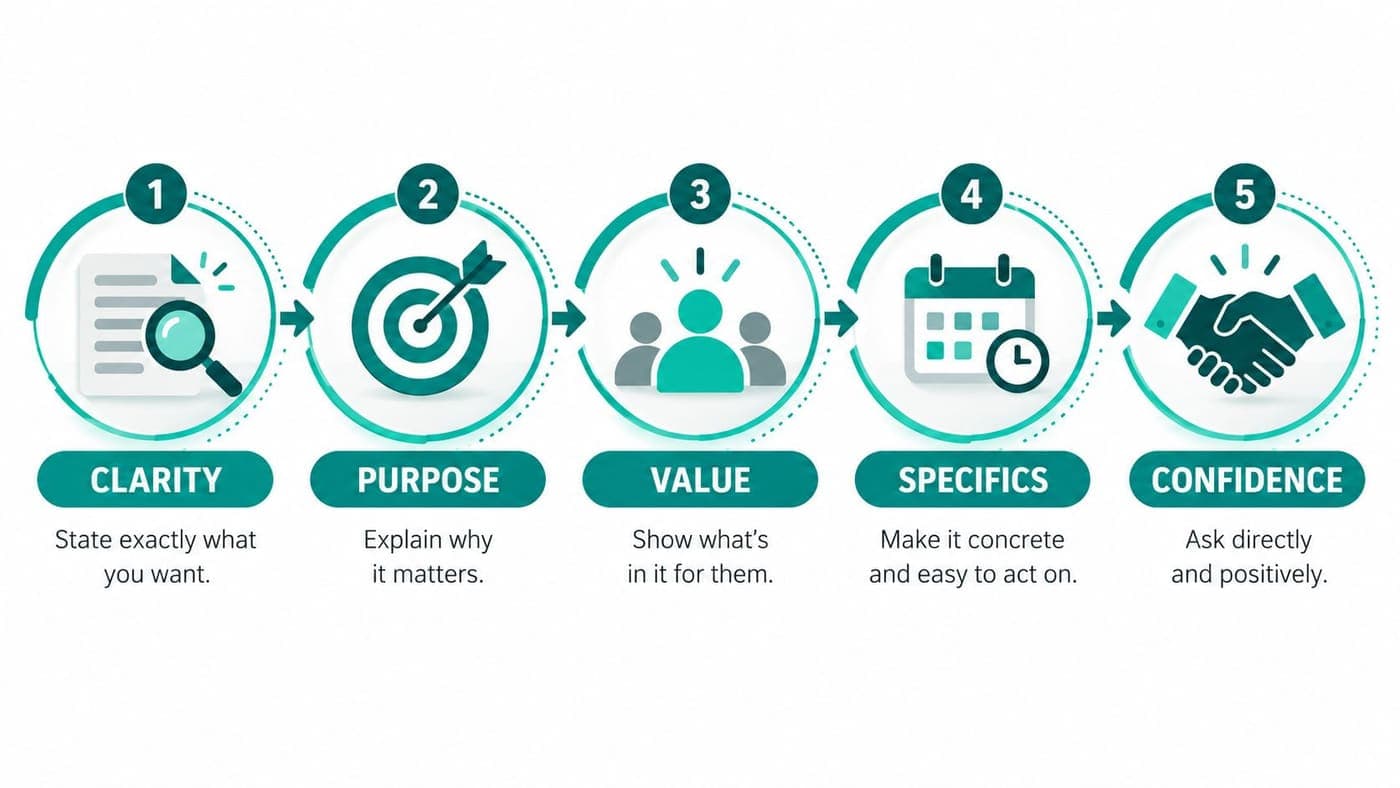
Effective asks look different across a campaign, but the underlying sequence stays consistent. You research, build trust, frame the opportunity, request a specific gift, and close with clarity.
Blackbaud's fundraising guidance recommends an undisturbed 20–30 minute meeting, asking in pairs when possible, and making the request after cultivation and prospect research. It also recommends a specific dollar amount, a pause after the request, and prompt follow-up after a pledge, as outlined in its guidance on the art of the ask.
Start with evidence, not assumptions
Research the prospect. Pull giving history, previous campaign responses, stated interests, event attendance, and notes from your CRM. Confirm what the donor has supported before, then look for capacity signals you can reasonably verify.
Cultivate with purpose. Don't fill calendars with pleasant but directionless meetings. Learn what the donor cares about, answer practical questions, and notice whether they engage with the problem and your proposed solution.
Frame the case in one sentence. Write a sentence that connects the donor's interest to a specific outcome. For example, “Your support would help us keep our after-school tutoring available to students who need consistent academic support.”
Name the gift and leave space
Make the request plainly. “Would you consider a gift of $5,000 to support this program?” is stronger than “We'd appreciate anything you can do.” A specific number gives the donor something concrete to evaluate.
Close with the next step. After asking, stop talking. If the donor needs time, agree on when you'll reconnect. If they pledge, confirm the amount, timing, payment method, and the person responsible for recording the commitment.
Many fundraisers handle the first four stages and then become uncomfortable at the close. They explain more, soften the request, or rush to fill silence. Resist that impulse.
For event-based fundraising, Live Tourney's revenue tips can help you think beyond the ticket and design opportunities around participation, sponsorship, and added support. The same principle applies to every channel. Build a clear path to action before you invite someone to take it.
Your CRM should preserve the whole journey, from first contact through renewal. A clear donor life cycle helps your team see whether a prospect is ready for a request or still needs meaningful cultivation.
Choosing the Right Channel for Each Donor
The right medium depends on the relationship, not on what's easiest for the fundraiser. A major-gift prospect who knows your work deserves a conversation. A recent event attendee may respond well to a concise email with a relevant giving page.
The available evidence makes the relationship point clear. A fundraising textbook excerpt reports response rates of about 50% when solicitors ask people they already know, compared with about 15% when they personally ask people they don't know. It reports direct mail at around 1% and phone solicitation at about 5%, as described in this fundraising textbook excerpt.
| Channel | Typical Response Rate | Best Donor Fit | Ideal Use Case |
|---|---|---|---|
| In person | About 50% when the solicitor knows the donor | Warm or loyal major-gift prospects | A focused request tied to a defined program |
| Phone | About 5% | Warm donors who prefer conversation | Renewal, clarification, or a timely campaign request |
| Varies by list and relationship | Broad audiences and active supporters | A specific appeal linked to a matching donation page | |
| Text | Varies by consent and engagement | Donors who already communicate by text | A short reminder, deadline, or low-friction gift request |
| Personalized video | Varies by relationship and execution | Lapsed or mid-level donors who recognize your team | A personal reintroduction and focused renewal invitation |
The table offers direction, not a guarantee. Response depends on trust, relevance, timing, consent, and the clarity of your request.
Match tone to the medium
In person, slow down and listen. Your tone should be confident but conversational, with enough room for questions.
On the phone, open by asking whether the donor has a moment. Keep your case focused, then make the request before the conversation drifts.
Email needs a clear subject, a short impact statement, one requested action, and a donation page that matches the appeal. Text should be even shorter. Don't send a paragraph when one sentence and a trusted link will do.
Personalized video works best when it feels like a direct note, not a campaign advertisement. Mention the donor's relationship to your organization, explain the immediate opportunity, and make the next step obvious.
Use online donation requests for nonprofits to strengthen the digital path from message to gift. Your routing rule should consider gift size, recent contact, and donor preference. If the donor has high trust and a substantial potential gift, schedule a conversation. If trust is developing, use a personal digital touchpoint before asking.
Matching Ask Size to Donor Capacity and Trust
Ask size should reflect what you know, not what you hope. A donor's past giving, stated interests, capacity signals, and relationship with your organization should shape the request.
Use the following tiers as a working framework:
- Under $500: Keep the request simple and concrete. Connect the gift to a clear, understandable outcome, and remove unnecessary steps.
- $500 to $5,000: Add context about the program, the donor's interests, and the role their support can play. A phone call, personal email, or small-group conversation may fit.
- $5,000 and above: Prepare carefully. Confirm the donor's interests, capacity, decision process, and preferred relationship before presenting a substantial proposal.
These ranges are decision tools, not rigid rules. A loyal donor with modest past gifts may be ready for a stretch request. A wealthy prospect with little relationship to your organization may need a smaller first commitment.
Let trust determine specificity
For a cold relationship, focus on relevance and permission. Don't force a major proposal into an introduction. Offer a useful conversation, invite questions, and leave the door open if the donor isn't ready.
For a warm relationship, connect the request to what the donor has already expressed. Ask for a defined amount and explain how the gift fits the program.
For a loyal relationship, make the request confidently. Don't undersell the opportunity just because you're nervous. Asking a high-capacity supporter for too little can signal that you don't understand their interests or the scale of the need.
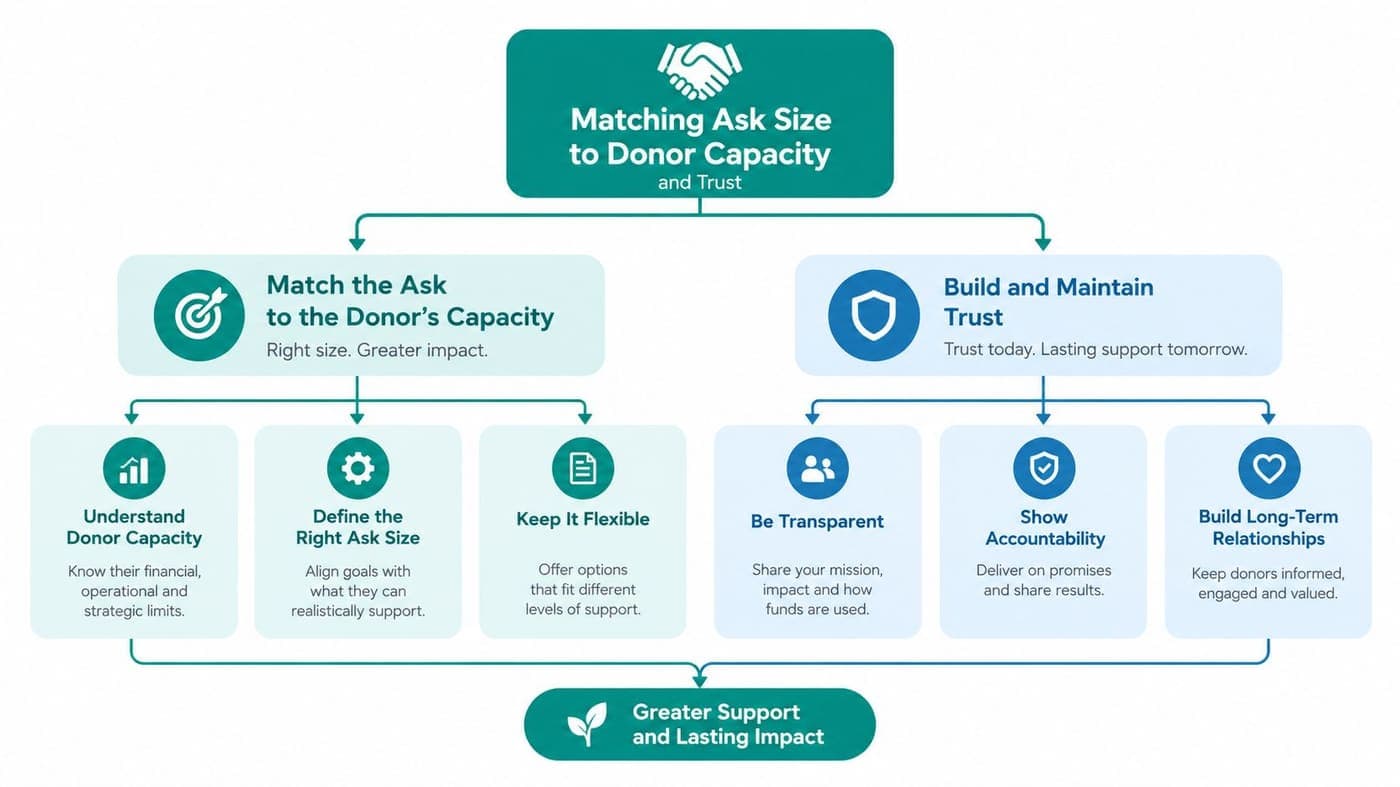
Suppose your initial plan calls for a $10,000 ask during a first major-gift conversation. If your research confirms capacity but the relationship is still new, recalibrate to $2,500 and frame it as an initial commitment to a defined project. You're not shrinking the mission. You're matching the request to the trust you've earned.
If the donor signals interest but uncertainty, don't pressure them into an immediate decision. Agree on the information they need, set a follow-up date, and deliver exactly what you promised.
A good donor management system should make that judgment easier by keeping history, notes, interests, and commitments together. Your team can then distinguish a donor who needs more trust from one who only needs a clearer proposal.
Scripts That Sound Human, Not Pushy
A script should support your confidence, not replace your judgment. Write the essential language beforehand, rehearse it aloud, and then speak naturally enough to listen.
A first ask to a new prospect
Weak version: “We're doing some important work in the community, and we'd love for you to be involved in any way that feels comfortable.”
Stronger version: “You mentioned that youth access matters to you. Would you consider a gift of $500 to help provide tutoring support this season?”
The stronger version names the donor's interest, connects it to an outcome, and gives the donor a specific decision. It doesn't claim that one gift solves the entire problem.
A renewal ask to a lapsed donor
Weak version: “We haven't heard from you recently, but we hope you'll consider supporting us again.”
Stronger version: “Your previous support helped us keep this program available. Would you renew with a gift of $250 this year?”
A lapsed donor doesn't need a guilt trip. They need a reason to reconnect and a clear way to do it. If the donor has engaged through email but not events, send a personal message with a matching donation page rather than insisting on a meeting.
A major-gift ask for a long-time supporter
Weak version: “You've been such a wonderful friend, and there are so many things we need. Anything you can do would mean a lot.”
Stronger version: “You've consistently supported this work, and I'd like to invite you to consider $10,000 for the program expansion. Would you be willing to discuss that commitment?”
The second version respects the relationship by being direct. It also gives the donor room to respond without assuming agreement.
Avoid three habits that make good intentions sound uncertain:
- Over-explaining: State the case, then stop adding reasons.
- Apologizing: Don't say you're sorry to ask. Fundraising is part of your responsibility.
- Trailing off: Finish the sentence, name the amount, and ask for a response.
Your body language should match your words. Sit still, keep comfortable eye contact, speak slightly slower than normal, and pause for five seconds after the request.
Don't rescue the donor from the silence. Give them the dignity of a thoughtful answer.
Your written language should sound like your spoken language. Resources such as Exerta's brand voice examples can help your team develop consistency, but no style guide can replace sincerity. Adapt the script to the donor in front of you.
Following Up So the Gift Sticks
The follow-up is half the ask. A donor who receives a warm request but an uncertain response may question whether your organization can manage the commitment.
Start by recording the outcome immediately. Note the amount discussed, the donor's response, the promised information, the preferred channel, and the next action. If the donor pledges, track the commitment separately from the received payment.
A practical 14-day sequence
Day of the ask: Thank the donor for the conversation and confirm what you agreed. Log the result in the CRM before the day ends.
Within 48 hours: Send the receipt or tax acknowledgment when the gift has been received, and confirm the pledge details when payment will follow.
Early follow-up: Share the promised budget detail, program information, or decision material in the format the donor requested. Don't send a generic packet if they asked one specific question.
Mid-sequence contact: Use a brief email, text, or personal video based on the donor's preference. A short Video Blast or one-to-one video thank-you can make the follow-up feel personal without requiring another meeting.
Final touchpoint: Confirm the next conversation, close the loop respectfully, or move the donor into stewardship. Don't keep sending reminders after the donor has clearly declined.
Your team should also connect the gift to the next meaningful update. If you promised a program report, schedule it. If the donor wants renewal information, create the reminder while the conversation remains fresh.
For wording and timing, keep your donation acknowledgement letters specific and warm. A receipt proves that money arrived. A good acknowledgment reminds the donor why their decision mattered.
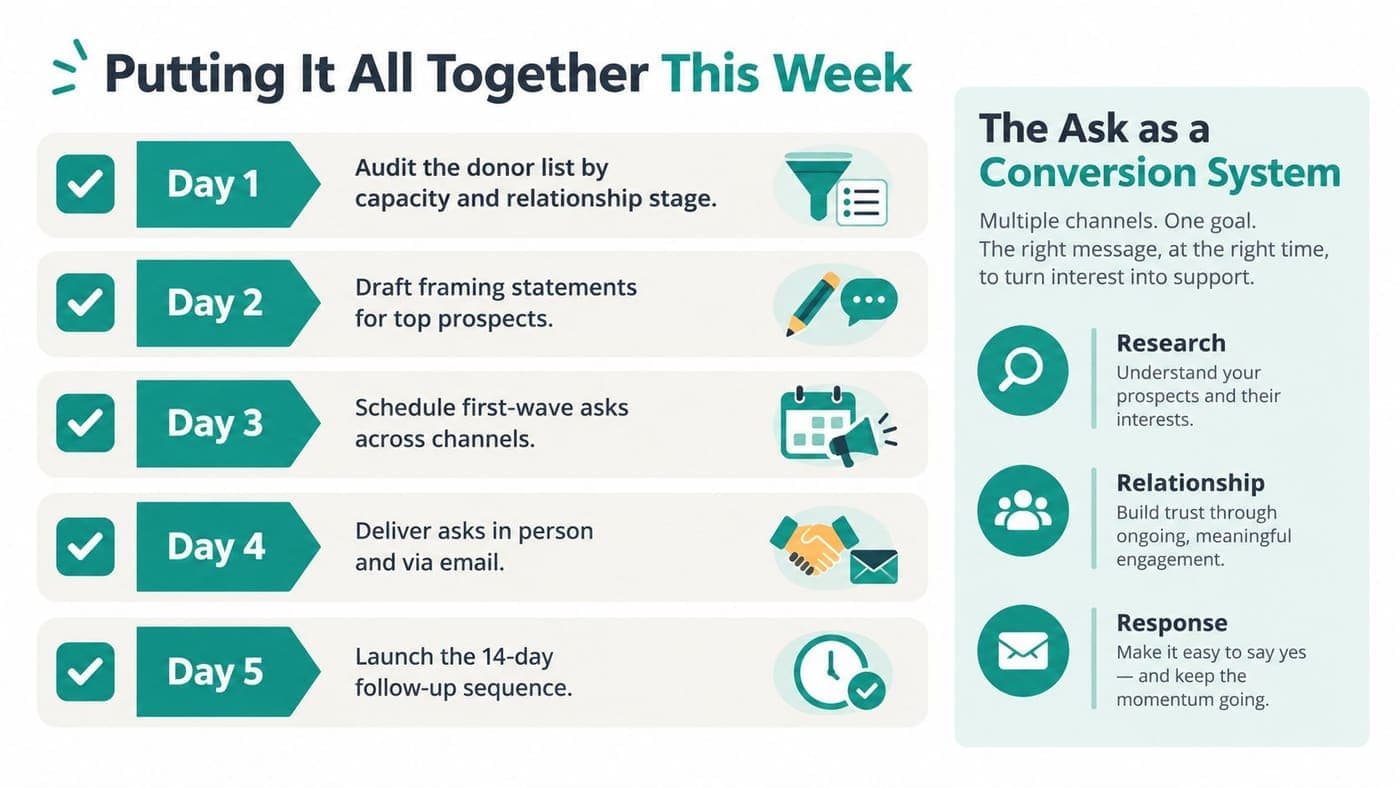
A conversion system doesn't require expensive software. It requires one reliable record, clear ownership, and a team habit of completing the next action.
Putting It All Together This Week
Stop treating the ask as one dramatic conversation. Your fundraising team needs a repeatable system that connects research, relationship, channel choice, request language, payment, and stewardship.
The system can begin this week.
Day one and day two
On Day 1, audit your donor list by capacity and relationship stage. Separate cold prospects, warm supporters, loyal donors, lapsed donors, and people who have recently engaged through events or digital channels.
On Day 2, draft channel-specific asks for your priority prospects. Write one sentence explaining the impact, one sentence naming the request, and one sentence confirming the next step. Keep each version natural enough to say aloud.
Day three through day five
On Day 3, record short personalized videos for top prospects who are likely to respond well to a direct digital touchpoint. Use the donor's name, reference the relevant relationship, and avoid turning the message into a general campaign announcement.
On Day 4, send the first wave of asks on a staggered schedule. Add CRM tags, record the chosen channel, and queue pledge-tracking entries before responses arrive.
On Day 5, issue receipts and thank-yous, schedule follow-up reminders, and assign renewal or stewardship ownership. Don't let a successful ask disappear into an inbox or a spreadsheet.
The software behind your process should fit the work. Salesforce offers broad CRM customization, Bloomerang emphasizes donor retention and engagement, Blackbaud supports complex fundraising operations, and QuickBooks remains familiar for general bookkeeping. Those tools have real strengths, but organizations should check whether they provide true fund accounting, volunteer workflows, event tools, marketing, and donor records in one operating view.
AlignMint combines accounting, CRM, volunteers, events, and marketing in one nonprofit platform. It includes true fund accounting rather than QuickBooks classes, a built-in marketing suite, online giving pages, donor records, pledge tracking, and Minty AI for questions about your organization's data. It also offers plan-based access without per-seat fees and a free tier for nonprofits under $100K.
Use this checklist before the weekend:
- Preparation: Review giving history, interests, capacity signals, and recent engagement.
- Channel choice: Match the medium to relationship strength and donor preference.
- Ask size: Choose a specific amount that reflects what you know.
- Script review: Remove apologies, vague language, and unnecessary explanation.
- Follow-up: Assign the next action and schedule the 14-day sequence.
- Stewardship handoff: Record the outcome, issue acknowledgments, and schedule promised updates.
The art of the ask becomes easier when your team stops relying on courage alone. Build the preparation, channel, request, and follow-through into normal operations, then improve the system after every campaign.
AlignMint brings fund accounting, donor management, volunteers, events, marketing, online giving pages, and team communication into one platform. Visit AlignMint to see how your nonprofit can keep every ask, pledge, receipt, and stewardship action connected.
Ready to try AlignMint with your nonprofit?
Start free — set up donor tools, giving pages, and Minty. Upgrade when you need accounting.