
A major donor calls with a simple question: what did my last gift support, and who followed up afterward? You search the spreadsheet, open the accounting file, check email, and still can't find the full story.
That delay signals a deeper problem. Disconnected tools create trust gaps, missed follow-up, and uncertain revenue. This guide shows how donor management can connect finance, fundraising, stewardship, and reporting, so you can honor donor intent while saving your team time.
Quick Answer: Donor Management That Keeps Donors Giving
Donor management keeps more donors giving when the gift, restriction, receipt, and next follow-up live on one relationship record. First-year retention is the weakest point, so the first thank-you has to be fast and accurate.
Start with donor management and stewardship of donors. For retention tactics, see how Minties drive donor retention.
Introduction Why Donor Management Decides Whether Donors Stay
A donor asks what their latest gift supported. Your team should answer without searching separate spreadsheets, inboxes, and accounting files. If the answer takes too long, the delay can weaken confidence in the organization.
Donor management connects the finance-to-fundraising workflow behind that answer. It brings contact details, giving history, receipts, pledges, recurring gifts, communications, notes, and fund assignments into one working relationship record. A system such as AlignMint's donor management feature connects these details with the broader operating picture.
Retention matters more than constant acquisition
New donors help a nonprofit grow, while retained donors make fundraising more dependable. Overall donor retention has hovered around 43% to 46% in most years. That means roughly 54% to 57% of donors from the previous year do not give again the following year, according to independent nonprofit donor retention benchmarks.
First-time donors are especially vulnerable. Their retention typically reaches only 19% to 26%. The gap makes the first gift a handoff point, not a completed transaction. Prompt follow-up, relevant stewardship, and clear reporting should begin immediately.
The connected workflow
A reliable donor system should help your team:
- Recognize the relationship: Review a donor's history before making contact.
- Honor the restriction: Link each gift to its intended fund or program.
- Complete the follow-up: Send receipts, thank-you messages, and reminders automatically.
- Prove the impact: Show how contributions supported approved work.
- Measure the outcome: Monitor retention, recurring giving, pledges, and lapsed relationships.
True fund accounting keeps donor intent aligned with available funds. Automatic receipting confirms that a gift was recorded. A donor portal gives supporters a clear place to review information and stay connected. Together, these functions close the trust gap that often turns a missed detail into donor churn.
The goal is a system your team can explain, use, and rely on, not more technology for its own sake.
What Donor Management Really Means for Your Nonprofit
Think of a donor relationship as a journey rather than a spreadsheet row. A spreadsheet may tell you that someone gave, but donor management helps you understand what happened before and after that gift.
The journey begins with a first contribution. You acknowledge it, record its purpose, learn how the donor prefers to communicate, and invite a second interaction. Over time, that person may become a repeat donor, monthly donor, major donor, volunteer, event participant, or advocate.
One relationship, several connected records
A generic contact list answers basic questions such as name, email address, and phone number. A donor-centric CRM answers more useful questions:
- Giving: What did this person give, when, and through which campaign?
- Intent: Was the contribution unrestricted, restricted, pledged, or recurring?
- Stewardship: Who thanked the donor, what did they say, and what should happen next?
- Engagement: Has the donor volunteered, attended an event, or opened campaign messages?
- Finance: Which fund received the gift, and what balance remains available?
That connection changes daily work. Before calling a long-time supporter, you can review the relationship without asking three colleagues to search separate files. Before sending an impact update, you can filter recipients by the fund or program they supported.
This also improves forecasting. A list of total gifts describes the past, while a connected record helps distinguish likely recurring income from one-time giving and outstanding pledges. You still need judgment, but your judgment starts with organized evidence.
Why donor intent belongs beside finance
Donors trust organizations that handle their gifts carefully and explain the results plainly. If your fundraising team promises a restricted use while finance tracks the contribution elsewhere, staff can lose the connection between the promise and the expense.
That's why donor management should connect directly with true fund accounting. Restricted funds, programs, grants, and designations should remain visible throughout the gift's life, rather than being recreated later through manual labels.
Core job: Donor management helps your organization remember every promise, complete every follow-up, and show what each gift made possible.
How to Segment and Steward Donors So They Keep Giving
A donor who gave yesterday needs different attention from someone who has funded your work for years. Sending both the same message wastes staff time and can make the relationship feel impersonal.
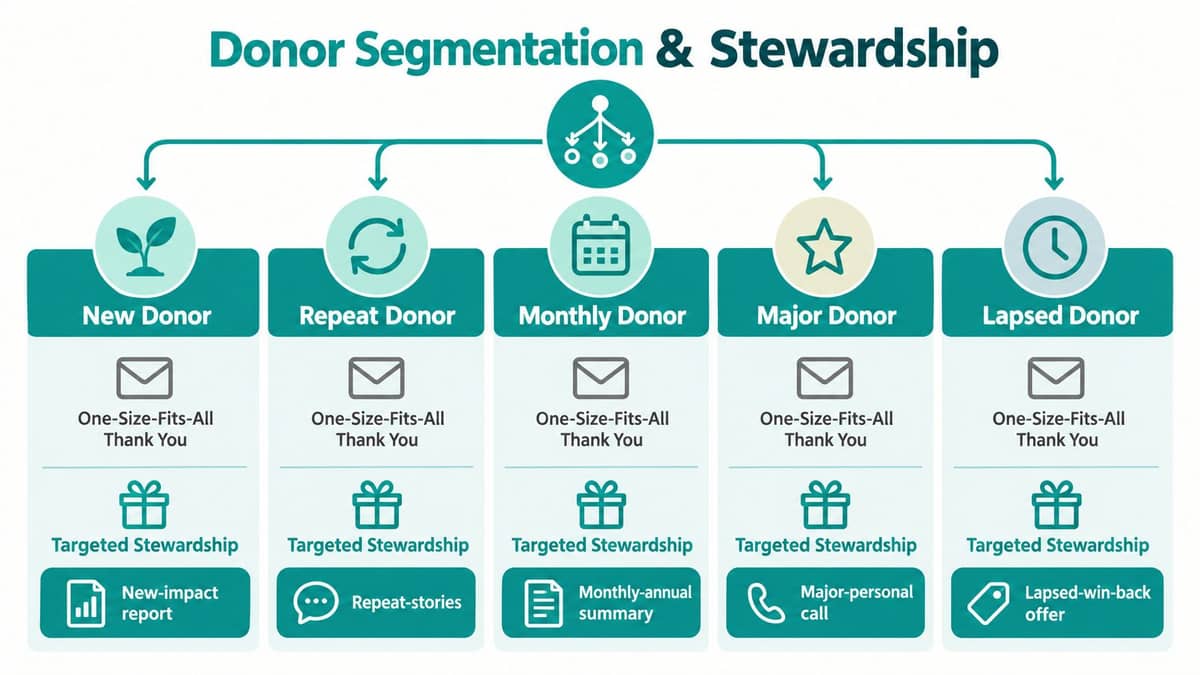
Start with five practical groups: new, repeat, monthly, major, and lapsed donors. The categories can stay simple. What matters is defining each group clearly, linking it to a specific action, and keeping the record current.
Match the message to the relationship
| Donor segment | Useful stewardship action |
|---|---|
| New donor | Send a prompt receipt, personal thanks, and a brief impact explanation |
| Repeat donor | Recognize continued support and share a relevant program story |
| Monthly donor | Provide a cumulative update and confirm payment details when needed |
| Major donor | Assign personal contact and connect giving with specific outcomes |
| Lapsed donor | Ask what changed, share recent progress, and offer a relevant reason to return |
With first-time retention far below overall retention, the first follow-up should be immediate, personal, and connected to the donor's reason for giving.
A new donor might receive a receipt followed by a short message about the program they supported. A major donor may need a call from you rather than another automated email. A lapsed donor deserves a thoughtful invitation back, based on recent progress and a relevant reason to return.
Stewardship works best when fundraising and finance share the same context. The donor's intent, designation, and giving history should remain visible, so a follow-up reflects both the relationship and the gift's purpose.
Make segmentation manageable
Your built-in marketing suite can turn these groups into communication lists and workflows. AlignMint AI can help staff find records that need attention, summarize donor history, and identify follow-up questions from existing data. Staff still decide what the relationship requires.
The broader idea also appears in lead management for SMBs: organize people by relationship stage, record the next action, and avoid treating every contact alike. For nonprofits, the outcome is a stewardship plan grounded in donor intent rather than a generic campaign calendar.
Use this practical guide to donor stewardship for sample rhythms and clearer follow-up responsibilities. The system should reduce repetitive work while leaving judgment, empathy, and personal contact with your team.
Practical rule: Segment first by relationship behavior, then tailor the message to the donor's intent.
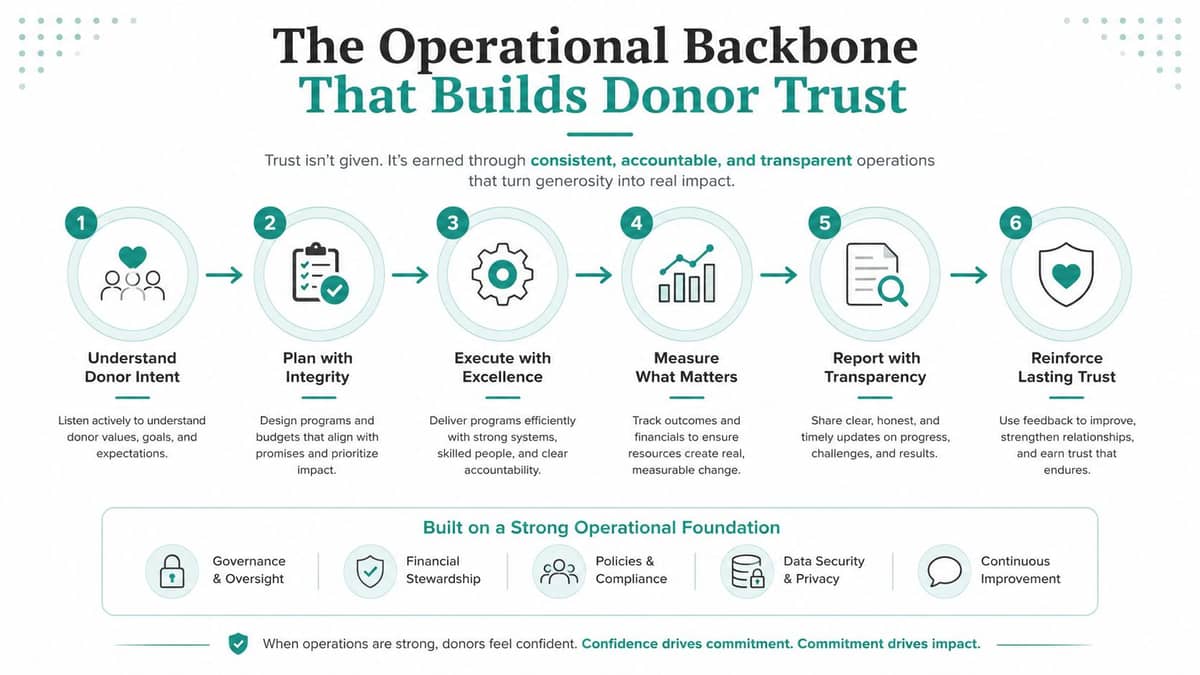
The Operational Backbone That Builds Donor Trust
Good stewardship fails when the underlying work remains manual and uncertain. A thank-you plan means little if receipts arrive late, pledges disappear, or finance can't confirm which fund received the money.
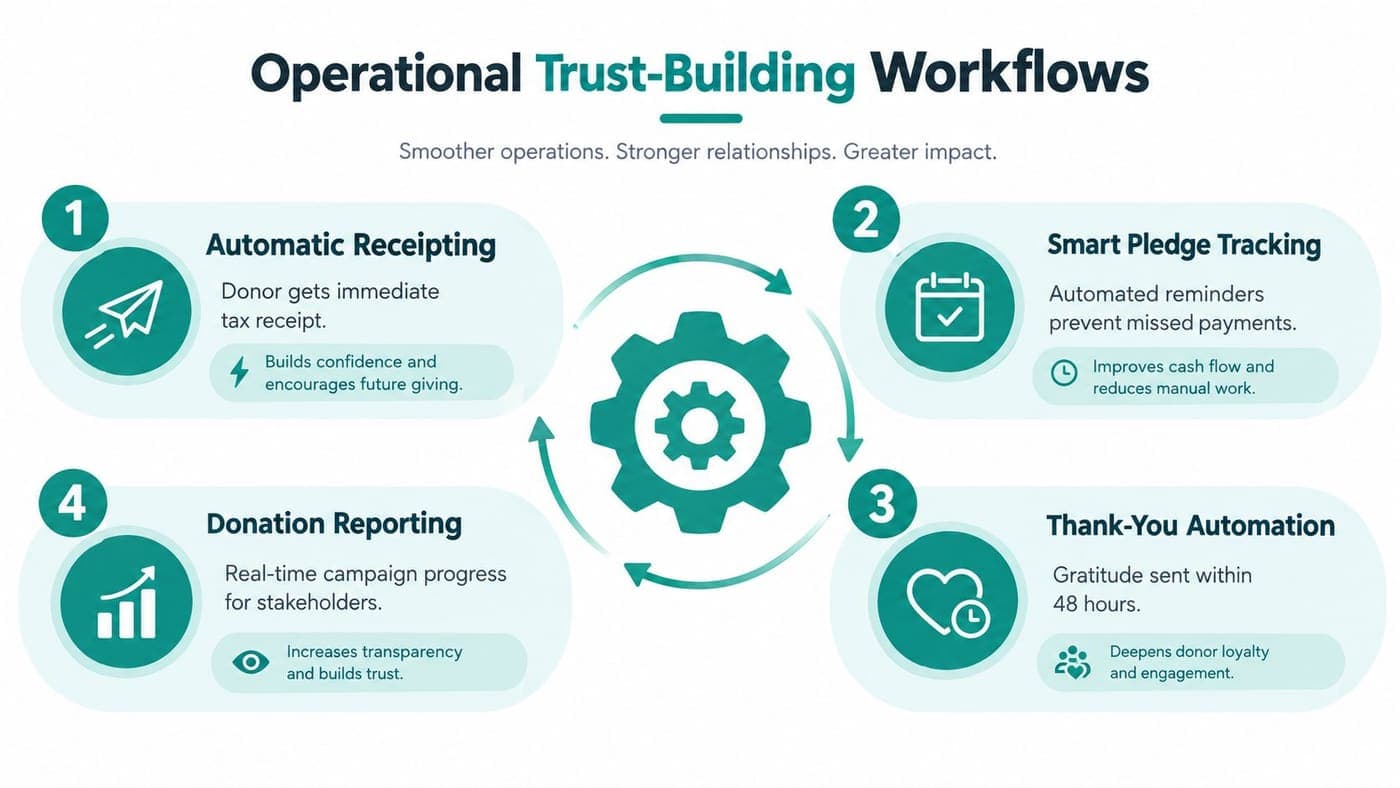
Four workflows create a dependable operating backbone. Each one gives donors a clearer experience and gives your staff fewer opportunities to miss an important detail.
Automatic receipting creates immediate confidence
A donor should receive a clear receipt after giving, with the correct amount, date, designation, and organizational information. Automatic receipting reduces the chance that a staff member forgets a confirmation during a busy campaign.
The receipt isn't the full thank-you. It confirms that your organization received the contribution and recorded it correctly. A separate stewardship message can then explain what happens next.
Pledge tracking protects commitments
Pledges often involve future payments, agreed schedules, and personal follow-up. A system should show what was promised, what arrived, what remains outstanding, and which reminder belongs to whom.
That visibility protects both sides. Your team can follow up without guessing, while the donor avoids receiving confusing requests about a commitment already fulfilled.
Portals give supporters useful control
A donor self-service portal can let supporters review giving history, manage recurring gifts, update details, and access relevant information. It also reduces routine requests that otherwise interrupt a small development team.
Self-service doesn't remove personal contact. It gives donors control over simple tasks, leaving your staff more time for conversations requiring judgment and care.
Reconciliation connects trust with accounting
Direct bank-feed reconciliation helps match deposits to gifts and funds. That connection matters most when one campaign includes unrestricted contributions, restricted gifts, grants, or program-specific support.
True fund accounting keeps resources separated by donor restriction or organizational designation. Restricted gifts stay in a restricted category until the stated purpose or time condition is satisfied, then the organization releases them to unrestricted net assets before recognizing the related expense, as explained in this guide to nonprofit bookkeeping and fund accounting.
The fund accounting explanation for nonprofits provides a useful foundation for reviewing whether your current donor and finance records tell the same story.
One 2025 donor-expectations study found that 24% of donors stopped giving because they lacked transparency about how contributions were used, while a 2025 analysis reported overall retention at 42.9%, as documented by Media Cause's donor retention analysis.
AlignMint's model includes accounting, CRM, volunteer management, events, marketing, online giving pages, and team communication in one platform. It also provides plan-based access without per-seat fees, which can help a small nonprofit include finance, fundraising, program, and leadership staff in the same workflow.
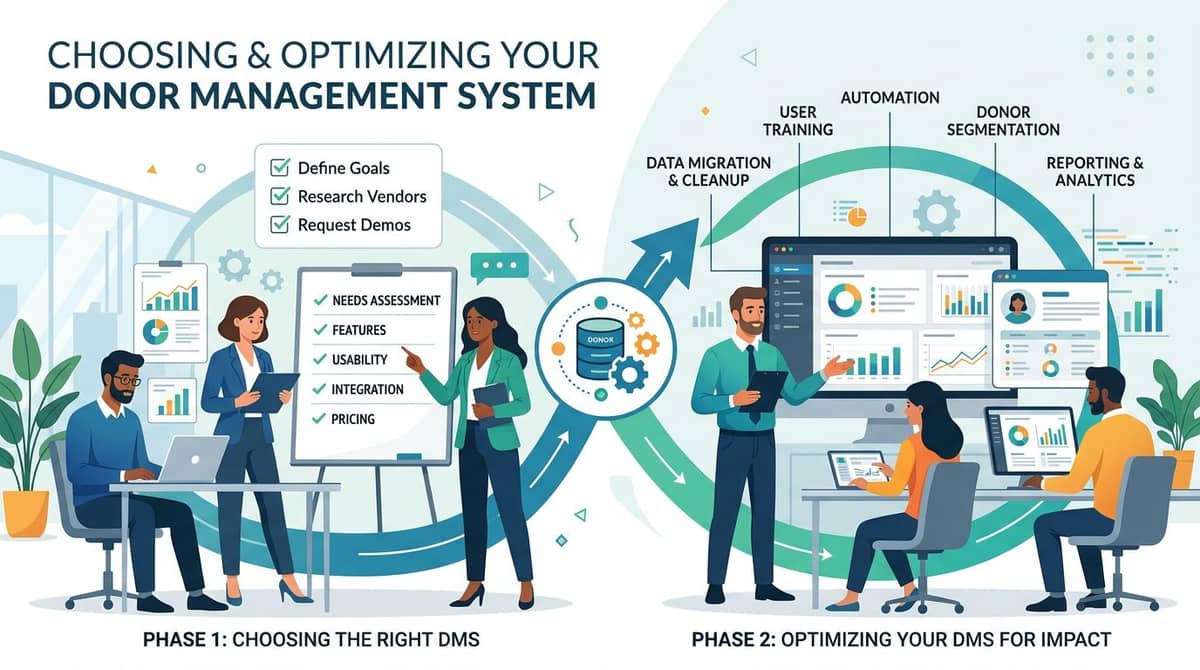
Choosing or Optimizing Your Donor Management System
The right system depends on the work you need to connect. Bloomerang is known for an approachable interface and donor engagement features. DonorPerfect serves many small and midsized nonprofits with donor tracking and fundraising tools. Blackbaud supports complex fundraising operations and large databases.
Those strengths may fit your organization. The question is whether your finance records, donor records, volunteer activity, events, and marketing work together without repeated exports or separate logins.
Compare the workflow, not just the feature list
| Capability | What to Look For | Why It Matters |
|---|---|---|
| Fund accounting | Native restricted funds, programs, grants, and designations | Finance can show what money remains available |
| Receipting | Automatic receipts tied to the donor record | Donors receive accurate confirmation promptly |
| Donor portals | Gift history, recurring giving, and profile updates | Supporters manage routine details themselves |
| Finance integration | Bank feeds, reconciliation, and shared gift records | Fundraising and accounting report the same facts |
| Pricing | Clear pricing, plan-based access, and a free tier for nonprofits under $100K | Small teams can involve everyone without surprise seat costs |
Some donor systems connect well with accounting partners rather than including true fund accounting natively. Others provide strong marketing or event tools but require another platform for financial controls. A careful vendor comparison for CRM systems can help your team frame the decision around requirements instead of attractive demonstrations.
Test the system with real questions
Ask each vendor to show how you'd answer these questions:
- Gift purpose: Which restricted fund received this donor's contribution?
- Outstanding pledge: What remains due, and who owns the next contact?
- Second gift: Which first-time donors have not yet received a relevant follow-up?
- Volunteer connection: Which donors also serve at programs or events?
- Financial report: Can staff trace a campaign total into the correct accounting records?
Recurring giving deserves particular attention. Recurring donors can be retained at roughly 79%, compared with about 32% for one-time donors, while monthly donor retention averages 71% after 12 months and 54% after 24 months. New one-time online donors retain at around 24%, according to recurring giving benchmark reporting.
That advantage doesn't excuse weak payment follow-up or poor stewardship. Your system should make recurring gifts visible, reliable, and easy for donors to manage.
For a smaller organization evaluating options, donor management software for small nonprofits offers another useful comparison point. AlignMint combines accounting, CRM, volunteers, events, marketing, and online giving, with a free tier for nonprofits raising under $100K.
Metrics That Tell You If Your Donor System Is Working
You don't need dozens of metrics to manage donor health. You need a small set that shows whether relationships continue, commitments arrive, and staff act before a donor disappears.
Start with retention by unique donor identity, not gift count. The calculation is:
Retained donors ÷ prior-period donors × 100
A donor who makes several gifts should still count as one retained donor. Otherwise, a handful of active supporters can make performance look healthier than the full file.
Separate the groups that behave differently
Track retention separately for new, repeat, monthly, and major donors. Overall retention typically sits around 43% to 45%, while first-time retention is much lower at roughly 14% to 25%, according to nonprofit fundraising benchmark guidance.
That separation helps you find the cause rather than merely observe the result. If monthly retention remains healthy but new donor retention drops, improve first-gift follow-up. If major donor retention weakens, review personal contact, reporting, and relationship ownership.
Other useful operating measures include:
- Second-gift timing: Identify how long first-time donors take to give again, then design follow-up around the observed pattern.
- Pledge fulfillment: Compare promised payments with received payments and assign clear responsibility for reminders.
- Recurring gift health: Watch active commitments, failed payments, cancellations, and donor requests.
- Lapsed donors: Create a review list before the relationship disappears from staff attention.
- Fund reporting: Confirm that campaign and donor communications match the fund activity finance can support.
The recurring giving health report can help leaders discuss recurring relationships using shared definitions rather than isolated payment records.
Connect fundraising metrics with compliance
Form 990 filers must complete Part IX, the Statement of Functional Expenses. The IRS requires totals across program service, management and general, and fundraising expenses, and it requires a Schedule O explanation for line 24e miscellaneous expenses when that amount exceeds 10% of total functional expenses, according to the IRS Form 990 instructions and form.
The University of Iowa explains that nonprofit organizations need expenses classified by both nature and function, with a separate Statement of Functional Expenses when the Statement of Activities doesn't provide both views, as described in its nonprofit financial statement guidance.
Your donor system won't replace financial judgment. It can, however, help keep gift, fund, program, and expense information connected enough for trustworthy reporting.
Your Next Step to Stronger Donor Relationships
You can improve donor management without beginning with a software replacement. Begin with the donor experience your organization wants to provide, then check whether your current records support it.
Use this short review with your finance and fundraising leads:
- Find one donor: Can you see gifts, restrictions, receipts, pledges, notes, and next steps together?
- Trace one gift: Can you follow it from the giving page through the bank and into the correct fund?
- Review one segment: Can you identify new, monthly, major, and lapsed donors without manual sorting?
- Test one promise: Can you show a donor how their contribution supported the designated work?
- Check one report: Can leadership understand retention and pledge fulfillment without rebuilding spreadsheets?
- Name one owner: Does every follow-up task have a person responsible for completing it?
Your communication should sound personal because the record behind it is personal. Resources such as guidance on relationship emails can help your team write warmer messages, but the message still needs accurate donor context.
A connected donor journey framework can help you map the stages from first gift through recurring support, major giving, volunteering, and reactivation. The strongest system then connects that journey to true fund accounting, volunteer management, events, marketing, online giving pages, and team communication.
AlignMint offers an all-in-one nonprofit platform with accounting, CRM, volunteers, events, marketing, donor portals, automatic receipting, pledge tracking, and Minty. Its free tier covers organizations raising up to $100K, and plan-based access can work from the same records without per-seat fees.
Visit AlignMint to see how connected donor management can join fundraising, true fund accounting, and stewardship in one practical workflow. Start with your donor record and one restricted gift, then invite the people responsible for finance, follow-up, programs, and communication.
Ready to try AlignMint with your nonprofit?
Start free — set up donor tools, giving pages, and Minty. Upgrade when you need accounting.