

How to Raise Money for Your Nonprofit
You're trying to raise money while reconciling gifts, answering donor questions, recruiting volunteers, and preparing the next board report. A spreadsheet, an email platform, QuickBooks, event software, and paper sign-up sheets may each work alone, but the gaps between them consume time and create avoidable errors.
The practical answer to how to raise money is to build one connected operating system first. When donation pages, donor records, receipting, fund accounting, volunteers, events, and outreach share information, you can spend more time strengthening relationships and less time repairing data.
Quick Answer: How to Raise Money for Your Nonprofit
Raising money for a nonprofit starts with one connected operating system. Donation pages, donor records, receipts, fund accounting, volunteers, events, and outreach should share the same gift so you spend time on relationships instead of repairing data.
Pair this with fundraising for nonprofits and fundraising. For giving pages, see nonprofit donation page best practices.
Building a Fundraising System That Actually Works
Many nonprofit directors inherit a patchwork of tools. Donor names live in a spreadsheet, campaign messages sit in an email account, QuickBooks holds financial records, and volunteer information may still be written on a clipboard. Each tool seems manageable until a donor gives online, attends an event, volunteers, and asks for a receipt tied to a specific program.
Fundraising works better when those activities connect. Your donor CRM should capture the gift, your donation page should record the transaction, your accounting system should identify the correct fund, and your marketing tools should support timely follow-up. Volunteers and event participants should remain part of the same supporter history.
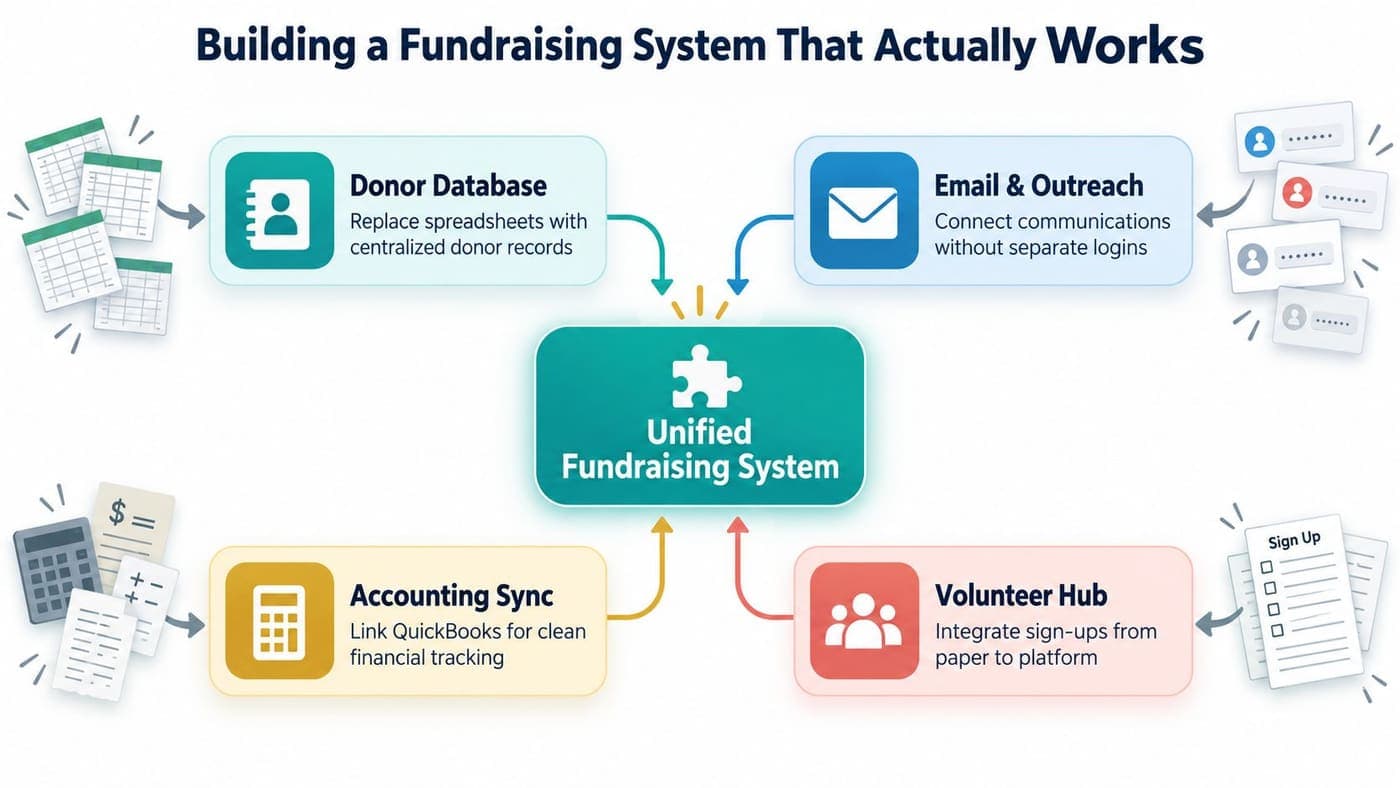
Put the operating pillars in place
Start with four connected functions:
- Donor records: Replace scattered spreadsheets with one record for gifts, communications, event attendance, volunteer activity, and preferences.
- Donation and outreach tools: Give supporters a clear way to donate, then connect email and text follow-up to the same records.
- Fund accounting: Track restricted gifts, grants, programs, and functional expenses in the ledger, rather than forcing generic business categories to behave like funds.
- Volunteer coordination: Store skills, availability, background-check status, group assignments, and hours where staff can find them.
True fund accounting matters because nonprofit money often carries purpose. A gift for a youth program shouldn't disappear into an unrestricted total just because the accounting software wasn't designed to distinguish funds. QuickBooks can be useful for financial bookkeeping, and many organizations rely on it, but classes and workarounds aren't the same as a fund model built around nonprofit reporting.
Practical rule: Choose a workflow that lets development and finance teams see the same gift, fund, donor, and receipt information.
An all-in-one platform can reduce duplicate entry by combining accounting, CRM, volunteers, events, and marketing. AlignMint, for example, includes true fund accounting, donation pages, donor management, volunteer tools, events, and a built-in marketing suite. Its free tier is available to nonprofits under $100K in annual fundraising, and it supports plan-based access without per-seat fees.
That doesn't mean every organization should replace every system immediately. If your team has a strong process with Salesforce, Bloomerang, Blackbaud, QuickBooks, or another established product, preserve what works. The decision should rest on data quality, reporting requirements, staff capacity, and the cost of moving information between systems. For a practical comparison of capabilities to assess, review nonprofit fundraising tools.
Setting Goals and Segmenting Your Donors
A campaign becomes easier to manage when you can answer two questions before writing the appeal: What will this money accomplish, and who has a reason to care? A general request for support creates work for the reader, while a defined need gives donors a clear decision.
Begin with the program or project, not the fundraising channel. Describe the need, the intended use of funds, the people served, the timing, and the evidence you'll use to report progress. A school might raise money for classroom technology, a church might support a food pantry, and a fiscal sponsor might fund a sponsored project with its own restrictions and reporting obligations.
Build a goal people can understand
Your internal budget may contain many line items, but the public appeal needs a simple explanation. Connect the amount requested to an outcome without promising more than the program can deliver. If the need includes several costs, explain the categories so donors understand what their gift supports.
Then establish a working dashboard:
- Revenue target: The amount your team needs to secure.
- Gift composition: The expected balance among individual gifts, recurring support, major gifts, grants, events, and sponsorships.
- Activity measures: Appeals sent, conversations held, applications submitted, event registrations, and follow-up completed.
- Outcome measures: Cash received, pledges committed, restricted funds available, and donors retained.
The United States recorded $592.50 billion in charitable giving in 2024, up 6.3% from 2023, according to nonprofit fundraising statistics from Double the Donation. Individuals supplied $392.45 billion, or 66.7%, while foundations supplied $109.81 billion and corporations supplied $44.40 billion. Your mix will differ, but the lesson is practical: individual donor relationships deserve sustained attention, with foundation and corporate support adding important diversification.
Segment by relationship, not just amount
A static list sorted by gift size tells only part of the story. A volunteer who has never donated may understand your mission better than a distant one-time giver. An event attendee may be ready for a follow-up invitation, while a recurring donor may need reassurance that the program remains on track.
Useful segments include:
- First-time donors: Thank them promptly, explain what happens next, and offer a low-pressure way to stay connected.
- Recurring supporters: Report consistently on the ongoing need they help sustain.
- Major donors: Give them personal contact, clear financial context, and meaningful opportunities to ask questions.
- Lapsed donors: Refer to their prior connection without making the message sound like a collection notice.
- Volunteers and event participants: Recognize their involvement before asking for another commitment.
A unified CRM makes those distinctions more useful because it can connect giving history with volunteer hours, event attendance, household relationships, and communication preferences. That context helps you write a relevant message instead of sending the same appeal to everyone. The practical principles behind this approach appear in donor management that keeps more donors giving.
Running Campaigns Across Email, Text, Events, and Grants
A small community nonprofit once planned a year-end appeal across four channels. The development director drafted the email, the program manager supplied stories, a board member maintained a separate major-donor list, and the finance team waited for a report after the campaign ended. The message went out, but staff spent the following weeks matching names and reconciling gifts.
A connected campaign keeps the donor experience consistent from the first message through the receipt and follow-up. Each channel still has a distinct job.

Email works best when the request has a clear next step
For a year-end sequence, begin with the need, follow with a specific program update, and close with a direct donation request. A short reminder can address the remaining need, while the final message should thank supporters and explain what happens after the campaign.
Keep the audience focused. First-time donors shouldn't receive the same language as recurring supporters, and major donors may deserve a personal call from a board member rather than another mass email. A built-in marketing suite can segment the list and track campaign activity without requiring staff to export records.
Minty, AlignMint's AI assistant, can help draft appeal variations, summarize donor information, and surface questions from your existing data. Staff should review every message for accuracy, tone, privacy, and mission fit. AI can reduce drafting time, but it can't replace judgment about a grieving family, a restricted grant, or a sensitive community story.
Text suits urgency, while events create shared energy
A disaster-relief fund may benefit from a short text message with one donation link, a clear deadline, and an opt-out process. Text isn't the right channel for a long program explanation. Use email or a landing page when donors need context before deciding.
Events combine fundraising with relationship-building. For a spring gala, set ticket levels that reflect the experience and audience, add secure payment options, and use promo codes when a partner group receives a special rate. Connect ticket buyers to their donor records so staff can thank them, identify first-time supporters, and record follow-up conversations afterward.
Treat grants as a pipeline
Grant writing deserves the same discipline as other fundraising channels. Screen opportunities for mission fit, eligibility, geography, reporting requirements, and realistic staff capacity before assigning an application.
A large analysis of 91,000 grant applications found success rates clustering around 43–46%, according to Instrumentl's analysis of grant success rates. Track your own win rate as grants won divided by applications submitted, but exclude opportunities that never represented a strategic fit from performance discussions.
Your campaign calendar should show the audience, message, owner, deadline, donation destination, acknowledgment plan, and reporting responsibility. The practical planning principles are also outlined in this guide to a marketing plan for nonprofit organizations.
Creating Donation Pages That Convert
Your donation page is the moment when goodwill becomes revenue. A strong email can't compensate for a slow page, an unclear form, missing payment options, or a checkout process that feels unsafe.
Measure the page before changing it. Donation-page conversion rate means completed donations divided by page visits. One nonprofit benchmark example reaches about 6.8%, while broader nonprofit website conversion is often around 1%, and donation-page averages can range from roughly 12–22% depending on the benchmark source, as explained by the Funraise donation-page conversion calculator. These figures come from different benchmark approaches, so use them as reference points rather than promises.
Remove friction in a deliberate order
Review the page on a phone before asking your board to approve a redesign. Then work through the experience as a donor would.
- Clarify the purpose: Put the program, need, and use of funds near the donation form.
- Shorten the form: Remove fields you don't need for receipting, compliance, or relationship management.
- Offer sensible choices: Provide suggested amounts that relate to the program, while preserving an open amount field.
- Make recurring giving visible: Explain what ongoing support makes possible without hiding the one-time option.
- Show trust cues: Display your organization name, contact information, privacy language, and payment security information.
- Test the full payment path: Confirm that receipts, fund designations, confirmation emails, and accounting records match the donor's selection.
Mobile and wallet-based giving deserve special attention. Q1 2026 data reported mobile donation share above 53% across the United States, United Kingdom, and Australia, with Apple Pay up 38% quarter over quarter in the United States and credit-card share down 11%, according to Fundraise Up's Q1 2026 Pulse Check. Because that source describes a specific period and market set, treat the figures as directional evidence for testing mobile checkout, not as a universal forecast.
Donors shouldn't have to overcome your internal process before they can support your mission.
A point-and-click builder can help staff update copy, suggested gifts, and campaign-specific pages without waiting for a developer. AlignMint includes donation pages connected to donor records, receipts, follow-up, and campaign results. Other platforms can work well too, including tools designed for personal creator support. If your team is comparing giving models, this explanation of what is Buy Me a Coffee provides useful context before you choose a page structure. For a focused checklist, review nonprofit donation page best practices.
Tracking Pledges, Receipting, and Fund Accounting
Fundraising records become financial records the moment a donor makes a gift, promises a pledge, or restricts support to a purpose. If development and finance maintain separate interpretations, your campaign total may look healthy while the available balance remains unclear.
Restricted contributions aren't ordinary operating money. They stay in a separate net-asset class until the restriction is satisfied, and staff then record a release from restriction. Pledges are recorded when promised, not when paid, according to GrantGraph's nonprofit accounting guidance. Tagged transactions should connect to the relevant grant or restricted fund name so staff can trace the original promise through payment and use.
Match the gift to its purpose
At the point of entry, capture the donor, amount, date, payment status, fund, campaign, restriction, and acknowledgment details. A donor's note saying “for the pantry” shouldn't remain trapped in an email. It should become structured information that finance can review and report.
This approach helps fiscal sponsors manage sponsored projects separately while producing consolidated organizational reporting. It also supports churches and schools that may handle building funds, ministry programs, scholarships, classroom needs, or grant-funded activities with different restrictions.
Form 990 Part IX requires nonprofits to report program services, management and general, and fundraising expenses separately, as described in bookkeeping guidance for nonprofits. A single cost may need allocation across functions when it supports multiple activities. That allocation requires a documented method and consistent records, not a last-minute spreadsheet exercise.
Keep receipting connected to the ledger
A timely receipt should reflect the correct donor information, gift date, amount, designation, and acknowledgment language. When staff re-enter those details manually, errors can affect donor trust and financial reporting at the same time.
True fund accounting software models funds, grants, and programs natively. QuickBooks remains a familiar and capable bookkeeping product, and many organizations value its accounting foundation. The trade-off is that a nonprofit may need additional systems or careful processes when it requires restricted-fund balances, development records, volunteer history, and Form 990 reporting in one place.
The IRS describes donor-restricted endowment funds as funds established by donor-restricted gifts and maintained to provide income for a specified period or until a specific event occurs, according to the Form 990 instructions. Your chart of accounts and fund structure should make those distinctions visible before the annual reporting period arrives. More detail on this operating model appears in fund accounting for nonprofits.
Mobilizing Volunteers and Measuring What Matters
Volunteers often introduce your organization to new supporters before a development staff member ever makes contact. A person who organizes a food drive, coaches a youth program, or helps at a church event may become a donor, ambassador, board connection, or recurring advocate.
That potential appears only when you treat volunteer activity as relationship information. Track skills, availability, assignments, training, background checks, hours, event participation, and follow-up consent in a shared record.
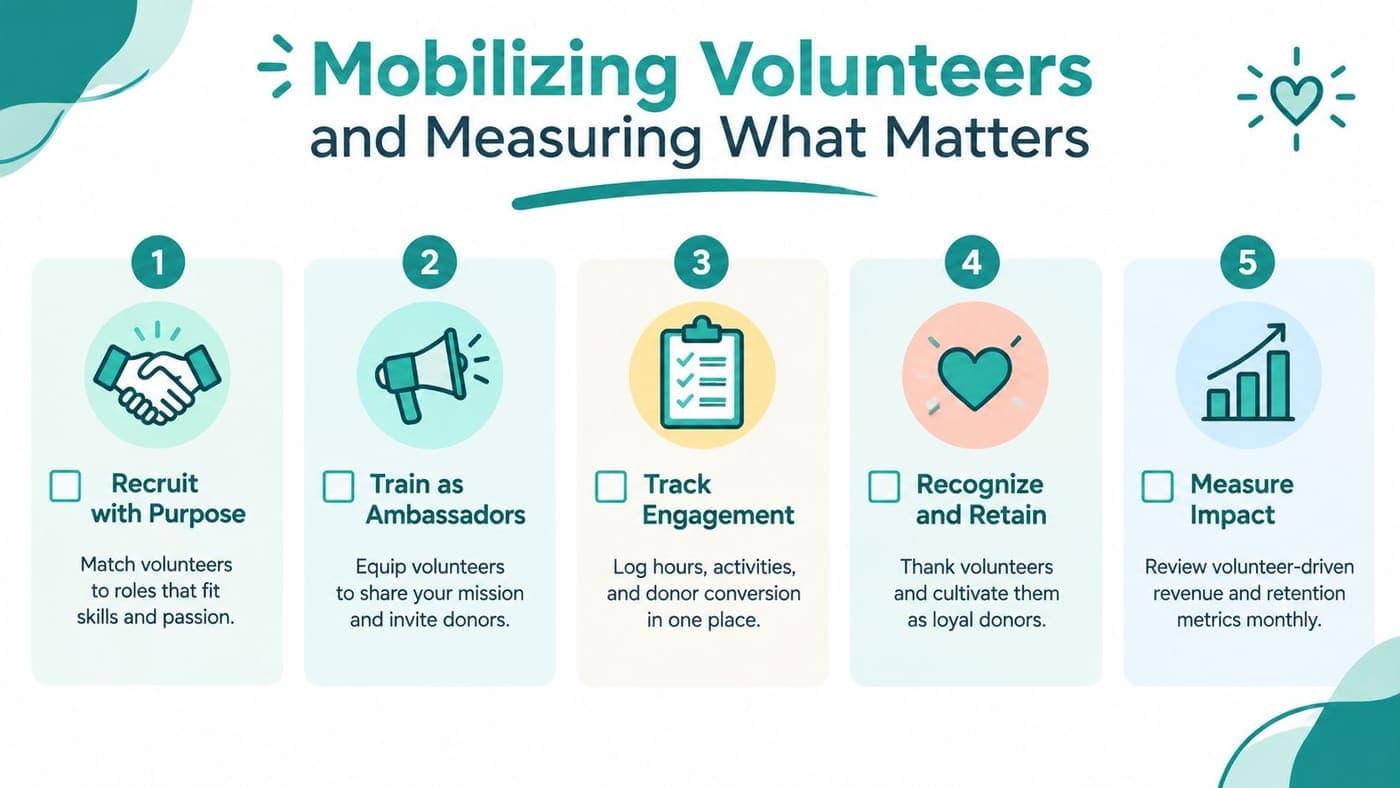
Give volunteers a clear ambassador role
Recruit people for specific roles rather than asking everyone to do everything. Train them to describe the mission accurately, share an approved donation link, welcome guests, and refer sensitive questions to staff.
Volunteer management software commonly supports background checks and hour tracking. Published pricing examples include individually priced background checks, including one cited offer of $5 per check with no monthly fee, while another cited platform describes hour tracking, compliance management, and year-round verification in its volunteer management software overview. Compare those features with your actual safeguarding requirements before selecting a tool.
Thank volunteers with the same care you give donors. A personal note, a progress update, or an invitation to see program results can strengthen the relationship without turning every interaction into an ask.
Measure retention before chasing acquisition
Overall donor retention benchmarks sit around 43–55%, while first-time donor retention is near 14–25%, or about 19.4% in one benchmark, according to nonprofit fundraising benchmarks from GoodCircles. Repeat donors show much higher retention, roughly 87% or more in the cited benchmarks. The practical conclusion is straightforward: follow up carefully after the first gift, then give repeat supporters reasons to remain involved.
Review a small monthly scorecard:
- Relationship activity: New donors thanked, volunteers contacted, and stewardship conversations completed.
- Financial activity: Cash received, pledges outstanding, recurring gifts, and restricted balances.
- Retention activity: First-time donors renewed, repeat donors retained, and lapsed donors re-engaged.
- Program activity: Volunteer hours, event participation, and donor actions connected to programs.
Present trends with context. Your board needs to know not only how much you raised, but which relationships produced that result, which funds remain restricted, and what staff will do next.
Your Next Steps to Fundraising Success
Over the next 90 days, establish one donor record, clean your fund designations, review your donation page on mobile, and schedule a stewardship sequence for first-time givers. Choose one focused appeal, one volunteer-led activity, and one grant pipeline review rather than launching every channel at once.
Standalone tools such as Salesforce, Bloomerang, Blackbaud, QuickBooks, and Mailchimp each have strengths and established users. An all-in-one platform reduces the handoffs between accounting, CRM, volunteers, events, marketing, and giving pages. AlignMint offers that combined approach, including true fund accounting, Minty AI, a built-in marketing suite, plan-based access without per-seat fees, and a free tier for nonprofits under $100K.
The right system won't replace sound judgment or donor trust. It will give your team cleaner information, fewer manual reconciliations, and more time for the conversations that raise sustainable support.
AlignMint brings donation pages, donor CRM, receipting, true fund accounting, volunteer management, events, marketing, and team communication into one nonprofit platform. Visit AlignMint to explore the free tier and see whether one connected workflow can simplify how your organization raises money.
Ready to try AlignMint with your nonprofit?
Start free — set up donor tools, giving pages, and Minty. Upgrade when you need accounting.