

Donor Life Cycle: A Practical Guide for Nonprofit Leaders
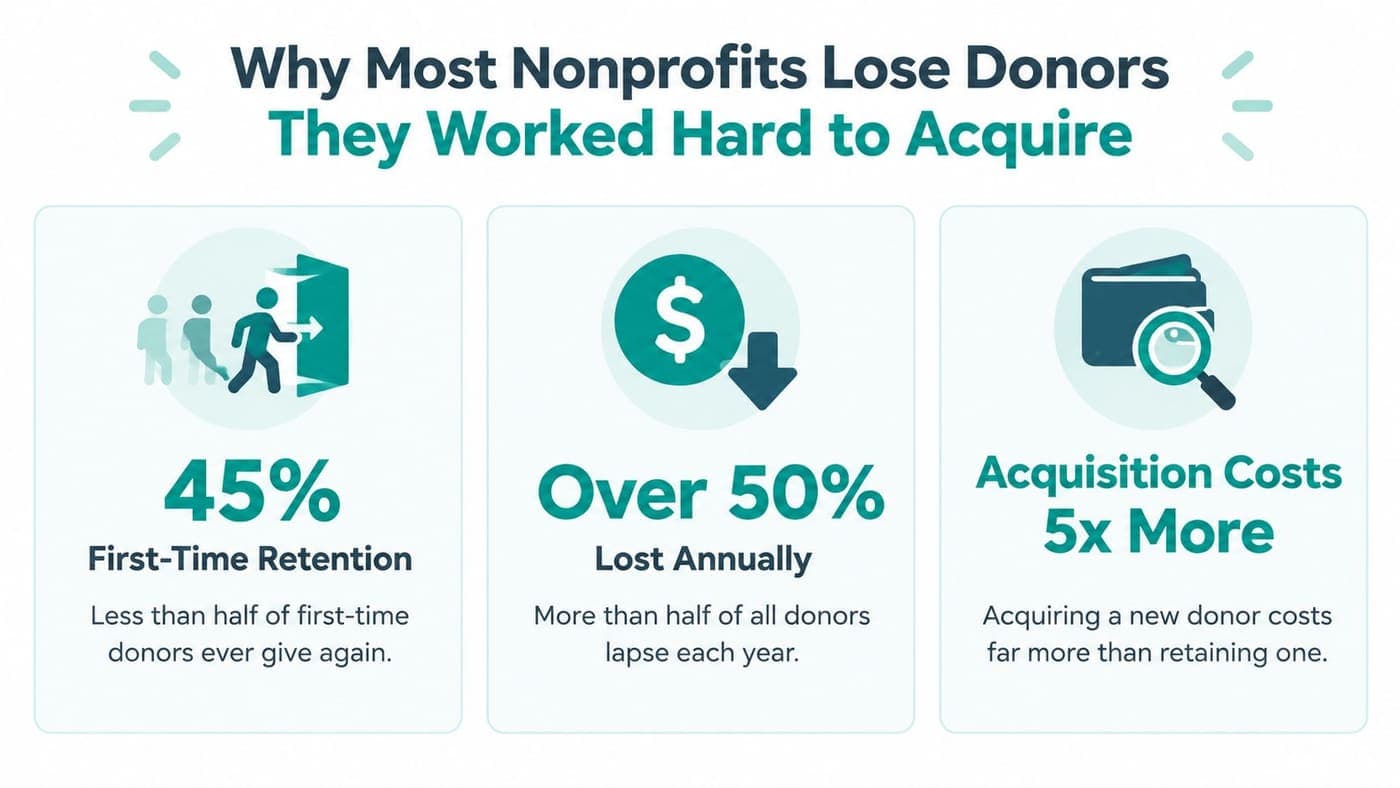
More than half of nonprofit donors don't give again the following year. The Fundraising Effectiveness Project's long-running benchmark places overall annual donor retention between 43% and 46%, making the first gift only the beginning of the relationship, not the result.
The practical answer is a donor life cycle built around the first renewal, clear impact communication, and shared fundraising and finance records. This guide shows where donors disappear, what to do during the first 30 to 90 days, and how an operating model can help your team retain more support without adding another disconnected system.
Quick Answer: Donor Life Cycle
The donor life cycle is the path from first encounter to renewal and upgrade. First-year retention is the weak point, so the first 30 to 90 days need a named owner, a timely thank-you, and a second-gift path that finance and development can both see.
Start with nonprofit donor retention strategies and donor management. For journey setup, see donor journeys.
Why Most Nonprofits Lose Donors They Worked Hard to Acquire
Acquisition produces visible results: new names, processed gifts, and a campaign total for the board. That activity can conceal the operational gap that appears after the first donation. The Fundraising Effectiveness Project's benchmarks show first-time donor retention at 19% to 26%, compared with 60% to 65% for donors who have already renewed (Fundraising Effectiveness Project retention benchmarks).
The first gift proves that a supporter was willing to act. It does not prove that your organization gave them a reason, update, or easy path to act again. Teams often have a welcome email and a year-end appeal, yet no owner for the weeks between them. Donors expect clear acknowledgment and evidence of impact. Staff capacity, disconnected records, and competing deadlines often prevent that follow-through.
The first renewal is the real test
A second gift marks a meaningful change in the relationship. The donor has seen enough value, trust, or relevance to return. Your team should manage that transition as a defined operating responsibility, not leave it to the next campaign.
For 1,000 first-time donors, the benchmark range means roughly three-quarters to four-fifths may not make a second gift without deliberate welcome, stewardship, and reactivation work. Acquisition still matters. The greater weakness is failing to fund and staff the follow-up that converts initial interest into repeat support.
Track the handoff after acquisition. Record who received a timely acknowledgment, who received a relevant impact update, who made a second gift, and who now needs reactivation.
Practical rule: Treat the second gift as a primary fundraising outcome, not an incidental byproduct of a successful appeal.
Fundraising totals can also hide a narrower donor base. In 2025, the Fundraising Effectiveness Project reported 5% higher total giving alongside a 3.6% decline in donors, meaning more dollars came from fewer supporters (2025 donor base analysis). That pattern raises the cost of ignoring first-time donors and leaves the acquisition pipeline less productive than it appears.
Use this guide to nonprofit donor retention strategies to strengthen the work after acquisition. Then report first-to-second-gift conversion separately from broader retention, so leadership can see whether the organization is earning a second opportunity to serve each new donor.
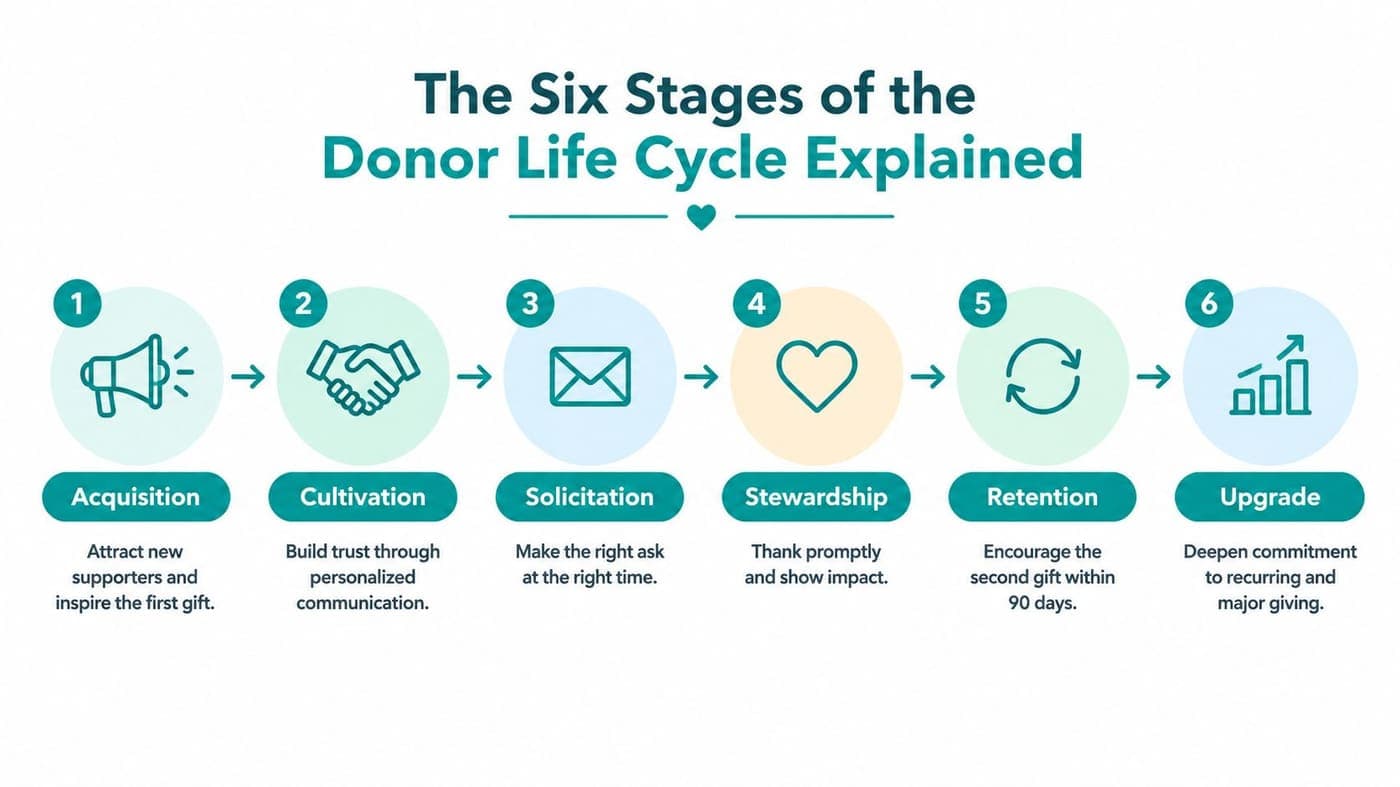
The Six Stages of the Donor Life Cycle Explained
The donor life cycle helps your team decide what each supporter should experience next. It is a working framework, not a fixed staircase. Someone may volunteer before giving, attend an event during cultivation, or return to reactivation after going quiet.
Acquisition
Acquisition starts with a first encounter with your mission. A church may welcome a new household, a school may connect with a parent, and a community nonprofit may gain a supporter through an event or online giving page.
Make that first action easy and credible. Explain the gift's purpose clearly, provide a straightforward payment experience, and collect enough information for a relevant follow-up. The operational gap appears when an organization can attract gifts but cannot deliver the communication donors expect afterward.
Cultivation
Cultivation builds familiarity before the next request. Invite supporters to a program visit, volunteer opportunity, event, or small conversation that shows how the work operates beyond a campaign message.
Relevance determines whether this stage works. A former student interested in scholarships should receive different updates from a parent focused on arts programming. For practical guidance on sustaining support through relationships, review approaches that connect communication to a donor's interests and involvement.
Solicitation
Solicitation presents a clear purpose and a reasonable next action. Use the donor's interests, previous involvement, and current relationship stage to shape the request.
Timing matters. Someone who just attended a program tour may need an impact update first, while a consistent supporter may be ready for a recurring gift invitation.
Stewardship
Stewardship begins as soon as the gift arrives. Thank the donor, issue the receipt, explain what happens next, and show how the contribution supports the work.
A receipt confirms a transaction. Stewardship confirms that your organization recognizes the person behind it and has a plan for the relationship.
Retention
Retention means earning another gift through trust, relevance, and reliable communication. The first renewal is the decisive test. If staff wait for the next campaign, the donor's initial interest can disappear before a second opportunity is presented.
Use this donor journey guidance to define the next action for each segment. Keep the plan practical enough for staff to deliver, because a journey that exceeds your team's capacity will fail in execution.
Upgrade
Upgrading deepens an established commitment. A one-time donor may move into monthly giving, a volunteer may sponsor a program, or a repeat donor may develop toward a larger annual or major gift.
Follow demonstrated interest. Do not ask someone to deepen commitment before showing that your organization understands and values the support already given. A clear lifecycle process aligns donor expectations with the communication and follow-up your team can provide.
The First Gift to Second Gift Transition That Breaks Most Strategies
A first gift proves willingness, not commitment. The second gift shows whether your organization earned another decision. Fundraising plans often spend heavily on acquisition, then leave the follow-up to a generic receipt and an overextended staff member. That operational gap is where donor expectations outrun nonprofit capacity.
Overall retention was reported at 43.3% in 2025, while new-donor retention appeared as low as roughly 11% in a recent half-year view and 14% through Q3 2025, depending on the reporting period (Nonprofit Pro analysis of 2025 fundraising trends). The timeframes differ, but the practical lesson holds: first-time donors need a defined path to a second gift.
Build a deliberate first ninety days
A thank-you email confirms the transaction. It does not explain who benefited, what happens next, or why the donor should remain connected. Assign each step to a person or team before the campaign launches.
- Immediate confirmation: Send the receipt and a personal acknowledgment through the donor's preferred channel.
- Early connection: Share a specific story, program detail, or invitation tied to the gift's purpose.
- Meaningful update: Report progress before the donor has to request results.
- Second-gift invitation: Offer a relevant next action, such as monthly giving, a program appeal, or event participation.
- Human follow-up: Ask staff or a volunteer leader to contact donors who show strong engagement or a clear connection to the mission.
Sequence matters. A donor should understand how the first contribution entered your work before receiving another appeal. Keep the plan small enough for staff to deliver consistently. A six-step journey that nobody owns is less useful than three actions completed on time.
Fix the operational failures first
Messaging cannot compensate for incomplete records. A delayed receipt, missing gift purpose, unrecorded appeal source, or follow-up task buried in an inbox can send the wrong message to the right donor.
Track first-time donors by cohort and tenure. Flag gifts requiring restricted-fund handling, connect every contribution to the correct donor record, and assign the next relationship step while the initial interest remains fresh.
Repeat donors had reported retention of 87.3% in Q3 2025, reinforcing the priority of moving more first-time donors into the repeat stage. Put scarce staff time at that transition, then build processes your team can sustain.
Why Recurring Donors Behave Differently and How to Cultivate Them
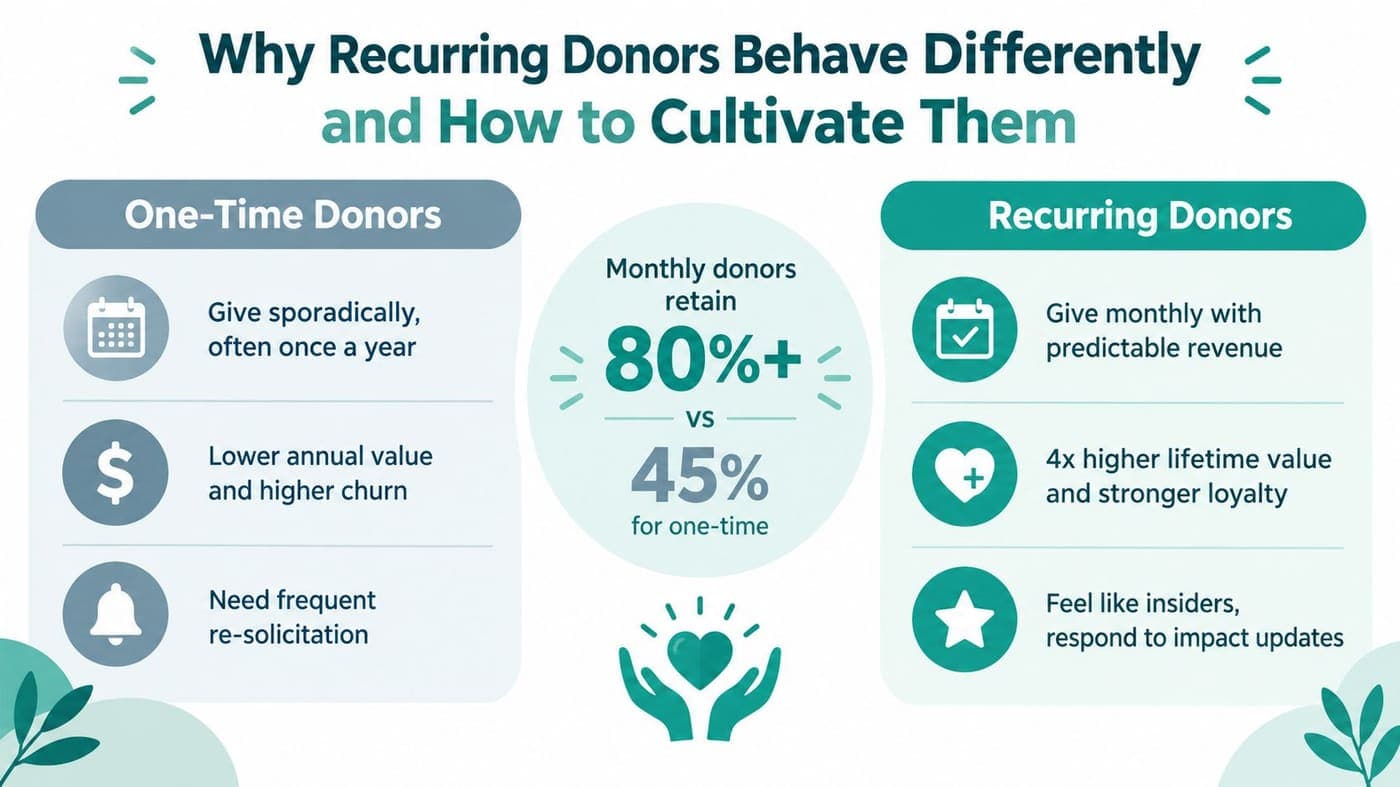
Recurring giving changes the relationship because the donor has chosen continuity. Instead of deciding whether to give again during each campaign, the supporter has made an ongoing commitment. Your organization must respect that commitment with reliable stewardship and clear follow-through.
A 2025 recurring-giving benchmark reported retention of 79.11% for recurring donors, compared with 32.41% for one-time donors, more than double the rate for one-time supporters (recurring donation statistics). That gap makes monthly giving a core part of a mature donor life cycle, not an add-on campaign tactic.
Protect the fragile early months
Recurring donors still need active care. The same benchmark reports that 10% of new monthly donors stop within two months, 81% remain active after seven months, 71% remain after twelve months, and 54% remain after twenty-four months.
That retention curve gives fundraisers a clear operating priority: make the first months dependable. Send a welcome message explaining the program, connect updates to the recurring fund, and give donors a straightforward way to resolve payment changes. Assign ownership for these tasks before enrollment grows. A recurring program fails when the promise made at sign-up exceeds the team's capacity to deliver consistent attention.
Treat monthly donors as members of a continuing relationship, not automatic revenue.
Invite the right one-time donors
The strongest recurring-gift prospects are not necessarily the largest one-time donors. Look for supporters who engage with updates, attend events, volunteer, respond to mission-specific appeals, or give repeatedly when prompted. Their behavior shows interest in an ongoing connection.
Explain the practical value of monthly giving. Regular gifts help the organization plan with greater confidence, while donors gain a clearer connection to continuing work. Offer a simple choice of purpose, frequency, and amount. Remove unnecessary form fields and make the decision easy to complete.
Use this recurring gifts resource to define the invitation and stewardship process. Keep the program visible throughout the year, not only during a major campaign.
The Transparency Gap That Drives Donors Away
Donors expect clear evidence that their support matters. Nonprofits often lack the staff time, financial workflows, and connected records to provide that evidence consistently. The first gift exposes this gap quickly, especially when the organization promises updates it cannot reliably deliver.
A 2025 Bloomerang survey summary found that 65% of donors wanted regular impact updates, while only 36% of nonprofits provided them. It also reported that 24% of donors stopped giving because of poor transparency about gift use, while 82% of fundraisers identified limited staff and resources as their biggest retention challenge (Bloomerang donor retention findings). These figures point to an operating problem, not a shortage of fundraising ideas.
Give donors useful answers
Transparency does not require a glossy annual report after every gift. It requires timely, specific communication tied to the donor's purpose.
- Purpose: Explain which program, fund, or initiative received the gift.
- Progress: Share a milestone, service update, or program development.
- Financial context: Clarify how restricted support differs from general operating support.
- Next connection: Invite the donor to learn, attend, volunteer, or continue giving.
Finance must also confirm whether a gift carries donor restrictions. Under current GAAP, nonprofits present net assets in two classes, with donor restrictions and without donor restrictions. Restricted gifts can be used only when the stated purpose is met or the time restriction expires (nonprofit fund accounting guidance).
That distinction should shape every related message. If fundraising promises an update about a restricted program, finance and fundraising need a shared record showing the fund balance, spending, and remaining purpose. Without that record, staff either send vague updates or risk describing the gift inaccurately.
Design communication your staff can sustain
A small team cannot write a custom report for every donor after every transaction. Set a manageable calendar with a few dependable updates, then segment communications by purpose and relationship.
Use templates for receipts, welcome messages, and milestone notes. Reserve personal calls and handwritten messages for donors whose involvement warrants them. The standard is dependable and accurate communication, not elaborate production.
A built-in marketing suite can connect email and text campaigns with donor records, events, and giving pages. That connection reduces manual exports and helps staff send the right message after a gift, volunteer shift, event, or program milestone. Assign ownership before the calendar begins, so transparency does not depend on one person remembering every follow-up.
Metrics and KPIs That Actually Matter for Each Lifecycle Stage
A donor life cycle dashboard should help you decide what to do next. If a number doesn't change a staffing decision, communication plan, or fundraising priority, it probably doesn't belong on the executive director's main report.
Track results by cohort, tenure, purpose, and giving type. Overall retention can hide a weak first-year experience, while a strong campaign total can hide a shrinking donor base.
| Lifecycle Stage | Primary Metrics | Target Benchmarks |
|---|---|---|
| Acquisition | New donors, source, cost per acquired donor, first-gift completion | Compare channels over time and identify sources that produce second gifts |
| Cultivation | Event attendance, volunteer activity, email engagement, meaningful contacts | Look for rising involvement before making an ask |
| Solicitation | Response, average gift, purpose selection, recurring-gift enrollment | Compare asks by segment and relationship stage |
| Stewardship | Receipt timeliness, acknowledgment completion, impact updates delivered | Meet your stated communication promise consistently |
| Retention | Second-gift conversion, annual retention, repeat-donor retention, cohort retention | Separate first-year performance from established-donor performance |
| Upgrade | Recurring conversion, increased giving, major-gift movement | Upgrade donors after demonstrated engagement and trust |
| Reactivation | Lapsed donors contacted, response, renewed gifts, reactivation cost | Test whether former supporters still connect with a relevant purpose |
Measure the handoff, not just the result
Your most important early indicator may be whether a first-time donor received the right acknowledgment and next step. Review failed handoffs weekly. Find gifts without a purpose, records without a follow-up owner, and donors who engaged but received no relevant communication.
The metrics and trends documentation can support a more disciplined reporting routine. Keep the board view concise, but give staff access to the underlying segments that explain changes.
Don't set universal benchmarks without considering your mission, audience, and maturity. Use historical performance to establish a baseline, then improve one lifecycle stage at a time.
Aligning Your CRM and Finance Data to Optimize Lifetime Value
Your fundraising team sees relationships. Your finance team sees funds, restrictions, deposits, and reports. Donors experience both, so your organization needs one operating picture.
Disconnected systems create avoidable gaps. A gift may appear in the CRM but wait for a manual finance import. A pledge may be tracked in a spreadsheet while the donor receives a generic appeal. A restricted balance may be correct in the ledger but invisible to the person planning the next campaign.
Connect the donor record to the money
A useful donor record should show giving history, receipts, notes, pledges, recurring gifts, and relationship follow-up. It should also connect each gift to the fund or program that governs its use.
True fund accounting is different from using QuickBooks classes as a substitute for fund structure. Your system should model restricted funds, grants, and programs natively, so the finance team can produce Form 990 reports, restricted balances, grant drawdowns, and Statements of Functional Expenses without rebuilding the story manually.
Form 990 complexity also rises with organizational size. The IRS full-return threshold applies when gross receipts are at or above $200,000 or total assets are at or above $500,000 at year-end (nonprofit accounting guidance). Finance leaders should establish clean records before reporting demands become urgent.
Include the work beyond donations
Volunteer participation can reveal donor interest before another gift arrives. The U.S. Department of Labor states that unpaid volunteers serving charitable or public purposes aren't employees under the Fair Labor Standards Act (Department of Labor volunteer guidance). Many nonprofits still track volunteer hours because those hours can support grant reporting, board updates, and service measurement.
Fiscal sponsors need the same discipline. Social Impact Commons explains that sponsored projects are accounted for through fund-based accounting and consolidated into the sponsor's annual Form 990. The IRS generally doesn't require individual project breakout except for re-granting activities and disregarded entities (Social Impact Commons fiscal sponsorship FAQ).
Schools, churches, and fiscal sponsors also need purpose-based reporting. Endowment funds created by donor-stipulated gifts receive specific treatment in Form 990 instructions, including donor-restricted amounts held to provide income for a specified period or until a specific event occurs (IRS Form 990 instructions).
An all-in-one platform can combine accounting, CRM, volunteers, events, and marketing. AlignMint offers true fund accounting, donor management, volunteer records, events, online giving pages, team communication, a built-in marketing suite, and Minty AI, with plan-based access and no per-seat fees. It also has a free tier for nonprofits under $100,000 in annual fundraising, which gives smaller organizations a practical starting point (AlignMint CRM and accounting integration).
Executive director's test: If your team must export, reconcile, and re-enter information before answering a donor question, your systems are slowing retention.
AlignMint brings fund accounting, donor management, volunteers, events, marketing, and online giving into one platform, so your team can act on the complete donor life cycle. Visit AlignMint to review the free tier for nonprofits under $100,000 and see how one shared record can support stronger second-gift conversion.
Ready to try AlignMint with your nonprofit?
Start free — set up donor tools, giving pages, and Minty. Upgrade when you need accounting.