


Your Actionable Guide to a Marketing Plan for
Quick Answer: Your Actionable Guide to a Marketing Plan for
Build a lean nonprofit marketing plan: goals, channels, editorial calendars, and KPIs executive directors can explain to any board without a consultant deck. The sections below walk through practical steps, examples, and what to watch for.
For related tools, see AlignMint features. Creating a solid marketing plan for nonprofit organizations can feel overwhelming. It isn't about chasing trends; it's about focusing your team's time where it counts. You need a simple plan that turns your efforts into the real-world impact your mission requires.
This guide will help you build that plan. We will walk through how to connect every marketing activity back to your core purpose. This ensures every dollar and minute you spend pushes your mission forward.

Build Your Foundation With Mission-Aligned Goals
As an executive director, you need to know your marketing is working. It is easy to get caught up sending emails without a clear line back to your purpose. A successful marketing plan for your nonprofit closes that gap.
It builds a solid bridge between your daily activities and your ultimate goals. This foundation should be a small set of clear, achievable objectives. Spreading your team too thin across a dozen goals leads to burnout and poor results.
Focus on 4-6 High-Impact Goals
You can bring incredible clarity to your team by focusing on a few powerful goals. This focus makes success feel attainable and measurable, leaving no room for guesswork. Your goals must be specific to give your team a clear finish line.
Here are a few examples of strong, mission-aligned goals:
- Increase recurring monthly donations by 15% in the next six months. This ensures predictable funding for your programs.
- Recruit 25 new skilled volunteers for our mentorship program before fall. This provides direct support where it is needed most.
- Secure 3 new corporate partnerships to sponsor our annual fundraiser. This diversifies your funding and expands your reach.
- Grow our email subscriber list by 20% to build our community of supporters. This gives you a direct line to people who care.
These goals work because they tie to specific outcomes. You can see how marketing contributes, whether you're a school or a church.
A common mistake is setting vague goals like "raise more money." A goal like "Acquire 100 new donors through our year-end digital campaign" is much better. It gives your team a clear target.
Connect Marketing Activities to Financial Impact
You can prove marketing's value by connecting it directly to your finances. This is hard when you use separate tools for marketing and accounting. Many nonprofits struggle here.
For example, a platform like QuickBooks often requires workarounds with "classes" to track restricted funds. This makes it difficult to see how a specific campaign truly performed. You lose valuable time trying to make the numbers match up.
This is why we built AlignMint with true fund accounting. It gives you a crystal-clear view of your marketing's real-world impact. Every dollar raised through a campaign can be tied directly back to a specific fund.
This integration lets you confidently show your board how an email appeal funded a program. It turns marketing from a cost center into a visible driver of your mission. Our all-in-one platform makes this kind of reporting simple and automatic. This aligns with recent nonprofit communication trends, which show a focus on community engagement.
Know Your Supporters to Build Real Connections
Your supporters are the heart of your organization, but they are not all the same. A retired teacher who volunteers is driven by different things than a young professional who gives online. A strong nonprofit marketing plan speaks to each person in a way that resonates.
This is not about a massive research project. It's about creating simple supporter "personas" based on what you already know. Think of them as quick sketches of the real people who make your work possible.

Identify Your Key Supporter Groups
Start with the people who are already in your corner. Who are your most committed supporters? You can probably picture a few distinct groups right now.
Think about segmenting your audience by how they engage with you:
- Loyal Donors: The folks who give consistently, whether monthly or at year-end.
- Major Givers: Those who make significant contributions, even if less frequently.
- Dedicated Volunteers: The hands-on crew who give their time and skills.
- Event Attendees: People who buy tickets to your annual gala or community picnic.
A school might focus on current parents, alumni, and local business partners. A church could segment into longtime members, new families, and service volunteers. Your goal is to identify 3-4 primary groups that form your core support base.
Figure Out What Makes Them Tick
Once you have your groups, you need to understand their "why." Why do they support you over all the other worthy causes? You can uncover incredible insights just by talking to them.
Ask a few trusted supporters for 15 minutes of their time. Ask what they value about your work and what first drew them to your mission. This is easier than you think.
The most powerful insights come from simple conversations. You will learn the exact language your supporters use. You can then reflect that language back in your marketing to build deeper trust.
This process helps you build a persona. For an after-school arts program, you might have "Community-Minded Carol." She is a retiree who volunteers and wants updates with personal stories and photos.
See the Whole Person With a Unified View
Understanding your supporters is much easier when all their information is in one place. Many nonprofits struggle when donor data, volunteer lists, and event sign-ups are in separate systems. It is impossible to see the whole picture that way.
Donor management tools like Bloomerang or DonorPerfect are good for tracking gifts. But they may not show you if a donor also volunteers. Our all-in-one platform solves this by creating a single profile for each person.
With AlignMint, you see every interaction in one clean record. You can connect giving history with volunteer hours, event attendance, and every opened email. This helps with effective donor management for nonprofits.
This integrated view lets you personalize your outreach in a way that feels human. You can thank a volunteer for their hours in the same email you acknowledge their donation.
Craft Core Messages That Inspire Action
Your story is your most powerful fundraising asset. A great marketing plan for nonprofit organizations tells that story in a way that connects with your supporters. This means creating specific, compelling messages for each of your donor personas.
It is about turning your financial data into undeniable proof of your impact. A generic mission statement will not move anyone to give or volunteer. You must be specific.
Turn Financial Data into Impact Stories
You can create a real connection by showing what a gift made possible. Do not just announce that you received a $10,000 grant. That is a number, not a story.
A far more powerful message is: "Thanks to a generous grant, 50 local children now have a safe place to learn and grow." That simple shift turns a dry number into a tangible, human story. People give to people, not to bank accounts.
Your supporters want to see the direct results of their contributions. When you draw a straight line from a dollar given to a life changed, you build deep trust. This is what fuels long-term support.
This kind of transparent storytelling is only possible with clear financial data. It is the key to proving your impact, not just stating your mission.
The Power of True Fund Accounting in Storytelling
Here is where the right financial system completely changes your marketing. Many nonprofits use standard business software like QuickBooks. It was not built for our world.
You end up with complicated workarounds using "classes" to track restricted funds. This makes telling an accurate story very difficult. You cannot confidently report on the specific impact of every restricted dollar.
This is why we built AlignMint with true fund accounting at its core. It is the foundation of the platform, designed to track and report on every dollar. This lets you craft marketing messages that are both compelling and authentic.
Use AI to Refine Your Message
We know you are short on time. This is a practical place where new technology can help. Our built-in AI assistant, Minty, can help you find the right words.
Minty can analyze your donor data and suggest specific messaging. It can look at your "Community-Minded Carol" persona and recommend language that emphasizes community impact. It helps you tailor communications without spending hours drafting different versions.
This is a smart way to make your messages more personal and effective. You can create stronger connections with your supporters. As fundraising statistics for nonprofits show, 75% of donors look for concrete achievements before giving. Unified data makes this easier.
Choose the Right Channels Without Spreading Yourself Thin
You can create real connections instead of just noise by focusing your efforts. A smarter approach is to pick the communication channels where your supporters actually are. This gives you a better return on your team's sanity and your budget.
Many nonprofit leaders feel pressure to be everywhere online. This is a recipe for burnout. Your time and resources are too precious for that.
Prioritize Channels That Drive Real Results
For most nonprofits, a few channels drive most of the results. Zero in on these for the biggest impact if you feel stretched.
- Email: This is your single most important asset because you own your email list. It is perfect for telling impact stories and making direct donation asks.
- Social Media: You do not need to be on every platform. Pick one or two, like Facebook, where your community already gathers.
- Events: Nothing builds connection like a face-to-face experience. Events bring your mission to life in a way digital channels cannot.
- Partnerships: Teaming up with local businesses is one of the fastest ways to grow. A partner can introduce your cause to a new audience.
The goal is not to be everywhere; it's to be effective where it counts. Doing an excellent job on two channels beats a mediocre job on five.
The Power of an Integrated Marketing Suite
You can save time and money by using one system for your marketing. Many nonprofits use Mailchimp for emails and other tools for events. This patchwork of systems creates disconnected data and extra work.
When your marketing tools are built into your main system, everything changes. Our built-in marketing suite saves you from juggling multiple subscriptions and logins. It gives you a clear picture of your supporter engagement.
With AlignMint, you can build a beautiful online giving page and send a targeted email campaign. You can track all the results from a single dashboard. This unified approach eliminates the disconnected data and manual work.
Imagine you want to invite donors who gave over $500 to a special event. With our marketing suite, you can pull that list in seconds. Your donor data and email tools are already connected.
Nonprofit Marketing Channel Focus for 2026
This table outlines key marketing channels to help you prioritize your efforts.
| Channel | Primary Strength | Best For | AlignMint Integration Tip |
|---|---|---|---|
| Direct Communication | Nurturing donors, direct appeals, newsletters, impact stories | Create donor segments like "Lapsed Donors" and send targeted re-engagement campaigns directly from the CRM. | |
| Social Media | Community Building | Sharing visual stories, promoting events, engaging volunteers | Schedule posts promoting a donation page and track traffic sources back to specific social channels. |
| Events | Personal Connection | Major donor cultivation, volunteer appreciation, community outreach | Sell tickets, manage RSVPs, and automatically add attendees to a post-event follow-up email list. |
| Volunteer Outreach | Mission Engagement | Recruiting for specific roles, sharing volunteer-only updates | Use our Volunteer Management hub to post opportunities and email your list when a new role is available. |
| Partnerships | Audience Expansion | Co-hosting events, cross-promotion with local businesses | Create a unique tracking link for a partner's promotion to measure how many new supporters they send your way. |
An integrated system gives you the clarity to see what is working. You can do more with the limited time you have. Learn more in our guide to nonprofit donation page best practices.
Create a Realistic Marketing Calendar and Budget
A plan is only useful if you can actually execute it. A good marketing plan for nonprofit organizations translates goals into a realistic calendar and budget. This process forces you to make smart choices about where to invest your team's energy.
It is about mapping out your key campaigns and knowing what resources you need. A simple calendar can be the difference between a chaotic year and a strategic one.
Build a Marketing Calendar That Works for You
Your marketing calendar can start as a simple document. It should plot your major activities over the next few months. The key is to work backward from your big moments.
Start by marking down your most important dates:
- Your annual fundraising gala or major event.
- Big giving days like GivingTuesday.
- Key program launches or mission milestones.
- Important volunteer recruitment periods.
Once these are on the calendar, you can build smaller activities around them. Your year-end giving campaign planning should start in October, not December. This forward-looking approach prevents last-minute scrambles.
A common mistake is treating marketing as a series of one-off tasks. A calendar helps you see it as a connected series of campaigns. Each activity builds on the last, creating momentum.
Sample 3-Month Nonprofit Marketing Calendar
Let's imagine you run a small community arts center. Here is what a focused, three-month calendar might look like.
| Month | Email Campaign | Social Media Focus | Key Activity/Event |
|---|---|---|---|
| Month 1 (Sept) | "Early Bird" registration discount for fall workshops. One impact story on a past student. | Behind-the-scenes videos of classes being set up. Feature a different instructor each week. | Host a free "Open House" night for the community to tour the space and meet instructors. |
| Month 2 (Oct) | Launch a 3-part email series telling the story of one program from start to finish. | Share testimonials and photos from current students. Start teasing the year-end campaign theme. | Run a targeted volunteer drive for your upcoming holiday-themed children's art fair. |
| Month 3 (Nov) | Send a "Thank You" email to all recent donors and volunteers. Launch the official year-end giving appeal on GivingTuesday. | Daily posts during the week of GivingTuesday showing impact. Share a personal video message from you. | The holiday-themed children's art fair serves as a great community engagement and soft fundraising event. |
This template is adaptable for any nonprofit. A school could focus on alumni engagement, while a church might plan around holiday services. The structure is what matters.
Budgeting for Marketing With Tight Funds
Your marketing budget does not need to be huge to be effective. The biggest drain on a budget is often paying for a dozen different software tools. These costs add up fast.
An all-in-one platform offers a huge financial advantage by combining these functions. It eliminates multiple subscription fees. At AlignMint, we also offer plan-based user allowances (1 on Free, up to 10 on Plus, up to 25 on Pro, and unlimited on Enterprise).
More importantly, we provide a completely free tier for any nonprofit with under $100K in annual revenue. This includes donor management, giving pages, fundraising tools, Minty, and My Workspace. Fund accounting starts on Plus when your reporting needs grow. Explore our nonprofit budget template for Excel to help you get started.
Measure What Matters and Report Your Success
Is your marketing plan actually working? You need to track your progress in a way that proves your impact. This is for your board, your donors, and your own peace of mind.
The secret is to stop chasing "vanity metrics" like social media likes. Instead, zero in on the key performance indicators (KPIs) tied to your mission's financial health. These numbers tell the real story.
Focus on Actionable Metrics
For any nonprofit, the most powerful metrics connect to fundraising and engagement. You do not need dozens of data points; you just need the right ones.
Here are a few to get you started:
- Donor Retention Rate: What percentage of last year's donors gave again? This is a key measure of supporter loyalty.
- Average Gift Size: Are people giving more over time? This shows your messaging is connecting with committed supporters.
- Cost Per Donation: How much are you spending to acquire a single gift? This helps you see how efficient your campaigns are.
Tracking these numbers tells you what is working. It allows you to make smarter decisions with every dollar.
This timeline shows how different marketing activities can build on each other over a single quarter.
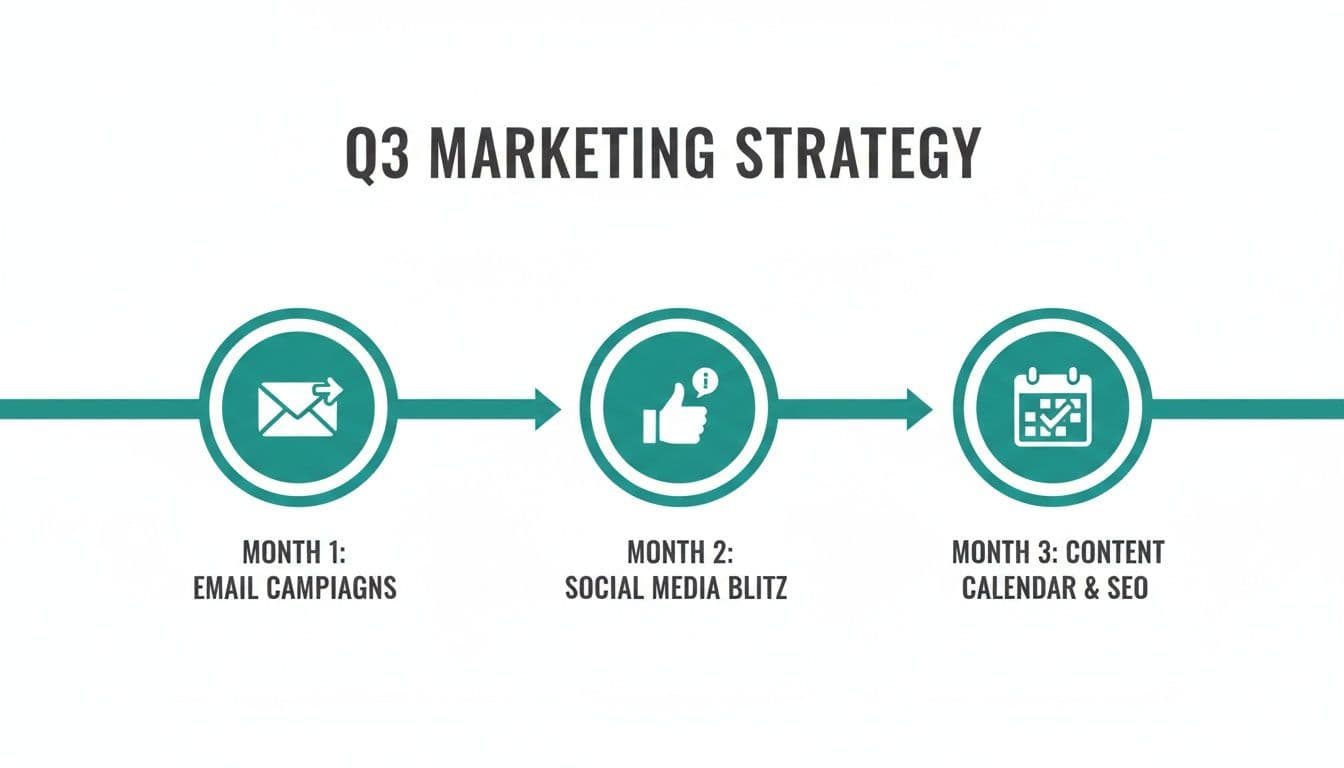
As you can see, the plan layers targeted emails and a social media blitz. It also uses ongoing content to build momentum toward a key event.
The Advantage of an Integrated System
You can see the complete story of your impact when your marketing and financial data are connected. Reporting becomes a nightmare when you use separate tools. It is tedious and the information is often outdated.
Your marketing data is most powerful when it's connected to your financial data. Seeing campaign results alongside real-time fund balances tells you the complete story of your impact.
Because AlignMint's true fund accounting and CRM are built into the same platform, you get this complete story automatically. You can generate a Statement of Functional Expenses with just a few clicks. This unified reporting makes preparing your Form 990 far less stressful. For more planning resources, our guide to building a nonprofit budget is a great place to start.
Your Marketing Questions, Answered
As a nonprofit leader, you are juggling a dozen different roles. Here are some straightforward answers to the marketing questions we hear most often.
How Can I Start Marketing With No Budget?
This is the most common question, and the answer is simple: start with what you have. Your most powerful assets are your people. Their authentic stories are marketing gold and cost you nothing.
Focus on your existing community. Ask passionate supporters to share a quick story about why your mission matters. Next, pick just one social media platform and post 3 times a week. It is about working smarter, not harder.
How Often Should I Communicate With Donors?
There is no single magic number, but a good rule of thumb is to give more than you ask. You are building a genuine relationship, not just processing transactions.
Aim to send at least 3-4 non-ask communications for every one fundraising appeal.
Send them impact stories, highlight a volunteer, or share a program update. A platform like AlignMint lets you see a donor's complete history. This helps you send a personalized thank you before you ever ask for another donation.
How Can AI Realistically Help a Small Team?
Think of AI as a time-saving assistant, not another complicated technology. Its best use is making your existing work faster. Forget the hype about it replacing your job.
For example, you can use an AI tool to get a first draft of an email in minutes. Our own Minty can look at your donor data and suggest talking points for that email. It can also turn a few bullet points into a compelling newsletter story.
Ready to stop juggling separate tools and start building a marketing plan with clear, measurable results? AlignMint brings your accounting, CRM, and marketing together on one simple platform. Explore how AlignMint can unify your nonprofit's operations today.
Frequently Asked Questions
Ready to try AlignMint with your nonprofit?
Start free — set up donor tools, giving pages, and Minty. Upgrade when you need accounting.