

How to Ask for Donations for a Fundraiser
Effective donation requests make the beneficiary, purpose, and action immediately clear. In 2023, U.S. charitable contributions reached an estimated $557.16 billion, while individual donors supplied about 67% of that total.
You may be staring at a fundraising email draft that sounds sincere but still feels vague. Your board wants stronger results, your staff has limited time, and donors increasingly expect to understand both what their gift will do and how you'll report back.
The answer to how to ask for donations for a fundraiser isn't a more emotional subject line alone. It's a complete cycle built on clarity, relevant segmentation, an easy response, accurate records, and a credible promise of accountability.
Quick Answer: Asking for Fundraiser Donations
Ask for fundraiser donations by naming the beneficiary, the purpose, and the next action. Then record the gift against the right donor and fund, and report back on what the money did.
Start with fundraising and the art of the ask. For the letter itself, see letter requesting donations.
Crafting the Ask: Clarity Before Emotion
A donor opens your appeal between meetings, sees a specific need, and wants to know whether a gift will produce a credible result. If the message makes that outcome difficult to find, sincerity will not compensate for the extra work.
A fundraising request is an invitation to help produce a specific outcome, and it carries an obligation to report back. That obligation should influence the wording, the response path, and the follow-up plan before the appeal goes out.
In 2023, charitable contributions in the United States reached an estimated $557.16 billion, the highest amount recorded in current dollars at that time. After inflation, total giving declined 2.1% from 2022, while individuals supplied approximately $374.40 billion, or about 67% of total giving. Giving USA explains these figures and their implications for fundraisers.
Individual donors therefore need appeals that respect their attention. State the need in plain language, connect it to a defined activity, explain how funds will be used, and make the next action easy to complete.

Start with the donor's outcome
Before drafting, complete this sentence:
“Your gift will help [specific people] receive [specific support] by [specific activity].”
If the team cannot answer plainly, the request needs more work. “Support our mission” may be accurate, but it leaves donors guessing about the immediate result.
A stronger appeal identifies the beneficiary, need, and action. It could invite a supporter to fund supplies for a school program, sustain a church outreach service, support a fiscal sponsor's project, or provide a program hour for a defined group. The example should match what the organization can document after the campaign.
State whether the gift supports a restricted campaign or general operations. That distinction lets donors choose with a clear understanding of what the campaign can and cannot fund.
Treat every ask as a promise
The request signals that your organization understands the need, will handle the money carefully, and will explain what happened afterward. Build those commitments into the campaign record before sending the first message.
Tell donors when they will receive an update, and assign follow-up to a named person or team. A campaign that tracks gifts but loses the reporting deadline creates an accountability gap, even when the fundraising target is reached.
For examples of campaign structures, review these fundraising playbook strategies and adapt only what fits your organization's voice and donor relationship. A clear gift invite process can connect the appeal, response path, and donor record, so staff do not have to reconstruct the campaign when it is time to report impact.
Designing Effective Donation Requests
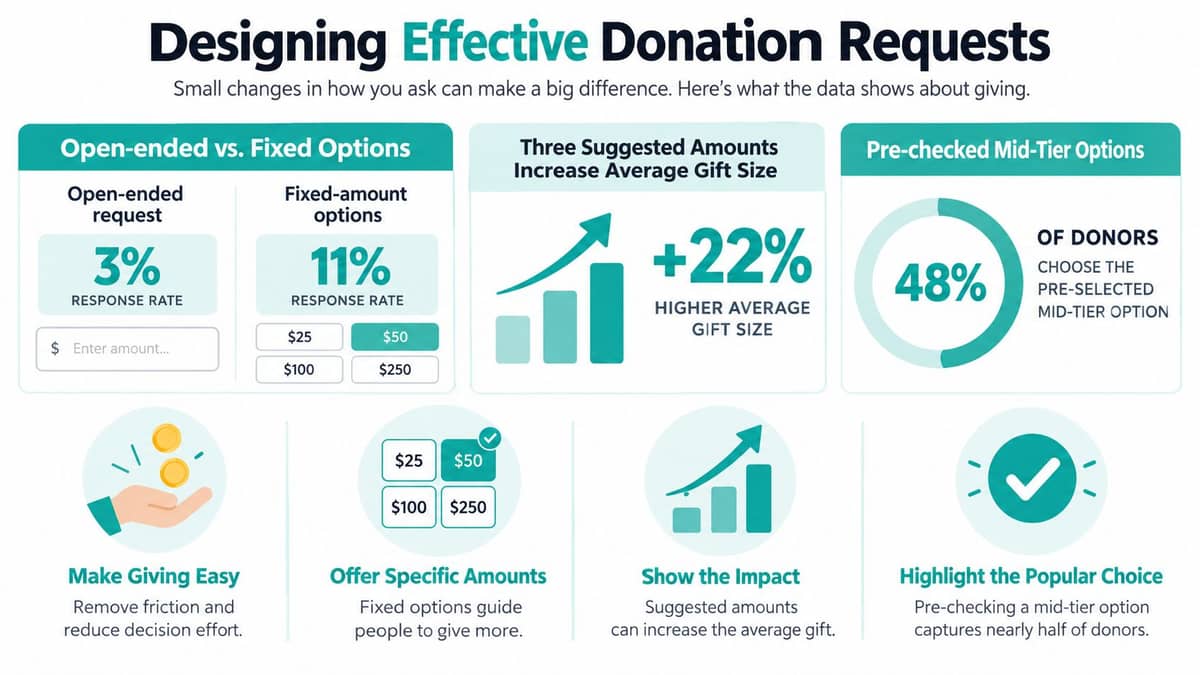
Open-ended requests create unnecessary work for donors. Asking someone to “give whatever you can” may sound flexible, but it forces them to decide whether their amount is appropriate before they've even considered the impact.
Research across seven studies, involving 9,028 participants, found that requests offering multiple contribution amounts produced a 28.5% donation rate, compared with 19.8% for open-ended requests. The difference was statistically significant, as reported in the research on suggested donation amounts.
Build an ask ladder with judgment
Offer a small set of clearly labeled amounts, each connected to a real use. Include an unrestricted or write-in option so donors can choose outside your suggested range.
Your labels should explain impact without making promises your finance team can't verify. For example, describe what a gift can help fund, such as supplies, a meal, a scholarship component, or a program hour. Avoid claiming that one gift independently completes a large outcome if the campaign depends on pooled resources.
A useful request structure includes:
- A lower entry option: Give cautious or first-time donors a comfortable way to participate.
- A middle option: Present a practical contribution tied to a meaningful activity.
- A higher option: Invite donors with greater capacity to make a larger difference.
- A write-in choice: Preserve donor control and accommodate unusual circumstances.
- One primary action: Send every donor toward the same donation form or response method.
Calibrate instead of assuming
Suggested amounts aren't guaranteed upgrades. A field experiment involving more than 10,000 public-television members found that raising the full set of suggested amounts by 20% to 40% reduced the probability of giving by approximately 15%, with little effect on average gift size. Treat this evidence as a warning against aggressive anchors, not as a reason to abandon suggested amounts.
Use prior giving, relationship history, and capacity signals when creating ask strings. A long-time supporter, a first-time prospect, a volunteer, and a major donor shouldn't necessarily receive the same ladder.
Test one meaningful variable at a time. Compare the ask amounts, impact framing, subject line, or call to action, then track response rate, average gift, revenue per recipient, and completed donations.
Your donation page should carry the same promise as your message. Review donation page guidance before launch, especially the mobile experience, recurring-gift option, restricted-fund language, and write-in field.
If your staff also promotes the campaign through social media, prepare short versions that supporters can share without rewriting the entire appeal. A practical tool for teams preparing consistent social copy is this guide to format LinkedIn posts, though the final wording should still sound like your organization.
Running the Ask as a Conversion Funnel
A fundraiser rarely succeeds because of one perfect email. It succeeds when each stage gives the donor a clear reason to continue.
Consider a school raising support for a student access program. The first message states the problem in a few sentences, explains the program's response, and asks for one specific action. The landing page repeats the outcome, offers contribution choices, and works properly on a phone.
The donor may arrive through email, a peer referral, a text message, direct mail, or an event. Those channels can differ, but the underlying campaign information should remain consistent.
Measure each stage separately
The average fundraising email click-through rate is approximately 0.59%, according to email messaging benchmarks for fundraising. That figure doesn't tell you whether your campaign worked, because a click can still end without a completed donation.
Track the journey in separate stages:
- Delivery: Did the message reach the intended audience?
- Engagement: Did recipients open or interact with it?
- Click-through: Did they reach the donation page?
- Completion: Did they finish the contribution?
- Value: What were the average gift and revenue per recipient?
- Stewardship: Did the donor receive an accurate receipt and useful update?
This separation helps you diagnose the actual problem. A weak click rate may indicate poor relevance or a buried call to action. Strong clicks with few completed gifts may point to a confusing form, slow page, missing payment option, or unexpected restriction.
Sequence the communication
Start with the appeal, then follow with a benefit or impact reminder. Use a deadline or matching-gift reminder only when it's genuine, and close the campaign with a clear final message.
Suppress recent donors from repetitive acquisition asks. They should receive a thank-you and an appropriate stewardship message instead of being treated like people who ignored the campaign.
A small nonprofit can manage this sequence with a simple calendar:
- Initial appeal: State the need, outcome, amount choices, and response path.
- Reminder: Explain what the campaign is making possible.
- Decision point: Share a genuine deadline or funding milestone.
- Final close: Invite a last response without manufactured pressure.
- Receipt and update: Confirm the gift, then report the funded activity.
Use a unique campaign URL or attribution code so your team knows which channel produced each response. A donor journey workflow can keep those messages, records, and follow-up tasks connected across email, text, events, and direct outreach.
Closing the Accountability Gap
Many fundraising teams invest heavily in the request and then treat reporting as an administrative afterthought. Donors experience the opposite. The follow-up is where they decide whether your original promise was credible.
65% of donors want regular updates about their impact, while only 36% of nonprofits provide them, according to Bloomerang's report on donor expectations and nonprofit actions. That gap gives smaller organizations a practical opportunity to stand apart through simple, consistent communication.

Make reporting proportionate
You don't need a glossy annual report after every campaign. You do need to tell donors what happened, what remains, and what comes next.
A useful impact update can include:
- Funded activity: Explain what the campaign paid for.
- Amount status: State what was spent, committed, or still available.
- Outcome: Share the measurable result your records support.
- Remaining need: Describe the next responsible step.
- Reporting contact: Give donors a clear route for questions.
Use different language for restricted and unrestricted gifts. A restricted contribution should be tracked against its stated purpose, while general support can help cover broader program and operating needs. Your appeal, receipt, and internal records should agree.
Practical rule: Never promise a reporting detail your team can't reliably produce.
The receipt process also deserves careful attention. The IRS requires written disclosure when a donor pays more than $75 and receives goods or services in return. The disclosure must explain that the deductible amount is limited to the payment exceeding the value of those benefits, and it must provide a good-faith estimate of that value. The IRS guidance on substantiating charitable contributions also explains contemporaneous written acknowledgment requirements for single contributions of $250 or more.
Connect operations to trust
Your finance, development, program, and volunteer records need to describe the same campaign. If volunteers deliver the activity, capture their involvement alongside the funded program. If a fiscal sponsor manages several projects, keep each project's restrictions and outcomes distinct.
Teams comparing tools for volunteer records may find volunteer donation software useful for connecting participation with donor communication. The important point is operational, not technological. Your organization must be able to answer where the money went without searching across disconnected spreadsheets.
A reusable donation acknowledgment letter template can help staff issue consistent thanks while leaving room for the campaign's specific impact details.
Understanding Your Audience and Platform
A donation request succeeds when the message, timing, and response path fit the person receiving it. A first-time mobile donor, recurring supporter, older constituent, and parent connected to a school may need different reasons to give and different ways to respond.
A 2025 survey of 227 donors found that younger donors were more likely to give spontaneously or respond to disaster relief, while donors over 45 more often responded to structured campaigns and direct outreach. The report also found that 11% of donors wanted to be approached more, while 22% said they might give more if approached. Donors ranked text messaging as their third-preferred communication channel, although only 13% of fundraisers use it, according to the report on engaging the next generation of donors. Relevance, permission, and timing matter more than message volume.
Match the message to the relationship
Younger or spontaneous prospects may respond to a short peer message, a mobile form, or an urgent relief request. Make the action immediate and keep the route to payment short.
Established supporters usually need more context. State the campaign purpose, expected outcome, and deadline clearly. Someone who already knows your church, school, or community program may respond better to a structured explanation than to a dramatic appeal.
Recurring donors need recognition and a reason to continue. After an initial contribution, offer a monthly option when the ongoing need is clear. Segment follow-up by relationship and prior behavior rather than sending every donor the same appeal.
Give donors a choice of channel
Email supports explanation and tracking. Text works well for short reminders and urgent actions. Direct mail and phone conversations may suit long-standing relationships, while peer referrals can add credibility to community campaigns.
Keep your donation page easy to find, even when outside platforms accept contributions. During major campaigns, more than 40% of donors preferred giving directly through the recipient organization's website rather than third-party platforms, according to GivingTuesday's international review.
Your donor management tools should let you segment channel preferences and honor them automatically. The donation page should support the promised outcome, recurring gifts, accurate receipts, and donor preferences. If a donor gives through an outside platform, preserve enough information for thoughtful follow-up, subject to applicable privacy requirements.
For organizations evaluating a connected system, AlignMint combines true fund accounting, donor management, volunteer management, events, and a built-in marketing suite. It includes Minty AI, a free tier for nonprofits under $100K, plan-based access without per-seat fees, and online giving pages. It also distinguishes restricted funds from QuickBooks-style classes.
AlignMint brings accounting, CRM, volunteers, events, marketing, and online giving into one nonprofit platform. Visit AlignMint to connect donation requests with fund tracking, donor follow-up, and impact reporting, so the promise made during the ask continues after the gift arrives.
Ready to try AlignMint with your nonprofit?
Start free — set up donor tools, giving pages, and Minty. Upgrade when you need accounting.