

For related tools, see AlignMint features.
Top Church Management Software Guide 2026
Quick Answer: Top Church Management Software: Find Your Ministry's Best
Top church management software should unify giving, people, volunteers, and true fund accounting-not just membership records. Compare Planning Center, Breeze, Realm, Tithely, Rock RMS, and all-in-one options like AlignMint based on restricted-fund reporting, user access, and whether finance still lives in a separate system.
Choosing the Right Tool for Your Ministry's Future
Finding the right church management software can feel overwhelming when your staff is already stretched thin. You may be juggling one system for giving, another for accounting, and a third for volunteer schedules, while spreadsheets fill the gaps. This guide cuts through the noise and shows you which tools help, especially if you want one system that brings finance, fundraising, and people management together.
The bigger issue isn't just software overload. It's uncertainty. When donation records, fund balances, event signups, and volunteer data live in different places, you spend more time checking numbers than leading ministry. If you're comparing options right now, this compare church management software guide is a useful companion.
Churches are clearly moving toward digital operations, even if vendors describe that shift in very different ways. One market forecast projects the global church management software market will grow from approximately $1.2 billion in 2024 to $2.1 billion by 2030, with cloud-based tools leading the market in 2024 because they support remote access and simpler pricing for church teams (Strategic Market Research church management software market). The point for you is simple. This category is maturing, and the right decision now can save years of workarounds later.
1. AlignMint
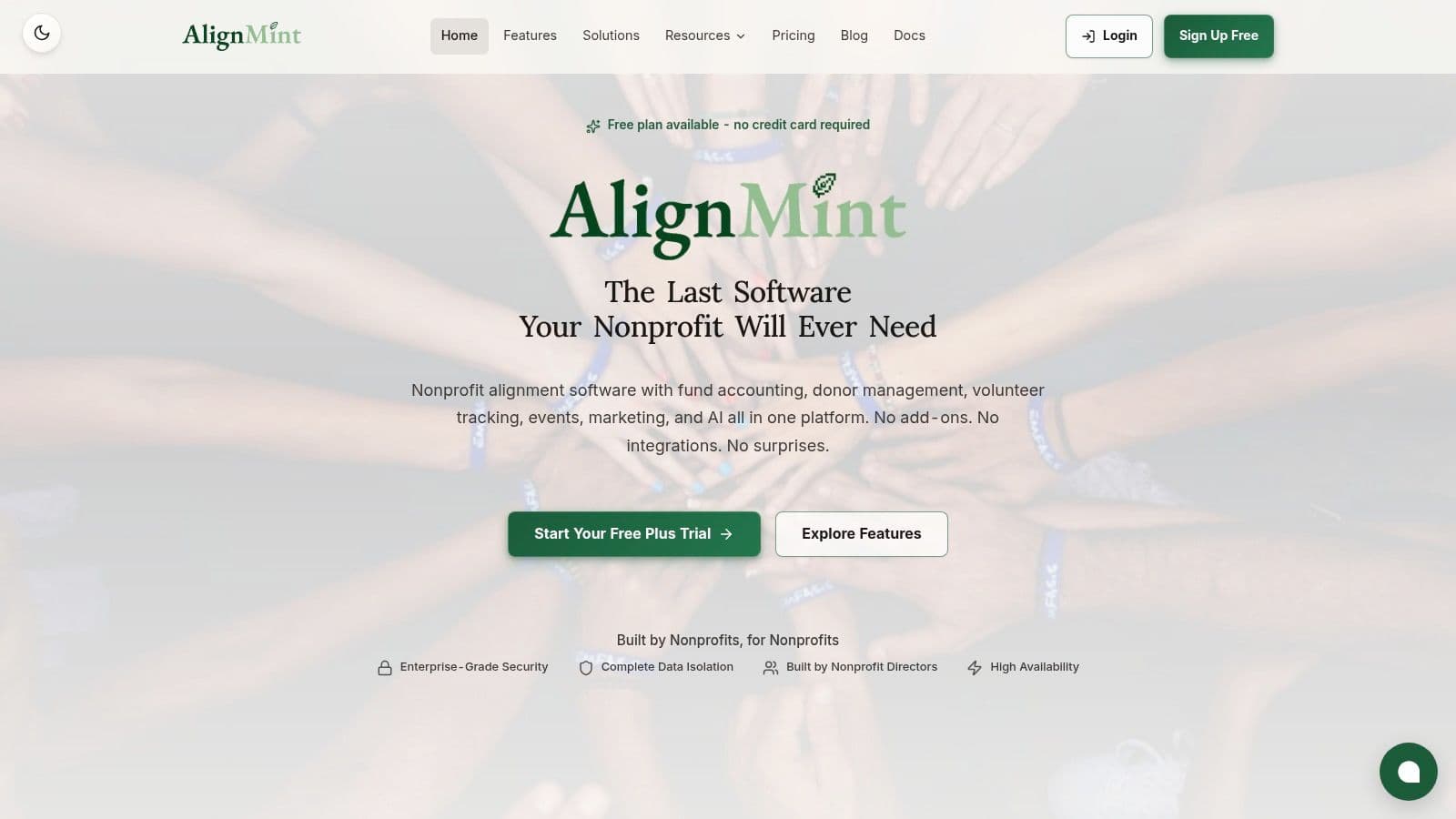
If your goal is financial clarity, AlignMint stands out because it starts with true fund accounting, not as an afterthought. You don't have to force restricted gifts, grants, and program activity into general business accounting logic. That matters when your board wants answers quickly and your finance team is tired of spreadsheet repairs.
AlignMint is built as one platform for accounting, donor management, volunteer management, events, online giving pages, team communication, and a built-in marketing suite. For ministries that also run a school, support sponsored projects, or manage multiple programs with separate restrictions, that unity is the biggest advantage. Instead of asking whether data synced correctly, you work from one record of truth.
Why it works for executive directors
Most church software handles membership and giving well enough. The trouble starts when finance gets serious. A review of church software content noted that most lists still miss the difference between standard donation tracking and true fund accounting, even though restricted grants and program reporting create real pain for nonprofit teams (analysis of church software fund accounting gap).
That gap is where AlignMint is strongest. Restricted funds, grants, and programs are modeled natively. Donor records and finance records live together, so receipting, pledge tracking, donor self-service, and reconciliation don't depend on exports.
Practical rule: If your treasurer still rebuilds reports in Excel, your software stack isn't unified enough.
Minty is another meaningful difference. It gives your team an AI assistant tied to your live data, so you can ask questions without building custom reports first. For leaders who aren't technical, that's often the difference between "we should look into this" and "I can answer the board today."
Best fit and trade-offs
AlignMint also makes a strong case on cost structure. It offers a free tier for nonprofits raising under $100K annually, which is rare among all-in-one options and directly helpful for smaller ministries and newer organizations. If you serve a smaller congregation, this guide to best church accounting software for small churches goes deeper on the accounting side.
What works well:
- True fund accounting: Restricted funds, grants, and program reporting are built into the ledger.
- Unified ministry operations: Accounting, CRM, volunteers, events, fundraising, and marketing live together.
- Plan-based user allowances (1 on Free, up to 10 on Plus, up to 25 on Pro, and unlimited on Enterprise): You don't have to ration staff access or volunteer logins.
- Strong fit for fiscal sponsorship: You can manage multiple projects with consolidated reporting and fee allocation.
- Good support for church and school workflows: The platform suits ministries with more than one operating unit.
What doesn't:
- Public pricing is limited: Beyond the free tier and trial, you'll likely need a conversation to map fit.
- Switching takes planning: If you're replacing several legacy tools, setup and change management still matter.
For churches that want one system instead of a patchwork, AlignMint is the clearest all-in-one option in this list.
2. Planning Center
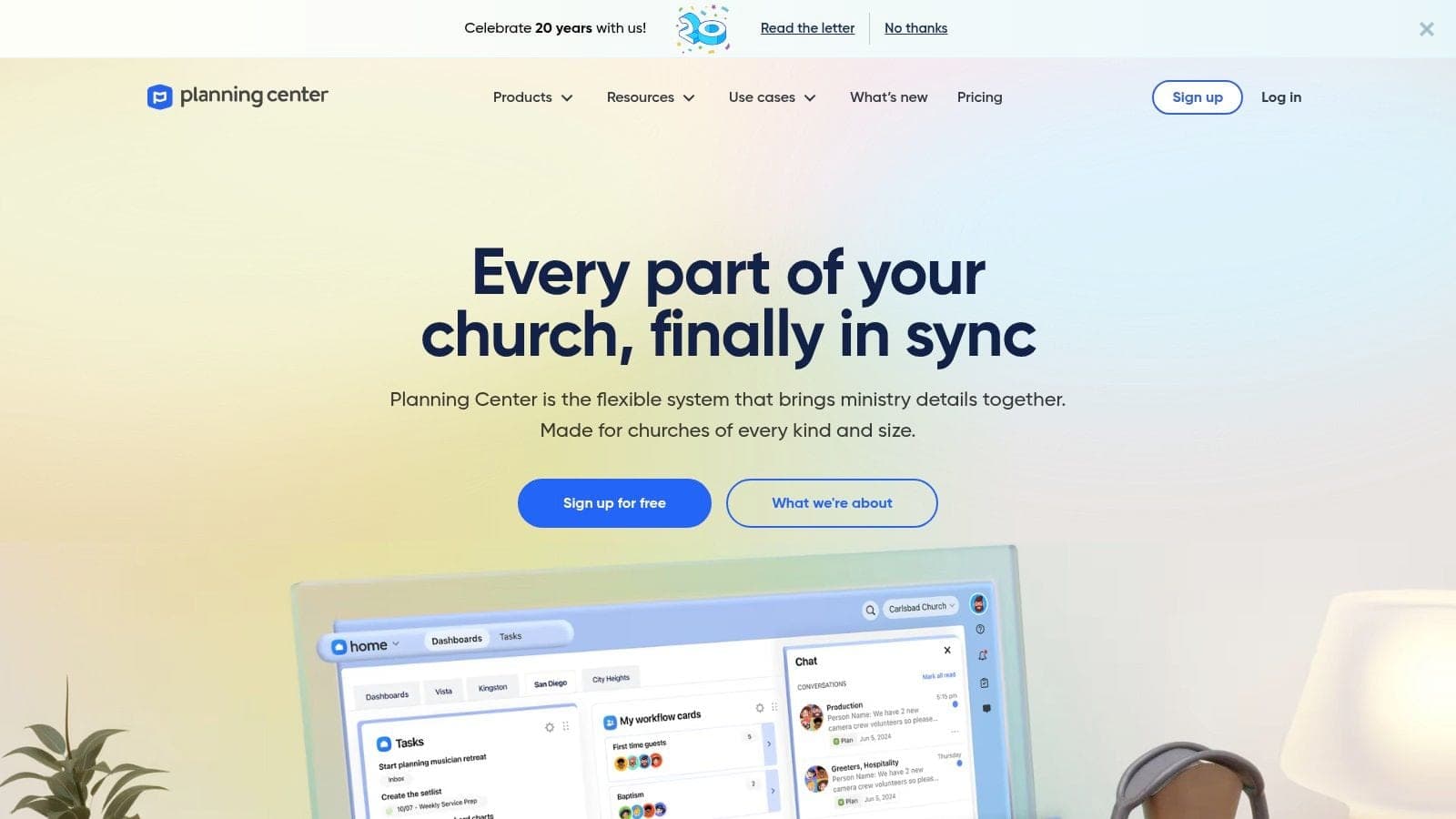
Planning Center earns its place near the top because it helps you get organized quickly, especially around people, worship planning, check-ins, groups, and events. If your ministry team wants to start small and add tools over time, its modular structure is practical.
The biggest strength here is clarity. You can begin with the People database and add Services, Giving, Registrations, Groups, Calendar, or Check-Ins as needed. That makes Planning Center approachable for churches that don't want a large software decision all at once.
Where Planning Center shines
Planning Center is often the best answer when worship planning and volunteer scheduling are your immediate pain points. Its Church Center app also gives congregants one place for profiles, giving, registrations, and groups. That member experience is one reason so many churches adopt it early.
Only a few platforms offer a free tier for organizations raising under $100K annually, and Planning Center is one of the names specifically noted alongside that budget-friendly option (Charity Charge church management software overview). For smaller churches, that lowers the risk of getting started.
Planning Center is easy to like when ministry operations come first. It gets harder when finance needs a true nonprofit ledger.
Best fit and trade-offs
Planning Center is strongest as a modular ministry suite. It isn't the best choice if your main goal is unifying fund accounting, donor CRM, volunteer records, and reporting in one place. Many churches eventually pair it with separate accounting software, which can work, but it also creates extra handoffs.
- Best for: Worship planning, check-ins, groups, volunteer scheduling, and churches that want to add tools gradually
- Works well: Clear pricing, free entry points, familiar church workflows
- Watch for: Costs can rise as you add modules and activity increases
If you're weighing the trade-offs against a finance-first platform, this comparison of Planning Center vs Realm is worth reading before you commit.
3. Breeze ChMS
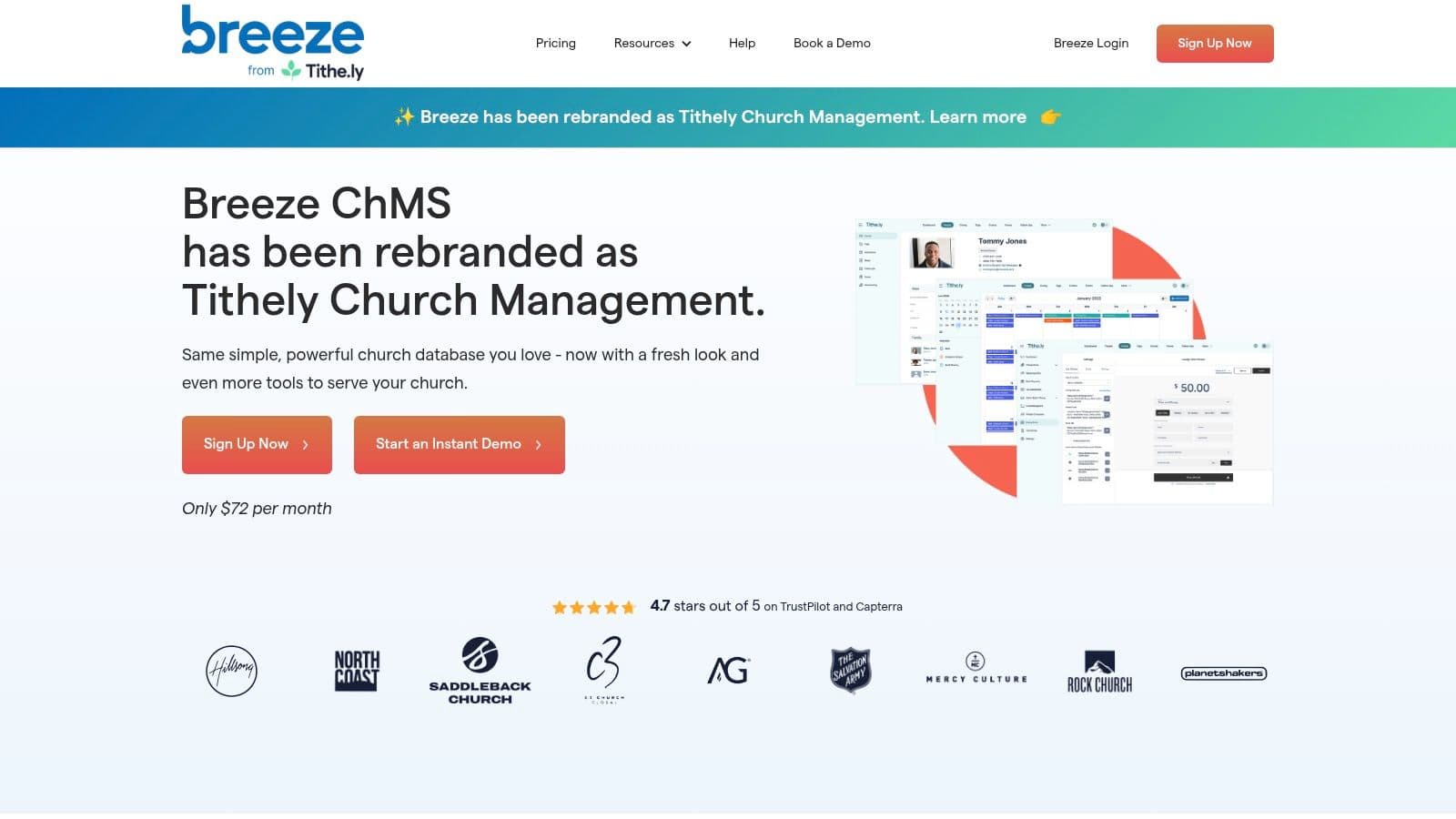
Breeze ChMS is a strong choice when your priority is simplicity. If your office manager and volunteers need to learn a system quickly, Breeze usually feels less intimidating than larger suites. That low learning curve is its biggest advantage.
It also suits churches that want predictable software costs. Flat-rate pricing and unlimited records appeal to ministries that don't want to revisit software math every time attendance grows or a new admin needs access.
Where Breeze makes sense
Breeze handles people records, giving, statements, forms, events, and volunteer scheduling well for everyday church administration. It gives small and midsize churches enough structure without burying them in options they may never use.
Breeze is also one of the market leaders mentioned in broader market coverage, alongside Planning Center and Tithe.ly, as churches move toward integrated software that combines giving, volunteer management, and event tools in one package (Market Research Future church management software market). That aligns with Breeze's appeal. It focuses on the core work most churches typically do.
Best fit and trade-offs
The trade-off is depth. Breeze is not trying to be the finance nerve center for a church with complicated restricted funds, multiple campuses, or advanced grant reporting. That's not a flaw. It's merely a boundary.
- Best for: Small and midsize churches moving off spreadsheets or older databases
- Works well: Fast setup, predictable costs, easy training, basic giving and people workflows
- Watch for: Limited depth for advanced finance or highly customized operations
If volunteer coordination is one of your major pain points, this church volunteer management complete guide will help you think beyond scheduling and into retention, safety, and reporting.
4. Realm by ACS Technologies
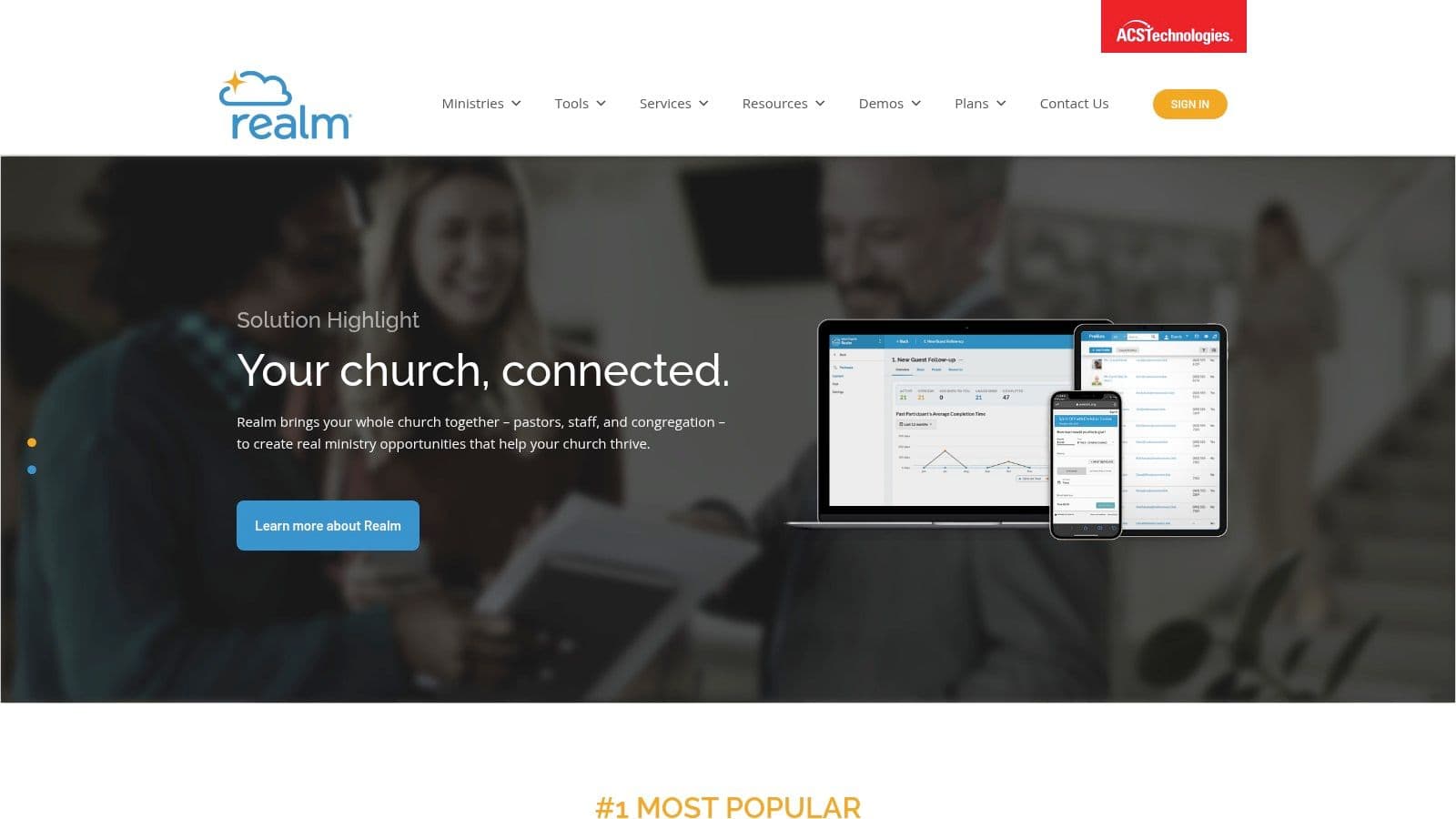
Realm works best when you want one vendor for membership, groups, communication, giving, and accounting-related functions. For churches that prefer a broad church platform from an established provider, Realm remains a serious option.
Its appeal is straightforward. You can manage profiles, pathways, groups, communication, and check-in in one environment, then add Realm Accounting if you want finance under the same vendor. That can reduce the friction of stitching systems together yourself.
Where Realm fits best
Realm is particularly relevant for churches with more formal pastoral care, discipleship steps, or sacrament tracking needs. ACS has served church organizations for a long time, and that experience shows in the structure of the product.
North America holds approximately 48% of the church management software market, and digital adoption in the United States is cited at 68%, with ACS Technologies Group named among prominent vendors in that region (Business Research Insights church management software market). Realm benefits from that established regional footprint.
Realm is often a good fit for churches that want stability and broad coverage from one church-focused vendor.
Best fit and trade-offs
Realm's biggest question isn't whether it can cover a lot. It can. The practical question is whether the accounting add-on, pricing model, and implementation fit your church's pace and budget.
- Best for: Churches that want a mature church platform with an accounting path under one vendor
- Works well: Membership, communication, pathways, giving, and denomination-friendly workflows
- Watch for: Quote-based pricing and the fact that accounting is an add-on, not the core product
If your church prefers one long-standing vendor relationship, Realm deserves a demo.
5. Pushpay with Church Community Builder
Pushpay, paired with Church Community Builder, is strongest when generosity, mobile engagement, and communication are central to your strategy. Larger and multi-campus churches often like this combination because it supports donor engagement and church app experiences well.
Pushpay's giving tools are polished, and the Church Community Builder side gives you workflows for people, groups, and volunteer coordination. If your church already thinks in terms of engagement funnels and digital response, this stack can feel natural.
Where Pushpay stands out
This option is built for churches that want a polished member-facing experience. Mobile giving, analytics, branded app tools, and enterprise support are part of the appeal. It tends to fit ministries that have enough staff capacity to take advantage of those features.
This is also where vendor positioning matters. Some churches don't just want a database. They want a growth platform that supports communication and generosity across channels. If that sounds like your setting, these 10 proven church growth strategies pair well with a Pushpay-style approach.
Best fit and trade-offs
Pushpay is not usually the first choice for smaller churches that want a simple, self-serve setup. Pricing is quote-based, and contracts are often longer. That can be reasonable for large ministries, but it reduces flexibility.
- Best for: Larger churches, multi-campus ministries, and teams focused on giving and engagement
- Works well: Mobile giving, communication, app-led engagement, enterprise support
- Watch for: Quote-based pricing, contract structure, and the need for separate accounting depth
If your church is growth-focused and digitally mature, Pushpay belongs on your shortlist.
6. Tithely Church Management and Tithely All Access
A familiar church office problem looks like this. Giving lives in one tool, volunteer schedules in another, texting in a third, and the website sits somewhere else entirely. Staff can keep it running for a while, but sooner or later someone is exporting CSVs, reconciling donor records by hand, and wondering why basic reporting takes half a day.
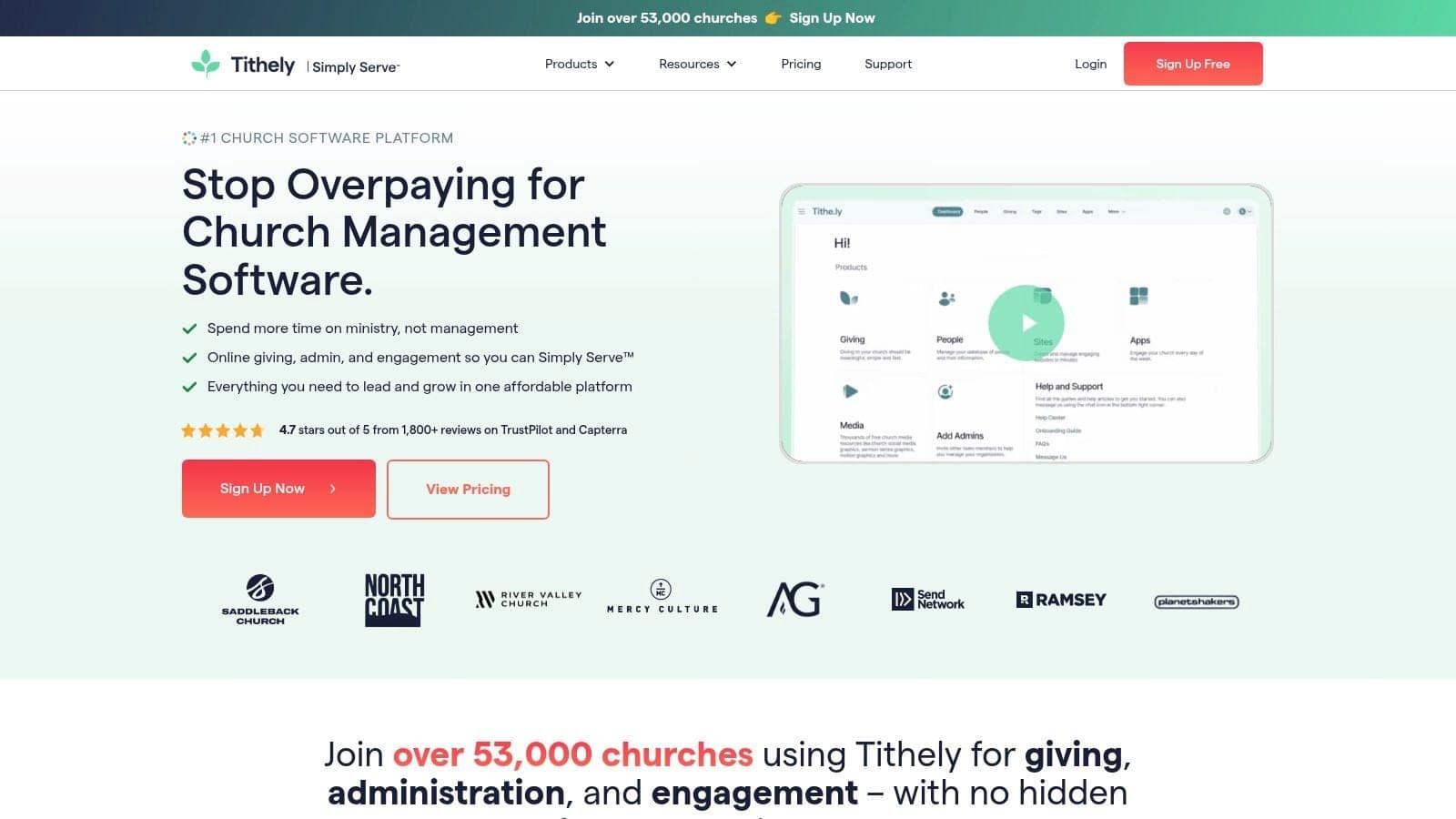
Tithely is built for churches that want to reduce that sprawl fast. The appeal is straightforward. One vendor can cover giving, church management, messaging, apps, websites, and a few ministry add-ons, all packaged in Tithely All Access. For small and midsize churches, that can simplify purchasing and cut down on the day-to-day friction of managing too many separate subscriptions.
What Tithely does well
Tithely's main advantage is consolidation. You can pair Elvanto ChMS with online giving, messaging, websites, worship planning, apps, and MinistrySafe integration. That makes it a practical fit for churches that need a connected operating system for ministry activity, not a patchwork of point solutions.
That said, operational unity only matters if it reduces back-office work. Tithely can help on the people and communication side, and it can centralize giving workflows better than a disconnected stack. The question I would press on is finance. If your leadership team needs true fund accounting, cleaner restricted fund reporting, or fewer workarounds between donations and the general ledger, you need to test how far the system goes before assuming the bundle solves the whole problem.
That is the primary trade-off here.
Best fit and trade-offs
Tithely makes the most sense for churches that want broad coverage from one vendor and are willing to accept less specialization in certain areas. Many teams will see that as a fair exchange. Others outgrow it once financial complexity increases or reporting standards get tighter.
- Best for: Small and midsize churches that want one vendor for giving, messaging, websites, apps, and member management
- Works well: Consolidating common ministry tools and reducing software sprawl
- Watch for: Extra costs tied to premium branding, and gaps if you need deeper accounting or more specific workflows
If giving is the first area you need to clean up, this guide on how to track tithes and offerings without creating extra reconciliation work will help you evaluate whether your current process is saving time or just hiding manual effort.
7. Rock RMS
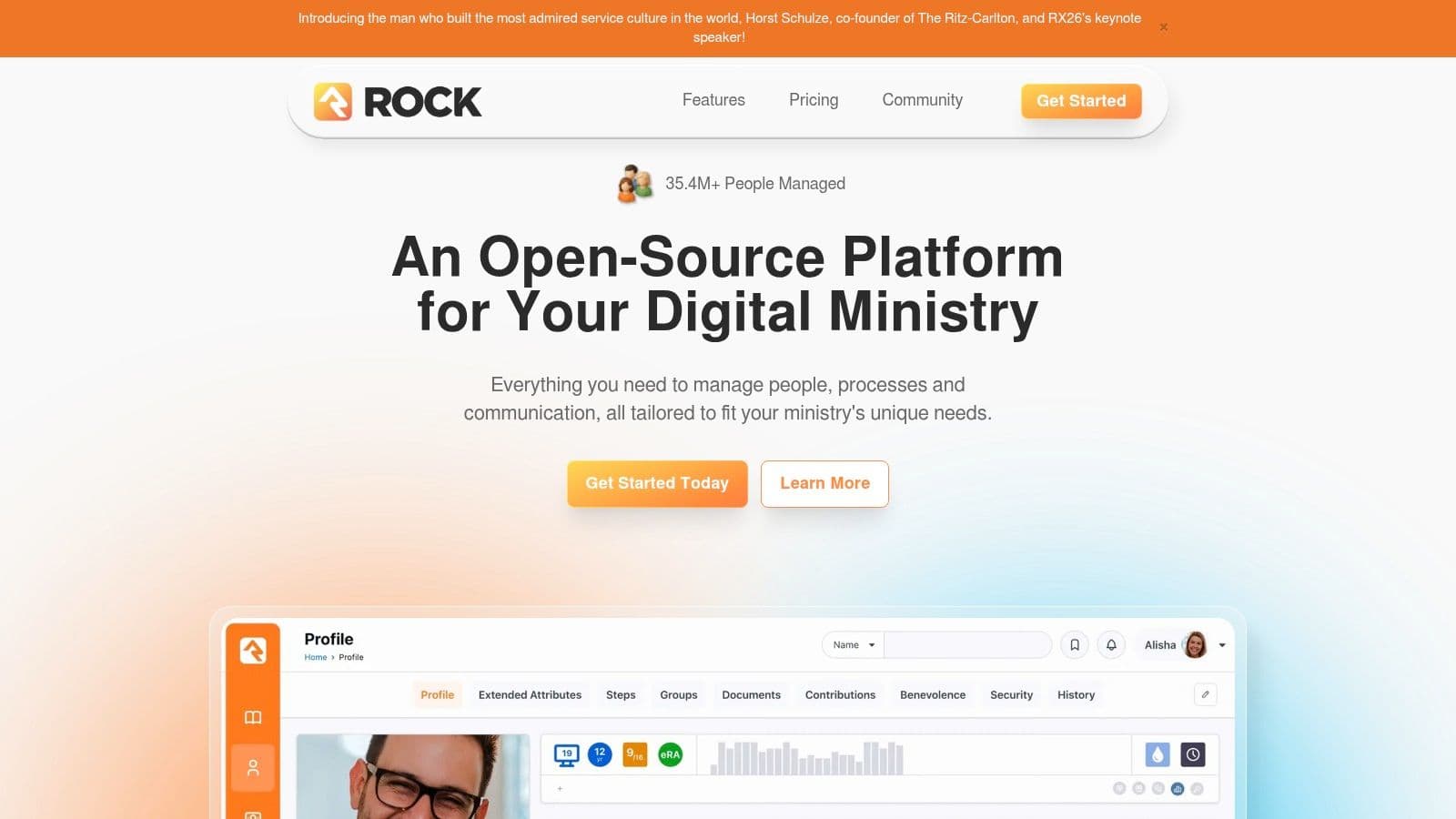
Rock RMS is the best option in this list if your church wants deep customization and has the technical capacity to support it. You can shape workflows, extend the platform through its API, and choose self-hosting or approved cloud partners.
For the right team, that's powerful. Multi-site churches and ministries with unusual workflows often like Rock because they don't have to squeeze themselves into a rigid product model. You can build around your ministry instead of adjusting ministry around the software.
The practical reality
Rock is not a simple plug-and-play choice. It works best when someone on your team, or a trusted partner, can own implementation and maintenance over time. If that person doesn't exist, Rock often becomes harder than it needs to be.
The upside is flexibility. The downside is responsibility. That's a reasonable trade-off for technical churches, but not for every church.
If your team asks for total flexibility, make sure someone also owns the consequence of that flexibility.
Best fit and trade-offs
One other point is important. Rock can manage giving data and workflows, but churches still need to think carefully about accounting and restricted fund reporting elsewhere if that's a core need.
- Best for: Large churches, multi-site ministries, and teams with technical staff or partner support
- Works well: Custom workflows, integrations, data ownership, extensibility
- Watch for: Implementation burden, ongoing maintenance, and separate finance planning
Rock is impressive. It just asks more of your team than most cloud tools do.
8. ChurchTrac
ChurchTrac is often the right answer when you want broad functionality at a price that feels reasonable. It covers people management, giving, check-in, worship planning, events, and includes a website and church app in its core offering. For smaller churches, that's a compelling mix.
This isn't the fanciest platform in the category. That's part of its appeal. It focuses on everyday church operations and gives budget-conscious teams a practical all-in-one option without a heavy learning curve.
Why many smaller churches like it
ChurchTrac fits churches that want good value, straightforward pricing, and responsive support. If your team cares more about getting organized than customizing every process, it checks many important boxes.
The monthly subscription model is noted as the most-used pricing strategy in this category, which helps explain why tools like ChurchTrac remain attractive for churches that want predictable operating costs without a large software purchase decision upfront. That trend sits alongside the broader market move toward cloud deployment and mobile access, both of which are shaping how ministries manage daily operations.
Best fit and trade-offs
ChurchTrac can cover a lot for a modest church office. The main limitation is scale. Larger or more complex ministries may eventually want deeper integrations, more advanced reporting, or more specialized finance tools.
- Best for: Small to mid-sized churches seeking value and broad everyday functionality
- Works well: Giving, people records, basic operations, included website and app
- Watch for: Less depth for large organizations or highly specialized workflows
If your current software budget feels upside down, ChurchTrac is one of the first tools I'd look at.
9. One Church Software
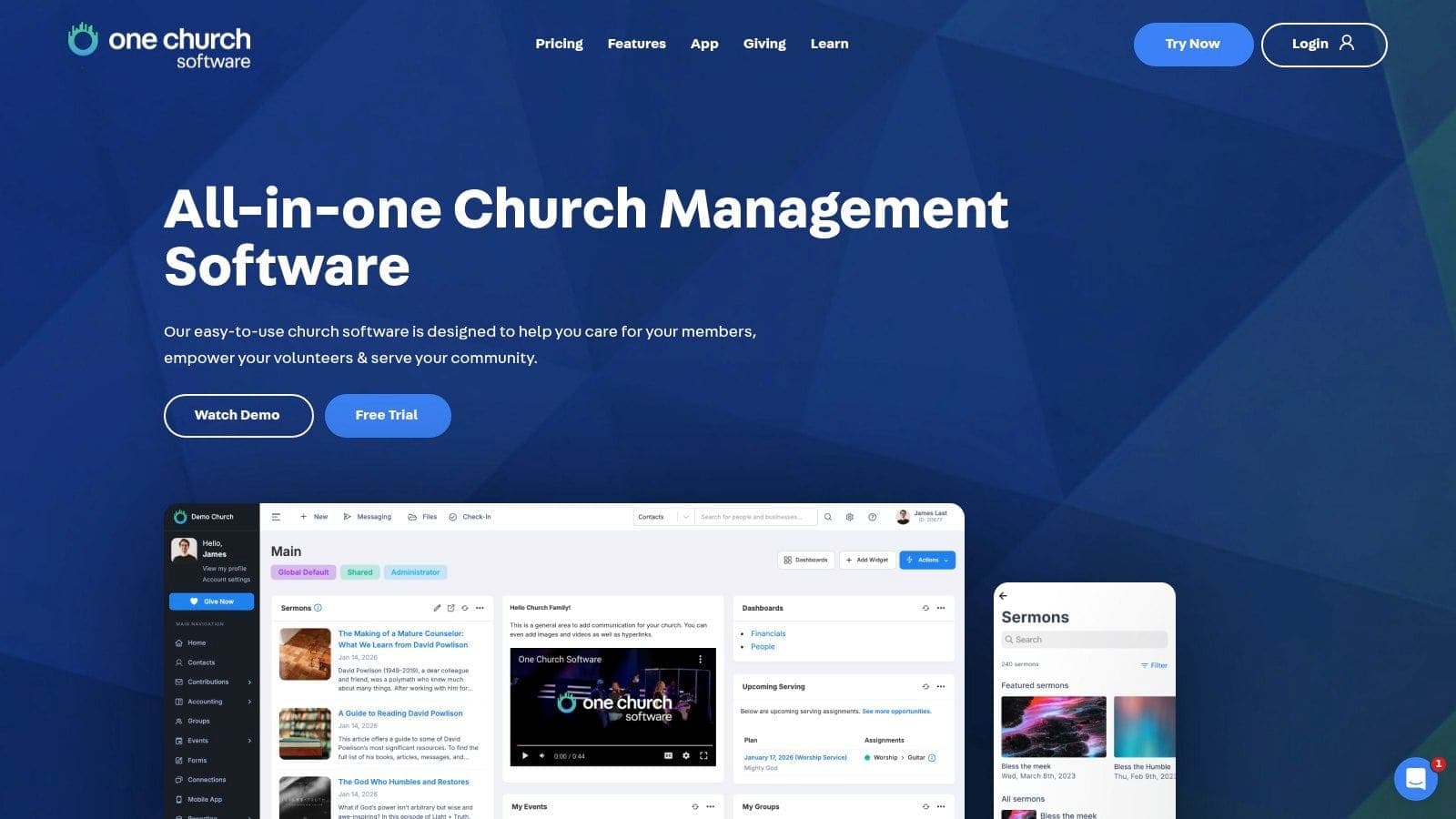
One Church Software is a thoughtful middle-ground option for churches that want more automation and operational range than entry-level systems usually offer. It covers contacts, forms, check-in, events, metrics, contributions, serving, service planning, and a mobile app, with higher tiers adding automation, facilities, API access, and multi-campus tools.
That makes it appealing for churches that are growing and starting to feel the limits of simpler software. If you need more structure, but you aren't ready for a heavier enterprise product, this can be a good fit.
Where it earns attention
One Church Software does a solid job of balancing breadth and manageability. Reporting and automation are meaningful strengths, especially for churches trying to reduce repetitive administrative work. Optional financial tools also help if you want to keep more operations under one vendor.
This sits well with another shift in the category. Cloud services are described as holding the major share of the market by type, while broader market growth is projected from 2025 through 2035 as churches adopt centralized platforms for congregation data, giving, and event planning instead of disconnected tools (Future Market Insights church management software market forecast). One Church Software is very much part of that centralized-platform trend.
Best fit and trade-offs
The main trade-off is cost creep as profile counts increase, especially once you add the financial suite. That doesn't make it a poor choice. It just means you should model your likely growth before signing.
- Best for: Growing churches that want automation and broad integrated operations
- Works well: Multi-campus support, forms, serving, events, reporting, API access
- Watch for: Pricing that rises with profile volume and extra cost for financial tools
It's a practical step up from entry-level ChMS tools without jumping straight into the most complex platforms.
10. TouchPoint
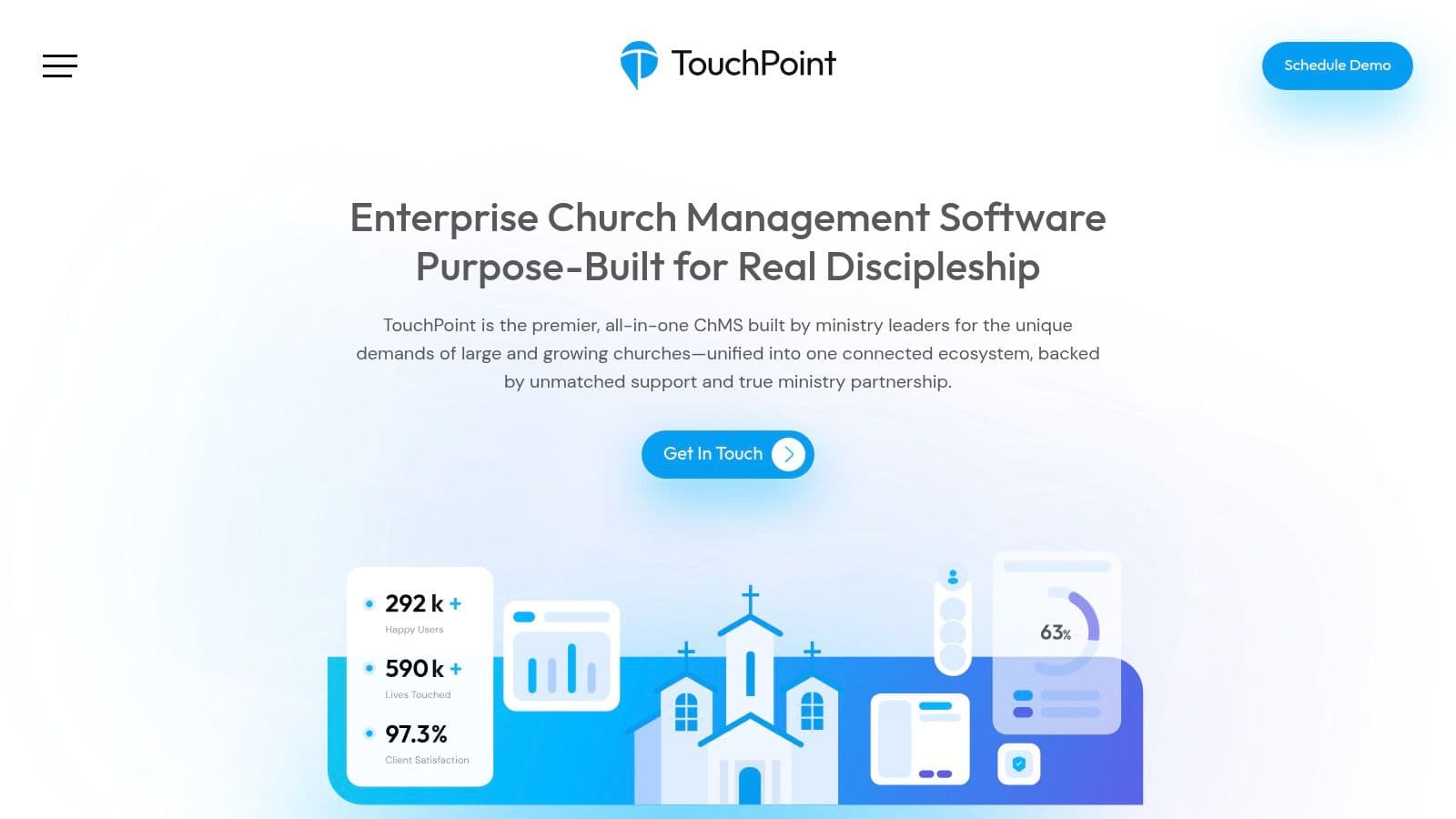
TouchPoint is aimed at churches that need a serious central database and are ready to invest in a more substantial system. It combines workflows, communication, mobile app functions, and integrated giving in a cloud environment that is generally geared toward medium and large churches.
If your ministry has multiple departments, a broad staff structure, and several active ministries sharing one database, TouchPoint can make sense. It isn't trying to be the cheapest or simplest option. It's built for churches that need range and are prepared to pay for it.
Where TouchPoint fits
TouchPoint works well when engagement at scale matters. A customizable database, implementation support, and integrated giving all help churches that have moved beyond lightweight administration and into more structured operations.
That need for unified operations matters more than many lists admit. Capterra notes that approximately 87% of nonprofits using church management software report donor tracking and pledge management as critical features, yet many platforms still rely on external accounting tools instead of offering true fund accounting for restricted grants and programs (Capterra church management software overview). TouchPoint addresses the donor side well, but churches should still ask detailed accounting questions during evaluation.
Best fit and trade-offs
TouchPoint is not ideal for a small church that wants to clean up records and online giving. It becomes more attractive when your church needs a larger investment-grade system.
- Best for: Medium to large churches needing a customizable cloud database and integrated giving
- Works well: Multi-ministry structures, implementation support, larger-scale engagement
- Watch for: Higher starting cost and a heavier commitment than lightweight tools
If your team is ready for a more involved rollout, TouchPoint is worth considering.
Top 10 Church Management Software Comparison
| Product | Core features | User experience & reliability | Value proposition / Unique selling points | Best for & pricing |
|---|---|---|---|---|
| AlignMint | True fund accounting (restricted funds, grants, programs), donor‑centric CRM, volunteers, events, fundraising, Minty | Unified interface, real‑time dashboards, bank‑level encryption, 99.9% uptime | All‑in‑one nonprofit ops; one‑click Form 990s; finance+donor data unified; fiscal‑sponsor reporting | Nonprofits wanting a single secure platform; free tier ≤$100K/year; 30‑day Plus trial; all‑inclusive pricing |
| Planning Center | Modular suite: People, Giving, Services, Registrations, Check‑Ins | Strong worship planning & volunteer scheduling; free People DB; scalable modules | Pay‑for‑what‑you‑use modularity; clear public pricing | Churches starting small and scaling; transparent pricing, free entry tiers |
| Breeze ChMS | Unlimited people & admins, giving, service planning, SMS allotment | Very low learning curve; fast setup; responsive support | Predictable flat monthly pricing; no contracts | Small-mid churches wanting simple, predictable costs |
| Realm (ACS) | Profiles, groups, communication, giving, optional Realm Accounting add‑on | Broad integrated suite; established vendor | One vendor for membership + finance (accounting as add‑on) | Churches seeking consolidated vendor; quote‑based pricing (attendance‑tied) |
| Pushpay + CCB | Embedded giving, analytics, CCB ChMS, apps, engagement tools | Enterprise implementation & support; app‑focused UX | Deep generosity analytics & engagement stack | Large multi‑campus churches focused on donor engagement; quote pricing, multi‑year contracts |
| Tithely (Elvanto) | All Access bundle: Giving, ChMS, Messaging, Apps, Sites, Worship tools | Easy start, free trials, modular options | Cost‑effective bundled tools; public US transaction fees | Churches wanting bundled vendor value; public transaction fees for giving |
| Rock RMS | Open‑source platform, self‑host or cloud partner, API & workflows | Extremely flexible but requires technical capacity | Deep customizability, data ownership, no required license fee | Tech‑savvy teams and multi‑site churches; hosting/partner costs vary |
| ChurchTrac | People, giving, events, check‑in, worship planning, website/app included | Budget‑friendly, clear pricing, fast human support | Low price with included website/app and setup | Small-mid churches on tight budgets; clear low pricing tiers |
| One Church Software | Contacts, Events, Check‑In, Contributions, Automation, optional Financial Suite | Modern UI, automation, API, training and free setup tiers | Strong automation and reporting; usage‑based transparency | Churches needing automation and integrations; pricing scales with profiles |
| TouchPoint | Church‑wide database, workflows, mobile app, integrated giving | Scales for mid-large churches; US-centric support & implementation | Flexible implementation for multi‑ministry contexts | Medium-large churches prepared to invest; higher starting cost |
Your Next Step Toward a Unified Ministry
Choosing church software is a leadership decision as much as a technology decision. What you're really deciding is how much operational friction you're willing to keep. If finance lives in one system, giving in another, and volunteers in a third, your staff will keep paying the price in manual work and delayed answers.
That's why I don't think a simple feature checklist is enough anymore. Many products on this list are good. Planning Center is strong for worship planning and ministry operations. Breeze is refreshingly easy to adopt. Realm offers a broad church platform from an established provider. Pushpay is strong for generosity and engagement. Tithely is appealing when you want a bundled toolset. Rock RMS gives technical teams room to build. ChurchTrac offers real value. One Church Software and TouchPoint both serve growing churches well.
Still, the most important distinction is this one. Does the software unify stewardship, relationships, and operations, or does it leave you stitching them together after the fact?
A lot of church leaders feel this problem before they can name it. Donation numbers don't match the books right away. Restricted balances take too long to verify. Volunteer information sits apart from donor history. Communication tools know one version of your people, while accounting knows another. None of those problems look dramatic on a vendor demo. They become painful in the week before a board meeting, at year-end reporting time, or when your finance lead leaves and nobody remembers the workaround.
The best church management software doesn't just organize activity. It gives leaders confidence in the numbers behind that activity.
That is why operational unity matters so much. Your church should be able to track giving, manage donors, coordinate volunteers, run events, communicate with members, and report on funds without moving data through spreadsheets every week. If you also run a school, manage grant-funded programs, or act as a fiscal sponsor, that need becomes even more pressing. At that point, the line between a church database and a true operations platform matters.
This is also where AI intelligence starts to become practical, not just promotional. An AI assistant tied to your live ministry data can help only if the data is already connected. If records are fragmented, AI leads to faster confusion. If records are unified, AI can help you answer real leadership questions in plain language.
For many churches, the right next step is not buying more software. It's reducing the number of systems you depend on. A unified platform can give your finance team cleaner books, give your development team better donor visibility, give ministry leaders better volunteer coordination, and give you a clearer picture of what is happening across the whole organization.
If you believe your accounting, donor, and volunteer tools should work together, we invite you to see our approach.
If you're tired of disconnected systems and want one place for fund accounting, donor management, volunteers, events, online giving pages, team communication, marketing, and AI support, take a closer look at AlignMint. We built it for nonprofit and ministry leaders who want cleaner reporting, fewer workarounds, and more confidence in their data.
Ready to see how AlignMint fits your workflow?
Schedule a free walkthrough — we will help you map donors, funds, and migration steps.