


A Guide to the Balance Sheet for Nonprofit Leaders in 2026
Quick Answer: Nonprofit Balance Sheet Guide for 2026
This guide simplifies the balance sheet for nonprofit leaders. Learn to read assets, liabilities, and net assets - and keep restricted funds clear for your board.
As a nonprofit leader, you measure success by the lives you change, not the numbers on a spreadsheet. But what if one of those reports - the balance sheet for nonprofit organizations - could actually tell the story of your impact? It’s a snapshot of your financial health that gives you the confidence to answer tough questions and lead with clarity.
Your Nonprofit Balance Sheet Is a Strategic Story
Let’s reframe the balance sheet. It’s not a chore for your accountant. It's your most powerful tool for strategic planning.
This single document answers the critical questions that keep you up at night. Are we financially stable? Can we afford to launch that new program? How much do we really have available for our mission? When you understand this report, you gain real confidence in your financial position, which is what you need to make mission-critical decisions.
From Financial Chore to Leadership Tool
For too long, the balance sheet has felt like a compliance document. Its real value is in how it informs your leadership. At its core, it’s a simple statement of what you own (assets), what you owe (liabilities), and what’s left for the mission (net assets).
This report helps you:
- Answer Board Questions: Show your board the organization's financial strength and capacity for growth with confidence.
- Secure Funding: Give grantmakers a clear picture of your fiscal responsibility, making a much stronger case for support.
- Make Strategic Decisions: Know exactly what resources are available before you commit to new staff, programs, or other major initiatives.
To see how the balance sheet fits into the bigger picture, read our guide to nonprofit financial reporting. It helps frame how this statement connects to the rest of your financial story.
Why Your Current System Might Be Holding You Back
If producing a balance sheet feels like a huge effort every time, your tools are likely the problem. Many nonprofits try to make software like QuickBooks work, but it was not built for our sector's needs. It requires clumsy workarounds to track restricted funds, making it nearly impossible to get a true picture of your finances.
A clear, accurate balance sheet is the foundation of trust with your donors and board. It proves you are a responsible steward of the community's investment in your mission.
Our platform was designed by nonprofit professionals to solve this exact problem. AlignMint provides true fund accounting to manage restricted grants correctly from the start. Because our system is all-in-one, your balance sheet is always up-to-date, reflecting real-time data from your donor management activities. This means you can pull an accurate report in minutes, not weeks.
The Three Pillars of Your Nonprofit Balance Sheet
The term "balance sheet" can feel intimidating. For a nonprofit leader, it’s not as complicated as it sounds. It is one of the most powerful tools you have for telling the story of your organization’s financial health.
Every balance sheet is built on the same simple foundation. It all comes down to understanding your assets, liabilities, and net assets.

What You Own: Assets
First are your assets. Think of these as everything your nonprofit owns that has value. On a balance sheet, assets are listed by how quickly you could turn them into cash.
Common nonprofit assets include:
- Cash and Cash Equivalents: The money sitting in your bank accounts.
- Accounts Receivable: Promised donations or grant payments you expect to collect soon.
- Investments: Funds your organization has invested to generate returns.
- Property and Equipment: Physical things like buildings, vehicles, and computers.
The collective value of these assets across our sector is staggering. As of 2026, U.S. nonprofits held $10.73 trillion in total assets. This includes $4.94 trillion in property and equipment used to deliver services. You can explore the Federal Reserve's full report on nonprofit balance sheets to see this data.
What You Owe: Liabilities
Next, you have liabilities. These are your organization’s financial obligations. They are a normal part of running an organization.
Liabilities are typically sorted by when they are due.
- Accounts Payable: Unpaid bills for rent, utilities, or program supplies.
- Accrued Expenses: Salaries or vacation time you owe your staff.
- Deferred Revenue: Money you received for a future event, like gala ticket sales.
- Loans or Mortgages: Long-term debt for a major purchase, like a building.
What Is Left for Your Mission: Net Assets
This is where the magic happens for nonprofit leaders. Your net assets are what’s left after you subtract liabilities from assets. This number shows your organization's true financial worth and its capacity to serve.
For-profit businesses call this "equity." For us, it’s the community's investment in our mission. Net assets are split into two critical categories:
- Net Assets Without Donor Restrictions: This is your flexible money. You can use these funds for any purpose that supports your mission.
- Net Assets With Donor Restrictions: This is money earmarked by a donor for a specific purpose. You are legally bound to use these funds only as specified.
Understanding this distinction is essential for compliance and building trust. Generic accounting tools often fail here. It’s hard to properly track and report on these separate buckets of money without manual work.
This is where a system designed for nonprofits makes a difference. With true fund accounting for nonprofits, you can see your restricted and unrestricted funds in real time. AlignMint’s all-in-one platform handles this complexity automatically, so you always have a clear picture of what you can spend.
How a Nonprofit Balance Sheet Differs From For-Profit
If you have spent time in the business world, a nonprofit balance sheet can feel familiar but different. The layout seems recognizable, but the language is not the same. This reflects the core distinction between measuring profit and measuring mission.
A for-profit balance sheet tells a story of ownership and financial return. A nonprofit balance sheet tells a story of stewardship and community investment. Grasping this shift is the first step toward using the report as a strategic tool.
Net Assets Replace Owner's Equity
The most glaring difference is in the bottom section of the report. A for-profit company has an "Owner's Equity" section. This represents the financial stake the owners have in the business.
In a nonprofit, there are no owners. Instead, you have a Net Assets section. This number represents the community's investment in your cause.
This is a critical mindset shift:
- For-Profit Equity: Belongs to owners or shareholders.
- Nonprofit Net Assets: Belongs to the mission, held in trust for the community.
Purpose and Terminology Are Mission-Focused
The differences go much deeper than one line item. A business exists to generate profit for its owners. A nonprofit exists to deliver on its mission, and any surplus is reinvested into programs.
Think of it this way: a business balance sheet answers, "How much is the company worth to its owners?" A nonprofit balance sheet answers, "What resources do we have to serve our community?"
To illustrate these differences, let’s compare how each type of organization approaches its financial reporting.
For-Profit vs. Nonprofit Balance Sheet Key Differences
| Component | For-Profit Business | Nonprofit Organization |
|---|---|---|
| Primary Goal | To demonstrate financial worth and profitability for owners. | To demonstrate stewardship and accountability to donors and the board. |
| "Bottom Line" Section | Owner's Equity or Shareholder's Equity | Net Assets, broken down by restriction. |
| Interpretation | Shows what owners would receive if all assets were liquidated. | Shows the total resources available to fulfill the mission. |
| Surplus Funds | Retained Earnings, which can be distributed to shareholders. | Increase in Net Assets, which must be reinvested into programs. |
This table makes it clear that while the math is the same, the story is entirely different. It’s a story of profit versus a story of purpose.
Why Generic Software Like QuickBooks Falls Short
This is where many nonprofit leaders get into trouble. Software like QuickBooks is excellent for for-profit businesses. It was never designed to manage the complexities of nonprofit finance, especially tracking donor-restricted funds.
You are forced to create complicated workarounds using "classes" to separate restricted grant money. This process is manual, prone to error, and rarely gives you a clear picture of your finances. It leads to hours in spreadsheets just to answer a simple question.
AlignMint’s all-in-one platform was built to solve this exact problem. We integrate true fund accounting directly into our system. Your balance sheet automatically and correctly separates your net assets. You can see your financial position with clarity in just a few clicks. For annual filing context, see our guide to Form 990 for new nonprofits.
Reading Your Balance Sheet for Smarter Decisions
Your balance sheet isn’t a document you should only see once a year. Think of it as a decision-making guide for you and your leadership team. It gives you the power to tell a compelling, fact-based story to your board and funders.
Let's walk through what this report is actually telling you. Once you understand the key questions it answers, you can use it to make much smarter strategic decisions.
Assessing Your Financial Health
The first things to look for answer two practical questions about your organization's liquidity and solvency. These get to the heart of your stability.
- Liquidity (Short-Term Health): Do we have enough cash to pay our bills next month? Find this by comparing your current assets (like cash) to your current liabilities (like unpaid bills).
- Solvency (Long-Term Stability): Are we stable enough to thrive in the long run? This is about your ability to meet long-term obligations, looking at total assets versus total liabilities.
An accurate balance sheet gives you a clear "yes" or "no" to these questions. For a deeper look, our guide on how cash disbursement journals improve accuracy shows how daily tracking impacts these numbers.
The diagram below highlights how a balance sheet's structure differs between for-profit businesses and nonprofits.
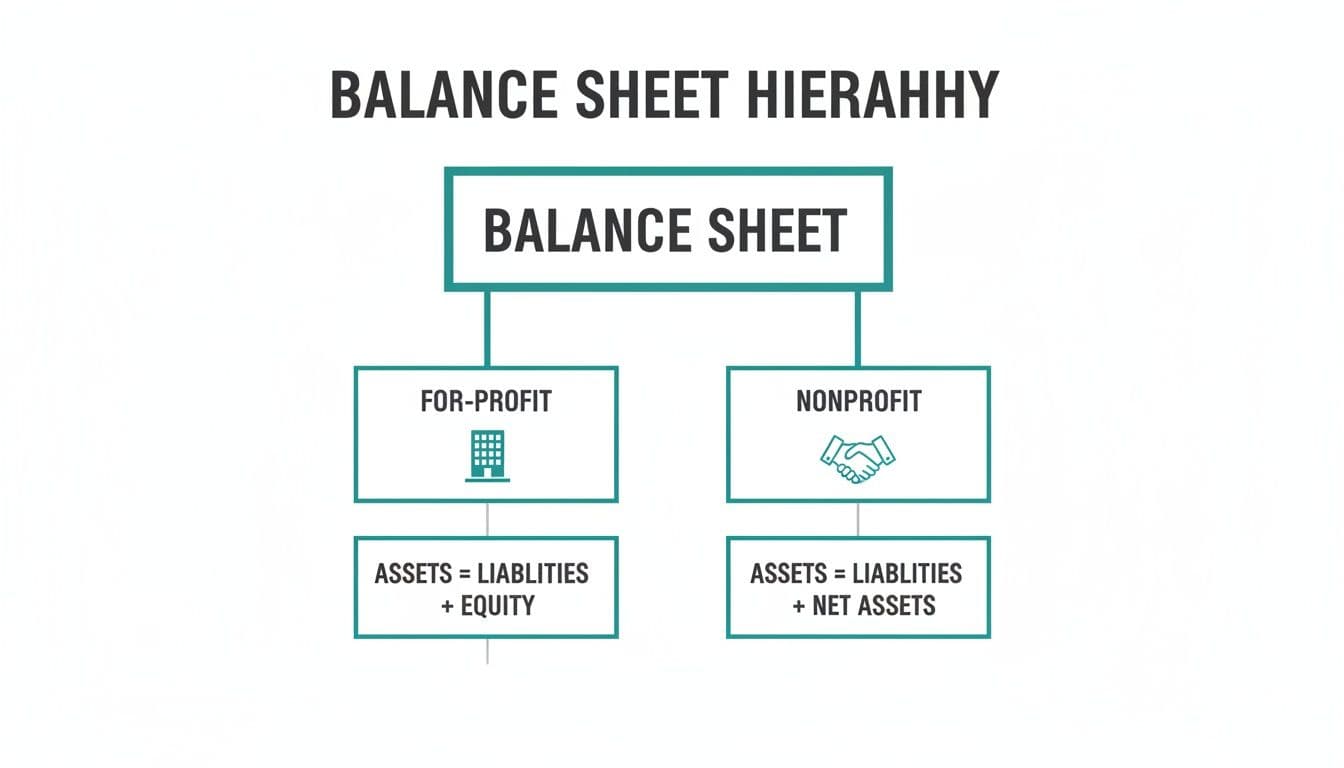
This visual shows that a nonprofit's "bottom line" is its Net Assets. This number represents community investment in your mission, not an owner's equity.
A Practical Example of Reading Your Balance Sheet
Imagine your balance sheet shows $50,000 in cash and $100,000 in "Net Assets with Donor Restrictions." A board member might see $150,000 in total assets and suggest hiring a new program manager.
This is where your understanding is critical. You can explain that while you have healthy assets, $100,000 of that is restricted. It cannot be used for a new salary.
A balance sheet gives you the data to turn a "no" into a strategic "not right now, and here's why." It transforms you from a gatekeeper into an informed leader.
This clarity is vital for building trust with your board. Without it, you could accidentally misspend restricted funds, which can damage your reputation with donors.
How an All-in-One System Gives You Confidence
Generating this report should not be a frantic, month-end scramble. With an integrated platform like AlignMint, the balance sheet for nonprofit organizations is created with a single click. Because our system combines accounting, fundraising, and program data, the report is always based on real-time information. You no longer have to make mission-critical decisions based on last month's numbers.
Common Mistakes That Undermine Your Financial Story
Your balance sheet tells a story of stewardship, but small errors can accidentally tell a tale of disorganization. These mistakes can create serious headaches, like a rejected grant proposal or an inaccurate Form 990. Knowing these pitfalls is the first step toward building trust.
The financial pressure on nonprofits is real. In 2026, challenges left 81% of U.S. nonprofits unable to cover all their costs. An accurate balance sheet for nonprofit organizations is your best tool for proving sustainability. You can read more about the financial pressures nonprofits face in the Independent Sector's report.
Misclassifying Restricted Funds
This is the most common and dangerous mistake a nonprofit can make. When you receive a grant for a specific program, that money is legally restricted. You cannot legally use it for general operating costs.
Leaders using generic software like QuickBooks often run into this problem. They try to use "classes" to tag transactions, but it's a clunky workaround. One wrong click and you could misspend funds.
You could have $200,000 in the bank, but if $150,000 of it is restricted for future programs, you don't have $200,000 to spend. Understanding this is key to financial leadership.
A system with true fund accounting is built to stop this. AlignMint automatically creates digital "walls" around these funds. Your balance sheet always shows a clear picture of what is actually available.
Forgetting to Record Pledges and In-Kind Donations
Your financial story is not complete if it only includes cash in the bank. Your balance sheet should reflect all your resources, including promises from donors.
- Pledges (Accounts Receivable): A reliable donor’s promise to give is a valuable asset. Recording pledges gives you a more accurate picture of your future cash flow.
- In-Kind Donations: If a company donates laptops or a firm provides free legal services, those contributions have real monetary value. They should be recorded as both revenue and an asset or expense.
Forgetting these items makes your organization look smaller than it is. AlignMint’s unified system connects your donor management CRM directly to your accounting. A pledge is automatically reflected the moment it is made.
Failing to Reconcile Accounts Regularly
Do your bank statements always match your books? Reconciling your accounts should be a monthly habit, not an annual chore.
This simple process is your chance to catch:
- Bank errors or fraudulent charges
- Uncashed checks from months ago
- Transactions that were missed
- Simple data entry mistakes
Inconsistent reconciliation leads to a balance sheet you cannot trust. Our platform includes direct bank feeds and reconciliation tools to make this a quick weekly task. What’s more, our Minty assistant acts as a second set of eyes, spotting inconsistencies for you. For more on this, our guide for new nonprofits on the Form 990 is a great resource.
From Daily Work to Your Balance Sheet and Form 990
Your balance sheet should be the natural outcome of what your team does every day. When your financial processes are healthy, your big reports simply summarize the story you are already telling.
Imagine a donation comes through your online giving page. In a healthy system, that action instantly updates the donor’s record in your CRM and posts the transaction to the correct fund. This ends the task of entering the same data twice.
The Power of Connected Operations
When your systems talk to each other, your financial story basically writes itself. Your balance sheet becomes a living report on your organization's health.
Here’s how this looks in the real world:
- Online Donations: A gift made through an AlignMint giving page automatically creates the accounting entry and updates the donor's history.
- Volunteer Hours: You track a volunteer’s time spent on a specific grant-funded project. That data is immediately ready for the funder report.
- Event Tickets: Someone registers for your annual gala. The system sees it as both a registration metric and a financial transaction.
The daily activities of your nonprofit directly feed into your balance sheet and Form 990. For a deeper comparison of tools, read our nonprofit accounting software guide.
From Real-Time Data to Board-Ready Reports
The true payoff of a connected system is the speed and confidence it gives you. When your balance sheet is always up-to-date, you are always prepared. The numbers you need for your Form 990 can be pulled in minutes, not weeks.
When your board asks a tough financial question, you can pull a report during the meeting that is accurate up to that very moment. That is the kind of confidence that transforms how you lead.
This approach gets rid of the month-end scramble. Instead of compiling data, you can spend your time analyzing trends as they happen. With AlignMint, this connected workflow is built right in, since our free tier for small nonprofits makes it accessible to all. For more on annual filing, our guide for new nonprofits on the Form 990 is a great place to start.
Ready to have a balance sheet you can trust and use for strategic decisions? AlignMint provides a single source of truth by integrating your accounting, donor management, and fundraising. See how you can generate board-ready reports in a click, not weeks.
Frequently Asked Questions
Ready to try AlignMint with your nonprofit?
Start free — set up donor tools, giving pages, and Minty. Upgrade when you need accounting.