


Quick Answer: Boost Funding with Nonprofit Corporate Sponso
Build a repeatable corporate sponsorship program. This guide covers packages, outreach, agreements, fund accounting, ROI reporting, and renewal strategy.
For related tools, see AlignMint features. You already know the feeling. A board member asks for new revenue, an event needs underwriting, and someone says, "Have you tried corporate sponsors?" It sounds simple until you picture one more spreadsheet, one more proposal, and one more reporting burden on a team that's already stretched thin.
Done poorly, nonprofit corporate sponsorship becomes a last-minute scramble for logos on a banner. Done well, it becomes a repeatable funding program with clear packages, clean accounting, and sponsor reports that make renewal easier the second time. That's the difference this playbook focuses on.
Nonprofit Corporate Sponsorship
The Growing Opportunity in Corporate Sponsorships
If you're running a small or mid-sized nonprofit, sponsorship can feel like something larger organizations are built for. It isn't. It works for smaller organizations too, especially when you stop treating it like a one-off donation request and start treating it like a business relationship tied to mission and audience.
That shift matters because the market is moving in your direction. In 2022, global brands invested $97.4 billion in corporate sponsorships, and that figure is projected to reach $189.5 billion by 2030 according to Double the Donation's corporate sponsorship statistics. That's a major funding stream, and it's one that many local nonprofits still approach too casually.
What companies are buying
Most sponsors aren't looking for a thank-you note and a table at lunch. They're looking for fit. They want community presence, employee engagement, local credibility, and proof that their dollars support something their customers and staff care about.
That's why the strongest sponsorship conversations sound different from donor conversations. You're not asking a company to "help if they can." You're offering a defined opportunity with clear benefits, clear guardrails, and a clear connection to your work.
Practical rule: Sponsorship works better when you describe outcomes for the sponsor and impact for the community in the same sentence.
For event-based organizations, it helps to think beyond signage. Sponsors increasingly care about activation, staff participation, and memorable touchpoints. If you want a useful outside example of how brands think about live audience engagement, PSW Events has a clear overview of experiential marketing that can help you shape sponsorship benefits in more practical terms.
Why small nonprofits have an advantage
Large nonprofits often have bigger reach. Smaller nonprofits often have stronger trust. That matters more than many executive directors realize.
A church, school, education nonprofit, youth program, or local human services agency often knows its audience personally. You know which families attend, which volunteers show up, which local employers already care, and which businesses want visibility with your community. That's not a weakness. It's your edge.
A sponsor would often rather reach the right room than the biggest room. If your organization serves a well-defined local audience, you can package that access clearly and credibly. You can also connect sponsorship to volunteer days, family events, school programs, seasonal campaigns, or community drives. If you need ideas for what those activations can look like in practice, these fundraising activities at work can spark sponsor-friendly opportunities.
Designing Your Sponsorship Packages
Most sponsorship packages fail for one reason. They're written from the nonprofit's point of view, not the sponsor's.
"Gold, Silver, Bronze" isn't wrong, but on its own it's lazy. A company doesn't buy "Gold." It buys visibility, staff involvement, goodwill, and access to a specific audience. Your package should make that obvious within the first minute.

Build tiers around benefits, not labels
Start with the sponsor experience. Ask what a company receives at each level, then group those benefits into sensible tiers. Keep the differences visible. If every tier includes the same items with minor changes in font size or placement, buyers won't see the reason to move up.
A practical package usually includes a mix of:
- Recognition benefits like logo placement, website listing, event signage, and printed acknowledgment
- Engagement benefits like staff volunteer opportunities, speaking moments, hosted tables, or family participation
- Content benefits like social media mentions, email inclusion, sponsor spotlight stories, or post-event recaps
- Access benefits like introductions, tours, student showcases, or community-facing activations tied to your mission
The package should also say what is not included. That protects your staff from custom promises made in a hallway conversation and keeps the program manageable.
A simple starting table
Below is a sample structure. It won't fit every organization, but it gives you a way to make the offer concrete.
| Benefit | Bronze Level ($1,500) | Silver Level ($5,000) | Gold Level ($10,000) |
|---|---|---|---|
| Logo on event signage | Included | Included | Featured placement |
| Website sponsor listing | Included | Included | Included with spotlight feature |
| Social media recognition | One post | Multiple posts | Campaign series |
| Event tickets | Limited | More included | Premium seating/table |
| Staff volunteer opportunity | Optional | Included | Included with custom coordination |
| Sponsor mention from stage | Included | Priority acknowledgment | |
| Post-event impact summary | Included | Included | Customized summary |
This works best when each benefit is defined in plain English. "Featured placement" means nothing unless you spell out where it appears.
Don't make sponsors guess what they're buying. If a benefit matters, define it.
Price with discipline
You don't need a perfect formula. You do need internal consistency.
Set pricing by looking at three things together:
-
Audience value Who will the sponsor reach, and in what setting?
-
Operational cost What will it take your team to deliver the benefit well?
-
Strategic value Does this sponsor help fund a priority program, event, or annual goal?
If your pricing is low because you're nervous, sponsors may question the value. If it's high without a clear reason, they'll stall. The middle ground is confidence with specifics.
Include in-kind support the right way
Cash matters, but in-kind support can be just as useful when it fills a real budget need. Venue space, printing, food, transportation, branded shirts, photography, software, or student supplies can reduce event costs and free cash for programs.
The key is to treat in-kind support with the same discipline as cash sponsorship. Define what's being provided, when it's needed, and what acknowledgment the company receives. If you're planning volunteer shirts, giveaway items, or event uniforms, it helps to review practical custom apparel options early so your package reflects real deliverables instead of vague swag promises.
Make customization possible, but limited
You should customize proposals. You should not reinvent your sponsorship model for every prospect.
Keep a standard menu, then create room for one or two specific elements based on the company's goals. That might be a volunteer day, a school family activation, a branded scholarship announcement, or a co-hosted community drive. The base offer stays stable. The custom piece creates relevance.
That balance saves time and keeps your team from promising things it can't track later. If you want a practical starting point, these sponsorship proposal templates for nonprofits make it easier to standardize the package while still leaving room for tailoring.
Finding and Pitching the Right Partners
A long prospect list can feel productive. Usually it isn't.
The fastest way to waste staff time is broad outreach with weak alignment. The best sponsorships come from organizations that already make sense together. When the fit is right, the first conversation is easier, the proposal is sharper, and fulfillment is much less painful.
Start with warm alignment
In 2024, U.S. corporate giving reached a record $44.4 billion, up 9.1% year over year, the highest growth rate among major philanthropic sources, according to NonProfit PRO. That's encouraging, but it doesn't mean every company is your prospect.
A better starting question is simple. Which businesses already intersect with your community?
Look in places you already know:
- Volunteer employers where your regular volunteers work
- Donor businesses connected to recurring donors, board members, or school families
- Program-adjacent companies whose staff or customers care about your mission
- Local service providers already visible in your neighborhood and looking for trusted community ties
If you're a school, think family-facing companies and local employers with strong parent participation. If you're a church, think businesses whose owners are already known in the congregation. If you're a fiscal sponsor, think companies tied to the causes your sponsored projects serve.
What targeted outreach looks like
Targeted outreach doesn't need fancy research. It needs a short list and a reason for each name on it.
For each prospect, write down:
-
Why them now A recent expansion, community initiative, staff volunteer interest, or local presence
-
Why your audience fits Families, seniors, students, young professionals, neighborhood residents, or faith community members
-
What you can offer first Event sponsorship, program sponsorship, volunteer day, campaign match, or content recognition
That turns outreach from "Can you sponsor us?" into "There may be a fit here."
The strongest pitch is often a quiet one. Specific, short, and clearly tied to the company's goals.
A practical outreach sequence
You don't need a polished corporate script. You need a sequence that respects time and keeps the ask low pressure at first.
First email Keep it brief. Mention the connection, the reason for fit, and one possible opportunity.
Follow-up call or second email Offer a short conversation, not a full ask. The purpose is discovery.
Meeting Ask what community priorities matter to them, what kinds of partnerships they've done before, and how they define a successful sponsorship.
Proposal Send only after you understand the fit. The proposal should reflect their goals, not just your standard package.
Donor and relationship data are vital. If your team can see past gifts, event attendance, volunteer ties, and board relationships in one place, you'll write a much better ask. For practical examples of how to shape that ask, these examples of sponsorship proposal are useful because they show how the same core offer changes based on the sponsor.
Where competitors fit
Many organizations patch this process together with tools like Salesforce, Bloomerang, DonorPerfect, or HubSpot. Those tools have real strengths, especially for contact tracking and communications. The gap is that sponsorship often touches finance, events, volunteers, and marketing at the same time. When those records live in separate systems, simple questions become hard to answer, and customized outreach gets slower than it should be.
Securing the Agreement and Your Funds
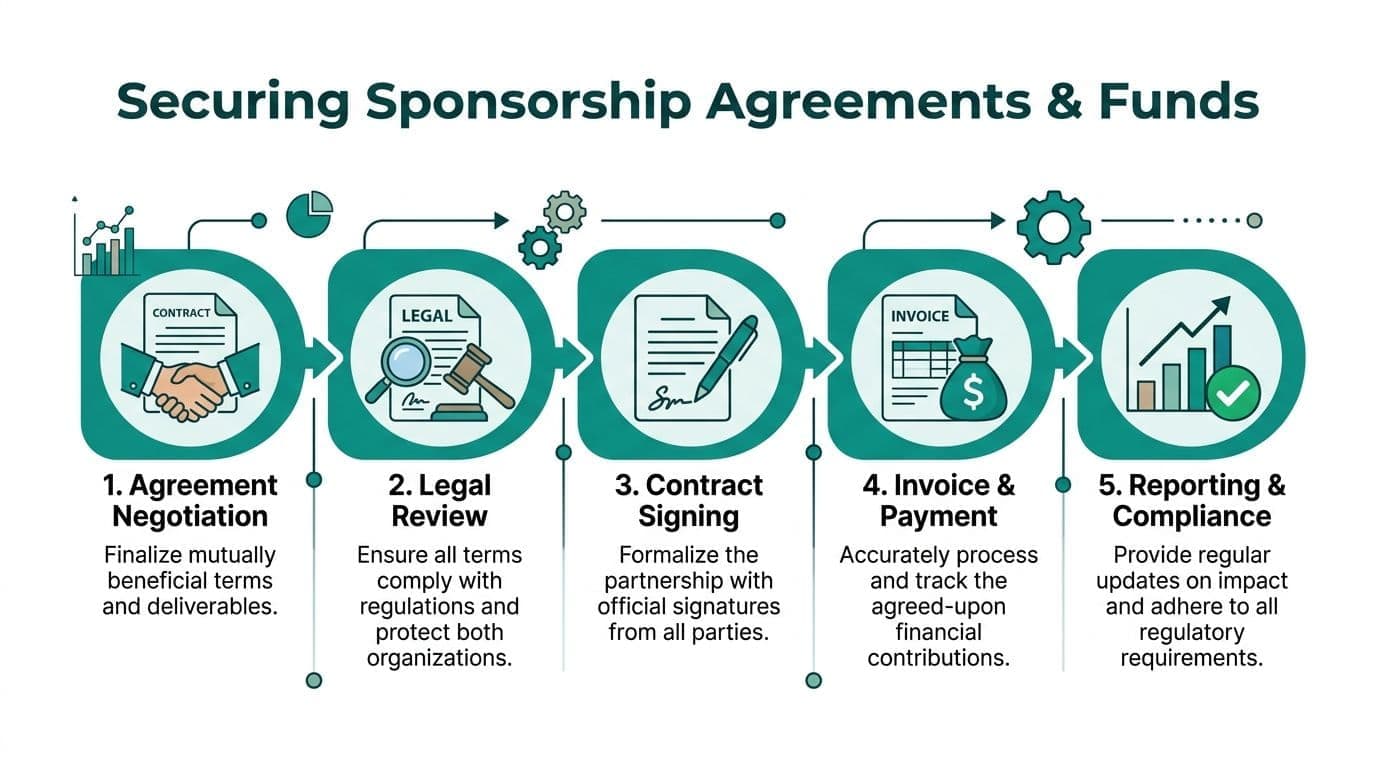
The sponsorship isn't finished when the company says yes. In many ways, that's where the actual work starts.
This is the point where small nonprofits get into trouble. A verbal agreement becomes a rushed invoice. A sponsor asks for added logo rights or promotional language. Finance books the payment like a donation. Then months later, no one can clearly explain which benefits were promised, which restrictions apply, or how the revenue should appear in reporting.
Sponsorship is not the same as a donation
That distinction gets ignored far too often. A sponsor is usually paying for a defined relationship with benefits attached. The tax treatment depends on those benefits.
The safest ground is acknowledgment, not advertising. A company name, logo, or neutral recognition is generally different from promotional claims, pricing, endorsements, or language urging people to buy. The more your package reads like marketing copy for the company, the more careful you need to be.
IRS data from 2025 shows that 28% of small nonprofits with revenue under $1 million underreported UBTI from sponsorships, according to the National Council of Nonprofits corporate sponsorship guidance. That's not a technical footnote. It's a warning that many organizations are still mixing up acknowledgment and advertising.
Contract terms that deserve extra attention
You don't need a long contract for every local sponsor, but you do need a written agreement outlining the basics clearly.
Focus on these points:
-
Deliverables List exactly what the sponsor receives. Logo placement, event mentions, tickets, volunteer opportunities, and reporting should all be stated plainly.
-
Language controls Keep sponsor recognition factual. Avoid comparative claims, product endorsements, pricing language, or direct purchase prompts unless you've reviewed the implications carefully.
-
Restrictions on funds If the money is tied to an event, scholarship, program, or campaign, record that restriction clearly from the start.
-
Timing State payment dates, asset deadlines, and deliverable windows. This prevents the common problem of receiving logos after the print deadline and then scrambling.
-
Exit terms Include what happens if the event changes, the sponsor misses a deadline, or either side needs to adjust the arrangement.
Clean agreements protect relationships. They reduce confusion inside your office as much as they reduce risk outside it.
Why fund accounting matters here
A lot of nonprofits still track sponsorship money in general revenue and rely on manual notes to remember what happened. That's risky even before tax questions come into play.
Sponsorship often touches restricted funds, event expenses, donor records, invoices, and board reporting. If you're trying to manage all of that with workarounds in QuickBooks classes or disconnected spreadsheets, the details start drifting. Finance sees one version. Development sees another. The executive director ends up reconciling the difference by hand.
That's where true fund accounting matters. The system should treat sponsorship funds according to purpose and restriction, not as an afterthought. It should also support Form 990 reporting and functional expense reporting without extra gymnastics.
One option is AlignMint's fund accounting software, which combines accounting, donor records, volunteers, events, and reporting in one system. For sponsorships, that matters because the financial record and the relationship record stay tied together. You can see what was promised, what was paid, how it was coded, and what still needs to be delivered without hunting across tools.
A practical approval flow
If your team is small, keep the approval process simple and repeatable.
-
Program or development lead confirms fit Is the sponsor aligned, and are the benefits realistic?
-
Finance reviews the structure Are restrictions clear, and does the language stay on the acknowledgment side?
-
Leadership approves exceptions Any unusual rights, custom activation, or added benefit should be reviewed centrally.
-
Invoice and coding happen immediately Don't wait until after the event.
-
Fulfillment checklist is assigned Someone must own every deliverable.
The cleaner this process is, the easier sponsor reporting becomes later. More important, your board and finance committee can trust what they're seeing.
Proving Your Value and Tracking ROI
A sponsor report should answer one question clearly. Was this partnership worth doing again?
That answer won't come from a stack of vanity numbers. It comes from matching the sponsor's goal to the right evidence and reporting it in plain language.
Start with the sponsor's goal
The strongest ROI work starts before the sponsorship begins. You need a baseline and a shared definition of success.
A sponsor might care most about local visibility. Another might care about employee volunteer engagement. Another may care about association with a school, church, or trusted neighborhood institution. If you don't settle that early, you'll send a report full of data they didn't ask for.
A practical method for proving ROI starts by mapping specific KPIs to sponsor goals, and that matters because 70% of brands report receiving irrelevant metrics such as simple impressions that fail to show long-term value, according to SponsorUnited's guidance on sponsorship ROI pitfalls.
What to track by sponsorship type
A community event sponsor and a program sponsor won't need the same dashboard. Track what fits the arrangement.
For an event sponsor, you might report:
- Attendance and participation tied to the sponsored event
- Sponsor visibility placements delivered
- Email and social inclusion that mentioned the sponsor
- Staff engagement if the sponsor's employees attended or volunteered
For a program sponsor, you might report:
- Program reach during the sponsorship period
- Stories from participants that show mission fit
- Volunteer involvement connected to the company
- Milestones funded by the sponsorship
For school, church, and family-facing organizations, qualitative context matters a lot. A sponsor often wants to know who they reached, what the setting felt like, and whether the relationship felt credible and community-rooted.
Good ROI reports are selective. They show the right evidence, not every possible metric.
Pull data from one operating record
Disconnected tools create unnecessary work. If your event attendance lives in one system, donations in another, volunteer hours in a third, and email data in a fourth, your sponsor report turns into a manual assembly project.
A more workable setup pulls from one operating record so you can answer simple questions quickly:
- How many attendees were at the event?
- Which email messages included the sponsor?
- Did the sponsor's employees volunteer?
- Was the sponsorship tied to a restricted program fund?
- What follow-up activity happened afterward?
If your software can't answer those questions cleanly, your sponsor will still expect the report. Your staff will just spend more time building it by hand.
Use a plain-English report format
Most executives overcomplicate sponsor reports. Keep the structure short and readable.
Use five parts:
-
Original goal State what the sponsorship was meant to accomplish.
-
What was delivered List the benefits and activations completed.
-
Audience reached Include the most relevant attendance, engagement, or participation measures.
-
Mission impact Show what the sponsorship helped make possible.
-
Next opportunity Suggest a renewal path that fits what worked.
If you want a practical model for organizing sponsor fees and related reporting details, this sponsor fee report guide is a useful reference.
Don't ignore narrative evidence
Not every important outcome belongs in a chart. Sponsors remember stories, photos, volunteer experiences, and staff feedback. A short quote from a parent, teacher, participant, or volunteer can explain relevance better than a page of generic engagement metrics.
Use numbers to establish credibility. Use stories to make the renewal emotionally easy.
From One-Time Sponsor to Long-Term Partner
The first sponsorship proves interest. The second proves trust.
That's why renewal should shape your process from day one. A good partnership doesn't end with the event recap. It moves through a steady rhythm of fulfillment, appreciation, reporting, and a thoughtful next ask.
What renewal usually looks like in real life
A local business sponsors your fall event. The event goes well, but then your team gets busy. You send a thank-you note, maybe a social post, and then silence. Six months later, when next year's budget pressure arrives, you reach back out and ask if they'll sponsor again.
That approach puts all the weight on memory. It assumes the sponsor remembers the value, still feels connected, and can piece together what happened without your help. Many won't.
The better pattern is steadier. You send the thank-you quickly. You confirm every promised recognition item was delivered. You share a short recap while the event is still fresh. Later, you send a cleaner impact report with selected metrics, a few photos, and one or two stories that show why the sponsorship mattered.
Renewal often depends less on the pitch than on the quality of follow-through after the first yes.
Why integrated data changes the renewal conversation
Smaller nonprofits can outperform larger peers. They often know their sponsors personally, and their community already trusts them.
That local trust matters because, according to Nonprofit Learning Lab, repeat sponsors grew by 18% for nonprofits using analytics to prove impact, and small nonprofits can attract 2x more renewals than large ones when they prove ROI with integrated data. That isn't about fancy dashboards. It's about being able to show what happened in a way the sponsor can understand.
A sponsor is more likely to renew when you can connect the dots clearly. Their support funded the event. Their employees volunteered. Their brand appeared in the right settings. Your audience responded well. The mission moved forward.
The stewardship rhythm that works
You don't need an elaborate corporate relations department. You need a rhythm your team can maintain.
A practical cadence looks like this:
-
Right after payment Confirm receipt, timeline, and next steps
-
Before the activation Collect logos, names, volunteer interest, and approval details
-
Immediately after the event or campaign Send thanks and a short recap with one or two photos
-
Later, when the data is complete Share the formal impact report
-
Before the next planning cycle Ask about renewal while the prior success is still easy to recall
Many organizations struggle when data is scattered, the notes live in inboxes, and no one can see the full relationship history. A disciplined donor and sponsor record helps prevent that. These nonprofit donor retention strategies are useful here because sponsor renewal and donor retention share the same core truth. People stay when they feel known, appreciated, and confident in your follow-through.
What to say when asking for renewal
Keep it specific. Don't send a generic "Would you like to sponsor again?" message.
Try this structure instead:
- remind them what they supported
- name what was delivered
- share one or two outcomes that mattered to them
- suggest the next logical step
That next step might be the same package renewed early. It might be a broader annual partnership. It might be a shift from event-only support to a mix of sponsorship and employee engagement.
For executive directors, this is the practical promise of a good nonprofit corporate sponsorship program. You stop rebuilding the whole machine every season. You keep the parts that worked, improve the ones that didn't, and build a partner base that gets easier to maintain each year.
If you want a simpler way to manage sponsorships alongside fund accounting, donor records, volunteers, events, and reporting, take a look at AlignMint. We built it for nonprofits that need clean operations without stacking multiple tools, and the free tier is available for organizations raising under $100K.
Frequently Asked Questions
Ready to try AlignMint with your nonprofit?
Start free — set up donor tools, giving pages, and Minty. Upgrade when you need accounting.