

What Are Monetary Donations? A Director's Guide for 2026
Quick Answer: Monetary Donation Meaning
Cash, checks, cards, ACH, and wires are monetary donations. Gift cards, stock, and volunteer time usually are not. Receipt the gift type first, then assign the fund — mixing them on one receipt is the usual Form 990 mistake. See donation management and fund accounting for how AlignMint connects gifts to the ledger.
A monetary donation is a gift of money. For nonprofits, that can mean cash, checks, credit card gifts, debit card gifts, ACH transfers, bank transfers, wire transfers, grants, and other funds given to support your mission. The key point is that the gift has a money value you can record, receipt, deposit, and report.
Gift cards are usually not the same as cash, even though they have a dollar value. Treat a gift card as a non-cash or in-kind gift unless your accountant tells you otherwise, because it is a specific item with a set use, not unrestricted money in your bank account. If a donor gives cash so you can buy gift cards, record the cash as a monetary donation and track how the money was spent.
| Common question | Plain answer |
|---|---|
| What does monetary donation mean? | A gift of money your nonprofit can deposit, record, receipt, and use according to any donor restriction. |
| Are monetary donations only cash? | No. Checks, online payments, ACH, wires, and grants are also monetary donations. |
| Are gift cards monetary donations? | Usually no. They have value, but they are normally tracked as non-cash or in-kind gifts. |
| What are monetary donations called in reports? | They may appear as contributions, donations, gifts, grants, or contribution revenue depending on your chart of accounts. |
Monetary Donation Examples by Type
Use this table when your board, bookkeeper, or donor asks whether a gift counts as a monetary donation.
| Gift type | Monetary donation? | How to record it |
|---|---|---|
| Cash in a collection jar | Yes | Count it under cash-handling controls, deposit it, and record the donor if known. |
| Check from an individual | Yes | Record the donor, date received, amount, fund, and check number. |
| Credit card gift | Yes | Record the gross gift, processing fee, net deposit, donor, and receipt. |
| ACH or bank transfer | Yes | Record the donor, amount, fund, deposit date, and any recurring gift schedule. |
| Wire transfer | Yes | Record it like a cash contribution and keep bank confirmation with the donor record. |
| Recurring monthly gift | Yes | Record each payment as it is received and keep the donor's recurring plan attached. |
| Restricted program gift | Yes | Record the money and the donor restriction together so finance knows where it can be used. |
| Matching gift from an employer | Yes when received | Record the original donor gift and employer match separately so both records stay clear. |
| Gift card | Usually no | Track as an in-kind or non-cash gift unless your accountant directs otherwise. |
| Donated supplies | No | Record as an in-kind gift, not a monetary donation. |
The accounting point matters because a monetary donation affects cash, deposits, receipts, donor history, and fund balances. A non-cash gift may still be generous and reportable, but it does not move through the bank in the same way.
Why Monetary Donations Are Your Most Flexible Asset
You can accomplish more when you have flexible resources. Monetary donations are your most versatile tool, giving you the cash you need to pay staff, keep the lights on, and run your programs.
While in-kind gifts are valuable, cash is what lets you respond to urgent needs with speed and precision. Understanding how these gifts arrive helps you plan your fundraising more effectively.
Common Forms of Monetary Donations
This table gives you a quick snapshot of how donors give money. Recognizing each method helps you manage your incoming funds.
| Donation Form | Example Method | What to Know |
|---|---|---|
| Physical Gifts | Cash and Checks | These are the traditional, tangible gifts often received in person or through the mail. |
| Online Payments | Credit or Debit Cards | A popular and convenient way for donors to give through your online giving pages. |
| Direct Transfers | ACH/Bank Transfers | These are direct electronic payments, often used for recurring gifts with lower fees. |
| Formal Awards | Grants | This is money awarded from foundations or government for a specific, agreed-upon project. |
Unlike a business transaction, every donation carries a story and an expectation of good stewardship. Your supporters trust you to use their money wisely. Tracking every dollar is how you maintain that trust. To clarify any financial terms, you can explore our nonprofit glossary.
Why This Definition Matters to You
You get more time for your mission when your finances are clear and predictable. A firm grasp of monetary donations allows you to build accurate reports and answer board questions with confidence. It shows donors the real impact of their generosity.
The challenge is not just raising money. It is managing it in a way that honors donor intent while giving you a clear view of your financial health. Without this clarity, strategic decisions become guesswork.
This is where a unified system gives you an advantage. When your donation processing, donor management, and accounting are all connected, you end the tedious work of reconciling separate systems. You get a single, reliable source of truth for your finances.
Exploring the Types of Monetary Gifts You Can Receive
You will raise more money by making it easy for supporters to give. While some donors prefer writing a check, others want the speed of a quick tap on their phone. If you meet donors where they are, they are more likely to give.
To maximize your fundraising, you need a system ready to welcome every type of gift. This includes everything from cash in a donation jar to a complex grant award.
In 2024, Americans donated an incredible $592.50 billion to charitable causes, with individual contributions at $392.45 billion. This trend shows why having flexible tools is so critical for organizations like yours. You can read more about these charitable giving statistics to see the full picture.
Let's walk through the different ways money can flow to your mission, from traditional methods to modern digital tools.
Traditional Donation Methods
These are the tried-and-true ways supporters have given for decades. While digital giving is growing, many of your most loyal donors still rely on these classic methods.
- Cash: This is the simplest form of giving, perfect for events or in-person gifts. It is immediate but demands tight security and careful cash-handling procedures.
- Checks: A check is still a go-to method for many donors making larger gifts. It gives you a clear paper trail but also means manual data entry and trips to the bank.
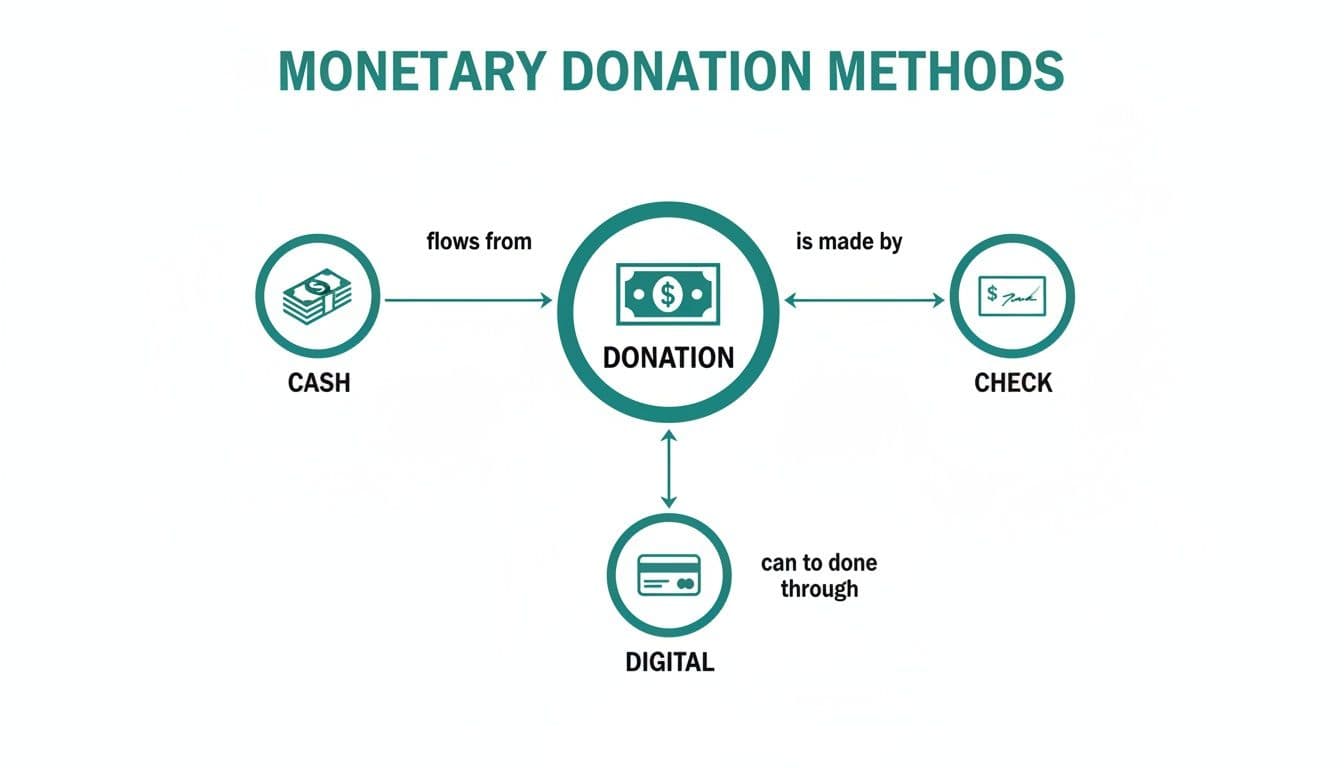
This visual shows how cash, checks, and digital payments are all essential streams of support for your work.
Whether it is physical or digital, every path leads to fueling your mission.
Modern Digital Payments
You can capture generosity in the moment with instant and easy digital options. These are essential for online campaigns and connecting with a new generation of supporters. You can accept these through online giving pages built for nonprofits.
- Credit and Debit Cards: This is the most popular way people give online. It lets a donor complete a secure transaction in seconds from their phone or computer.
- ACH (Automated Clearing House) Bank Transfers: Donors can authorize a direct payment from their bank account. The processing fees are lower than credit cards, which is great for large or recurring gifts.
Strategic Gift Types
You can build a more predictable financial foundation with strategic gift types. These methods help you create a sustainable nonprofit that weathers any storm.
- Recurring Donations: These are automated, scheduled gifts that create a steady income stream. This reliable revenue helps you budget and plan with much more confidence.
- Pledges: A pledge is a donor's promise to give an amount over time. A good CRM is key here, helping you track commitments and send automated reminders.
- Corporate Sponsorships: Businesses can support your events or programs for public recognition. These are often larger gifts that can underwrite major operational costs.
- Grants: These are formal awards of money, usually restricted to a specific project. Managing their strict reporting needs is why many turn to our fiscal sponsorship software resources and platform tools.
- Matching Gifts: These are employer or sponsor gifts connected to an individual donor's original gift. Track the donor's gift and the match separately so receipts, recognition, and campaign totals stay accurate.
AlignMint lets you accept all these gift types in one unified system. This ensures you never miss an opportunity to fund your mission.
Understanding Restricted vs. Unrestricted Funds
You can manage your finances better when you know that not all money is the same. A donation for your new after-school program is different from a gift with no strings attached. This distinction between restricted and unrestricted funds is vital in nonprofit finance.
Getting this right is about honoring the trust your donors place in you. It is also about maintaining your organization’s financial health and legal standing.
Unrestricted funds are like your general checking account. You can use that money for salaries, rent, or supplies. Restricted funds are like separate envelopes labeled "Summer Camp." You can only use that money for its designated purpose.

This separation is a core principle of nonprofit accounting. It proves your good stewardship to donors, grantors, and auditors.
What Makes a Fund Restricted?
A donation becomes restricted when a donor explicitly states how the money must be used. This is called donor intent, and it is legally binding.
- Time-Restricted Funds: These are gifts that must be held for a certain period. An example is a donation to an endowment where only the earnings can be spent.
- Purpose-Restricted Funds: This is the most common type. It includes gifts for a specific program, a capital campaign, or a scholarship fund.
A grant is almost always a restricted fund. The grant agreement is your rulebook for how you can spend the money. For more guidance, see our article on restricted funds tracking.
The Power of Unrestricted Funds
You gain crucial flexibility with unrestricted funds. These are the general donations you receive without specific instructions from the donor. You can direct this money where it is needed most, from an unexpected repair to a new program.
This flexibility is critical during a crisis. It empowers you to make real-time decisions that directly impact your mission's success. A healthy mix of both restricted and unrestricted funding is key to building a resilient organization.
The Problem with QuickBooks and Workarounds
You face a huge liability during an audit if you cannot track funds correctly. Many nonprofits get into trouble here, especially when using standard business software. A tool like QuickBooks was not built for the unique demands of fund accounting.
Many leaders use the "classes" feature to tag transactions as a workaround. But this is not a real solution. It is prone to error and cannot give you a true, real-time balance of your restricted funds.
AlignMint solves this with true fund accounting built into its core. Each fund is treated like its own distinct bank account within the system. This built-in clarity ends the guesswork and ensures your financial statements are always audit-ready.
Mastering Tax Receipts and Donor Acknowledgment
Your donors give because they believe in your mission. While generosity comes from the heart, the tax deduction is an important and expected benefit for them.
Providing timely, accurate receipts for monetary donations is not just good manners. It is a critical IRS requirement and a cornerstone of building donor trust.
Let's walk through the essentials of donor receipting without the dense legal jargon. You will know exactly what to put on a receipt and when to send it.
What Makes a Receipt Compliant
The IRS requires a compliant acknowledgment for any single contribution of $250 or more. Donors must have this document before they file their taxes.
For your own peace of mind, it is best practice to receipt every single gift. An automated thank-you email with the required details builds confidence from the very first dollar.
A compliant receipt must include:
- Your nonprofit’s name.
- The amount of the cash contribution.
- The date the donation was received.
- A statement that no goods or services were provided in exchange.
If you did provide something in return, like a dinner ticket, you must state its value. You can find helpful examples in these free donation receipt template resources.
Monetary Donation Tracking Checklist
For every monetary donation, capture the same core fields before staff memory becomes the record:
- Donor name and contact information, unless the gift is truly anonymous.
- Gross gift amount, processing fee, and net deposit when a processor is involved.
- Gift date, deposit date, and payment method.
- Fund, campaign, event, or restriction.
- Receipt status and any goods or services provided.
- Source, such as website, event, check, email appeal, text appeal, or donor portal.
- Follow-up owner and next stewardship step.
This is where many small teams get stuck. The donation is real, but the donor record, fund restriction, receipt, and bank deposit do not match. A connected donation system prevents that mismatch before it reaches the month-end close.
Automating Acknowledgments to Save Time
You can save hours each month by automating your receipts. Manually creating and sending receipts is a massive time-sink. This is where an integrated system pays for itself.
AlignMint can instantly send a compliant, personalized thank-you receipt to a donor's inbox. Our system automatically populates all the required information so you stay compliant without extra work. You can learn how our system does this in our guide to donation receipts.
That instant acknowledgment reinforces their decision to give and makes them more likely to support you again. With AlignMint, you can generate annual giving statements for all your donors in just a few clicks. This gives your supporters exactly what they need for their taxes, hassle-free.
Best Practices for Recording and Reporting Donations
You build trust and maintain strong donor relationships with good records. Good records are the foundation of accurate financial reports. They prove you are a responsible steward of donor support.
With the right approach, you can handle every gift with confidence. Let's walk through some straightforward ways to manage your donation data.
Connect Financials and Donor Records
You gain a single source of truth for every dollar when you connect your systems. When your financial data and donor records live separately, you create unnecessary work and open the door to mistakes. It forces you to enter the same information twice.
An all-in-one platform is designed to fix this. When you record a donation in AlignMint, it automatically updates both your financial ledgers and the donor’s giving history. There is no second step because your accounting and CRM are two sides of the same coin.
You make smarter, faster decisions with a clear, real-time picture of your nonprofit's health. This allows you to lead with information you can trust, not with patched-together spreadsheets.
Reconcile Bank Deposits with Ease
You can save hours of work by simplifying bank reconciliation. Matching bank deposits to individual donations is a headache, especially after a big campaign. You might see a single deposit that represents dozens of separate online gifts.
Our platform groups online donations into batches that match the exact deposit amounts. This means you can reconcile your bank feed in a few clicks, not a few hours.
Track Your Fundraising Campaign Performance
You can raise more money when you know what works. Tracking the performance of each campaign tells you where to invest your limited time and resources. It is about understanding where your monetary donations came from.
You should be able to see key metrics for any campaign at a glance:
- Total amount raised.
- Number of donors who gave.
- Average gift size for the campaign.
This data helps you understand your supporters and refine your next appeal. For example, income is a strong predictor of giving. We know from data on how income impacts charitable giving that targeting mid-income donors is vital.
Our integrated fundraising and marketing tools automatically tags every donation from an email or text campaign. This gives you instant insight into which messages are resonating with your audience and driving gifts.
Why An All-in-One Platform Makes Sense
As an executive director, you know the biggest hidden cost is wasted time. The hours your team spends copying data between separate tools for accounting, fundraising, and marketing is a quiet drain on your resources.
An all-in-one platform is designed to end that chaos. The goal is to unite your fund accounting, donor CRM, and marketing tools in one place. It stops the manual work of exporting and importing data.
The Disconnected Reality
Many nonprofits are forced to piece together a system that looks something like this:
- QuickBooks for Accounting: It handles basics but struggles with restricted funds, forcing clumsy workarounds.
- A separate platform for donations: It processes online gifts but is a stranger to your accounting software.
- An email service for marketing: It has no direct link to giving history or your financial records.
This disjointed approach creates information silos. You never get a complete picture of a donor in one place. Answering simple questions requires wrestling with spreadsheets for hours.
A Unified Approach
An all-in-one platform brings these functions together by design. When a monetary donation comes through an AlignMint giving page, the system automatically does three things at once:
- It records the revenue in the correct fund within your true fund accounting ledger.
- It updates the donor’s profile in the built-in CRM with their complete giving history.
- It sends an automated, compliant tax receipt and thank-you message from our marketing tools.
There is no double entry or manual reconciliation. Everything is connected, which means your reports are always accurate and ready for your board or auditor.
How Different Platforms Compare
Other nonprofit software providers see this challenge, but their solutions are often incomplete. Bloomerang offers strong donor management but relies on connecting to QuickBooks for accounting. Neon One offers a broad suite of tools, but they often come from acquiring different companies, which can feel less connected.
AlignMint is different because our true fund accounting is the heart of the platform, not an add-on. We also include fundraising and marketing in the same product, volunteer management, and plan-based user allowances (1 on Free, up to 10 on Plus, up to 25 on Pro, and unlimited on Enterprise). We even offer a free plan for nonprofits with under $100K in annual revenue.
Common Questions About Monetary Donations
As you manage your nonprofit's finances, new questions always pop up. The answers are usually much simpler than the jargon makes them sound.
We get these questions all the time from directors just like you. Here are some direct, practical answers to help you manage your funds with confidence.
Can Our Nonprofit Refuse a Monetary Donation?
Yes, and sometimes you should. It feels strange to turn down money, but accepting the wrong gift can create more problems than it solves. Your board can decline a donation if it poses a conflict.
You might refuse a gift if it comes from a source that clashes with your mission. You might also say no if a donation comes with restrictions that cost more to manage than the gift is worth. A formal gift acceptance policy makes these tough decisions clear and consistent.
What Is the Difference Between a Donation and a Grant?
This is a great question. Think of a donation as a straightforward gift, usually from an individual or business. It is often given because the giver simply believes in your overall mission.
A grant is a more formal award of money, typically from a foundation, corporation, or government agency. Grants almost always come with strict reporting rules tied to a specific project. Learning to manage the fine points of fiscal sponsorship and grant reporting is a key skill as you grow.
The simplest way to see it: you solicit donations, but you apply for grants. Donations support your organization; grants fund a project.
How Soon Do We Need to Send a Donation Receipt?
The best practice is to send a receipt the moment a gift is made. That immediate acknowledgment makes your donors feel secure and appreciated.
Legally, the IRS requires a written receipt for any single contribution of $250 or more before the donor files their taxes. But automating this for every gift is a powerful way to improve your donor management strategy. An all-in-one system like AlignMint keeps you compliant and builds goodwill without you lifting a finger.
Managing these details doesn’t have to be a headache. AlignMint brings your accounting, donor data, and marketing together so you can handle donations, receipts, and reporting all from one place. See how an all-in-one platform can give you more time for your mission.
Frequently Asked Questions
Ready to try AlignMint with your nonprofit?
Start free — set up donor tools, giving pages, and Minty. Upgrade when you need accounting.