Director's Guide to the Best Nonprofit Accounting Software
Comparison data as of May 2026. Features and pricing may change.
As a nonprofit director, your time is best spent on your mission, not wrestling with spreadsheets or generic business software. Yet so many of us feel buried exporting data and manually tracking restricted funds. This guide is your straightforward path to finding the best nonprofit accounting software that gives you back your time.
We'll compare the top options, explain what really matters for nonprofit finance, and help you make a choice with confidence. Then you can get back to what you do best - advancing your cause.
Choosing Software That Understands Your Mission

This guide will clarify essential features like true fund accounting and show you the real-world impact of an all-in-one nonprofit management software.
You'll also learn how to evaluate choices beyond just their features. We'll explore the practical benefits of AI in nonprofit software to ensure your next system truly supports the way you work.
Quick Answer: Best Nonprofit CRM With Integrated Accounting
The best nonprofit CRM with integrated accounting connects donor records, giving history, receipts, restricted funds, campaigns, and board reports in one system. That matters because a gift is both a relationship event and an accounting event. If CRM and accounting are separate, your staff has to reconcile donor totals, fund balances, receipts, and campaign results by hand.
| Integration question | What a good platform should show |
|---|---|
| Did the gift reach the right fund? | Donation, fund designation, receipt, and ledger entry connected. |
| Which donors need follow-up? | Giving history, campaign response, LYBUNT/SYBUNT status, and notes in one profile. |
| Can finance trust fundraising data? | Donor totals and accounting reports match without manual exports. |
| Can leadership see performance? | Board-ready reports for revenue, restrictions, campaigns, and donor retention. |
For a deeper look at this exact buying decision, read CRM with accounting integration, nonprofit donor reporting software, and all-in-one nonprofit management software.
What Makes Accounting Software Genuinely for Nonprofits?
When you’re choosing software, it’s easy to get lost in sales pitches. The first step is learning how to spot the difference between a real nonprofit tool and business software with a new coat of paint. You deserve a system that actually understands your mission, not one you have to constantly fight.
This means you need to look past the marketing and know what to demand. Having a clear idea of the non-negotiable features will help you cut through the noise and ask the right questions.
Look for More Than Just Basic Bookkeeping
Real nonprofit accounting software is defined by a handful of core functions that standard business software simply can't handle without clunky, error-prone workarounds. These are the pillars that will support your financial compliance and reporting. This saves you countless hours and a ton of stress.
At a minimum, your software must handle:
- True Fund Accounting: This is the absolute deal-breaker. The system must track restricted, temporarily restricted, and unrestricted funds separately. This ensures you can honor donor intent without a tangled web of spreadsheets.
- Integrated Donor Management: Your financial records and donor information shouldn't live in separate worlds. Having them in the same place gives you a complete view of your supporters. It also automates tasks like sending donation receipts.
- Automated Nonprofit Reports: You need to generate reports like the Statement of Functional Expenses in just a few clicks. This is non-negotiable for board meetings, grant applications, and your Form 990.
A key characteristic of true nonprofit accounting software is its ability to handle financial transactions smoothly. It should integrate with the best payment processing software for small business to manage incoming funds efficiently.
The Importance of True Fund Accounting
Many general accounting systems, like QuickBooks, try to mimic fund accounting by using a feature called "classes." While it can work in a pinch, it's just a workaround that quickly becomes messy. It also requires constant manual supervision.
You can dive deeper into this critical difference in our guide to fund accounting for nonprofits. True fund accounting is completely different because it's baked into the software's DNA. This structure guarantees that every dollar is tracked correctly, giving you a precise, real-time view of your financial standing.
The need for these specialized tools is why this growing market on Data Insights Market is projected to expand significantly. Increasing compliance demands that basic spreadsheets just can't handle are fueling this boom.
How the Top Nonprofit Accounting Platforms Compare
Let's cut through the noise and look at the most common options side-by-side. As a director, you need a clear, honest comparison to make the right choice for your organization. We’ll look at the strengths and gaps of QuickBooks, Aplos, Blackbaud Financial Edge NXT, and our own platform, Alignmint.
The nonprofit software market is complex, but the trend is clear. Small to mid-sized nonprofits are finally moving away from generic business tools. They are demanding solutions built for their world.
QuickBooks for Nonprofits
Many of us started our organizations on QuickBooks. It’s familiar, and for a tiny nonprofit with simple finances, it can feel like enough. You get solid features for tracking income, expenses, and payroll.
The problem is its entire design is for for-profit businesses. This creates a huge headache when it comes to the most important part of nonprofit finance: fund accounting. You are forced into a manual workaround called "classes," which is prone to human error and becomes a tangled mess as you grow.
QuickBooks is a good starting point for basic bookkeeping. But it lacks true fund accounting, forcing you into manual workarounds that raise your risk of compliance errors. You are also guaranteed to need separate systems for donors and volunteers.
For a wider look at how these general accounting tools are positioned, you can explore comparisons of QuickBooks vs Xero vs Sage.
Aplos
Aplos is a definite step up from QuickBooks because it was actually built for nonprofits and churches. Its biggest advantage is that it offers true fund accounting right out of the box. The system is designed from the ground up to properly track your restricted and unrestricted funds.
Aplos also combines its accounting with a donor management CRM. This helps you connect your financial data to your fundraising, a big improvement over using two separate systems. It’s a strong choice for small to mid-sized organizations, but you might still need separate software for volunteers, events, or email marketing.
Blackbaud Financial Edge NXT
For very large, established nonprofits, Blackbaud Financial Edge NXT is the powerful option. It offers deep, comprehensive fund accounting, grant management, and sophisticated reporting. Blackbaud’s real strength is its ability to handle immense complexity for organizations with large endowments or government contracts.
But all that power comes at a steep price and can be overwhelmingly complex for a smaller team. The cost is a major hurdle for most growing nonprofits.
This infographic shows the core pillars that define a true nonprofit accounting system.
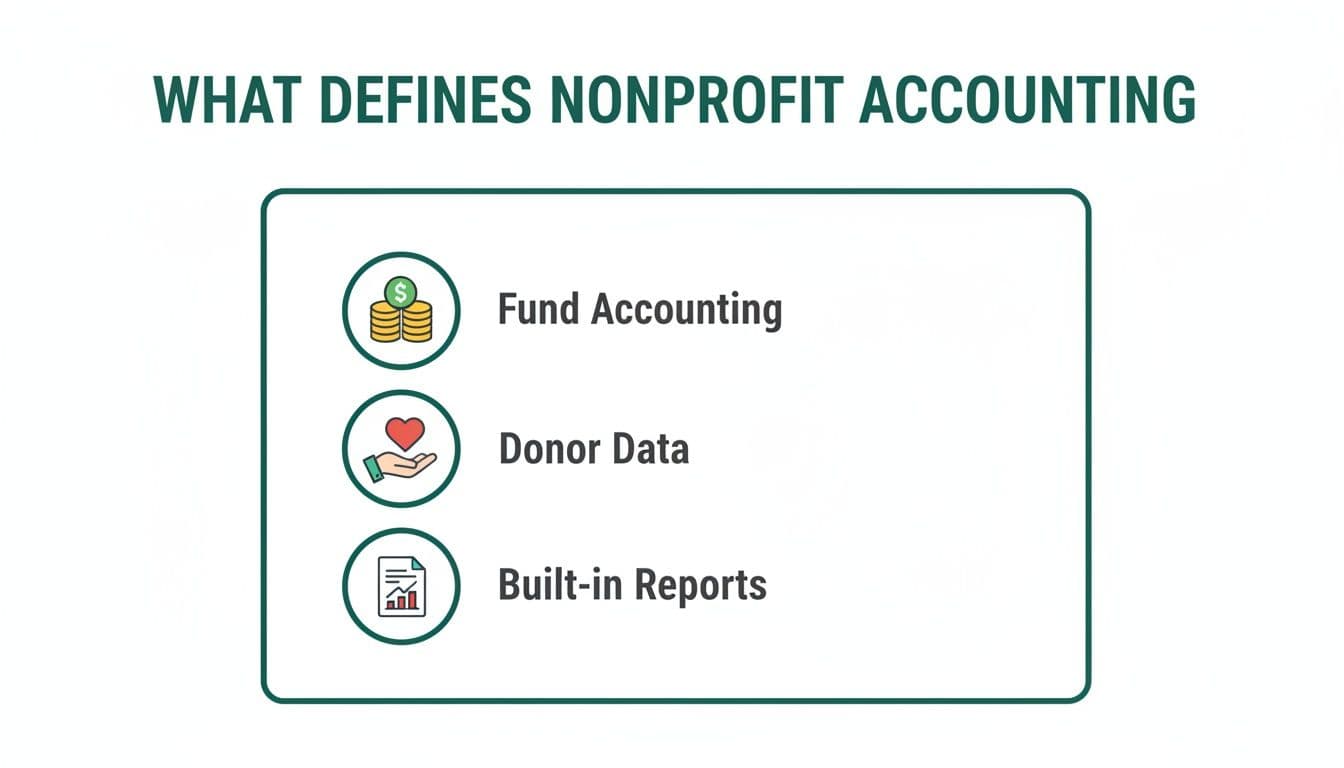
These three elements - fund accounting, donor data, and reporting - are the foundation for financial transparency and operational efficiency.
Alignmint: An All-in-One Alternative
We built Alignmint to fill the frustrating gap between overly simple tools like QuickBooks and overly complex systems like Blackbaud. It was designed by nonprofit directors who were tired of juggling multiple software subscriptions.
Alignmint is a true all-in-one platform that brings your entire operation into one place. You get real fund accounting without workarounds, just like in Aplos. But you also get an integrated CRM, volunteer management, event ticketing, and even a built-in marketing suite. Critically, there are no per-user fees, so your entire team can collaborate without driving up your costs.
For organizations with revenue under $100,000, we offer a free plan to help you get started on the right foot. You can even ask our AI assistant, Minty, questions about your data in plain English, a feature we explore in our article about how AI is changing nonprofit software. This unified approach saves time and gives you a complete, real-time view of your organization's health.
Nonprofit Software Feature Comparison
Here's a side-by-side look at how these leading platforms handle the core financial and operational needs of a nonprofit.
| Feature | QuickBooks Online | Aplos | Blackbaud Financial Edge NXT | Alignmint |
|---|---|---|---|---|
| True Fund Accounting | No (uses "classes" workaround) | Yes, it's a core feature | Yes, it's deep and powerful | Yes, built-in and automated |
| Donor CRM | No (requires a separate system) | Yes, a basic CRM is included | No (separate product, Raiser's Edge) | Yes, a full CRM is integrated |
| Volunteer Management | No | No | No | Yes, fully integrated |
| Marketing Suite | No | No | No | Yes, built-in |
| Online Giving Pages | No | Yes | Requires separate product | Yes, fully integrated |
| Automated 990 Reporting | No | Limited | Yes, for financial data | Yes, with functional expense allocation |
| Pricing Model | Per-user fees, tiered features | Per-user fees, tiered features | High enterprise cost, quote-based | No per-user fees, one all-in-one plan |
| Free Offering | 30-day trial | No | No | Free forever plan for orgs under $100k |
This table makes the trade-offs clear. While tools like QuickBooks and Aplos solve parts of the puzzle, a truly unified platform like Alignmint is designed to solve the whole problem at once.
Why an All-in-One Hub Is a Game-Changer
As a director, you know that your finances are woven into every part of your mission. Each donation, volunteer hour, and fundraising event is a financial event. So why are we still managing them with a patchwork of separate, disconnected tools?
You're probably feeling this pain right now. Maybe you use QuickBooks for the books, another system for your donor CRM, and spreadsheets to track everything else. This fragmented setup creates hidden work and forces your team to manually re-enter data.
Worst of all, it keeps you from seeing the full story of your organization's health. It’s nearly impossible to answer critical questions without a major reporting project.
Finally Get a Single, Unified View of Your Mission
When your software works as one cohesive unit, you get a complete, real-time picture of your organization. That’s the entire point of an all-in-one operations hub. It’s not about piling on more features; it’s about connecting the ones that truly matter.
Imagine a donor gives through your online giving page. In a truly unified system, that transaction automatically posts to your accounting ledger. The donor's record is updated in your CRM, and a tax receipt is instantly emailed, with no manual entry.
This connected workflow saves a staggering amount of administrative time. It frees up your team to focus on what they were hired to do.
Connect Every Piece of Your Operation
An integrated platform does more than just link finances and donors. It brings every part of your nonprofit into one place. This unlocks powerful insights that were previously hidden.
Think about these common scenarios:
- Volunteer Management: You can track volunteer hours and tie them directly to a specific grant or program. This makes it effortless to report on in-kind contributions to funders.
- Smarter Outreach: With giving history and program involvement all in one place, your communications become more effective. You could send a special appeal just to people who have volunteered for a specific program in the last year.
- Team Communication: When your program manager sees their budget and your development coordinator sees donation history in the same system, it just clicks. It helps everyone see the big picture.
The real power of an all-in-one system is seeing how every action - from a new volunteer to a major gift - affects your financial position in real time. It moves your accounting from a historical record to a strategic tool.
Lower Your Costs and Reduce Complexity
Juggling multiple software subscriptions isn't just a headache; it's expensive. You're paying separate bills for each tool, often with per-user fees that punish you for growing your team. An all-in-one platform simplifies everything.
You get one login, one bill, and one team to call for support. With Alignmint, you also get unlimited users at no extra cost, so your entire team can get the access they need. For smaller organizations, our free plan for nonprofits under $100K in revenue removes the cost barrier completely.
According to data from Mordor Intelligence, a staggering 82% of organizations still struggle with disconnected systems. This leads to endless manual reconciliations that can eat up a huge portion of a finance team's time. By bringing everything together, you finally eliminate the data silos that cause so much frustration.
You can explore how this works in practice by reading our guide on all-in-one nonprofit management software. This shift to a central hub is what will help you find the best nonprofit accounting software for your future.
Making the Switch Without the Headaches
The thought of moving years of financial data from one system to another is daunting. We get it. That fear is what keeps so many nonprofits stuck in systems that burn hours of staff time every week.
A well-planned switch is empowering, not intimidating. It’s less about being a tech expert and more about following a logical process with a partner who guides you. The goal is to feel in control.
Preparing Your Data for a Smooth Move
First things first: you need to get your current financial house in order before you pack it up. This step is critical. A messy migration just moves old problems to a new home.
Start by running a few key reports from your old system. You'll want your most recent Statement of Activities and Statement of Financial Position. Also, pull together a complete list of your current donors, active grants, and any outstanding pledges.
The most important decision you'll make is choosing a "cut-over" date. This is the official date you will stop entering transactions in your old system and start using the new one. Many organizations choose the start of a new fiscal year or quarter.
Your new software provider should help you establish your opening balances. A true partner will take your core financial statements and use them to set up the starting point for each of your funds.
Choosing a Partner Who Helps You Move In
The company you choose should be just as invested in your transition as you are. A provider who just gives you a login and a help manual is a major red flag. Look for clear, guided support designed for someone who isn't an IT expert.
When you're talking to potential software providers, ask them directly about their data import process.
- Can they help you import your chart of accounts?
- Will they assist in uploading your complete donor list with giving histories?
- Do they provide a clear checklist of the files they need from you?
A good partner makes this feel like a managed project, not a technical puzzle you have to solve alone. This type of hands-on support is critical for finding the best nonprofit accounting software for a busy director. You can learn more about how to create better reports in our guide to improving your nonprofit financial reporting.
Getting Your Team Comfortable and Confident
Finally, the success of your new software depends on your team actually using it. The system should feel intuitive to everyone, not just your accountant. This is where an all-in-one platform really shines.
Instead of having to learn a separate system for volunteer management or another for donor notes, everything is in one place. This simplifies training enormously. When your entire team works from the same system, it helps everyone see the big picture.
Our Recommendation for Growing Nonprofits
After walking through all the options, we understand the tough spot you're in. You’ve outgrown basic tools but feel enterprise systems are too complex and expensive. You need a solution that fits right in the middle.
This is precisely why we built Alignmint. We believe it's the best nonprofit accounting software for growing organizations ready to stop juggling separate tools. It was designed by nonprofit directors, just like you, to solve the daily frustrations we all face.

Get Confidence in Your Financial Reports
You can finally get clear grant reports without spending days buried in spreadsheets. Alignmint was built with true fund accounting at its core. This means every donation and grant is automatically tracked against the correct fund.
You no longer have to worry about manual workarounds or errors from a simple typo. When a funder asks for a report, you can generate it in a few clicks, confident the numbers are right. You can dive deeper into this topic in our post about improving your nonprofit financial reporting.
See the Full Picture of Your Supporters
You will understand your donors on a much deeper level because their financial history is connected to their story. Alignmint combines your accounting with a complete donor CRM. You can see every donation, event ticket, and volunteer hour all in one place.
This allows for smarter, more personal communication. For example, you can easily send a targeted appeal to everyone who has both donated and volunteered. It closes the gap between your fundraising efforts and your financial reality.
Bring Your Entire Team Together
You can empower your whole team to work together without worrying about extra costs. Alignmint includes tools for volunteer management, a built-in marketing suite, and online giving pages. Best of all, we offer unlimited users with no per-user fees.
This means your program managers, development staff, and board members can all access the information they need. This approach is a core part of what makes an all-in-one nonprofit management software so effective.
We designed Alignmint to grow with you. For organizations with revenue under $100,000, you can use our free plan forever. As your needs evolve, you have a clear path to a complete operational hub.
Get Answers from Your Data Instantly
You can get an immediate answer by asking your software a question in plain English. That’s what our AI assistant, Minty, does for you. Instead of building complex reports, you can ask, "What was our total individual giving last quarter?"
Minty finds the information and presents it clearly, saving you valuable time. It’s like having a data analyst on your team, ready to give you the insights you need. This helpful technology is a key part of how we see the future, as we explore in our article on AI for nonprofit software.
You deserve a system that was built for the work you do. Alignmint gives you the tools you need to manage your finances, engage your community, and grow your mission - all in one place.
Your Questions, Answered by a Director
As you consider a change this big, a few common questions always come up. Here are some straightforward answers to what we hear most often from nonprofit leaders just like you.
How Hard Is It to Switch from QuickBooks?
The thought of moving years of financial data is daunting. We get it. That fear is what keeps so many nonprofits stuck in systems that burn hours of staff time every week.
But modern platforms are designed for this exact transition. A good software partner won't just hand you a tool; they'll give you a clear, step-by-step roadmap. It's their job to help you map old information into a proper fund structure.
How Can We Afford New Software on a Tight Budget?
This is probably the most common question we hear, and it’s a perfectly valid one. The first thing to do is add up what you're really spending right now. Tally up the subscriptions for your accounting software, a separate donor CRM, and your email tool.
Your team's time is your most valuable resource. The hours spent manually entering data or fixing errors are a massive hidden cost. A unified system often pays for itself in reclaimed staff time alone.
This is why finding a platform with predictable pricing is so important. Some, like Alignmint, offer a completely free plan for organizations with revenue under $100,000. For larger organizations, our all-in-one plan with no per-user fees keeps your costs predictable and affordable.
What if My Team Isn’t Tech-Savvy?
You hired your team for their passion and expertise, not because they're CPAs. The best nonprofit accounting software is built with this reality at its core. The interface should feel welcoming and intuitive to everyone, not just your bookkeeper.
Look for a system that uses plain language and is designed around real-world tasks. When the software works the way your team thinks, they’ll feel confident using it. You can learn more by reading about the benefits of an all-in-one nonprofit management platform.
Related:
- Fund accounting for nonprofits - Core concepts for restricted funds
- Nonprofit accounting software - What to demand in demos
- Fund accounting - How Alignmint handles funds and grants
Frequently Asked Questions
Ready to see how Alignmint works for your nonprofit?
Schedule a free walkthrough - we'll set everything up for you.