


For related tools, see AlignMint features.
PTA Officer Job Description Templates 2026
Quick Answer: Parent Teacher Association Job Description: 2026 Templates
A parent teacher association job description should name the role purpose, key duties, time commitment, skills, and who the volunteer reports to. Officer templates for President, Treasurer, Secretary, and committee chairs reduce burnout, protect money handling, and make recruiting specific instead of vague.
A parent teacher association job description usually gets written in a hurry, then forgotten until something goes wrong. A volunteer quits midyear, receipts are missing, no one knows who owns the spring fundraiser, and the same two parents carry the whole load.
Clear role descriptions fix more than paperwork. They give your PTA a working structure, protect trust around money, and make it easier to recruit people who can actually help.
Why Clear PTA Job Descriptions Matter
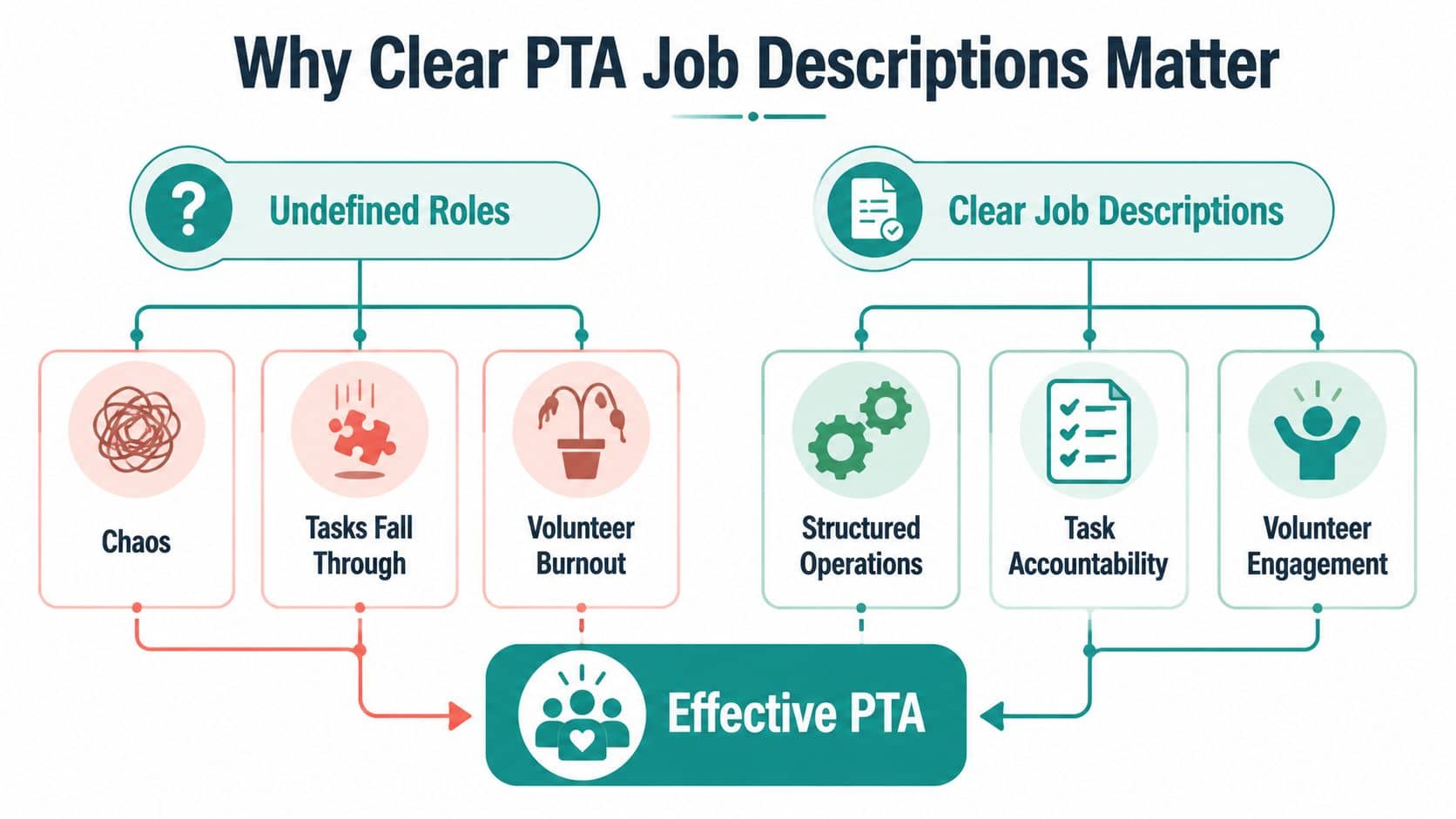
Most PTAs don't struggle because parents don't care. They struggle because nobody has defined who does what, who approves spending, who follows up with volunteers, and who closes the loop after an event.
That confusion gets expensive in time, energy, and goodwill. When a role is fuzzy, your most dependable volunteer fills the gap until they burn out.
Clarity protects people and process
A good parent teacher association job description does three jobs at once. It tells a volunteer what success looks like, tells the board where accountability sits, and tells next year's team how to pick up the role without starting from zero.
It also reduces the quiet friction that hurts volunteer groups. People don't mind helping. They do mind walking into vague expectations, scattered files, and side conversations that substitute for decisions.
Practical rule: If a task matters enough to complain about when it isn't done, it belongs in someone's written role.
Financial responsibility raises the stakes. Recent figures indicate that the average PTA raises approximately £8,000 per year, and those funds are designated to improve school experiences, which is why roles like Treasurer need clear written responsibility for transparent handling and reporting to parents, as outlined by Twinkl's PTA overview.
Better descriptions make recruiting easier
Strong job descriptions also help you recruit beyond the usual circle. Instead of asking for "someone who can help," you can ask for a Treasurer who reconciles records monthly, a Communications Chair who sends family updates, or a Volunteer Coordinator who matches people to tasks.
That kind of specificity opens the door to parents who are willing to serve but don't want surprises. It also helps when you're putting better systems around scheduling, follow-up, and retention. This is the same discipline behind these volunteer management best practices, where the role is defined before the role is assigned.
A PTA with written roles feels calmer. Meetings move faster, handoffs improve, and fewer things depend on memory.
The Core Components of Any PTA Job Description
A useful template isn't fancy. It just needs the parts that prevent confusion later.
When I review volunteer role documents, the missing pieces are usually the same. The title is there, maybe a short paragraph, but nothing about decisions, time, or reporting.
The six fields every role needs
Include these elements in every parent teacher association job description:
-
Role title: Keep it plain. "Treasurer," "Fundraising Chair," and "Family Engagement Chair" are better than creative labels that mean different things to different people.
-
Purpose of the role: One short paragraph is enough. State why the position exists and how it supports students, families, staff, or school programs.
-
Key responsibilities: List the repeatable duties. Use action verbs such as coordinate, prepare, track, schedule, report, and communicate.
-
Skills or qualifications: This doesn't need to sound corporate. Say whether the role needs comfort with spreadsheets, event planning, writing, bilingual outreach, or meeting facilitation.
-
Time commitment: Give a realistic estimate in plain language. Note whether the role is steady all year or heavy around certain events.
-
Reporting relationship: State who this person reports to and who they collaborate with. If approvals are needed, write that down.
A role description becomes much stronger when paired with your governing rules. If your documents are outdated or inconsistent, start with a nonprofit bylaws template so the role language matches how your group operates.
Write for handoff, not just hiring
The best descriptions aren't written only for the person stepping in now. They're written for the person who takes over next year.
That means naming recurring deliverables. Examples include "prepare agenda input before board meetings," "keep event vendor contacts in shared files," or "submit year-end notes for the transition binder."
A strong role description should answer three questions quickly: what am I responsible for, what authority do I have, and what does done look like?
Add the realities volunteers care about
Volunteers also want to know what they're walking into. Be honest about evening meetings, school-day tasks, deadlines tied to the calendar, and whether the role needs coordination with teachers or administrators.
For event-heavy roles, it helps to point people toward tested ideas instead of expecting them to invent a fundraiser from scratch. A roundup of practical nonprofit fundraising strategies can give your chairs a starting point for event planning, sponsor outreach, and family-friendly campaigns.
The goal is simple. Less mystery at the start means fewer frustrations in the middle of the year.
Job Description Templates for PTA Officers
Officer roles need more than a title and a smile at the annual meeting. These are the positions that hold governance, money, records, and continuity together.
Treat these templates as working drafts. Adjust the language to match your bylaws, meeting cadence, and school culture.
President or Chair
Purpose Leads the PTA's work, keeps the group aligned with its mission, and ensures decisions are carried out in a transparent and orderly way.
Key responsibilities
- Lead meetings: Prepare agendas, facilitate meetings, and keep discussion tied to decisions.
- Coordinate officers: Check progress across committees and help unblock issues early.
- Maintain governance: Confirm that the PTA follows agreed procedures and approved policies.
- Represent the group: Serve as the primary point of contact with school leadership.
- Support transitions: Keep records current so the next leadership team inherits a workable system.
Skills that help Meeting facilitation, calm communication, follow-through, and comfort delegating instead of doing everything personally.
Vice President
This role works best when it has real assignments, not just "fill in when needed."
Purpose Supports the President or Chair, oversees assigned projects, and steps in when leadership coverage is needed.
Common responsibilities
- Manage one or more major initiatives.
- Track committee milestones and deadlines.
- Help recruit volunteers for open roles.
- Maintain a current calendar of key PTA activities.
- Step into the lead role when the President is unavailable.
A Vice President often becomes next year's President. Give them enough exposure to budgets, decisions, and school relationships so that handoff is realistic.
Secretary
The Secretary role looks simple on paper and becomes mission-critical fast when it is neglected.
Purpose Maintains the PTA's official records, meeting minutes, and core administrative files.
Responsibilities
- Document decisions: Record minutes that capture motions, approvals, and follow-up owners.
- Manage records: Store agendas, minutes, policies, and annual reports in a shared location.
- Track official notices: Send meeting notices and preserve required documentation.
- Support continuity: Keep a clean archive that future volunteers can understand.
Minutes are not a transcript. They are the official record of what the group decided and who owns next steps.
Treasurer
This role deserves the most detail because money confusion creates the fastest loss of trust.
Purpose Manages the PTA's day-to-day financial records, handles receipts and deposits, supports transparent reporting, and helps leaders understand what funds are available for approved purposes.
According to the PTA guidance summarized by Twinkl, the Treasurer is responsible for managing day-to-day accounts, issuing receipts, and preparing annual reports for the AGM. The Chair is also responsible for ensuring transparent business conduct, which makes written division of duties essential.
Core duties
- Receive and record income from events and donations.
- Maintain receipts, invoices, and supporting documents.
- Prepare regular financial updates for the board and members.
- Track restricted activity by event, program, or purpose where needed.
- Coordinate annual reporting and transition materials.
Why the Treasurer needs the right structure
Many PTAs try to manage restricted activity with basic business bookkeeping workarounds. That's where things start to wobble. If the fall fair surplus is meant for playground equipment and another campaign supports a field trip fund, the Treasurer needs records that show purpose clearly, not just a general cash balance.
QuickBooks is a familiar tool and strong for many small businesses. But PTA leaders often run into friction when they try to track nonprofit-style funds, school programs, and board reporting through classes and manual workarounds. A true fund accounting approach fits this role better because it mirrors how nonprofit money is governed.
If you're preparing for an officer change, a club treasurer transition checklist can keep passwords, reports, bank access, and historical records from disappearing with the outgoing volunteer.
Job Description Templates for Committee Chairs
Committee chairs turn plans into real action. They recruit helpers, move information, and keep events from collapsing into last-minute improvisation.
These roles often need the most support because they involve many moving pieces, yet they're frequently described in one vague sentence.

Fundraising Chair
Purpose Plans and manages fundraising activities that support PTA goals while respecting family capacity and school culture.
Responsibilities
- Build an annual fundraising calendar with leadership.
- Draft event plans, volunteer needs, and supply lists.
- Coordinate vendor communication and approvals.
- Track event income and expenses with the Treasurer.
- Review what worked and document notes for next year.
This role works better when the chair owns the process, not every task. The chair should recruit table leads, shift captains, and checkout support rather than trying to run the whole event personally.
Volunteer Coordinator
The Volunteer Coordinator is often the hidden engine of the PTA.
Purpose Recruits, places, and communicates with volunteers so committees can staff events and projects without constant scrambling.
Key duties
- Match people to tasks: Track interests, skills, and availability.
- Fill open shifts: Maintain sign-ups and reminders for specific events.
- Support retention: Thank volunteers, follow up after events, and invite them back into manageable roles.
- Keep records current: Maintain contact lists and role history.
A central system helps here because spreadsheets break down once several chairs start editing at the same time. Event sign-ups, role assignments, and availability are easier to manage when they're tied to one calendar and one record.
If your group runs multiple family events, an event platform with registration and coordination tools can reduce back-and-forth. Consequently, dedicated systems for PTA events and scheduling save a lot of volunteer time.
Communications Chair
Purpose Keeps families informed through consistent, clear, and respectful communication.
Responsibilities
- Create and maintain the PTA communications calendar.
- Draft newsletters, event reminders, and meeting notices.
- Coordinate message timing with school leadership when needed.
- Keep tone welcoming and practical.
- Maintain basic standards for branding, files, and approvals.
This role shouldn't just blast messages. It should make sure families know what is happening, why it matters, and how to participate without needing insider knowledge.
If families have to know the right person to find out what's going on, your communication process is too informal.
Family Engagement Chair
This role deserves more attention than it usually gets. Many PTAs say they want broad participation, yet the assigned tasks stop at event setup and attendance tables.
Purpose Builds meaningful family participation across the school community, especially among families who may face language, cultural, scheduling, or trust barriers.
Responsibilities
- Identify participation barriers and report them to leadership.
- Coordinate outreach that welcomes families from different backgrounds.
- Recommend inclusive meeting formats, translation support, and feedback methods.
- Help establish a Family Engagement Advisory Team where appropriate.
- Encourage volunteer training focused on meaningful, ongoing engagement.
Emerging best practices from the National PTA encourage PTAs to create Family Engagement Advisory Teams and provide training on impactful engagement, as described in the Utah PTA family engagement guidance. That matters because movie nights and bake sales alone don't tell you whether families feel heard, informed, or represented.
A Family Engagement Chair should do more than count attendance. The role should help the PTA ask who isn't in the room, why, and what needs to change.
Customizing Descriptions for Your School
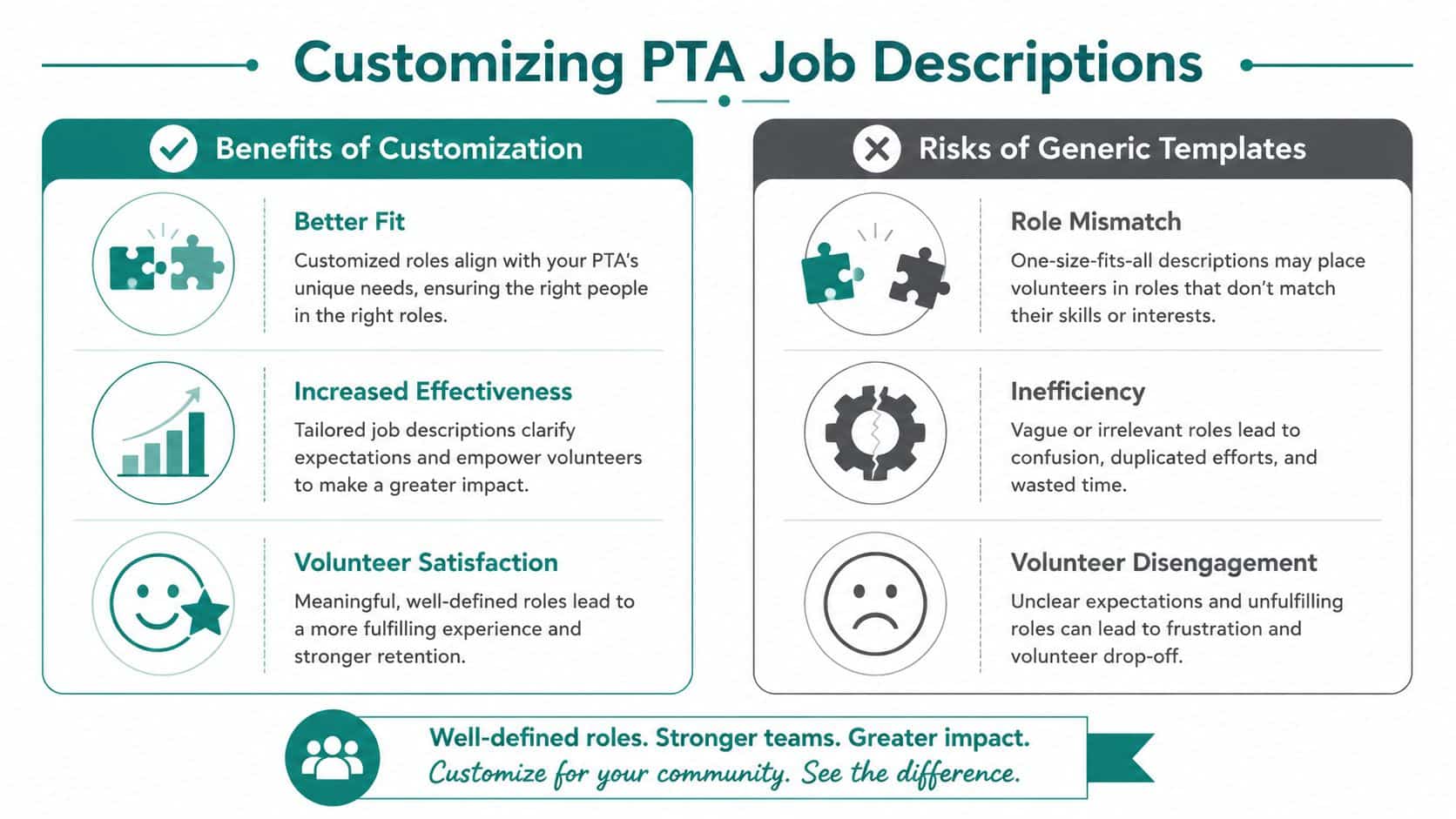
A template saves time, but a copied template can also create role mismatch. A small primary school, a large secondary school, and a school serving many working families won't need identical volunteer structures.
Good customization starts with workload. Great customization also addresses who gets invited in, who gets heard, and who gets left on the edges.
Adjust for size and capacity
If your volunteer bench is small, combine roles thoughtfully. You might pair Secretary with Communications, or Vice President with Volunteer Coordination, but only if the duties rise and fall at different times of year.
A quick screen helps:
| School reality | Better role design |
|---|---|
| Small volunteer pool | Combine low-conflict duties into one post |
| Many events, few planners | Keep Fundraising separate from Volunteer Coordination |
| Complex money handling | Give the Treasurer a narrower, clearer scope |
| Diverse family needs | Make Family Engagement a named leadership function |
Write inclusion into the role
Many PTA job descriptions often fall short. Research shows that without intentional effort, PTAs can reinforce disparities by attracting and serving families who already have social advantages, and that written expectations around inclusive outreach and equity auditing can help counter that pattern, as discussed in this research on social reproduction and PTAs.
That finding has practical consequences. If your role descriptions assume every volunteer can attend daytime meetings, respond quickly to email, donate supplies, or rely on existing friendships, your structure quietly excludes people.
Use language that broadens participation:
- Replace insider phrasing: Write "welcome and orient new families" instead of "connect with our usual parent group."
- Name outreach duties: Include follow-up with families who haven't participated before.
- Allow different forms of service: Offer remote tasks, short-term tasks, and event-day assignments.
- Build reflection into the role: Ask chairs to review who participated and who did not.
Inclusive outreach isn't extra work added after the plan. It belongs in the plan.
Schools with varied needs often benefit from tools built around education settings, shared calendars, and family communication. That's why many leaders look for systems designed for school and education nonprofits, not generic office software.
Customization works when it makes the role more realistic and more welcoming at the same time.
A Quick Start Checklist for New Appointees
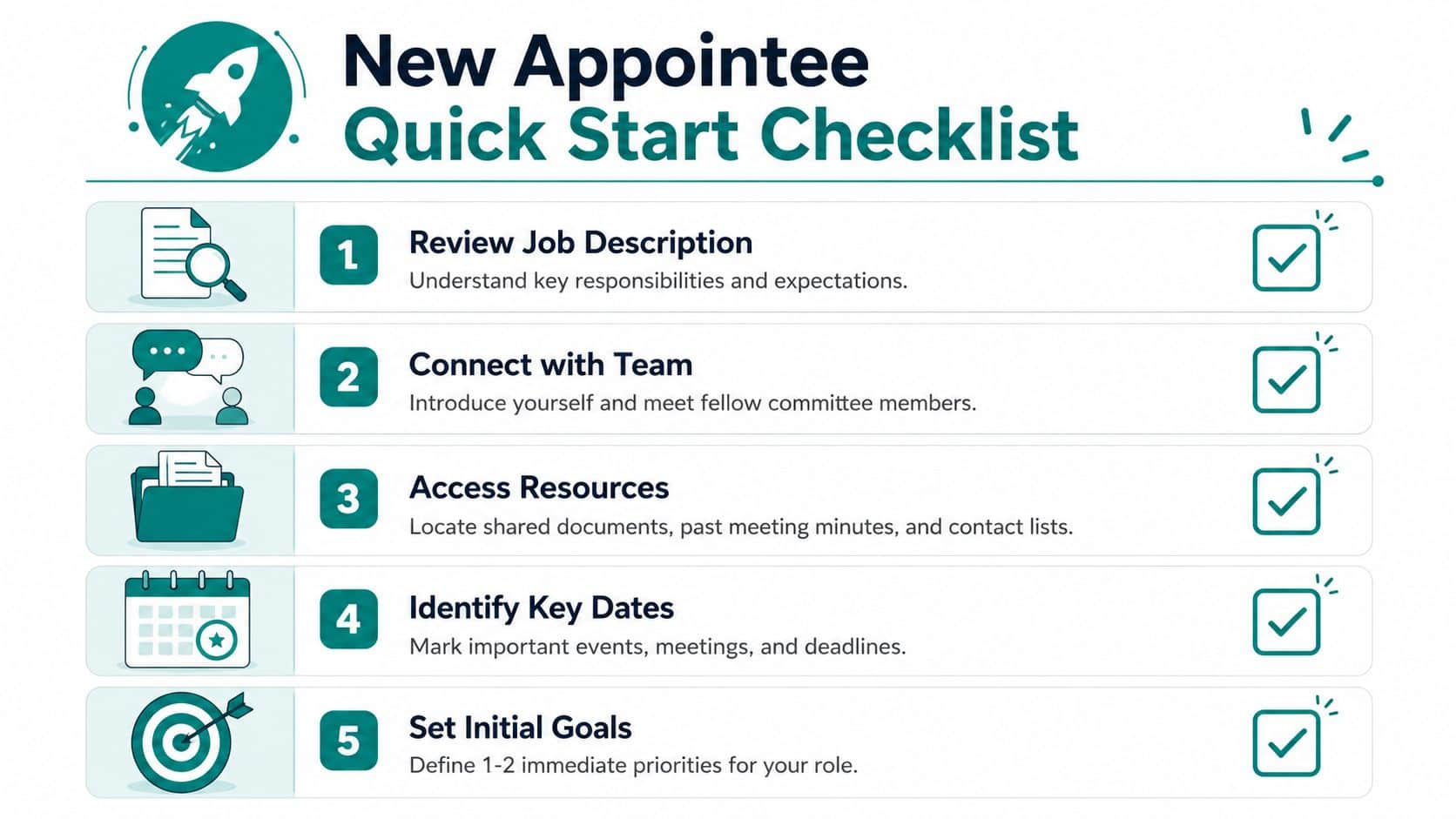
The fastest way to lose a good volunteer is to hand them a title and no start plan. New appointees need a short, concrete checklist that helps them feel useful in the first week.
Give this to every incoming officer and committee chair.
First-week checklist
-
Read the role description fully Confirm the purpose, key duties, and approvals tied to the role. Flag anything unclear before work begins.
-
Meet the outgoing volunteer or board lead Ask what repeats every month, what usually gets missed, and what deadlines matter most.
-
Get access to files and tools This includes minutes, budgets, vendor contacts, email lists, event notes, and any login credentials approved for the role.
-
Mark the key dates now Add meetings, event deadlines, budget reviews, and school milestones to one calendar.
-
Pick one or two early priorities Don't try to fix everything. Choose the most time-sensitive task and one improvement that will help later.
What leaders should provide
A smooth handoff is a leadership responsibility, not a test of whether the new person can figure it out alone.
Make sure each appointee receives:
- A named contact: One person who can answer questions quickly.
- Current records: Not last year's half-finished folders.
- Access without bottlenecks: Shared systems are easier when you don't have to pay per seat for every helper.
- Simple communication norms: Tell them where decisions happen and where files live.
A clean start tells volunteers your PTA is serious, organized, and respectful of their time.
How Integrated Software Supports Your PTA Leaders
Once roles are clear, the next headache is tool sprawl. The Treasurer has one system, the event chair has another, volunteer sign-ups live in a spreadsheet, and family emails sit in someone's personal account.
That setup creates risk and extra work. Volunteers spend their limited time chasing information instead of doing the job they agreed to do.
Match the tool to the role
Your Treasurer needs true fund accounting, not business bookkeeping shortcuts. Your donor and family records need to connect with giving history. Your Volunteer Coordinator needs one place to track availability and assignments. Your Communications Chair needs built-in email and marketing tools that don't require exporting lists over and over.
That's why many school groups look for an all-in-one platform that combines accounting, donor management, volunteer management, events, online giving pages, team communication, fiscal sponsorship support where needed, and a marketing suite. It also helps when the system includes AI intelligence for answering practical questions from real organizational data, instead of forcing volunteers to build reports manually.
Products like QuickBooks, Bloomerang, SignUpGenius, and Mailchimp each do useful things well. The gap is that most PTAs end up stitching several of them together. A unified platform reduces hand entry, simplifies access for changing volunteer teams, and avoids per-seat fee problems when multiple parents need visibility.
For many school nonprofits, the free tier available to organizations under $100K makes this kind of setup easier to consider without draining fundraising dollars. Plan-based user allowances (1 on Free, up to 10 on Plus, up to 25 on Pro, and unlimited on Enterprise) matter here too, because PTA work is shared work.
Frequently Asked Questions
What if a volunteer isn't doing the job?
Start with the written role. Review the expectations together, ask what is getting in the way, and narrow the scope if needed. Sometimes the problem is fit, not commitment.
How do we recruit for open PTA roles?
Recruit for a specific job, not a vague plea for help. Share the purpose, time commitment, and one or two visible outcomes. People say yes faster when they know what they're agreeing to.
Can two people share one role?
Yes, if the split is written down. Divide duties by function, timing, or event ownership so both people know where they lead.
Should every committee chair have a formal description?
If the role touches money, communications, events, family outreach, or recurring school support, yes. Written clarity prevents avoidable conflict later.
If your PTA is tired of juggling separate tools for accounting, donors, volunteers, events, and family communication, AlignMint gives you one place to manage the whole operation. We built it for real nonprofit teams that need true fund accounting, built-in marketing, volunteer coordination, online giving, Minty support, and plan-based user allowances (1 on Free, up to 10 on Plus, up to 25 on Pro, and unlimited on Enterprise). For school groups and other nonprofits under $100K, our free tier makes it easier to get organized without eating into the money you raised for students.
Ready to try AlignMint with your nonprofit?
Start free — set up donor tools, giving pages, and Minty. Upgrade when you need accounting.