

For related tools, see AlignMint features.
Build a Better Volunteer Management Program: A Guide
Quick Answer: Build a Better Volunteer Management Program: A Guide
A volunteer management program is the full system for recruiting, preparing, scheduling, communicating with, and retaining volunteers-not just a sign-up form. Start with a needs assessment, write clear roles, track hours by program, and connect volunteer records to donor and finance data when you can.
Your volunteer calendar is probably full of holes, your staff is covering gaps, and your best helpers are close to burnout. That isn't a volunteer problem alone. It's a systems problem that affects service delivery, fundraising, reporting, and team stress.
A strong volunteer management program gives you a repeatable way to bring in the right people, place them well, keep them engaged, and connect their service to the rest of your work. If your current process lives in spreadsheets, inboxes, and staff memory, you can fix it without making your day harder. For foundational practices, see our guide to volunteer management best practices.
What Is a Volunteer Management Program Really?
A volunteer management program is not just a sign-up form and a calendar. It's the operating system behind how your organization recruits help, prepares people, communicates clearly, tracks contribution, and keeps good volunteers coming back.
Think of it like building a dependable team, not filling empty shifts. When the system is working, volunteers know what they're doing, staff know who is showing up, and your mission gets carried forward without constant scrambling.
Formal volunteering dropped sharply during the pandemic, then recovered to 28.3% by late 2023, the fastest growth ever recorded, according to the National Council of Nonprofits volunteer update. That tells me the willingness to serve is there again. What matters now is whether your organization can capture that energy before it slips away.
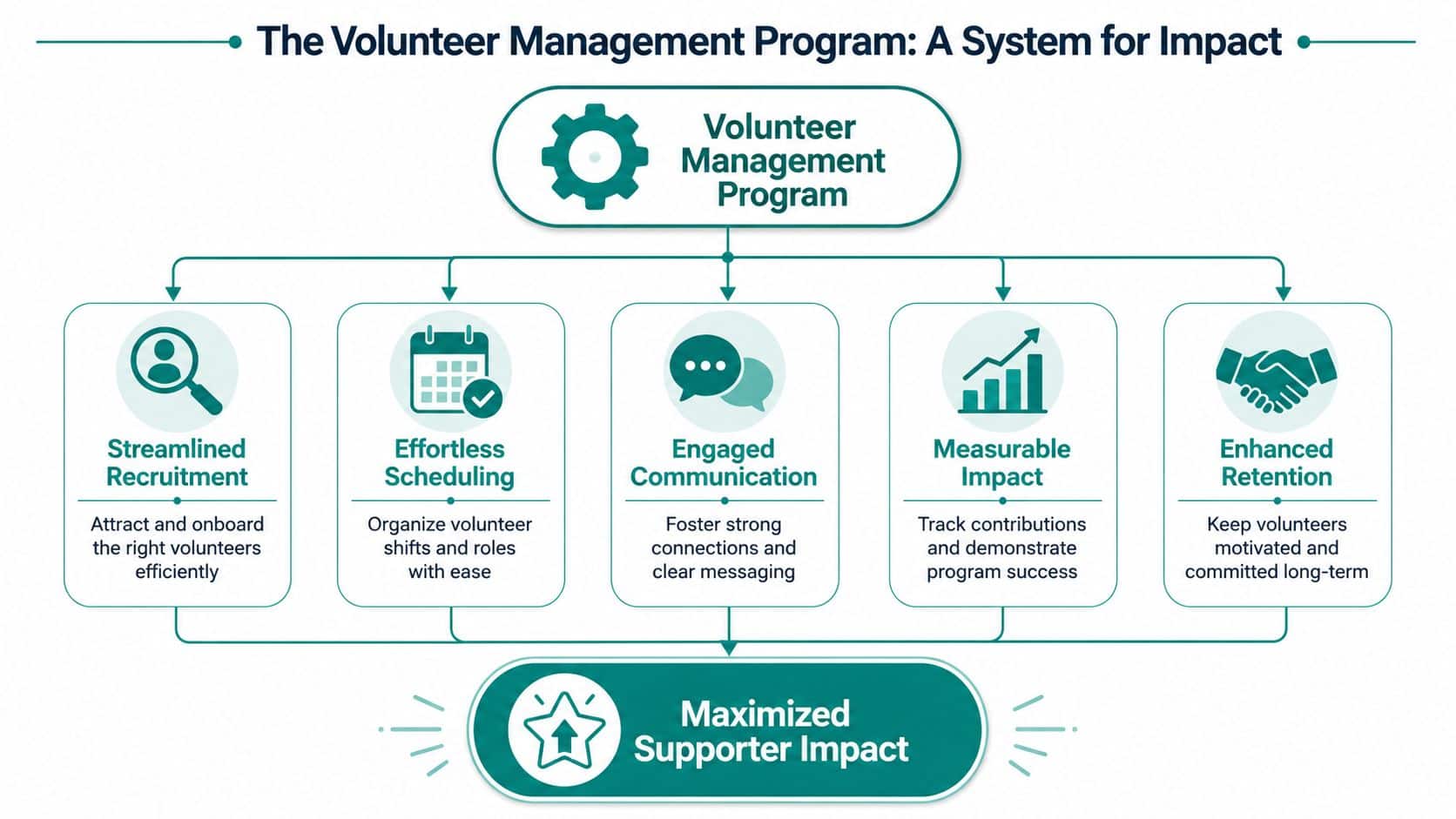
The four jobs your program must do
Most struggling programs break down in one of four places:
- Attract the right people. You don't need more names. You need people who fit real roles, hours, and expectations.
- Prepare them well. Confused volunteers create more work for staff. Clear direction saves time on both sides.
- Keep them engaged. Good volunteers leave when communication is inconsistent or the work feels disorganized.
- Show them their value. People stay when they can see the mission impact of their effort.
If one of those pieces is weak, the rest suffers. You may recruit well but lose people after their first event. You may retain loyal volunteers but keep overusing the same few people because scheduling is messy.
Practical rule: If your staff has to explain the same volunteer task from scratch every week, you don't have a staffing problem. You have a process problem.
This is also where team communication matters more than most leaders realize. Volunteer confusion often starts with staff confusion. If departments aren't sharing updates, event details, or role changes, volunteers feel that disorder immediately. Our workspace messenger guide gets into the habits that reduce that internal friction.
A healthy volunteer management program works as a cycle. Recruit, prepare, schedule, communicate, appreciate, and track. When you see it as a system instead of an extra chore, weak spots become easier to fix.
The True Value of Your Volunteers
If your board still talks about volunteers as "free help," the conversation is too small. Volunteers create financial value, expand your reach, and protect staff capacity in ways that deserve stronger language.
As of 2024, the estimated value of a volunteer hour in the United States is $34.79, according to Nonprofit Learning Lab's volunteer engagement guidance. For a small nonprofit with a modest core of regular helpers, that can add up to tens of thousands of dollars in contributed value.
Why this matters beyond the budget
That hourly value is useful because it helps boards and funders understand the scale of contribution. But the true benefit goes further.
A well-run volunteer program can:
- Reduce staff overload by shifting suitable work away from your smallest paid team
- Extend service capacity so programs don't stall when payroll is tight
- Deepen community roots because volunteers become ambassadors, not just extra hands
- Create resilience when unexpected staff turnover or event pressure hits
Those outcomes matter to executive directors because they affect burnout, credibility, and continuity. A volunteer who handles front-desk coverage, food sorting, tutoring support, event check-in, or call follow-up frees staff to do the work only staff can do.
What boards need to hear
When you present your volunteer program, don't frame it as a nice add-on. Frame it as part of operational strength.
A simple way to say it is this:
Volunteers don't just reduce costs. They increase what your mission can deliver without requiring the same growth in paid staff.
That language usually lands better with boards than software language or administrative detail. It also helps when you're defending time spent improving role design, training, and scheduling. Those aren't side tasks. They're what turns goodwill into dependable capacity.
If your finance and program conversations are still separate from your volunteer conversations, you're likely understating your real organizational strength.
How to Build Your Volunteer Program
Most nonprofits don't need a complicated model. They need a basic structure that staff can repeat without reinventing it each month. Start with the roles, not the software.
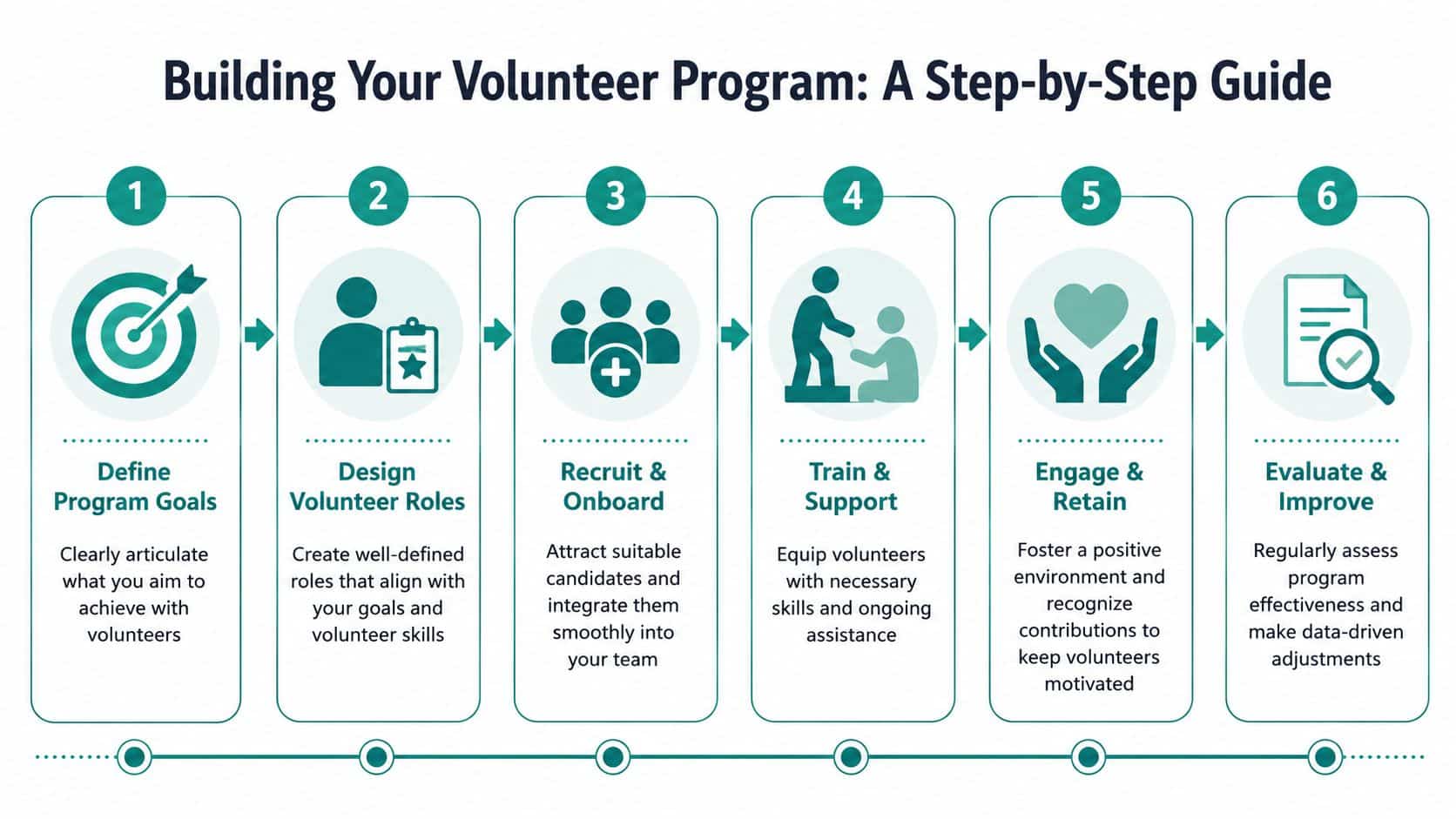
Start with a needs assessment
Before you recruit anyone, identify where volunteers help your mission. Penn State Extension notes that nonprofits should begin with a needs assessment tied to mission goals, followed by structured interviews and thoughtful placement through the screening process in its guidance on nonprofit volunteer management.
That means asking practical questions:
- Which tasks are mission-critical but don't require paid staff credentials?
- Where is your team repeating low-value administrative work?
- Which roles need regular help, and which are event-based?
- What supervision can you realistically provide?
A vague answer like "we need more volunteers" usually leads to vague results. A better answer sounds like "we need two weekly food pantry check-in volunteers and one monthly grant filing support volunteer."
Write roles that people can say yes to
This is one of the highest-return fixes you can make. Organizations that fail to define clear volunteer roles with specific skills and time commitments see a 25% drop in retention, while role-specific training and simple online applications can increase total volunteer hours by 15% to 20% annually, according to Better Impact's volunteer management guide.
Your role description should answer five things quickly:
- What the volunteer will do
- What skills are needed
- How much time is expected
- Who supervises the role
- Why the role matters
If a role description reads like a staff handbook, it's too long. If it reads like a slogan, it's too vague.
Screen carefully, then orient simply
Not every role needs the same level of screening. A volunteer handling children, finances, transportation, or personal data deserves closer review than someone helping at a one-time outdoor event.
Use a basic, repeatable intake process:
- Application first. Ask for availability, interests, and relevant experience.
- Conversation next. A short interview often reveals more than a form.
- Placement last. Match people to roles they can do well, not just the shifts you need filled today.
A rushed placement often creates a short-term fix and a long-term headache.
Once someone is accepted, give them a clear orientation. Cover your mission, expectations, boundaries, communication rules, and who to contact when something changes. People stay longer when they understand both the task and the reason behind it.
Keep the process human
Many directors worry that structure will make volunteering feel stiff. In practice, the opposite is usually true. Clear expectations reduce awkwardness and help people succeed faster.
For organizations trying to improve relationship-building after recruitment, I like Data Hunters Agency's community management tips because they focus on consistent engagement, response habits, and trust-building. Those same habits matter with volunteers.
A dedicated volunteer management system can help organize roles, availability, communication, and records in one place. The key is not adopting more technology for its own sake. The key is reducing staff memory work and making follow-through easier.
The Volunteer-to-Donor Blind Spot
Many nonprofits treat volunteers and donors as two different groups because their records live in two different systems. That separation feels normal until you realize what you're missing.
Research from Arizona State University found that volunteers are twice as likely to become donors as non-volunteers, as reported in the W. P. Carey School news article on smarter volunteer management. If you can't see volunteer activity next to donor history, you can't act on one of your strongest relationship signals.
What gets missed in a siloed setup
A common pattern looks like this. Your volunteer coordinator knows Maria has served at six events and filled in twice at the last minute. Your development director knows Maria gave once three years ago. Nobody sees the full picture at the same time.
That creates missed opportunities:
- Recognition gaps when a major volunteer receives only generic thank-yous
- Bad timing when someone gets a donation ask with no reference to recent service
- Incomplete stewardship because the development team can't see commitment beyond gifts
- Weak reporting because leadership can't show how service and giving reinforce each other
A stronger way to view supporter relationships
Volunteers are not just helpers. They are often your most engaged future advocates, recurring donors, event hosts, and board prospects.
When someone gives time first, they're telling you something important about trust.
That is why donor management and volunteer management shouldn't sit in separate corners of the organization. Your staff doesn't need more data. Your staff needs connected context.
If you're reviewing your current process, look closely at whether your donor management approach can reflect a supporter's full relationship with your organization. If it can't, your team is probably working harder than necessary to make good fundraising decisions.
Our related post on donor management best practices explores what that fuller supporter view should look like in day-to-day development work.
Unifying Your Operations with a Single Platform
Disconnected tools create hidden work. One system tracks volunteer interest, another handles donations, another holds event registrations, and accounting sits somewhere else entirely. Staff then spend hours reconciling records and answering simple questions manually.
That setup also hides useful patterns. You can't easily identify the volunteer who attends every event but has never donated, or the donor who stopped giving but still serves regularly, if every department is looking at a different screen.
What a unified view changes
When volunteer records, donor activity, events, and accounting live together, your team can make better decisions with less chasing around.
A unified setup lets you:
- See one supporter record with service history, gifts, event attendance, and notes together
- Coordinate staff work because development, finance, and program teams aren't each maintaining separate truths
- Report faster when leadership asks how volunteer activity connects to fundraising and program output
- Reduce duplicate entry so your office isn't retyping the same information in multiple places
This matters in churches, schools, and fiscal sponsorship environments too. Those organizations often have several programs, many participants, and multiple staff members touching the same supporter relationships. A fragmented stack makes that complexity harder.
Where standalone tools still fall short
Tools like Volgistics and Better Impact have real strengths, especially for scheduling and volunteer coordination. If your only goal is shift management, they may cover that need well.
The trade-off is that they can leave your donor records, event workflows, marketing, and accounting in separate systems. That means the original problem remains. Your volunteer program still lives in a silo.
That silo shows up in compliance work too. A common struggle for nonprofits is managing background check workflows across separate systems, which creates compliance gaps. A unified platform that integrates screening providers directly into volunteer profiles can automate status tracking and reduce manual entry and security risk, according to Verified First's discussion of volunteer management program challenges. For a detailed comparison of tools that solve this, see our nonprofit volunteer management software guide.
The operational payoff
The true win isn't software elegance. It's fewer dropped balls.
If you're planning a volunteer-heavy event, your team may need role assignments, attendee communications, gift processing, waiver records, and expense tracking in the same week. A practical planning aid like this essential event planning checklist can help you map the moving parts. But the daily pressure eases most when your systems already share information.
That is where all-in-one platforms stand out. When accounting, CRM, volunteers, events, marketing, AI insight, online giving pages, and team communication are connected, day-to-day gets simpler. You can also give access to volunteer coordinators, finance staff, and development staff without worrying about piling up per-seat costs.
If your current tools are creating more cross-checking than clarity, it's worth reviewing whether volunteer scheduling software should be part of a broader operations platform rather than another separate product.
Measuring What Matters and Staying Compliant
Boards usually ask for volunteer hours because they are easy to count. Hours matter, but they don't tell you whether the program is healthy.
A better scorecard looks at outcomes that reflect stability, mission support, and supporter growth. If you only measure activity, you'll miss the signs that your process is slipping.
Focus on strategic indicators
Track a short set of measures your team will review:
| Measure | Why it matters |
|---|---|
| Volunteer retention | Shows whether people want to return after the first experience |
| Roles filled per event or program | Reveals whether recruitment is matching actual need |
| Volunteer-to-donor movement | Connects service to fundraising potential |
| Time to place a new volunteer | Exposes friction in intake and approval |
| Hours by role type | Helps you see where volunteers are carrying the most weight |
A good volunteer hour tracking system should support these conversations, not just produce a long export no one reads.
Keep compliance plain and practical
You don't need legal jargon to improve risk management. You do need a few basics handled consistently.
- Clear waivers and consent. Volunteers should understand expectations, boundaries, and any relevant risk.
- Privacy discipline. Only collect information you need, and restrict access to sensitive records.
- Documented screening rules. Similar roles should follow similar screening steps.
- Current records. Expired checks, missing forms, and scattered notes create avoidable exposure.
Good compliance is usually boring. That's a compliment. It means your process is clear enough that staff aren't improvising.
If your reporting is concise and your records are orderly, you'll have an easier time with board conversations, grant questions, and staff transitions.
Your Getting-Started Checklist
You don't need a six-month project plan to improve your volunteer management program. You need a few decisions made clearly, then followed consistently.
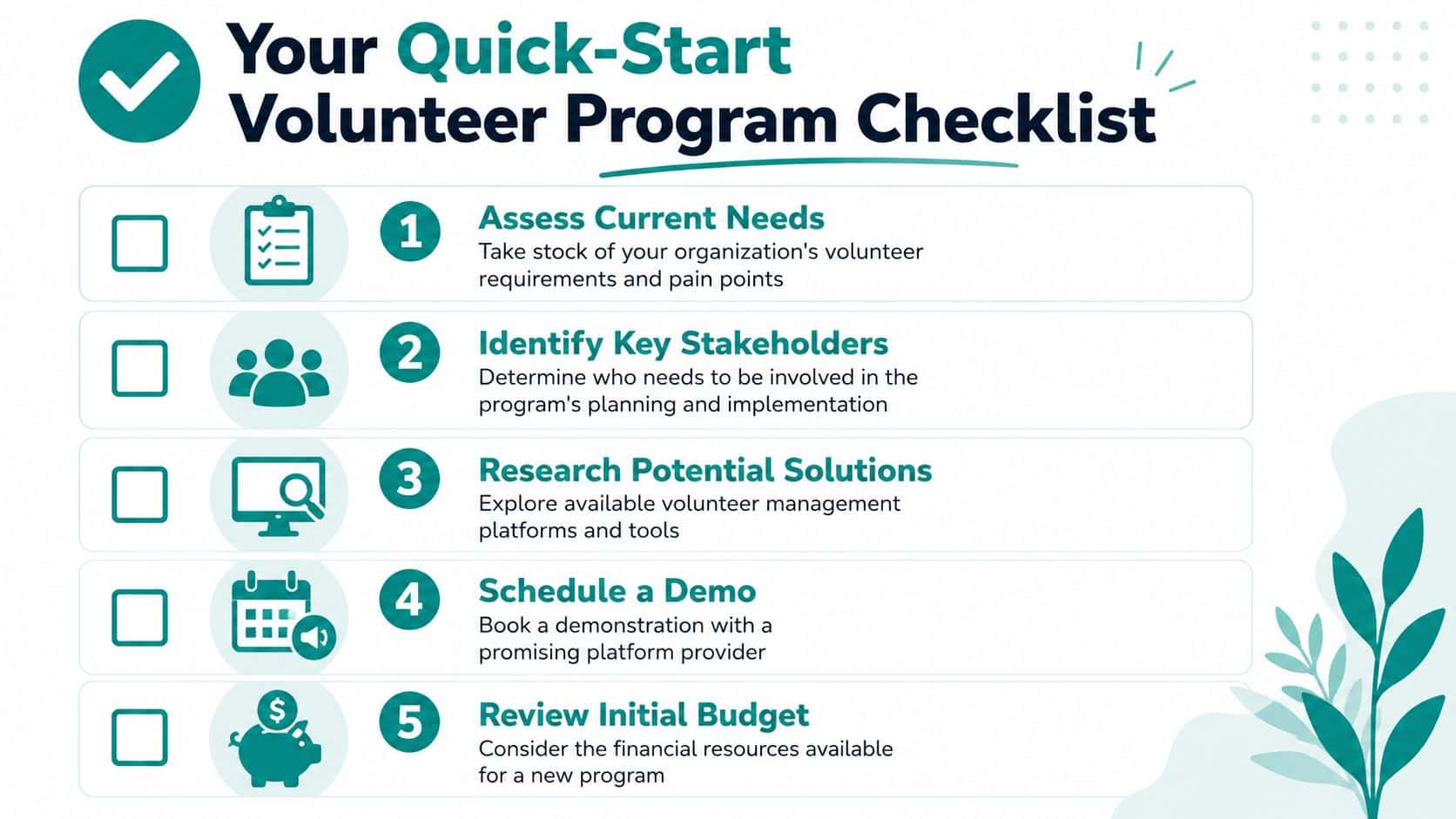
This week, do these five things:
- List your top three volunteer roles. Write them in plain language with duties, time commitment, and supervisor.
- Review your sign-up path. If a willing volunteer would feel confused, shorten the process and remove extra steps.
- Check where records live. Note whether volunteer data, donor history, and event participation are separated.
- Pick one success measure. Start with retention, filled roles, or volunteer-to-donor movement.
- Assign one owner. Even if several staff members help, one person should own follow-up.
If you're replacing paper files or trying to move out of disconnected tools, start with the basics and build from there. A practical first step is reviewing AlignMint's getting started guide so you can see what an all-in-one setup looks like, especially if your nonprofit is small and needs to keep costs down.
If you're tired of patching together accounting, donor records, volunteer tracking, events, and marketing, take a look at AlignMint. We built it as an all-in-one platform for nonprofits that want true fund accounting, connected supporter data, built-in marketing, Minty insight, online giving pages, team communication tools, and plan-based user allowances (1 on Free, up to 10 on Plus, up to 25 on Pro, and unlimited on Enterprise). If your organization raises under $100K, our free tier gives you a practical place to start without adding another budget headache.
Ready to try AlignMint with your nonprofit?
Start free — set up donor tools, giving pages, and Minty. Upgrade when you need accounting.