

It is Monday morning. Two new volunteers signed up over the weekend, three regulars canceled their shifts, and your program lead is asking who can cover a client-facing event on Thursday. In that moment, "why people volunteer" stops being a feel-good question. It becomes an operating question.
Leaders who understand volunteer motivation build stronger systems. They write roles that match what people want from the experience, train for the next step instead of the next shift, and follow up in ways that bring good people back. The result is better retention, steadier coverage, and less staff time spent scrambling.
That is the value of this topic for nonprofit leaders.
If you can translate individual reasons for volunteering into role design, communication habits, and progression paths, your program gets more predictable. It also gets more useful to the people giving their time. A strong volunteer program supports long-term mission delivery and strengthens related work like nonprofit fundraising strategies. For leaders building that system intentionally, volunteer management certification guidance can help clarify the standards, policies, and structure behind it.
1. Personal Growth and Skill Development
For many people, volunteering isn't only about helping. It's also about learning how to do something they couldn't practice anywhere else.
That matters more than many nonprofit leaders admit. If a volunteer can grow from basic tasks into higher-trust work, your program becomes more useful to them and more valuable to your organization.

A food bank volunteer might start by sorting donations, then move into schedule coordination after a few months. A church volunteer might begin with event setup, then join finance committee work once they understand donor records and reporting. A school volunteer might help draft a grant report after learning how restricted funds are tracked against program activity.
Match roles to growth, not just labor
I've seen this go well when leaders write roles around skills, not just coverage gaps. "Help at events" is vague. "Learn donor follow-up, check-in flow, and post-event reporting" gives the volunteer a reason to care.
The overlooked part is documentation. If you don't record what someone can do, you keep assigning them entry-level work long after they're ready for more. That's one reason role matching and simple records matter. We built our approach around that in this volunteer management certification guide.
Practical rule: Every volunteer role should teach one clear skill and support one real operational need.
A few practices work better than others:
- Name the skill plainly: Tell volunteers whether a role builds event operations, donor communication, finance support, writing, or leadership.
- Mark milestones publicly: Celebrate when someone moves from first-shift support into trusted responsibilities.
- Rotate with intent: Let reliable volunteers try different functions so they don't plateau too early.
- Show contribution records: A volunteer portal helps people see hours, assignments, and progress in one place.
What doesn't work is treating capable volunteers like permanent extra hands. People stay longer when they can see themselves improving.
2. Making a Direct Impact on Your Mission
A volunteer finishes a three-hour shift and asks a fair question: did that really help?
If your team cannot answer that quickly, motivation drops. The problem usually is not mission fit. It is weak translation between the work volunteers do and the result your organization delivers.

The motivation here is personal, but leaders should treat it as an operating issue. NCVO's Time Well Spent findings report that 90% of volunteers feel they make a difference through their work, with 47% saying they affect an individual's life and 44% saying they affect a specific group of people or societal issue. Those numbers tell nonprofit leaders something practical. People stay engaged when they can see the chain from task to outcome.
That chain needs to be designed.
A youth mentoring volunteer should know whether their weekly hour supports attendance, confidence, or family stability. A food pantry volunteer should understand whether faster intake means more households served, shorter wait times, or better follow-up for repeat visitors. If you want more examples of roles tied to visible outcomes, this list of community service examples for different nonprofit programs is a useful starting point.
Show mission effect in plain language
I have seen organizations lose good volunteers because the experience felt disconnected, even though the mission was strong. Staff knew the impact. Volunteers saw only isolated tasks.
The fix is usually simple, but it requires discipline. Define each role with one operational output and one mission outcome. For example, "enter donor thank-you notes within 48 hours" is the output. "Help improve donor retention that funds the tutoring program" is the outcome. That level of clarity turns a generic volunteer opportunity into a mission job people can believe in.
Fragmented systems make this harder than it should be. If volunteer records sit in one tool, donor history in another, and program spending in a spreadsheet, staff end up rebuilding the same story every month. Practical teams reduce that drag with documented workflows and clear reporting standards, which is why these volunteer management best practices matter.
When volunteers can see the result of their work, they do not need a speech to stay committed.
Connected operations matter more than polished messaging. When hours, assignments, funding activity, and program results line up, your team can send updates that answer the question volunteers are really asking: what changed because I showed up?
3. Building Community and Social Connection
A volunteer finishes a Saturday shift, does the work well, and never signs up again. In my experience, that usually is not a mission problem. It is a relationship problem.

People often start volunteering because they care about the cause. They return because they know someone, expect to be seen, and feel part of a group. For nonprofit leaders, that matters operationally. If you understand social connection as a real volunteer motivation, you can design for retention instead of treating it as luck.
As the NCVO data mentioned earlier shows, volunteering often helps people meet others and feel less isolated. That is especially relevant for retirees, new residents, younger adults, and people coming out of a major life transition. A volunteer program that feels purely transactional will lose some of those people, even if the mission is strong.
Build belonging into the program design
Community takes structure. Staff often assume connection will form on its own if people care enough about the cause. It usually does not. Connection forms when the program gives people repeated contact, recognizable groups, and simple ways to stay in touch between shifts.
Churches tend to understand this because shared routines are already part of the culture. Schools can apply the same principle by grouping parent volunteers by grade or event team. Nonprofits can do it with recurring pantry crews, mentoring cohorts, or event teams that work together more than once.
The trade-off is real. Open sign-ups can fill shifts faster, but they can also produce a revolving door if volunteers never see the same people twice. Recurring teams take more coordination, yet they usually create stronger retention and better peer accountability. That is one reason clear volunteer scheduling options for recurring shifts and team coordination matter.
A few practices work well:
- Create recognizable volunteer groups: Organize people by program, shift, or interest so they know where they fit.
- Keep communication predictable: Send regular updates with wins, needs, and volunteer spotlights so people stay connected between assignments.
- Leave room for interaction: A short pre-shift huddle, post-event debrief, or shared meal does more than another reminder email.
- Use shared experiences as the anchor: This collection of community service examples can help teams shape volunteer roles that people experience together, not alone.
I have seen programs improve retention with small changes here. A named team lead, a consistent shift roster, and five minutes for introductions can do more for volunteer loyalty than a polished recruitment page. Volunteers stay longer when they feel known by staff and by each other.
4. Flexible Schedule and Control Over Commitment
Flexibility expands your volunteer pool. It also creates management headaches if your process is loose.
Busy parents, working professionals, retirees, and caregivers often want to help, but they can't promise the same schedule every week. If you force rigid commitments, you'll lose good people who would've served well with a lighter structure.
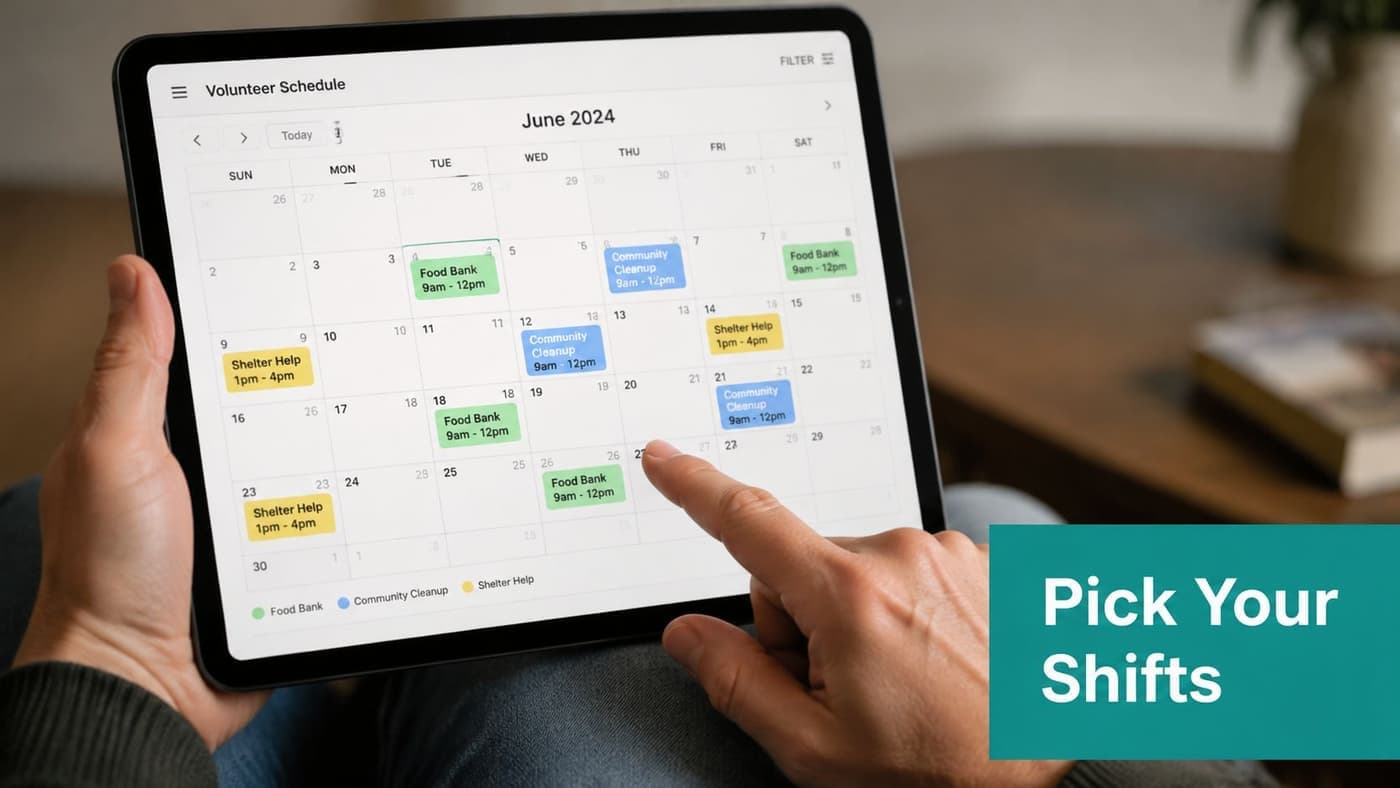
At the same time, poor organization drives people away. Idealist's volunteer experience guidance highlights that 23% of volunteers leave because their time feels wasted due to poor organization, weak training, or unclear roles. That's the trade-off. Flexibility works only when the system around it is clear.
Give choice, keep structure
A food bank can offer weekend shifts that working parents select on their own. A church can post short-notice opportunities for event support. A nonprofit can match retirees with tasks that fit irregular but substantial availability, including finance or grant support.
The key is making commitment visible before someone says yes. Our volunteer scheduling tools are designed around that basic idea. Show what the role requires, when help is needed, and whether the task is recurring or occasional.
Field note: Volunteers can handle limited availability. They won't tolerate confusion.
A few practical habits help:
- State time range up front: Tell people whether a role needs a one-time shift, a monthly commitment, or weekly coverage.
- Separate core from flexible roles: Keep mission-critical assignments stable and leave room for ad hoc support elsewhere.
- Ask, don't assume: Weekly availability requests work better than vague expectations.
- Post urgent needs clearly: Volunteers often respond well when they can see which shifts matter most.
What fails is pretending flexibility means no management. It doesn't. It means clearer management.
5. Tax Deduction and Charitable Contribution Recognition
A volunteer submits mileage in December, donates during your year-end campaign, and asks for a receipt in January. If those records sit in three different places, staff waste time piecing together a history they should already have.
This motivation is less about "getting a tax break" and more about trust. People want to know your organization handles expenses, acknowledgments, and contribution records correctly. For nonprofit leaders, that is a program design issue, not just an accounting task.
Track service, expenses, and giving in one record
The overlap is common. Many volunteers also give financially, buy supplies, cover mileage, or make event-related purchases during the year. If your volunteer system and donor records do not connect, recognition gets fragmented and finance questions land on staff who do not have the full picture.
That creates avoidable friction for everyone.
A church volunteer may serve weekly and also fund a classroom need. A school volunteer may pay for approved materials and expect clear instructions on whether reimbursement is available. A board member may contribute time, sponsorship money, and out-of-pocket event costs in the same quarter. Each case calls for one clean record and one clear process.
For compliance questions, it helps to review your nonprofit tax filing requirements before year-end, especially if finance and volunteer management sit on different teams.
A few practices make this easier:
- Explain expense policy at onboarding: Tell volunteers what the organization reimburses, what it does not, and what documentation is needed.
- Use simple submission forms: If mileage or supply logs take ten minutes to complete, people will skip them.
- Send acknowledgments on a schedule: Year-end summary requests should not trigger a scramble through inboxes and spreadsheets.
- Connect giving and service history: Staff can thank people accurately when they can see the full relationship in one place.
Poor records create two problems at once. Volunteers feel unseen, and staff lose hours fixing preventable mistakes.
6. Resume Building and Career Advancement
A well-run volunteer program can be a proving ground. That's especially true for younger adults, career changers, and people returning to work.
This motivation is stronger than many organizations admit. Verve AI's volunteer interview guidance notes that 60% of volunteers prioritize opportunities that offer specific skill transfer or professional development aligned with career goals. If your roles don't teach anything visible, you're leaving talent on the table.
Give ambitious volunteers real responsibility
This doesn't mean handing sensitive responsibilities to untested people. It means creating a path.
A nonprofit can let a volunteer support fund accounting preparation, then move into reporting support once accuracy is proven. A marketing volunteer can build a portfolio through email campaigns and event promotion. A grant writing volunteer can learn how program activity and restricted support connect in real reporting.
The volunteers most likely to grow into staff, board, or long-term champions usually ask one question early. Will this experience count for something?
That question deserves a real answer. In practical terms, that means documenting assignments, outcomes, and skill progression. It also means naming the skill clearly. "Volunteer coordinator support" is weaker than "managed shift communication and attendance records for recurring service days."
A few steps help:
- Define progression: Create beginner, intermediate, and advanced versions of key volunteer roles.
- Record achievements: Keep notes that support reference letters and future recommendations.
- Offer references selectively: Strong volunteers value a concrete endorsement more than generic praise.
- Connect service to governance: Some volunteers can grow into committee, advisory, or board service over time.
What fails is keeping everyone in low-trust tasks forever. Capable people leave when they can't see a path forward.
7. Values Alignment and Personal Fulfillment
Values alignment keeps volunteers engaged when the work isn't glamorous. That's the difference between someone who helps once and someone who keeps showing up.
People volunteer because they care about housing, hunger, education, faith, neighborhood stability, or dignity for a specific group of people. Your job is to keep that connection visible, especially when the work is routine.
Tie daily work to deeper purpose
If your organization runs on grants or restricted gifts, this matters even more. Volunteers should understand not just what they did, but which mission area it supported and why that support matters.
Fund accounting plays a quiet but important role here. In the United States, nonprofits need accounting that separates net assets into "without donor restrictions" and "with donor restrictions" under FASB ASC Topic 958 requirements explained here. If you can't track restricted support cleanly, you can't tell a credible story about how mission-specific resources were used.
That isn't abstract finance work. A school volunteer helping with a literacy initiative wants to know their service lines up with the program's purpose. A church volunteer wants to see ministry support tied to actual outreach. A social services volunteer wants confidence that their effort isn't disappearing into general overhead without explanation.
At AlignMint, this is one reason we insist on true fund accounting instead of QuickBooks classes. The benefit comes first. You get a clearer mission story. Then the feature matters. You can track funds, programs, grants, donors, and volunteers in one place and communicate from that shared record.
- Lead with mission language: Start updates with the cause, not the calendar.
- Share program outcomes regularly: Even a short monthly summary keeps values and work connected.
- Ask what drew them in: Their answers shape better messaging and better role placement.
- Use one narrative across teams: Finance, development, and volunteer staff should tell the same story.
What doesn't work is assuming shared values are obvious. They need to be reinforced.
8. Networking Opportunities and Professional Connections
Volunteering often creates the kind of network people want. It's purpose-driven, lower pressure, and built around shared work.
That makes it valuable for professionals, retirees, board prospects, and people entering a new community. A volunteer dinner can connect people across sectors in a way a business mixer rarely does.
Curate the room, not just the task list
A fiscal sponsor can convene volunteers from multiple sponsored projects and create useful cross-project relationships. A church can pair retirees with younger professionals for mentoring. A nonprofit can host quarterly gatherings where volunteers meet staff, committee members, and donors in the same room.
This social dimension also affects well-being. A Bloomerang roundup of volunteer statistics cites a meta-analysis showing an 11.11% increase in social well-being among participants. For leaders, the operational takeaway is simple. Volunteer programs aren't only labor systems. They're relationship systems.
That matters when you choose tools. Better team communication, event coordination, and group records make it easier to host gatherings that deepen ties. It also matters when comparing software categories. Tools like SignUpGenius and VolunteerHub do some scheduling jobs well. Bloomerang is strong in donor management. QuickBooks handles general accounting for many organizations. What they don't always provide is one shared operating record across volunteers, donors, funds, events, marketing, and team communication.
We built AlignMint for that all-in-one reality. Clear user access by plan also matters here, because networking and volunteer coordination usually involve more people than the finance office alone.
- Feature volunteer backgrounds: Let people know who brings legal, teaching, finance, or operations experience.
- Host non-service gatherings: Connection deepens when people can talk without packing boxes at the same time.
- Create subgroups: Shared interests often lead to stronger retention than broad mailing lists.
- Follow up after events: Introductions fade fast if no one continues the conversation.
Why Volunteer: 8-Point Comparison
| Title | Implementation complexity | Resource requirements | Expected outcomes | Ideal use cases | Key advantages |
|---|---|---|---|---|---|
| Personal Growth and Skill Development | Medium, role documentation, skill-tracking setup | Training time, role docs, volunteer portal | Improved competencies, higher retention, deeper engagement | Long-term placements, skill-based roles (finance, events) | Builds capable volunteer base, faster onboarding |
| Making a Direct Impact on Your Mission | High, integrates accounting, outcomes, dashboards | Data consolidation, program metric definitions, reporting tools | Visible program impact, increased volunteer motivation and retention | Programs with measurable outcomes, fundraising-linked activities | Real-time impact visibility, stronger storytelling |
| Building Community and Social Connection | Low–Medium, group management and comms setup | Staff time for culture building, event coordination, comms tools | Stronger social bonds, peer recruitment, accountability | Recurring group activities, volunteer-heavy programs | Organic recruitment, improved retention, leadership pipeline |
| Flexible Schedule and Control Over Commitment | Medium, availability and shift scheduling systems | Scheduling software, shift templates, ongoing monitoring | Higher participation flexibility, fewer no-shows, reduced admin | Episodic events, volunteers with irregular schedules | Attracts busy volunteers, self-service scheduling reduces staff time |
| Tax Deduction and Charitable Contribution Recognition | Medium, CRM integration and reporting workflows | Accurate hours/expense tracking, year-end reporting processes | Clear tax documentation, better donor-volunteer records | Volunteers incurring expenses or making donations | Compliance-ready receipts, improved donor relations |
| Resume Building and Career Advancement | Medium, achievement tracking and role design | Detailed role progression, mentoring, reporting features | Attracts career-minded volunteers, verifiable experience, leadership growth | Young professionals, career changers, workforce re-entry | Draws ambitious volunteers, supports professional development |
| Values Alignment and Personal Fulfillment | Low–Medium, impact storytelling and dashboards | Consistent messaging, program outcome tracking, marketing tools | Deep, durable motivation, ambassador volunteers, lower burnout | Mission-driven organizations, faith-based or social-justice groups | Deep engagement, long-term retention, authentic advocacy |
| Networking Opportunities and Professional Connections | Low–Medium, events and profile-sharing features | Event coordination, group facilitation, curated introductions | New professional contacts, peer recruitment, cross-sector ties | Professionals seeking networks, multi-org collaborations | Builds professional networks, boosts recruitment, strengthens community |
Turn Volunteer Motivation Into Mission Momentum
A volunteer signs up because your mission matters to them. They stay because your program is organized enough to make their time feel useful. For nonprofit leaders, that is a significant realization. Personal motivation has to be translated into role design, communication habits, reporting, and financial controls that hold up under pressure.
The operational test is simple. Can your team tell the difference between a volunteer who wants career experience, one who wants community, and one who wants a flexible way to help, then place each person in a role that fits? If not, recruiting gets expensive in staff time, retention drops, and the same scheduling problems keep landing on the same employees.
That is why volunteer management is not a side process. It sits inside program operations. If volunteers support funded work, finance and program staff need shared structure behind the scenes. Proper fund accounting supports the Statement of Functional Expenses required for Form 990 filers, with costs categorized across program, administrative, and fundraising activity, as explained in this guide to nonprofit fund accounting basics. Teams also need monthly fund-level reporting, including a Statement of Financial Position and Statement of Activities by fund, to track restricted and unrestricted revenue and stay aligned with grant requirements, as outlined by Charity Charge's fund accounting overview.
The same discipline applies when restricted funds are spent. Those amounts need to be released from restriction with the right accounting entry, as described in this fund accounting guide from Impactra. When that process is messy, the problem is not limited to accounting. Your impact reporting gets harder to trust, managers spend more time reconciling records, and board conversations drift into guesswork.
I have seen this trade-off firsthand. Teams can keep volunteer data in one tool, donations in another, event attendance in a spreadsheet, and finance somewhere else. That setup can work for a while. Then a grant report is due, a major donor asks how volunteer activity connects to outcomes, and staff lose a week pulling numbers that should have matched from the start.
A connected system helps because it ties hours, giving, communication, events, and accounting to the same operating record. Staff can follow up faster, supervisors can see who is engaged, and leadership can compare effort to mission results without stitching together reports by hand.
At AlignMint, we built around that reality. The free tier for nonprofits under $100K, unlimited users, built-in marketing tools, and Minty are practical choices for small teams that need fewer disconnected systems, not more features to manage.
If your organization is trying to connect accounting, donor records, volunteers, events, marketing, and team communication in one place, review AlignMint.
Ready to try AlignMint with your nonprofit?
Start free — set up donor tools, giving pages, and Minty. Upgrade when you need accounting.