

The grant report is due, volunteers need an event schedule, and a donor campaign is waiting for your approval. Meanwhile, the same staff members are expected to keep regular programs running. A small portfolio routine can help you choose what moves now, protect restricted funds, and give your team a clearer week.
Quick Answer: Managing Several Projects
Managing several nonprofit projects means choosing what fits the people, funds, and calendar you already have. Record each request, name an owner, and defer work that would break a grant or program commitment.
Start with workspace tools and nonprofit program management. For capacity, see nonprofit operations management.
Why Juggling Projects Feels So Hard in Small Nonprofits
A crowded week rarely looks like a single crisis. It looks like a handful of worthy commitments arriving at once. Your finance lead is closing the books and preparing a grant report; your development director is shaping a donor appeal; a program manager is coordinating volunteers for an event. Each project has a real purpose, but they may depend on the same people, money, and calendar.
A task list can show what needs doing without showing whether the work fits together. It may not tell you that a volunteer event depends on a program decision, or that a new campaign would draw staff away from a grant deliverable. When every request is treated as urgent, the team has no reliable way to decide what should wait.
The portfolio question: Which combination of projects can your organization responsibly carry with the people, funds, and time available?
That question matters even in organizations with established project-management practices. PMI's 2024 global research reported an average project performance rate of 73.8%, meaning roughly one in four projects didn't fully meet its intended performance expectations (PMI's 2024 project performance research). The same research found only marginal performance differences among predictive, agile, and hybrid delivery approaches. Choosing a project method alone won't resolve conflicts over capacity or competing priorities.
Replace firefighting with portfolio choices
Portfolio thinking means looking at all active work together, then making trade-offs in view of mission goals. You consider each project's intended outcome, urgency, resource demands, and dependencies before deciding what proceeds. That makes it easier to defer a lower-value initiative rather than overloading staff.
For example, a new fundraising event may support an important program, but its launch could collide with a restricted grant deadline. The right response may be to move the event, narrow its scope, or assign a different owner. The point isn't to treat mission work as a competition. It's to protect the commitments your organization has already made.
Make the current portfolio visible to the people who need to act on it. A clear view of project owners, deadlines, resource needs, and risks gives you a grounded way to discuss conflicts with staff, board members, and funders. If volunteer coordination is one source of pressure, AlignMint's volunteer operations health check can help you assess the processes behind that work.
Bring Order With Simple Intake and Prioritization
When a new request arrives, don't commit on the spot. First record what the work is meant to accomplish and what it will require. A consistent front door helps you compare a grant-funded program change with a new event or an operational improvement, rather than favoring the request that arrived most recently.
PMI's comparative research reported that organizations undervaluing project management as a strategic capability experienced an average of 67% more outright project failures (PMI's comparative project outcomes). The practical lesson isn't to add layers of approval. It's to make basic planning and trade-offs visible before a project starts.
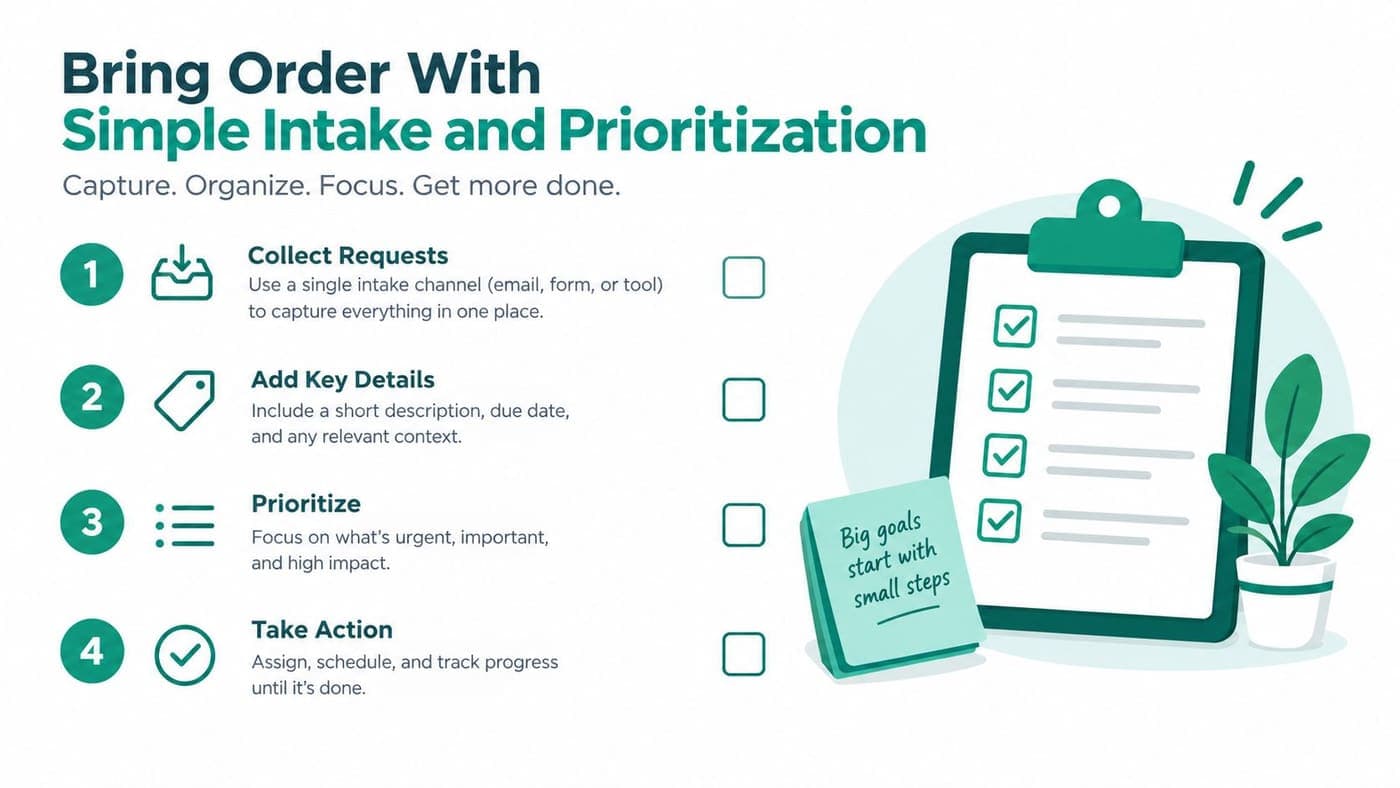
Give every request the same first review
Use a short intake form. Keep it to the information you need to make a decision:
- Outcome: What mission, compliance, fundraising, or operating result should this project produce?
- Deadline and obligation: Is the date tied to a grant, donor commitment, season, or internal preference?
- Funding fit: Are funds restricted to this work, and do the proposed costs fit those restrictions?
- People and time: Who would own the work, and which staff or volunteers would contribute?
- Dependencies and risks: What must happen first, and what could block delivery?
- Decision needed: Should the organization approve, defer, reshape, or decline the request?
Then review new requests against the same criteria: mission value, urgency, funding fit, resource demand, and dependency risk. A mandatory grant deliverable may need to proceed before a discretionary campaign, but only if the right people and eligible funds are available. If either is missing, change the scope or timeline before promising delivery.
Make the review a routine
Bring the active project list and new requests to one regular portfolio review. For each item, decide whether to start, continue, pause, or reshape it, and record who owns the decision. A one-page project workspace intake guide can help your team standardize what it submits for review.
When board members or funders propose additions, explain the trade-off plainly: “We can take this on if we move the other deadline or reduce its scope.” A practical operational plan template can help you turn approved priorities into owners, timelines, and expected outcomes. Intake works when it gives you a reasoned choice, not another form to file.
Assign People Budgets and Time Without Overload
Approval doesn't create capacity. Before you launch a project, check whether the people, budget, and funds are available. A promising initiative can become a hidden conflict when one employee may already support several programs, while a grant balance may be committed to a specific purpose.
Start with an honest picture of staff and volunteer availability. Name one accountable owner for each project, then list the people whose work it depends on. A person's calendar should reflect their actual responsibilities, not just the newest assignment. If the same finance lead is closing monthly accounts, tracking grant spending, and preparing event payments, your plan needs to show that collision.
Match each project to people and funds
Use a capacity-and-funding check before confirming dates. The table doesn't need to predict every hour perfectly. It should help you spot double booking, restricted-fund questions, and decisions that need leadership attention.
| Project | Owner | Staff Hours | Fund Type | Decision |
|---|---|---|---|---|
| Grant reporting | Finance lead | Estimate needed | Restricted grant | Protect deadline |
| Community event | Program manager | Estimate needed | Event or unrestricted funds | Confirm capacity |
| Donor campaign | Development lead | Estimate needed | Unrestricted funds | Sequence after review |
Replace the estimates with your team's best planning view, then revisit them when scope or deadlines change. Don't assign the same staff time to multiple projects as if each project were the only priority. If two commitments need one person at once, decide which date or deliverable will change.
Funding needs the same discipline. Restricted grants, donor-designated gifts, and endowment assets aren't interchangeable with general operating funds. A fund-accounting system should retain program, grant, and restriction details with each transaction, so your team can see the intended use before spending. Form 990 reporting makes this more than an internal preference: the IRS requires organizations filing Form 990 to separate expenses into total, program-service, management-and-general, and fundraising categories. Section 501(c)(3) and 501(c)(4) organizations must complete all functional-expense columns, while other organizations generally complete only the total-expense column (IRS Form 990).
Sequence the work and preserve the record
Break large commitments into manageable releases. A church might schedule a giving campaign after confirming the staff who handle services and donor records. A school might coordinate an event with grant reporting and program calendars before inviting volunteers. A fiscal sponsor may need to distinguish sponsored-project obligations from the sponsor's own operating work.
Use true fund accounting, rather than relying on QuickBooks classes alone, when you need restricted funds, grants, and programs represented as financial dimensions. AlignMint's annual budget-planning guide can help connect approved project work with budget planning. Keep donor restrictions visible as money moves through your books. Form 990 asks whether an organization holds assets in donor-restricted endowments or quasi-endowments and directs organizations answering yes to complete Schedule D, Part V (Form 990 with field names).
When an interruption or new request threatens the plan, assess its risk, reversibility, deadline, external obligation, and downstream impact. A compliance concern may call for immediate escalation; a routine event change may wait for the next review. That distinction protects focus without asking staff to ignore genuine obligations.
Track Progress With Dashboards That Flag Issues Early
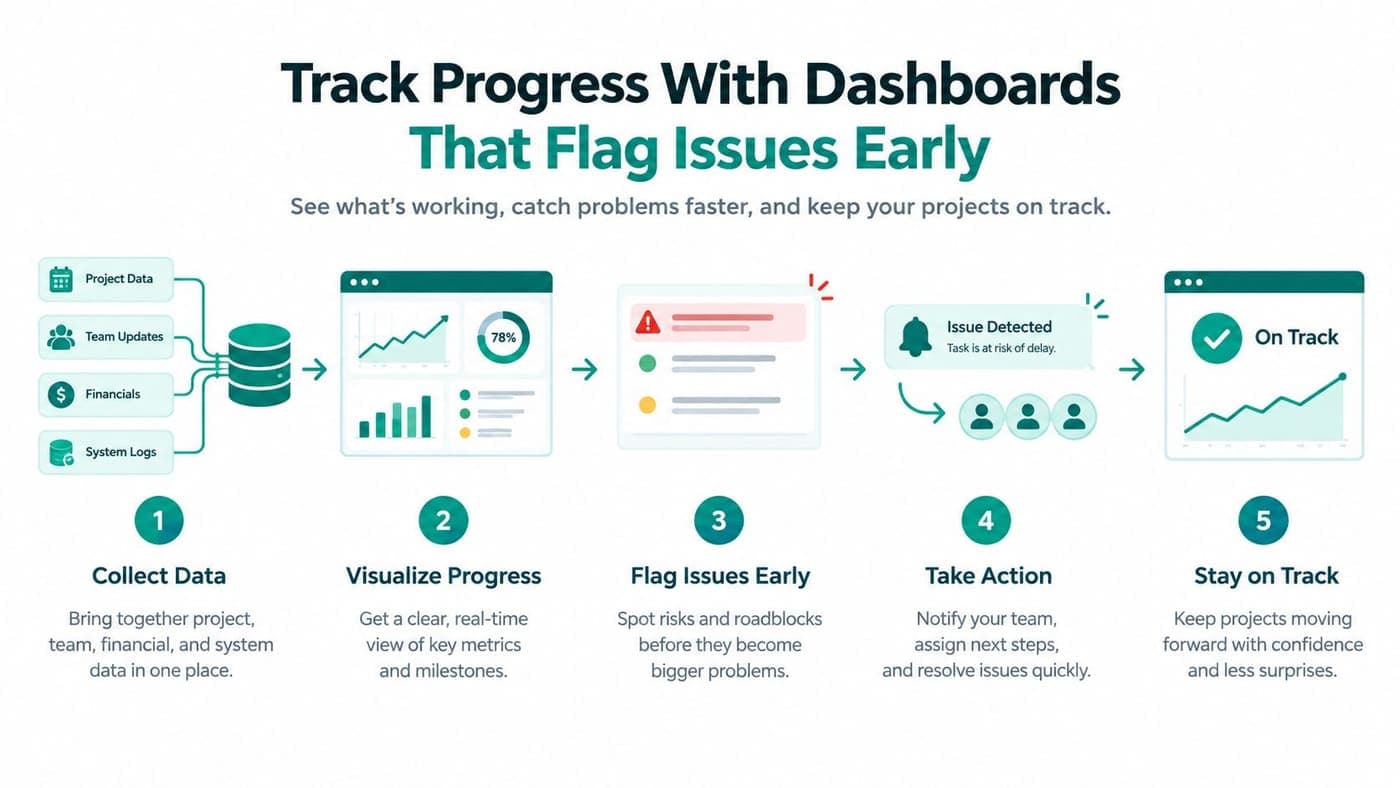
Progress tracking should make decisions easier, not give staff another report to maintain. A useful dashboard shows what's blocked, what needs a decision, and whether the expected outcome remains worth the time and money. It shouldn't reward activity volume while hiding missed commitments.
A simple review can look across schedule, budget, scope, risks, dependencies, and expected benefits. Keep a weekly exception discussion focused on work that needs help or a decision. Then review benefits and overall fit at portfolio level each month, so you can pause or redesign work that no longer merits scarce capacity.
Track outcomes, not busyness
Choose a small set of measures you can compare across projects: business goals met, schedule adherence, budget adherence, benefits realized, and failure rate. Record a baseline for each project, then look at the portfolio as a whole. For a nonprofit, outcomes might include a grant deliverable submitted, a program milestone reached, a donor commitment fulfilled, or a required report completed.
PMI's 2025 research reported that professionals with high business acumen had projects meeting business goals at 83% versus 78%, schedule adherence of 63% versus 59%, budget adherence of 73% versus 68%, and failure rates of 8% versus 11% (PMI's 2025 project performance research). These comparisons support a practical management point: leaders need to understand organizational goals and trade-offs, not just watch tasks move through a tracker.
For guidance on choosing measures and presenting them clearly, ELECTE's metrics and dashboards guide offers a useful reference. Keep your own dashboard focused on information that prompts action. A long list of numbers without an owner or decision attached won't help a busy executive director.
Use the dashboard to surface exceptions
Review the items that need attention, not every completed task. Ask whether a project is blocked by another initiative, whether a grant deadline is at risk, and whether a change in scope affects the budget or promised benefits. Record the decision and owner so the team knows what happens next.
A shared dashboard can bring project and financial signals into one view, replacing scattered spreadsheets when the data is connected. AlignMint's dashboard customization guide describes ways to shape a dashboard around the information your team needs. Minty AI can answer questions about your real data, which may help you find information without building another report. Treat any answer as a prompt to verify the underlying records, especially before making a funding or compliance decision.
Keep Volunteers Donors and Staff Informed With Less Effort
A clear project update does more than keep staff on the same page. It helps donors understand what their gifts supported and gives volunteers a reason to stay connected. When project communication, financial records, and follow-up are separated, someone has to reconcile the story manually.

Set a modest update rhythm and assign responsibility. Project owners can share progress and blockers with staff; finance can confirm spending and fund balances; development can use approved information for donor updates. The update doesn't need to become a meeting if the team has a clear shared place to record it.
Keep each audience's information useful
Donors need accurate, fund-aware reporting. If a gift supports a particular program or purpose, make sure the underlying records preserve that designation before communicating how funds were used. Fund accounting and donor management connected to the same operating record can reduce the gap between financial activity and donor communication.
Volunteers need clear instructions and follow-up. Log hours, skills, availability, and participation in a consistent place, then check who needs a thank-you or next opportunity. A national Urban Institute study found that the median charity retained 80 percent of its volunteers from one year to the next; nearly 3 percent retained none, while 17 percent retained all of them (Urban Institute research on volunteer management and retention). The figures make a useful case for treating volunteer records and follow-up as ongoing work, rather than relying only on event sign-up sheets.
Staff need to know who owns a decision and where to raise a blocker. A team communication space tied to projects can keep messages, schedules, files, and meetings close to the work. AlignMint's team workspace messenger guide describes this kind of shared project communication.
Connect updates to the systems you already use
Separate tools can each do their job well. QuickBooks, for example, is familiar to many organizations for bookkeeping, while dedicated donor CRMs can support fundraising records. The practical gap arises when finance, donor records, volunteer details, events, and marketing sit in separate places and your team has to match them by hand.
An all-in-one platform brings accounting, CRM, volunteers, events, and marketing into one operating record. AlignMint offers that combination, including a built-in marketing suite and online giving pages; it also has plan-based access without per-seat fees. You don't need to replace tools because they're separate. First identify where duplicate entry or mismatched records are costing your team time, then decide whether a connected system would address that specific problem.
Your Simple System and Next Calm Step Forward
Managing multiple projects gets calmer when you make a few decisions visible and repeat them consistently. You don't need a complex method or a new meeting for every initiative. You need a shared view of commitments, clear owners, honest capacity, and a way to revisit priorities when circumstances change.
Use this checklist to establish a workable routine:
- Record the portfolio: List each active project, its outcome, owner, deadline, dependencies, and resource needs.
- Review incoming work: Approve, defer, reshape, or decline requests based on mission value, urgency, funding fit, and capacity.
- Protect people and funds: Check for double booking and confirm restricted money supports eligible work.
- Review exceptions: Surface blocked work, deadline risks, scope changes, and decisions that need leadership attention.
- Check benefits: Reassess whether active work still serves your mission and deserves limited capacity.
Start with the projects already on your team's calendar. Ask each owner to confirm the outcome, next deadline, people involved, and any funding restriction. Then identify one conflict you can resolve by changing a date, narrowing scope, or assigning an accountable owner.
Avoid two common traps: treating every interruption as equally urgent and allowing project scope to expand without an explicit trade-off. Write down how staff should escalate compliance risks, donor restrictions, and deadline changes. For discretionary requests, decide what work will pause or shrink before accepting the addition.
AlignMint includes fund accounting, donor and volunteer management, events, marketing, and team communication in one platform. Nonprofits under $100K can use its free tier, and plan-based access means you don't pay per seat as more staff and volunteers need access.
If scattered records make project decisions harder, visit AlignMint to see how fund accounting, donor and volunteer management, and team communication can support one shared view of your work. Start by comparing that setup with the systems your team uses today, then decide whether it would give you clearer balances and more time for mission work.
Ready to try AlignMint with your nonprofit?
Start free — set up donor tools, giving pages, and Minty. Upgrade when you need accounting.