

Nonprofit Program Management: A Practical Guide
You arrive Tuesday morning with three grants due Friday, a Saturday volunteer gap, a donor asking about a restricted gift, and a board packet due next week. The answers sit in spreadsheets, email threads, accounting software, and your memory, so every report becomes a reconstruction project.
Nonprofit program management should give you one connected view of planning, funding, people, delivery, outcomes, and reporting. This guide shows how to build that operating system, whether you keep your current tools or move toward an integrated platform.
Quick Answer: Nonprofit Program Management
Nonprofit program management connects planning, funding, people, delivery, outcomes, and reporting so board, funder, and donor questions use the same numbers. If you need exports from four systems before answering a board question, the operating model is carrying extra risk.
Connect programs to nonprofit operations management and fund accounting. For people and hours, see volunteer management.
The Tuesday Night Reality of Running Nonprofit Programs
By Tuesday afternoon, your program team has already made decisions that finance hasn't seen. A volunteer changed shifts, a grant-funded activity moved locations, and a staff member paid an invoice using the wrong program code. None of those events feels catastrophic alone, but each creates another reconciliation task before the week ends.
You may also be answering several versions of the same question. A board member wants to know whether the program is on budget, a funder wants documented outcomes, and a donor wants confirmation that their restricted contribution supports the intended work. If each answer requires a different report, your team isn't managing one program. It's managing several disconnected records of the same program.
Practical rule: If you need exports from accounting, fundraising, volunteer, and event systems before answering a board question, your operating model is carrying unnecessary risk.
The cost isn't limited to wasted time. Disconnected records make it harder to spot an unfilled shift, match spending to a grant, explain volunteer capacity, or see whether activity levels support the outcomes you promised. They also make staff the unofficial integration layer, which means the process weakens whenever someone takes leave or leaves the organization.
A useful definition of nonprofit program management starts with that reality. It's the connected practice of designing, funding, staffing, delivering, measuring, and reporting on services that fulfill your mission.
That definition changes how you set up work. A program record should connect its goals to a budget, its budget to funds and restrictions, its activities to staff and volunteers, and its results to reports. Your volunteer management best practices should therefore sit beside financial and outcome workflows, not in a separate administrative corner.
The rest of this guide focuses on practical connections. You'll see how to define the system, choose useful indicators, protect restricted funds, evaluate back-office spending, and assess software without accepting a polished demo as proof of fit.
What Nonprofit Program Management Actually Means
A program isn't a calendar of activities. It's a promise your organization makes, supported by resources, people, processes, evidence, and accountability.
Think of a small restaurant kitchen. The meals are your programs. Fund accounting is the pantry inventory, showing which ingredients belong to which customer order. Staff and volunteers are the line cooks. Evaluation is the tasting process, and reports are what donors, funders, and the health inspector see.
When those parts share accurate information, the kitchen serves the right meal on time. When they live in separate binders, someone may use the wrong ingredient, miss an order, or discover a problem only during inspection.
A program is a connected record
Start with the service you deliver. Define who it serves, what it intends to change, which activities support that change, and what resources those activities require.
Then attach the practical records:
- Funding: Identify each grant, contribution, or earned-revenue source supporting the work.
- People: Track staff assignments, volunteer roles, skills, schedules, and hours.
- Activity: Record events, appointments, attendance, services, and deliverables.
- Evidence: Capture process measures and outcomes close to the point of service.
- Accountability: Preserve approvals, restrictions, agreements, and reporting history.
This is why a project tracker bolted onto QuickBooks often falls short. QuickBooks may feel familiar, and its classes can help organize information, but classes aren't the same as true fund accounting with donor restrictions modeled natively. A program management system needs to understand the relationship between the program, the fund, the people delivering it, and the evidence supporting it.
Your nonprofit operations management practices should reinforce those relationships. If they don't, staff will keep translating between systems manually, and the executive director will keep translating the results for everyone else.
The Core Components That Must Work Together
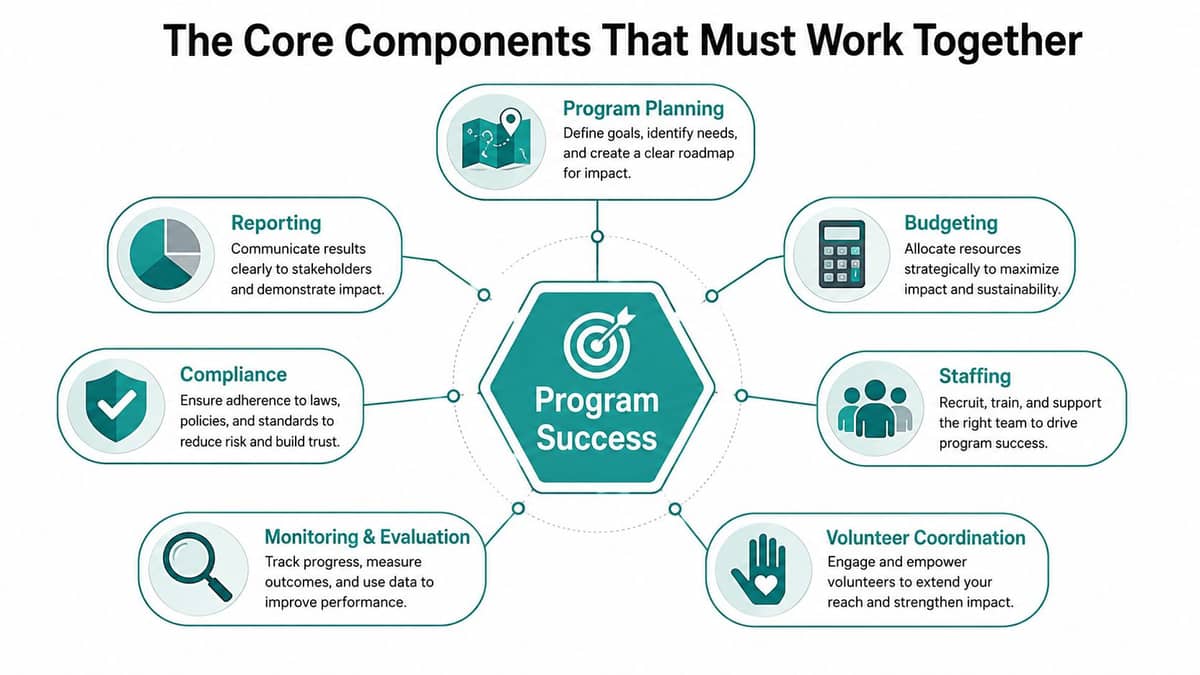
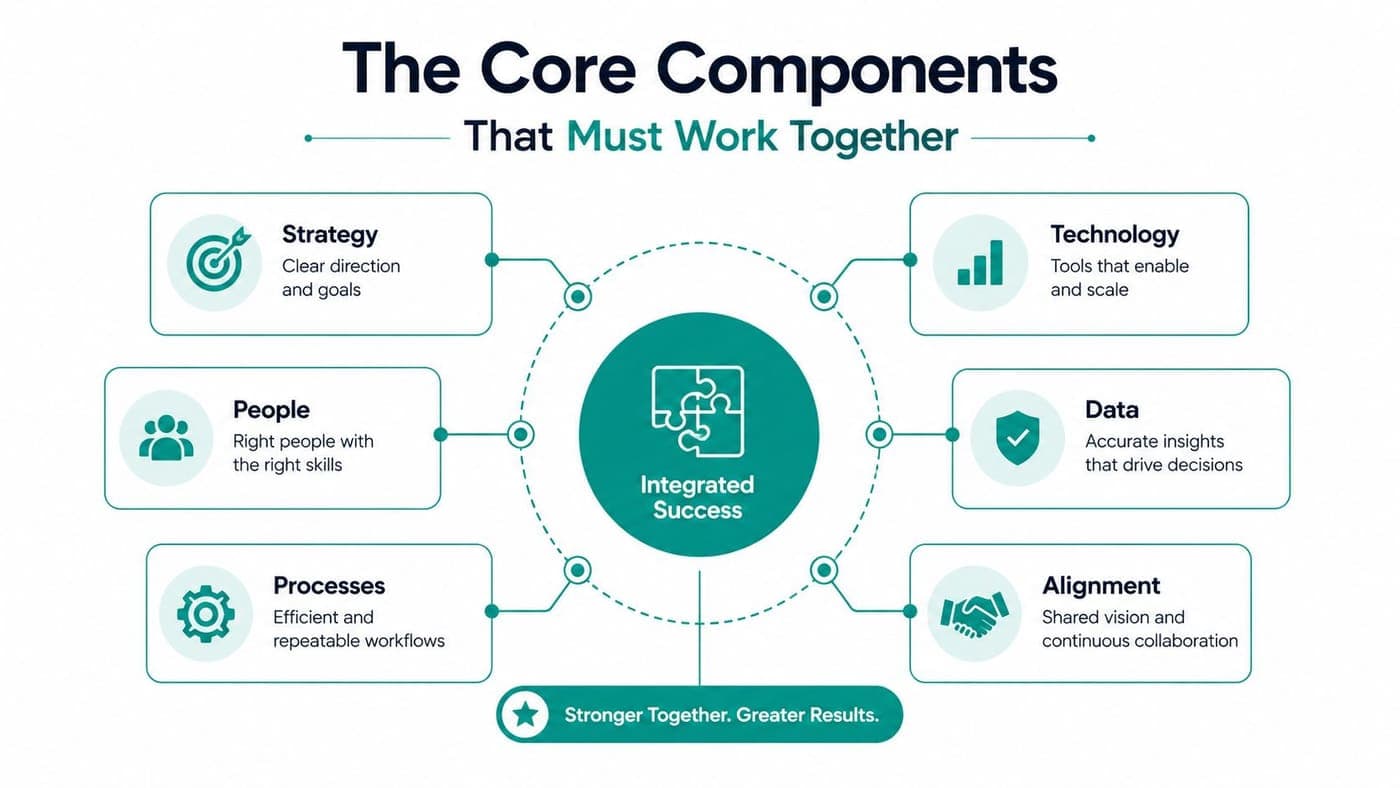
Seven components form the working loop of nonprofit program management. They aren't seven departments competing for attention. Each one creates information another component needs.
Start with purpose and resources
Program planning defines the need, population served, activities, intended outcomes, assumptions, and risks. A logic model gives your team a shared explanation of how daily work should produce meaningful change.
Budgeting translates that design into resources. Assign revenue and expenses to the correct program and fund, then identify which costs are restricted, unrestricted, shared, or supported by in-kind contributions.
Staffing places responsibility where work happens. Every major activity needs a person who owns delivery, a person who can approve decisions, or a clear escalation path when the plan changes.
Volunteer coordination adds another layer of capacity. Volunteer hours, skills, attendance, and assignments affect how much service your program can deliver. In the United States, people contributed roughly 6.9 billion volunteer hours in 2021, and about 24% of Americans volunteered through an organization that year, according to Independent Sector reporting.
For programs that depend on community participation, event materials can support recognition and consistency. Organizations planning a fundraiser or volunteer gathering may find promotional products for nonprofit events useful when selecting practical items for participants.
Close the loop with evidence and accountability
Monitoring and evaluation show whether delivery matches the plan and whether the work produces the intended result. Pew's guidance connects effective evaluation to evaluation skills, staffing and technology for data collection, and a culture of learning in its nonprofit evaluation research.
Compliance protects the conditions attached to funding. Restricted funds must support their stated purpose or time period, while unrestricted funds can support general operations. Nonprofit accounting guidance also notes that Form 990 reporting includes funds without donor restrictions on Part X, line 27, regardless of board designations.
Reporting turns the operating record into a usable explanation for the board, donors, funders, and leadership. The strongest report isn't assembled from memory. It draws from the same program, fund, people, and outcome records your team uses every day.
KPIs and Data Workflows That Actually Fit Small Teams
Your team doesn't need a larger dashboard. It needs a smaller set of measures that someone can collect, review, and act on without creating another administrative burden.
Staff time is the central design constraint. The 2025 NTEN Data Empowerment Report found that over 79% of respondents cited staff time as a barrier to collecting and using data, with other barriers including understanding data value, data-entry and governance processes, and existing tools and software. The report also identifies in-house technology staffing as the biggest challenge for data use, with funding as the second biggest challenge. Read the NTEN Data Empowerment Report before adding another complicated reporting process.
Choose measures that answer decisions
Use a limited set of indicators for each program:
- Outputs: Count services delivered, participants served, sessions held, or applications completed.
- Outcomes: Track the change your program intends to support, using a consistent method.
- Cost per beneficiary: Compare program spending with the number of people served.
- Volunteer hours: Connect contributed time to the specific program and activity.
- Fund burn rate: Compare restricted and unrestricted spending with the approved budget.
- Grant drawdown pace: Monitor eligible spending and reimbursement timing against grant requirements.
The right KPI is one that changes a decision. If nobody knows what action follows a number, remove the number.
| KPI | What It Measures | Data Source | Feeds Which Report |
|---|---|---|---|
| Output count | Delivery volume | Program activity record | Board and funder report |
| Outcome indicator | Progress toward intended change | Survey or assessment record | Evaluation summary |
| Cost per beneficiary | Resource use relative to reach | Fund accounting and participant records | Budget review |
| Volunteer hours | Contributed capacity | Volunteer log | Program and in-kind report |
| Restricted fund burn rate | Spending against donor intent | Fund ledger | Grant and finance report |
| Grant drawdown pace | Reimbursement readiness | Grant and expense records | Grant submission |
Run one monthly review
Collect information at the point of service. Code transactions to the program and fund when someone approves them. Reconcile restricted balances monthly, then review the results with leadership before preparing board or funder reports.
Assign one named owner for the review. That person doesn't need to enter every record, but they must know which data is missing, which measure changed, and what decision requires attention.
For teams refining their reporting process, better business reporting strategies can offer useful perspective on turning raw records into decisions. AlignMint's metrics and trends documentation can also help teams think through how recurring indicators should be organized.
A Day in the Life of a Connected Program
Maple Grove Youth Services runs an after-school mentoring program. The organization has a restricted city grant, ten volunteer mentors, in-kind donations, and quarterly outcome surveys. Its director used to keep volunteer schedules in a spreadsheet, invoices in accounting software, and survey results in a shared folder.
On Monday, the program director assigns mentors to students and records availability. Each mentor logs service hours against the youth program, so the organization can see who served, when they served, and which activities received volunteer support.
On Tuesday, the bookkeeper approves an invoice for snacks. The transaction is coded to the youth program and the restricted city grant at approval, rather than being repaired during month-end close. The grant record retains the agreement and spending conditions, so the bookkeeper doesn't need to search old email before deciding whether the expense qualifies.
The same record supports different questions
On Wednesday, the director reviews attendance and session activity. The executive director checks spending against the grant budget and sees whether the program is using volunteer capacity as planned.
Those people need different views, but they need the same underlying facts. The director cares about service delivery, finance cares about coding and restrictions, and leadership cares about whether resources support outcomes.
At the end of the quarter, Maple Grove administers its outcome survey. The results attach to the program's evaluation record, alongside the activity measures that explain how much service took place. The team can discuss an outcome change with enough context to understand whether delivery, staffing, or participation shifted.
The useful test: A report is trustworthy when the person who delivered the service recognizes the activity, and the bookkeeper recognizes the spending.
When the city requests a report, Maple Grove doesn't combine four exports. The program report draws from the same fund, volunteer, activity, and outcome records already used during the quarter.
That doesn't eliminate judgment. Staff still need to interpret results, document exceptions, and explain decisions. It does eliminate the avoidable work of proving that separate reports describe the same program.
Why Back-Office Investment Is Not the Enemy of Programs
Many boards still treat overhead as a scorecard for virtue. Executive directors then postpone accounting improvements, evaluation capacity, staff training, and systems work because every administrative dollar feels difficult to defend.
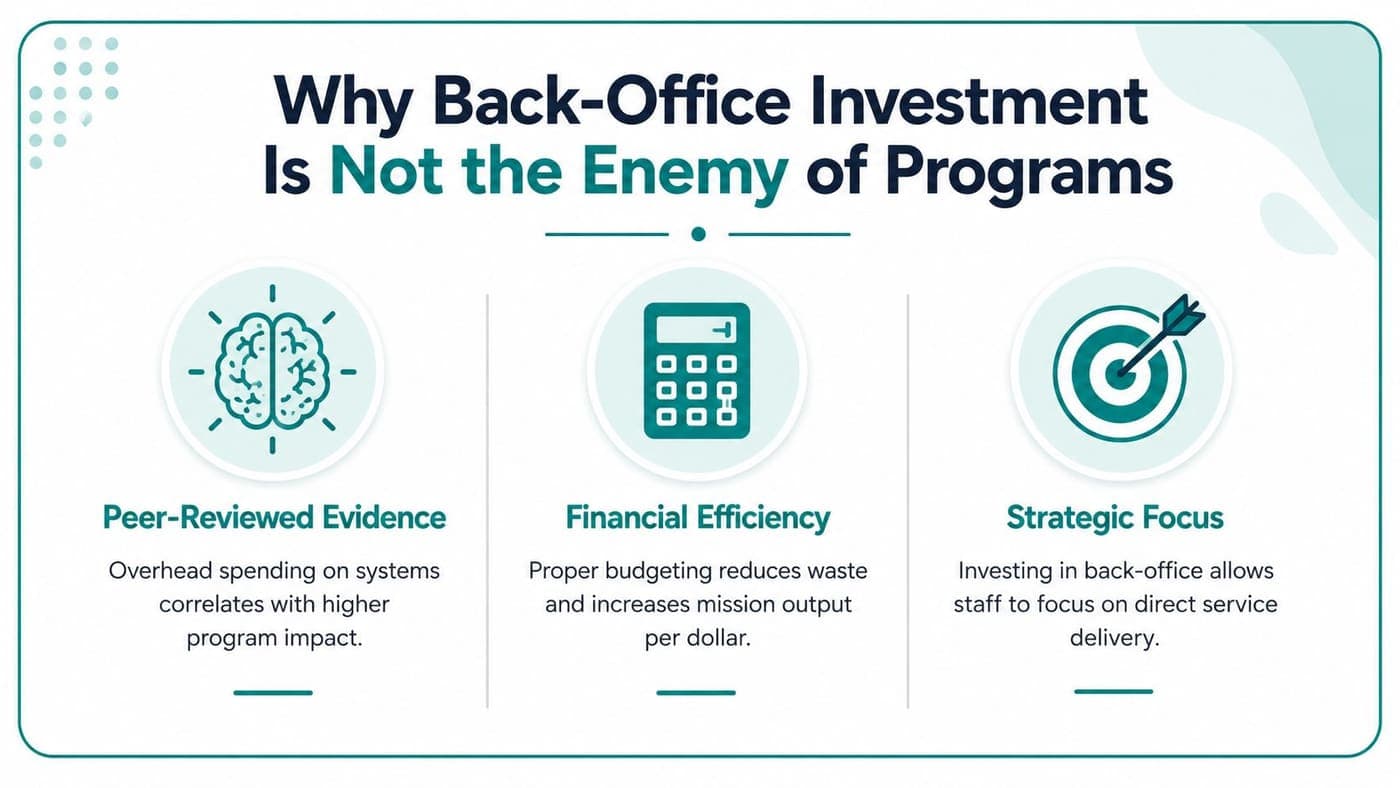
Peer-reviewed research revisiting the nonprofit starvation cycle found an inverted U-shaped relationship between overhead spending and program outcomes. Outcomes improve as overhead rises to an optimal point, then decline when overhead continues beyond that point, according to the peer-reviewed study.
The practical lesson isn't to spend freely. It's to stop treating zero overhead as the objective.
Look for the cost of being too lean
Underinvestment often appears as operational failure before it appears as a budget line. You may see missed grant drawdowns, delayed financial reports, repeated audit questions, incomplete volunteer records, or exhausted staff reconciling transactions by hand.
Those problems affect direct service. A late reimbursement can restrict cash available for delivery. A weak evaluation process can leave a strong program unable to demonstrate results. Poor coding can force staff to spend time correcting records instead of supporting participants.
Use plain language with your board:
- Accounting protects delivery: Accurate fund records prevent eligible spending from being missed or misclassified.
- Evaluation improves decisions: Regular review helps staff adjust activities before problems become expensive.
- Systems preserve capacity: Clear workflows reduce dependence on one employee's memory.
Fund accounting for nonprofits provides a useful foundation for explaining why finance infrastructure supports mission work.
Set an investment level your organization can defend through better control, faster reporting, stronger learning, and less manual rework. The right question isn't whether overhead is low enough. It's whether your back office helps the program team deliver responsibly.
Choosing Software Without Getting Sold To
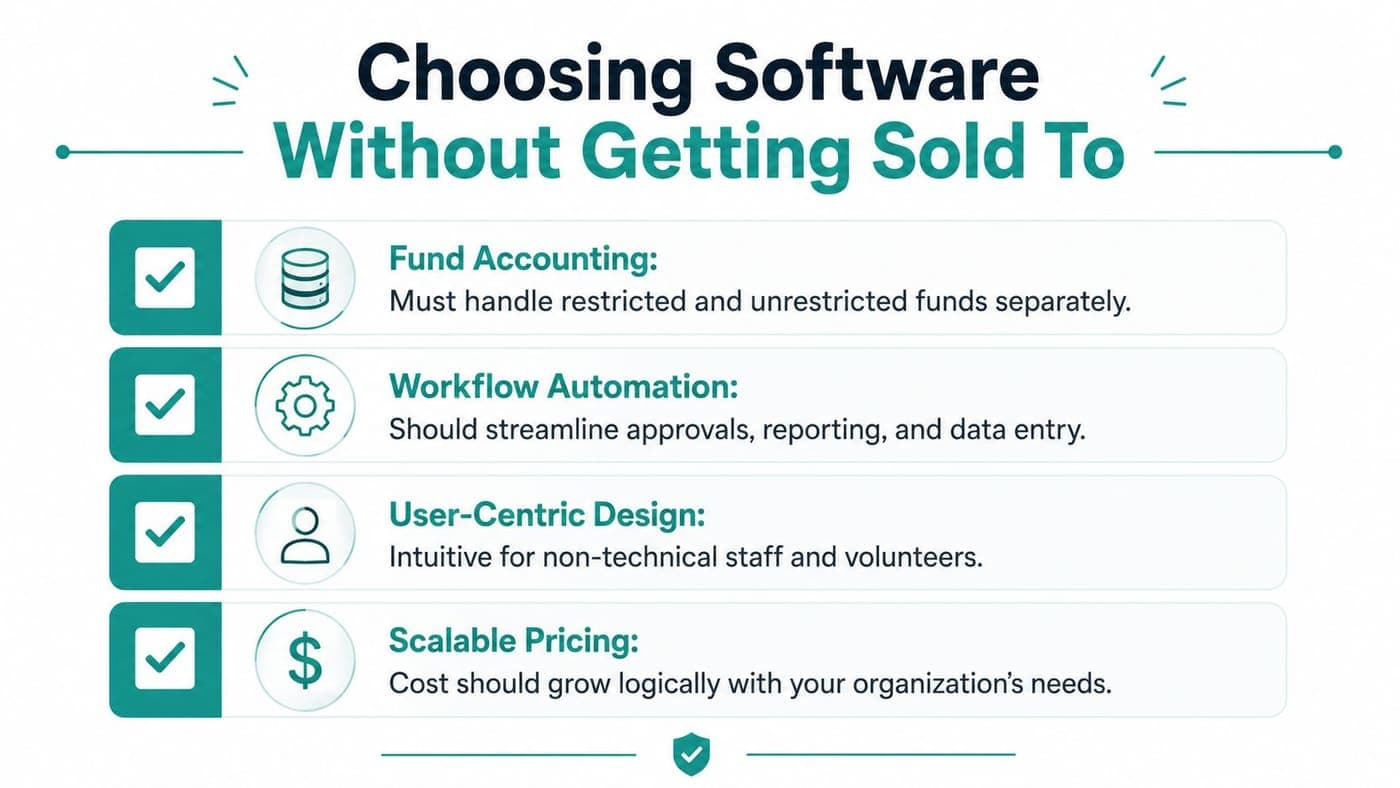
Start with the workflow, not the vendor. Ask what must be connected for your executive director to answer a board question without exporting four reports.
A serious demonstration should show a restricted contribution, a program expense, a volunteer assignment, an event, and a report using related records. Don't accept a slide describing integration. Ask the vendor to perform the actual workflow with your questions.
Compare the capabilities that matter
| Evaluation question | What to test during a demo |
|---|---|
| Can it handle restricted funds? | Create restricted and unrestricted funds, then show balances and releases. |
| Does the CRM connect to finance? | Open a donor record and trace giving into the ledger and receipt workflow. |
| Can volunteers log service? | Assign a volunteer, record hours, and filter the result by program. |
| Does evaluation belong to the program? | Enter an activity measure and show how leadership retrieves it later. |
| Does it support fiscal sponsorship? | Separate sponsored-project income and expenses from sponsor operations. |
| Is it Form 990 ready? | Review financial statements and functional expense reporting. |
| Does pricing punish participation? | Confirm whether staff, board members, and volunteers require paid seats. |
Aplos is known for nonprofit accounting fundamentals. QuickBooks earns loyalty through familiarity and broad accounting use, but classes aren't a substitute for native fund accounting. Bloomerang is strong in donor experience and retention-oriented fundraising workflows. Little Green Light offers a focused donor management approach, while Blackbaud serves organizations seeking a broad suite with extensive nonprofit functionality. Each platform can fit a particular operating model, so evaluate the connections your programs need.
Ask about the difficult cases
Test grant restrictions, shared costs, in-kind donations, fiscal sponsorship, church contributions, school programs, and event payments. For online giving, ask which charges belong to the payment processor and which platform fees donors may optionally cover. One documented platform example describes a donor-covered fee of 5% plus $0.30 per transaction, while the organization receives the donation minus Stripe's fee when the donor doesn't cover costs, as explained in this online giving fee guide.
Fiscal sponsors should test consolidated reporting carefully. The Council of Nonprofits explains that sponsors record sponsored-project income and expenses in their own accounting and Form 990 reporting, and remain responsible for donor acknowledgements. Its fiscal sponsorship guidance is a useful checklist for the demo.
AlignMint is one option for organizations seeking accounting, CRM, volunteers, events, marketing, and programs in one platform. Its features include true fund accounting, a built-in marketing suite, Minty for questions about organizational data, plan-based access without per-seat fees, and a free tier for nonprofits under $100K.
Review how to choose accounting software before scheduling demonstrations. The strongest choice is the one your staff can maintain, your finance team can reconcile, and your board can understand.
Your First 30 Days and Where to Go Next
You can improve nonprofit program management before purchasing anything. Start by making the relationships visible.
Week one
List every active program and identify its funding sources. Mark each source as restricted or unrestricted, record the relevant agreement or donor instruction, and identify the person accountable for delivery.
Week two
Code transactions to the correct program and fund when they receive approval. Reconcile restricted balances monthly, then document any release from restriction or correction while the reason remains clear.
Week three
Choose five KPIs for each program. Include delivery, outcomes, resources, and financial control, then assign one named owner for collecting and reviewing the information.
Week four
Run a thirty-minute leadership review using the same numbers you would show a funder. Discuss what changed, what requires action, and which process needs adjustment before the next review.
This plan works with spreadsheets, existing accounting software, or a new platform. The discipline matters more than the brand, although the right system can remove repeated transfers between records.
If your nonprofit needs one place for fund accounting, donor records, volunteers, programs, events, and marketing, visit AlignMint to see how the connected workflow works. You can also review its fund accounting and volunteer management capabilities against the 30-day plan before deciding whether a platform change makes sense.
Ready to try AlignMint with your nonprofit?
Start free — set up donor tools, giving pages, and Minty. Upgrade when you need accounting.