
Nonprofit Operations Management: A Practical Guide
It's 10 PM, the board wants numbers by morning, and you're still matching grant restrictions to bank balances while donor receipts sit in another system. Most executive directors know that pressure, and it usually means one thing, your operations are carrying more risk than anyone wants to admit.
Nonprofit operations management is the discipline that keeps the mission moving when cash is tight, staff are stretched, and reporting can't slip. If your organization also thinks carefully about aligning mission with investment policy, then you already know stewardship decisions are never just financial, they shape trust, timing, and capacity.
Quick Answer: Nonprofit Operations Management
Nonprofit operations management keeps finance, people, technology, compliance, and program delivery working together when cash is tight and reporting cannot slip. Track liquidity, reserves, grant utilization, and donor retention, then fix fragmented systems before they turn into service failures.
Start with fund accounting for nonprofits and nonprofit financial reporting. For a connected stack, review all-in-one nonprofit management software.
Introduction
A common night in a small nonprofit starts with one spreadsheet for donations, another for grants, and a third for payroll. The board wants clarity, the program team needs answers, and finance is trying to make sure nothing is misclassified before the next report goes out.
That pressure is exactly why nonprofit operations management matters. It keeps finance, people, technology, compliance, and program delivery moving together, instead of letting each area drift on its own. In practice, that means the organization can keep serving people even when grant payments arrive late, donor revenue softens, or demand rises faster than staff can absorb.
A practical guide matters because the right answer is not more theory. It is a clearer way to keep your organization steady when cash runs thin, reporting deadlines stack up, or leaders need reliable information fast. Strong fund tracking also depends on clean classification, which is why many teams review fund accounting for nonprofits early in the process.
If you also care about aligning mission with investment policy, you already know stewardship choices affect trust, timing, and capacity. That is the operational reality for most nonprofit leaders. Operations are not about looking efficient on paper, it is about keeping services stable when the money side of the organization is under pressure.
What Nonprofit Operations Management Really Means
A nonprofit can have a strong mission and still struggle operationally if the money, people, and program work are not aligned. One month the challenge is a delayed grant payment. The next month it is a staff vacancy, a donor dip, or a sudden spike in client demand.
Nonprofit operations management is the system that keeps finance, staffing, technology, compliance, and program delivery working together. It gives leadership a way to keep the organization steady when the day-to-day pressure changes faster than the plan.
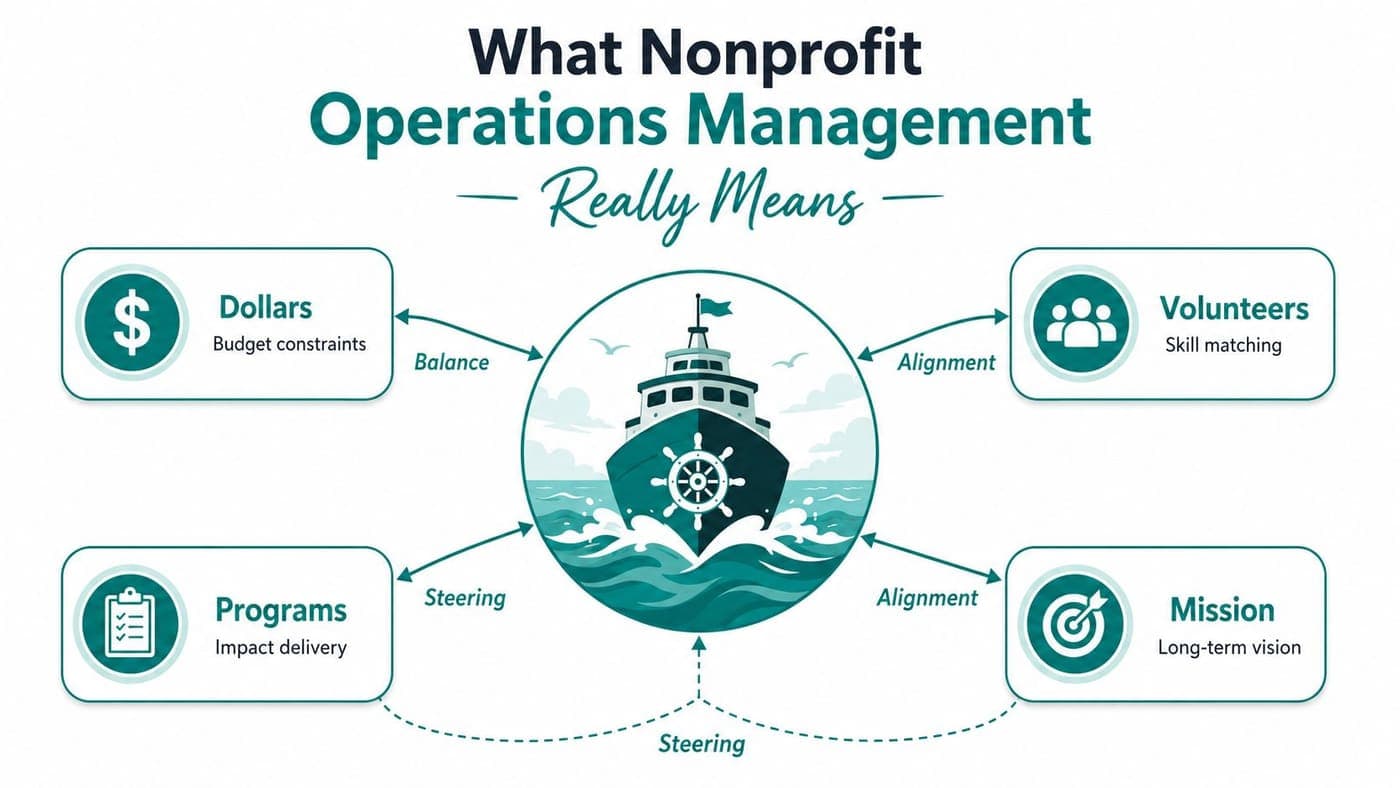
The point goes beyond back-office order. Operational discipline is what helps a nonprofit protect service continuity when funding is uneven, reporting deadlines stack up, or leaders need accurate information before making a hard call.
A practical definition you can use
If you need a board-ready explanation, keep it simple. Nonprofit operations management is the practice of making sure money is tracked correctly, people know what to do, records stay reliable, and services keep reaching clients.
That definition matters because it moves the conversation beyond overhead into strategic resilience. It also reflects the daily reality of executive directors who have to coordinate accounting, fundraising, volunteer activity, and service delivery while still meeting compliance requirements.
Practical rule: if a process affects cash, compliance, or client service, it belongs in operations.
For fund accounting specifically, it helps to see how restricted money should be tracked separately from unrestricted money. A clear primer on that topic is fund accounting for nonprofits, because many organizations first feel the gap between general bookkeeping and true nonprofit stewardship there.
The Core Functional Areas of Nonprofit Operations
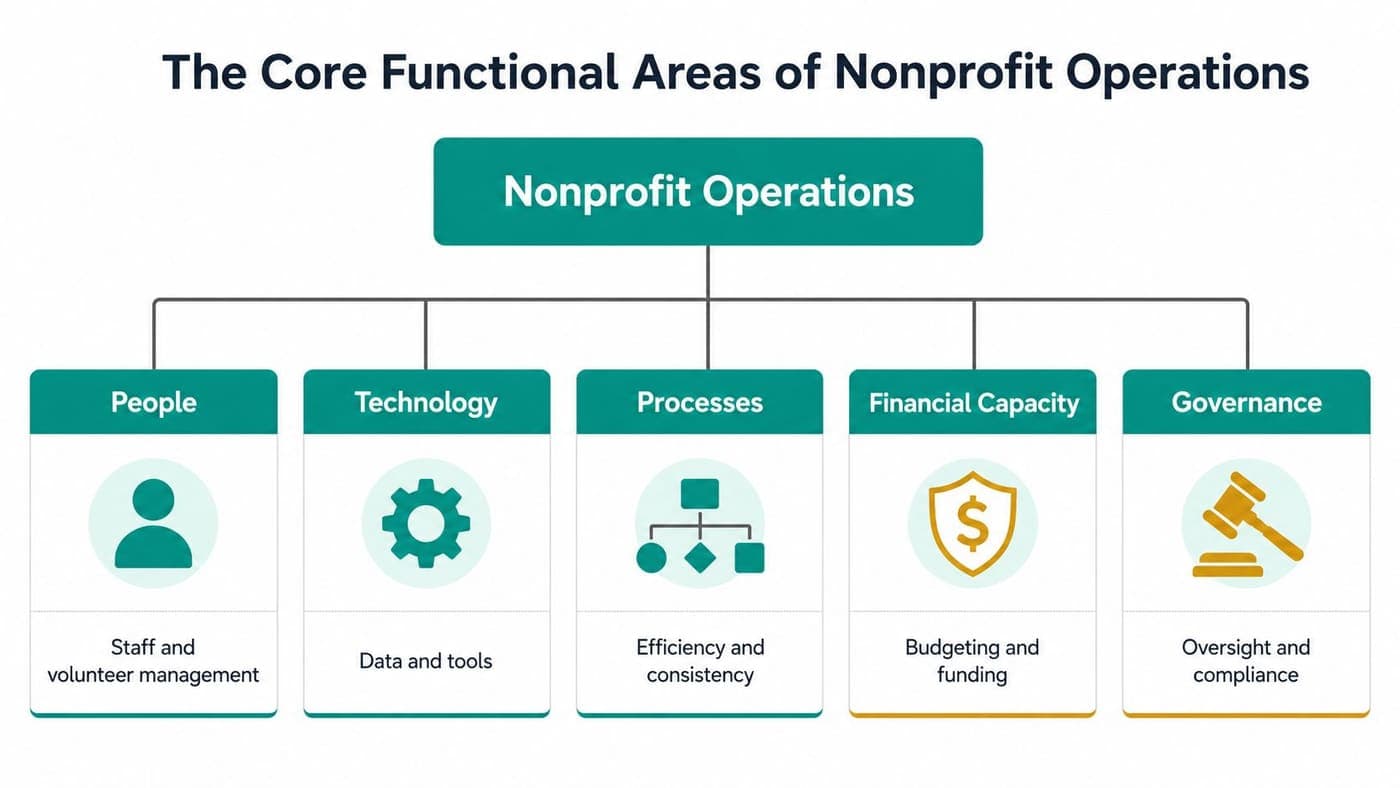
A nonprofit under pressure feels every weak spot at once. A delayed grant, a thin donor month, or a sudden spike in client need can turn a small process gap into a service problem. The Montana Nonprofit Association groups nonprofit operations into eight key areas, Legal, Human Resources, Accounting/Financial Management, Fundraising/Development, Board/Governance, Technology, Planning, and Training, and that spread is a useful reminder that operations cover far more than the ledger Montana Nonprofit Association toolkit.
People and governance keep operations grounded
People include staff, volunteers, and the working relationships that hold the organization together. Governance includes the board's oversight, the policies that guide decisions, and the controls that prevent confusion or misuse of funds.
The trade-off shows up fast in small organizations. You can move quickly with a lean team, but without clear authority lines, reimbursement rules, and board expectations, speed turns into rework. A volunteer group that knows who approves expenses, and a board that knows what to ask about restricted funds, can keep service delivery steadier when the pressure rises.
Technology and processes keep records usable
Technology shapes how information moves through the organization. Processes are the repeatable steps that keep donor records, grant deadlines, and client data from living in one person's memory.
When records are scattered across systems, staff lose time reconciling instead of serving. Practical data management guidance recommends bringing donor, volunteer, program, and finance records into one system, then setting the same fields, permissions, retention rules, and audit routines so reporting stays dependable LiveImpact.
Financial capacity is the core of operational stability
Financial capacity includes budgeting, accounting, payroll, cash flow management, grant tracking, and financial reporting, which is the heartbeat of true nonprofit operations One Abacus Advisory. A donor payment, a grant restriction, and a payroll run all meet in this pillar, so weak controls show up quickly in missed obligations or bad reporting.
This is also where funding volatility becomes visible. If cash flow is tight, finance cannot just close the books cleanly, it has to help leaders decide what can wait, what must be paid, and what service level the organization can sustain. For donor-facing systems, that also means keeping donor management tied to finance and follow-up, so the organization can see who gave, what was pledged, and what still needs attention. That link matters when revenue dips and every follow-up has to count. A useful external reference for broader operational measurement is UAE business performance indicators, because the discipline of tracking what affects performance applies well beyond one line item.
Your operations do not usually fail in one dramatic moment. They weaken when one area stays invisible long enough to disrupt the others.
Key Metrics and Governance Practices That Matter
A board facing grant delays or a donor dip does not need more reports. It needs a short list of signals that show whether the organization can keep services steady, pay obligations on time, and make trade-offs without guessing.
For nonprofit operations, the most useful measures are liquidity, reserve levels, revenue diversification, grant utilization, donor retention, and volunteer hours. Those indicators say more about resilience than overhead ratios do, especially when cash timing is uneven and staff are already stretched. They also help leaders see whether the organization can absorb a temporary funding gap without cutting too close to the bone.
What to watch in board reports
Liquidity shows whether the organization can meet obligations without scrambling. Reserve levels show whether there is breathing room when a grant arrives late or a campaign falls short.
Revenue diversification matters because too much dependence on one source makes every delay harder to absorb. Grant utilization shows whether restricted money is being used on time and in the right categories, while donor retention and volunteer hours help boards spot service momentum or fatigue before it shows up in missed commitments.
Board rule: if a metric does not change a decision, it does not need a headline spot in the report.
Boards also need to ask whether financial reporting is giving them a clear view of restrictions, timing, and control points. The guidance in nonprofit financial reporting is useful here because it connects the numbers to the reports boards and grant makers usually want to see, without losing sight of stewardship and compliance.
A practical governance checklist
A board-level operations review should answer a few simple questions. Are restricted and unrestricted funds tracked separately, are approval limits clear, are key deadlines reviewed on time, and do managers know who owns each process?
For a broader measurement lens, the UAE business performance indicators article is a useful reminder that every organization needs a small set of indicators it can act on. The nonprofit version has to respect stewardship, compliance, and mission delivery, not profit alone.
A clean financial reporting rhythm also helps boards read the numbers in context, especially when cash is tight and decisions have to be made quickly.
Common Operational Pitfalls and How to Avoid Them
The biggest mistakes in nonprofit operations are rarely dramatic. They usually start as ordinary habits that work until funding gets uneven, a grant payment slips, or demand changes faster than the team can adjust.
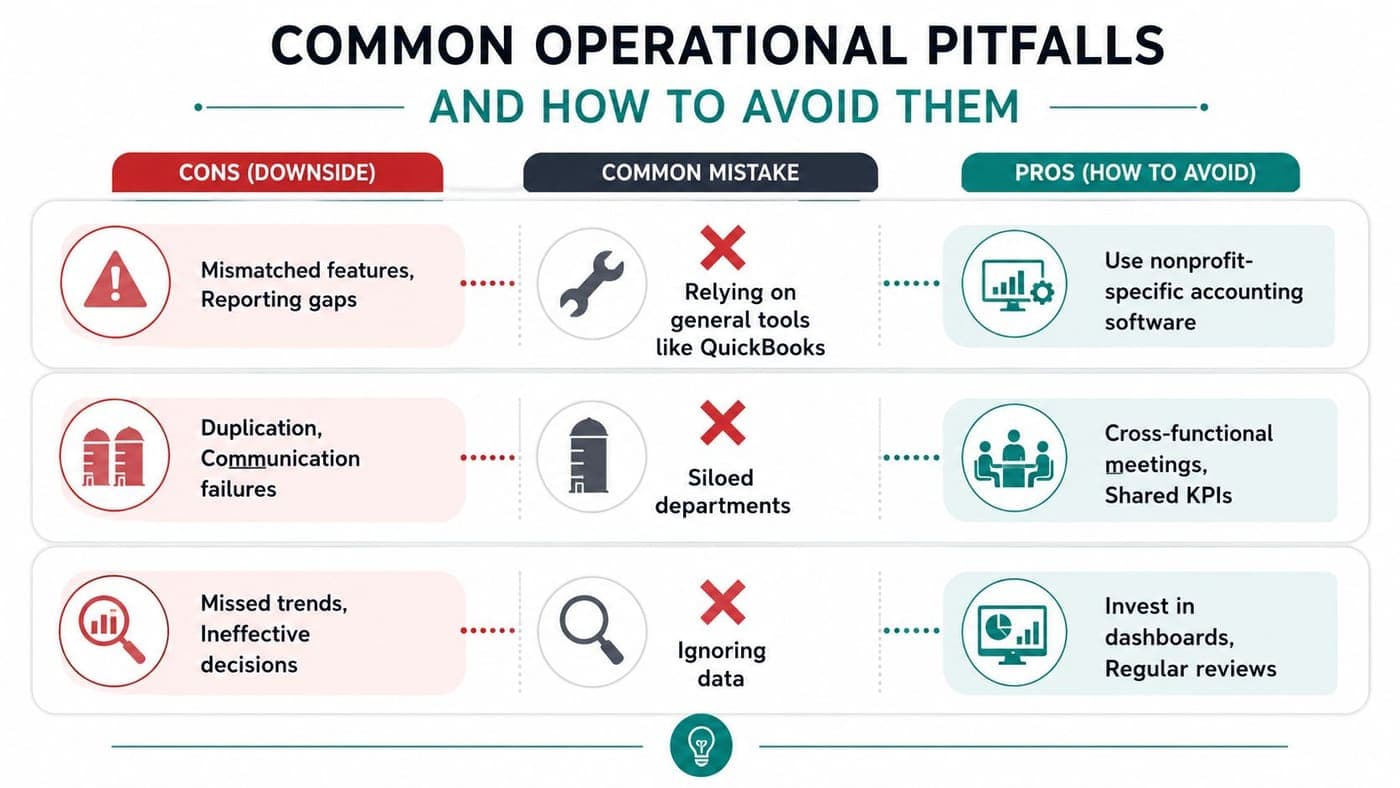
The first trap is treating general accounting software as if it were true fund accounting. QuickBooks is useful for many organizations, but classes are not the same as restricted funds, and class tags will not solve reporting gaps when grant conditions, programs, and donor restrictions need clear separation.
Fragmented systems create slowdowns
The next trap is having too many disconnected tools. Donor records in one place, volunteer hours in another, and finance in a third creates reconciliation work that steals time from service delivery and makes it harder to spot problems early.
Fragmentation also makes resilience weaker. When cash is tight, staff are stretched, or reporting deadlines come due, teams need one version of the truth, not three spreadsheets and a few half-finished exports. Consolidating records, standardizing fields, and setting ownership, permissions, retention rules, and audit routines reduces the time spent chasing the same answer across systems.
Cost efficiency can be the wrong first priority
A more subtle mistake is optimizing for the cheapest setup before thinking about variance. Nonprofits work under restricted funding and uneven demand, so a workflow that looks efficient in calm months can fail when grants arrive late, donor revenue dips, or service demand spikes.
The practical test is whether the process still holds when the month goes sideways. If one person is out, a funder delays payment, or an urgent reporting request lands on a busy week, a brittle setup turns into service disruption.
Better test: ask whether a system still works when cash is late, a key employee is out, and reporting is due.
The trade-off is real. A nonprofit-specific accounting setup, shared data across departments, and regular review of the few numbers that drive decisions usually cost more attention up front, but they reduce the scramble that happens when the organization has to absorb a shock.
If your records are already scattered, start with the nonprofit data migration checklist. Cleanup is rarely glamorous, but it often removes the hidden drag that keeps teams in constant catch-up mode.
A Practical Implementation Roadmap for Your Organization
You do not need a giant transformation to improve operations. You need a sequence your team can live with while still handling what is in front of them, especially when funding shifts and the week does not go as planned.
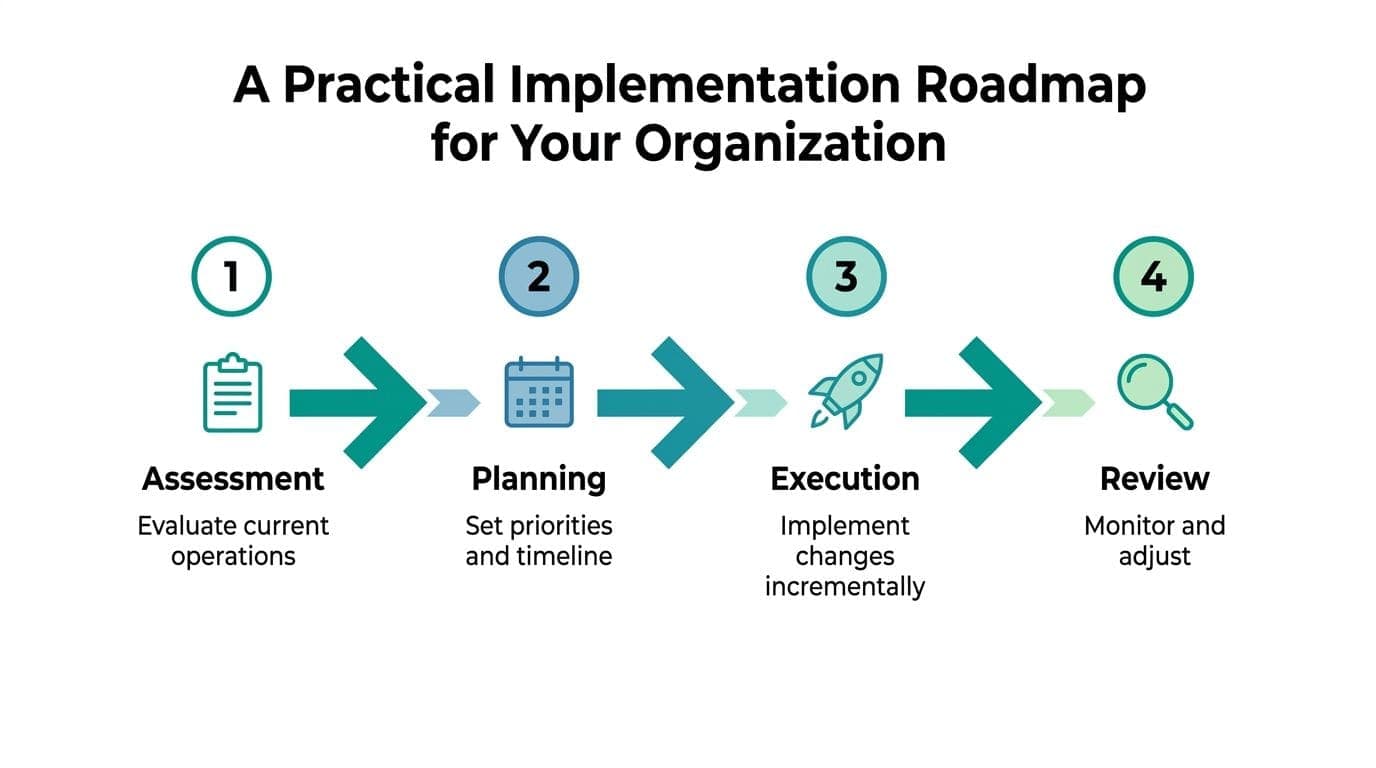
A practical roadmap starts with four phases, Assessment, Foundation, Integration, and Optimization. That order keeps you from buying tools before you know where the bottleneck sits.
Assessment and foundation
Assessment means inventorying what you already have, what still lives in spreadsheets, and where staff lose time reconciling the same numbers. In a small nonprofit, that usually includes donor records, grant tracking, approvals, and any manual handoffs that break when a key person is out.
Foundation means deciding which records, approvals, and reporting rules have to exist before anything else changes. If your organization is already feeling the strain of delayed grants or uneven donor income, this step protects service delivery by reducing avoidable confusion.
That is where governance matters. Strong nonprofit guidance recommends data centralization plus governance, not just a software purchase, because the system only helps if permissions, retention, and ownership are clear.
Integration and optimization
Integration is the point where systems need to share information fast enough to be useful. If fundraising, finance, volunteer coordination, and program data still sit in separate tools, staff end up bridging the gaps by spreadsheet, and that is usually where errors show up first.
A practical next step is to use an integrated platform that fits the way nonprofit work moves. An all-in-one nonprofit management software platform can reduce duplicate entry, keep records aligned, and make it easier to see where a delay in one area will affect another.
Optimization comes after the basics are stable. That means reviewing whether reports are accurate, whether staff are still entering the same information twice, and whether board reports reflect current realities instead of last month's assumptions.
Do not judge a system by the day it launches. Judge it by whether month-end closes faster and fewer people touch the same data twice.
The hard truth is that maintenance matters. Practitioner guidance keeps pointing back to the same issue, nonprofits need to budget for ongoing care of operational systems, not just the initial setup, because efficiency gains fade without regular upkeep NetSuite nonprofit operations management.
Small improvements compound. When handoffs are cleaner and the data is current, the organization is better positioned to hold service steady when cash is late, demand spikes, or staffing gets thin.
How an Integrated Platform Simplifies Your Operations
The right platform should make the day feel calmer, not busier. When your team can see giving, grants, volunteers, events, and marketing in one place, you spend less time reconciling records and more time keeping services on track.
QuickBooks handles general accounting well. Salesforce is strong for donor management. VolunteerMatch helps with volunteer coordination. The problem shows up when those tools do not share one operational picture, because staff then bridge the gaps by spreadsheet, and that is where errors usually surface first.
What changes when the stack is unified
An integrated platform handles true fund accounting in a way that fits nonprofit work, which matters when restricted funds, grants, and programs all need separate tracking. It also connects giving data directly to the ledger, so receipting, pledge status, and finance records stay aligned without constant manual handoffs.
That same setup can keep accounting, CRM, volunteers, events, and marketing in one place. For small and mid-sized organizations, that often means fewer logins, fewer duplicate records, and fewer places where a missed update can hide.
The trade-off is practical. General tools are often flexible, but nonprofits usually need systems that already understand restrictions, donor relationships, and reporting obligations. Specialized software starts closer to the workflow many teams live with, which can matter more than raw flexibility when staffing is thin or revenue timing is uncertain.
A concrete example is AlignMint, which combines accounting, fundraising, volunteers, events, and marketing in one platform, with true fund accounting built for restricted funds, grants, and programs so Form 990 reports and Statements of Functional Expenses can be generated in clicks. It also offers a free tier for nonprofits under $100K and plan-based access with no per-seat fees, which matters when staff and volunteer access both need to stay broad without adding another bill every time someone needs a login.
Our related overview on all-in-one nonprofit management software looks at how that kind of setup affects day-to-day operations. The practical takeaway is simple, fewer disconnected systems usually mean fewer surprises when a grant is delayed, donor revenue dips, or demand picks up faster than expected.
Your Next Steps in Nonprofit Operations Management
The goal is not cleaner spreadsheets. It is an organization that can keep serving people when money arrives late or demand spikes without warning.
Start by reviewing the systems you already use, with a close eye on where finance, donor records, volunteer data, and reporting still depend on manual handoffs. Those handoffs are usually where delays, duplicate entries, and missed updates start to show up, especially in small teams that already run close to capacity.
Then compare integrated options against the problems your staff faces, not against a sales brochure. If your current setup makes every grant delay or donor dip harder to absorb, that is a systems problem, not just a revenue problem.
The case for change is straightforward. Many nonprofits are already working with thin cash and stretched staffing, so operations need to hold up under stress, not just look tidy in a quiet month.
If you want a platform that keeps fund accounting, donor management, volunteer tracking, events, and marketing in one place, take a look at AlignMint. It is worth checking whether your current process helps your mission, or makes every hard month harder.
If you are tired of stitching together donor data, fund accounting, and volunteer records after hours, it may be time to simplify operations. AlignMint gives nonprofits one place for accounting, CRM, volunteers, events, and marketing, so your team can spend less time reconciling and more time serving. Visit AlignMint to see whether your operations could run with fewer moving parts and clearer reporting.
Ready to try AlignMint with your nonprofit?
Start free — set up donor tools, giving pages, and Minty. Upgrade when you need accounting.