

Grant Fund Accounting Explained for Nonprofits
You've just received a grant award. The money is in the bank, your program team is ready, and your board wants to know what can be spent. Yet the balance doesn't tell you which dollars are available, which are restricted, and which costs still need reimbursement.
Grant fund accounting answers those questions by connecting each award to its purpose, budget, expenses, restrictions, and reporting duties. This guide explains the practical mechanics, the cash-flow risks, and the system choices that help you protect funder intent without burying your team in spreadsheets.
Quick Answer: Grant Fund Accounting
Grant fund accounting tracks each award as its own activity stream: purpose, budget, expenses, restrictions, and remaining balance. Cash in the bank is not the same as spendable money, especially when a grant is restricted, conditional, or reimbursed after the cost.
Start with fund accounting for nonprofits and restricted vs unrestricted funds. For receivables, see grants receivable.
Introduction Why Grant Money Is Not Just Money
A grant deposit can feel like a solution to an immediate problem. Then the questions start. Can you use part of it for payroll? Does the funder allow administrative costs? Have you earned the revenue, or are you holding a conditional advance? If your program spends less than planned, what happens to the remaining balance?
Those questions matter because cash in the bank and spendable money aren't the same thing. A grant may carry a purpose restriction, a time restriction, performance condition, or reimbursement requirement. Your organization needs records that show not only how much cash arrived, but also what each dollar supports and what remains available.
The accounting principle has deep regulatory roots. IAS 20, the IFRS standard for government grants and disclosure of government assistance, was originally issued in April 1983 and later adopted by the IASB in April 2001. It says grants are recognized when there's reasonable assurance that the organization will meet the conditions and receive the grant, then matched with related expenses over the periods those costs occur. The IFRS overview of IAS 20 provides the formal foundation.
The scale makes accuracy more than an internal preference. The U.S. Treasury reports approximately $700 billion spent annually on grants and cooperative agreements, while USAspending.gov has examined more than $4 trillion in federal spending since its launch in April 2018 under the DATA Act. The grant accounting overview citing these public finance figures illustrates why restricted-use tracking matters across public and nonprofit finance.
The practical question: What amount can you spend today, on what, and what evidence will prove it later?
By the end, you'll be able to read a restricted balance, understand a release from restriction, set up a monthly reconciliation routine, and identify whether your chart of accounts is helping or hiding the answer. You'll also see why reimbursement timing makes grant accounting a treasury issue, not only a bookkeeping task.
What Grant Fund Accounting Really Means
Fund accounting separates resources according to their purpose and restrictions. Instead of treating every deposit as part of one general pool, you assign each award to a distinct fund or project record with its own revenue, expenses, budget, and remaining balance.
A simple envelope analogy helps. If a donor gives you money for youth meals, you place that money in a labeled envelope. If another donor gives unrestricted support, that money goes into a different envelope. Both envelopes may sit in the same bank account, but you still need to know which envelope paid for each expense.
Fund accounting definition: Grant fund accounting tracks each award as a separate financial activity stream, so you can prove where money came from, what restrictions apply, and how much remains available.
That differs from ordinary business accounting, where the central question is often profitability. A nonprofit may instead need to answer whether a grant paid only allowable program costs, whether a time restriction has expired, and whether a funder report agrees with the general ledger.
Fund accounting for nonprofits offers a useful introduction to the wider nonprofit structure. The key distinction is that a fund isn't merely a label attached after the transaction. It should shape how you budget, code purchases, assign payroll, review balances, and prepare reports.
Why QuickBooks classes aren't the same
QuickBooks can help a nonprofit organize activity, and its classes may provide useful reporting categories. That doesn't make classes true fund accounting. A class can function as a helpful tracking dimension, but it may not model restrictions, releases, conditional revenue, grant receivables, and fund balances as native accounting structures.
The gap becomes visible during close. You may have a total bank balance and a class report, yet still need separate spreadsheet work to determine which revenue is restricted, which expenses qualify, and what amount should appear in net assets.
True fund accounting keeps the fund or project identifier attached to related revenue and expense lines. That creates a reliable connection between the award, the transaction, the report, and the supporting documentation.
Who this protects
Good grant fund accounting protects your organization, your board, your donors, your staff, and the communities your programs serve. It helps leadership avoid promising money twice, helps finance explain available cash, and gives auditors a clearer trail.
It also protects the grant relationship. A funder doesn't only want to see that the program operated. They need evidence that the award was used according to its terms.
How Restricted and Unrestricted Funds Work Together
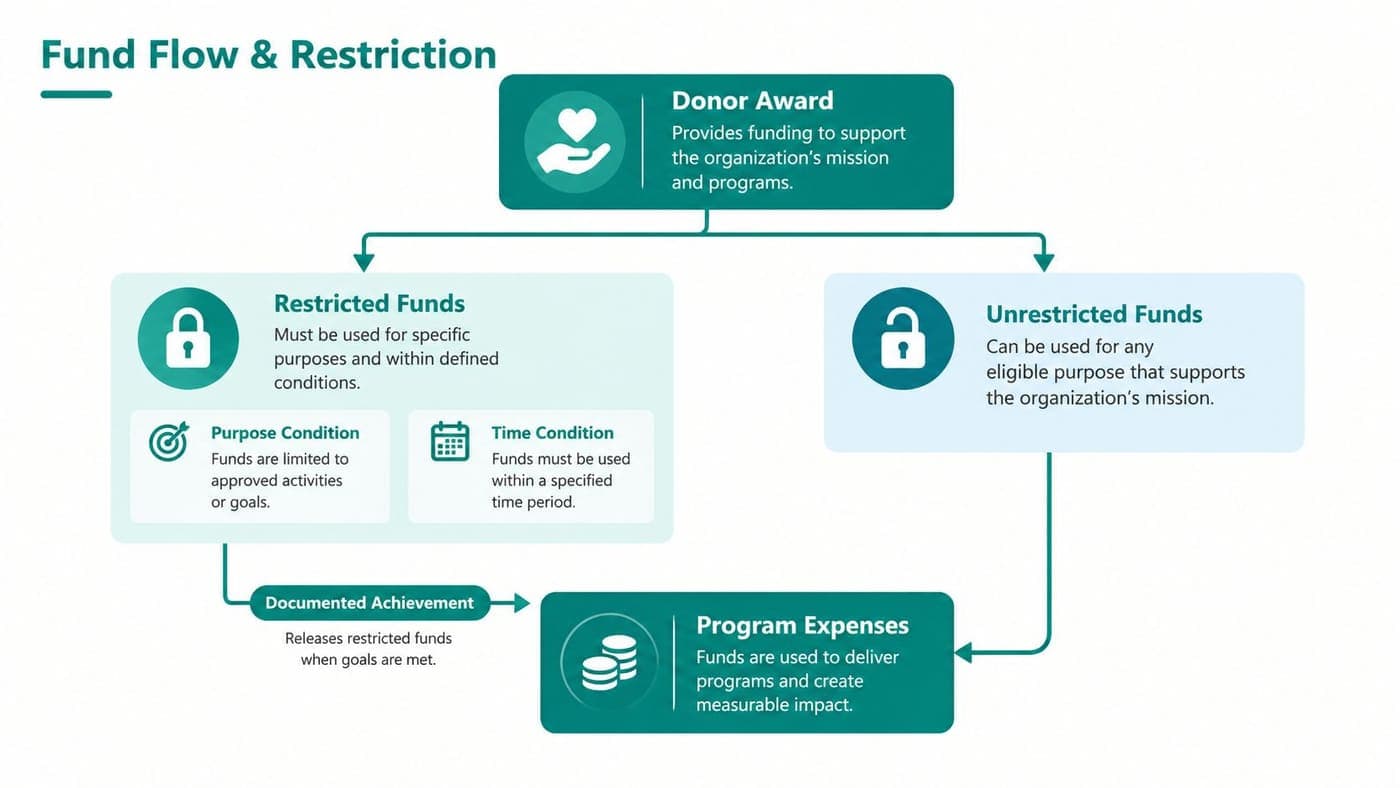
The most important distinction is whether a grant or contribution carries a restriction or condition. Restricted funds must be used according to a donor or funder requirement. Unrestricted funds support purposes your organization can choose within its governing mission and policies.
Restrictions can be tied to purpose or time. A grant might support a named tutoring program, while another award might be available only during a defined project period. Donor-restricted endowments add another form. IRS instructions cite ASC 958-205-45 and describe them as donor-restricted gifts maintained to produce income for a specified period or until a specific event occurs. The IRS Form 990 instructions provide that definition.
When your organization spends restricted money on an allowable purpose, the accounting effect isn't just "expense goes out." Under FASB ASC 958, nonprofits keep grant money in net assets with donor restrictions until the purpose or time restriction is satisfied. When the qualifying expense occurs, the same amount is released from restriction and becomes available for unrestricted use. The nonprofit restricted-funds guidance explains this cause-and-effect relationship.
Reading the balance correctly
Suppose a grant fund shows award revenue, qualifying payroll, supplies, and a remaining restricted balance. That balance should answer a specific question: how much of the award remains restricted and unspent, after accounting for eligible activity?
A useful report should let you see:
- Award activity: The approved revenue, receivable, or cash connected to the grant.
- Eligible expenses: Costs assigned to the grant and supported by documentation.
- Released amount: Restricted net assets moved because qualifying costs or conditions were satisfied.
- Remaining restriction: The amount still tied to the grant's purpose, time period, or event.
- Unresolved conditions: Amounts that can't yet be recognized as revenue because requirements remain unmet.
A per-grant fund code or project dimension makes this possible. Every related revenue and expense line carries the same identifier, which supports live restricted-balance reporting, year-end net-asset classification, and audit support.
Conditional and unconditional awards
An unconditional grant is generally recognized as revenue when received, subject to the applicable accounting framework and restriction classification. A grant with an unresolved condition is different. Under the nonprofit treatment described in the verified guidance, it remains a refundable advance until the condition is met.
That distinction prevents a common error. An award letter isn't automatically spendable revenue. You need to identify whether the funder imposed a barrier that your organization must overcome before it has earned the funds.
Restricted versus unrestricted funds provides additional context for separating these categories. Your finance team should keep the grant agreement, approval documents, budget, and condition assessment with the fund record, not in a separate folder disconnected from the ledger.
Tracking Grant Budgets Drawdowns and Monthly Reconciliation
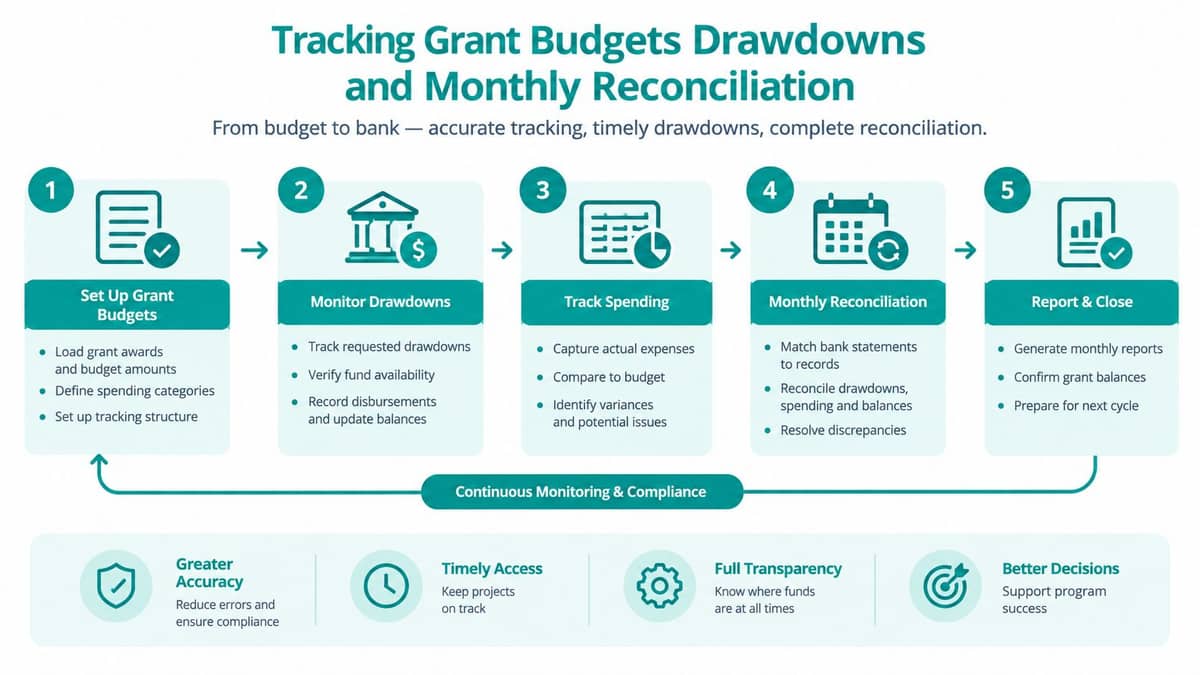
A grant budget becomes useful when your ledger can report in the same categories the funder uses. That sounds simple, but many organizations budget by funder-required categories while their chart of accounts uses different groupings. Your monthly report then needs manual translation before anyone can tell whether spending is on track.
Start by mapping the approved budget to your accounting structure. Keep the funder category visible, even when several general-ledger accounts feed into it. For example, multiple payroll or supply accounts may roll into one program category for the grant report.
A repeatable monthly routine
Use the same sequence each month. Consistency matters more than a complicated process.
-
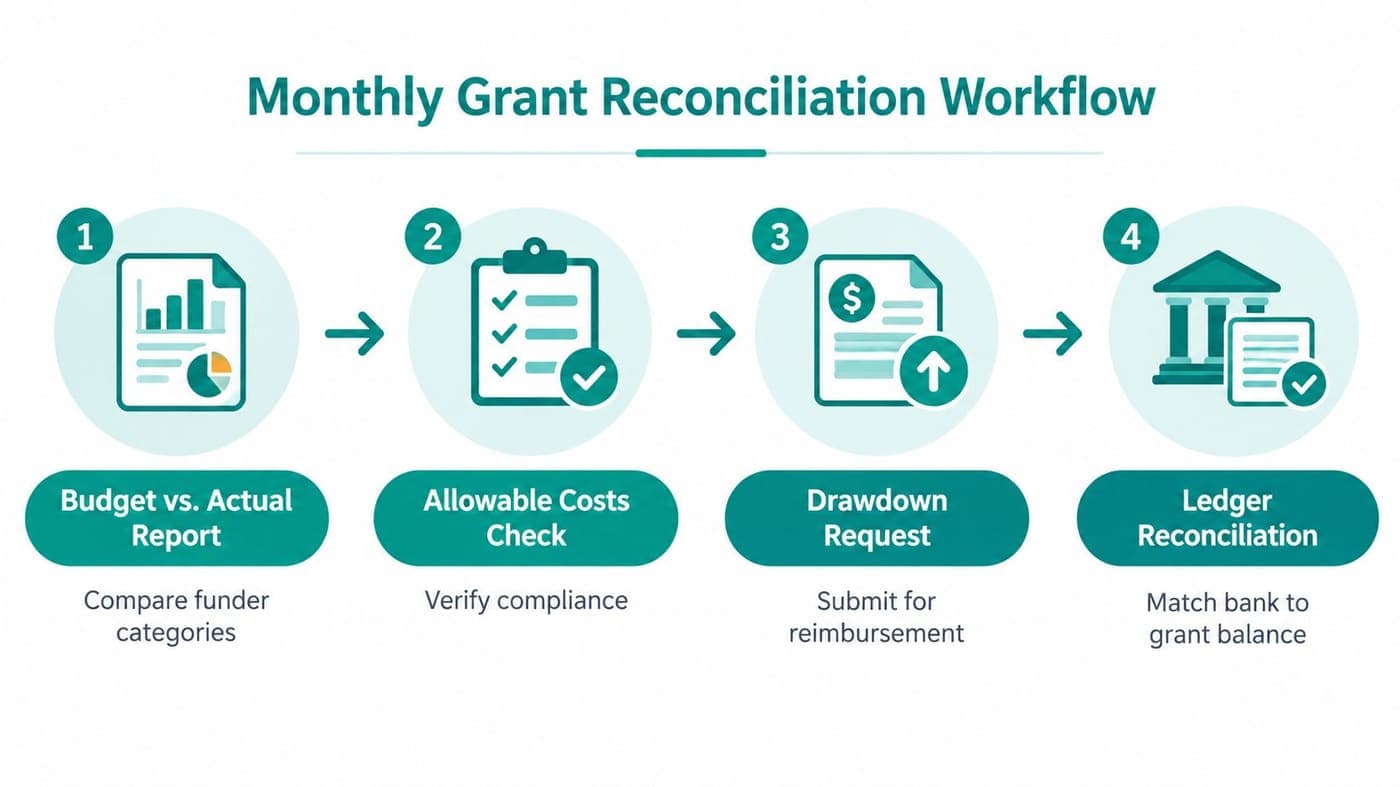
Compare budget to actual activity. Review each funder category, current-period cost, cumulative cost, and remaining budget. Investigate unusual variances before submitting a report.
-
Test each cost. Confirm that expenses are allowable under the agreement, allocable to the grant, and reasonable for the work performed. Keep invoices, payroll support, timesheets, approvals, and allocation calculations together.
-
Review cutoff items. Check payroll earned before month-end, unpaid invoices, open purchase orders, and costs incurred but not yet entered. A late transaction can distort both the restricted balance and the reimbursement request.
-
Prepare the drawdown. Request reimbursement only for supported eligible costs. For a federal or reimbursement-style award, connect the request to the underlying expense detail.
-
Reconcile the records. Match the drawdown file to the bank deposit, the general-ledger entry, and the grant-cost report. The SF-425 requires cash received, cash disbursed, and expenditures to reconcile back to the drawdown file and ledger. Grant compliance guidance on monthly reconciliation describes this control.
The grants receivable documentation can help your team distinguish an awarded amount from cash already received and eligible reimbursement still due.
What to keep in the close file
Your monthly close file should show the approved budget, actual expenses, variance explanation, drawdown calculation, bank evidence, ledger detail, and unresolved questions. It should also record who reviewed allowability, allocability, and reasonableness.
Organizations planning future applications can also monitor grant tender alerts from Bidwell. Knowing possible funding opportunities early helps program and finance staff consider reporting categories, matching requirements, and cash timing before an award arrives.
The purpose of monthly reconciliation isn't to create more paperwork. It keeps the grant balance, cash account, reimbursement request, and funder report aligned while corrections are still manageable.
Reporting That Proves Compliance From Form 990 to Functional Expenses
Grant fund accounting earns its keep when your organization prepares reports for the IRS, funders, auditors, and the board. Clean fund records let you explain not only total expenses, but also their restriction class and functional purpose.
The IRS recognizes the fund method of accounting and instructs organizations to report balances for current restricted and unrestricted funds. Form 990 also includes a Statement of Functional Expenses, while the instructions identify program services, management and general, and fundraising as key functional categories. Fundraising expenses include costs for soliciting cash and noncash contributions, gifts, and grants, including government grants. The IRS Form 990 instructions connect these reporting requirements to the underlying accounting records.
The reporting connection
A transaction should carry enough information to answer three questions:
- Which fund or award supported it?
- What natural expense was incurred?
- What function benefited from it?
Natural categories describe what you bought, such as salaries, rent, supplies, or professional services. Functional categories describe why the organization incurred the cost. Your system needs both views.
| Report or Requirement | What Fund Accounting Provides | Why It Matters |
|---|---|---|
| Form 990 fund balances | Restricted and unrestricted fund activity | Supports accurate classification |
| Statement of Functional Expenses | Natural and functional expense coding | Shows program, management, and fundraising costs |
| Grant report | Award-level revenue and eligible expenses | Connects spending to funder categories |
| Board financial package | Fund balances, budgets, and variances | Helps directors make informed decisions |
| Audit support | Transaction detail and source documents | Makes testing and follow-up more direct |
Fiscal sponsorship requires the same discipline. Sponsored projects are commonly treated as restricted funds under GAAP, and funds collected by fiscal sponsors should be recorded as restricted on financial documents. The fiscal sponsorship accounting guidance explains why sponsored projects shouldn't disappear inside general operating activity.
For schools, churches, and other organizations with donor-restricted endowments, the restriction may be time-based or event-based. Your reports should show whether the organization is holding principal, recognizing related income, or releasing amounts after the specified requirement is satisfied.
The Form 990 checklist can help your leadership team gather the records needed before preparation begins. Improvement comes earlier, when each transaction receives the correct fund and function at entry.
Common Challenges That Quietly Break Grant Accounting
A grant can show an available balance while your operating account feels tight. That happens when budgeting, transaction coding, and reimbursement tracking sit in separate systems. The accounting problem is also a cash-flow and system design problem.
Your chart of accounts may group costs by internal department, while the grant agreement uses personnel, supplies, travel, or contracted services. Someone must translate one structure into the other. Manual translation can hide variances, delay indirect-cost allocation, and make state or funder reconciliations harder.

The budget and ledger mismatch
Ask your team:
- Can we produce a report in the funder's categories without rebuilding it in a spreadsheet?
- Does every grant expense receive a fund or project identifier when it is entered?
- Can we see the remaining spendable balance after pending payroll and purchase orders?
- Do program managers know which costs each grant can support?
If not, staff effort is only part of the issue. The chart of accounts and reporting dimensions may not match the grant's rules. Separate tools can also delay the view leaders need until month-end or closeout. A well-aligned system works like a shared map. The budget, ledger, and funder report use the same labels, so the organization can see both permitted spending and real cash pressure.
Reimbursement creates a liquidity gap
Reimbursement grants add timing risk. Your organization may incur an allowable cost today and wait for the funder to repay it. Recent grant guidance describes a typical 30 to 60 day lag between spending and reimbursement. One analysis estimates that a program spending $50,000 per month could have roughly $100,000 out of pocket during that lag. The reimbursement-focused analysis discusses these figures and their cash-flow implications.
That exposure matters when reserves are limited. A 2025 nonprofit survey cited by Intuit reported that 52% had three months or less of cash on hand, while 36% ended 2024 with an operating deficit.
Your cash forecast should include expected drawdowns, eligible costs not yet billed, grant-reporting dates, and unrestricted cash available to bridge the delay. A grant may be healthy on paper while its reimbursement schedule creates immediate operating strain.
A Simpler Way to Manage Grants With AlignMint
Your accounting structure should make the important answer easy to find: what remains restricted, what remains spendable, and what reimbursement is due. That becomes difficult when accounting, donor records, volunteer schedules, event data, and marketing activity live in separate systems.
An all-in-one platform can reduce those handoffs when it models the underlying work correctly. Look for true fund accounting, not only QuickBooks classes. You need grant, program, restriction, and project dimensions that flow into budgets, expenses, drawdowns, board reports, and Form 990 preparation.
AlignMint's fund accounting feature supports restricted fund tracking, grants, programs, live balances, board-ready reports, Form 990 preparation, and Statements of Functional Expenses. Its broader platform also combines accounting with donor management, volunteer management, events, marketing, online giving pages, and team communication.
Compare the fit, not the sales pitch
QuickBooks remains familiar and flexible for many organizations, particularly those with an experienced bookkeeper and a carefully designed class structure. Blackbaud offers established nonprofit products with deep fundraising and financial-management capabilities. Sage Intacct is known for configurable accounting and dimensional reporting. These tools can be strong choices, but teams should examine whether grants, restrictions, donor records, volunteers, and communications connect without repeated exports.
For a small or mid-sized nonprofit, the practical questions include:
- Fund structure: Are restricted funds native, or are they recreated through classes and workarounds?
- Cash visibility: Can leadership distinguish cash received from reimbursement due?
- Reporting: Can the system produce Form 990 and functional-expense views from transaction data?
- Team access: Are users limited by seat fees or able to participate across departments?
- Automation: Can an AI assistant answer questions from actual organizational data?
AlignMint includes Minty AI, plan-based access without per-seat fees, and a free tier for nonprofits under $100K. Its donor CRM, volunteer tools, marketing suite, events, and online giving pages sit alongside finance rather than requiring separate exports.
Start with one active grant. Map its award terms, funder categories, chart-of-accounts codes, reimbursement schedule, and reporting deadlines. Then ask whether your current system can show the restricted balance and cash exposure without a spreadsheet.
AlignMint brings true fund accounting, grant tracking, donor management, volunteers, events, marketing, and team communication into one nonprofit platform. Visit AlignMint to review the free tier for organizations under $100K and see whether your next grant close can become clearer and easier to manage.
Ready to try AlignMint with your nonprofit?
Start free — set up donor tools, giving pages, and Minty. Upgrade when you need accounting.