


Form 990 Extensions How to File on Time Without Stress
May is already crowded with board meetings, grant reports, audits, and program demands. Then the Form 990 deadline appears, and you're left deciding whether to submit incomplete numbers or request more time.
A Form 990 extension can protect your organization from that rushed choice. Used properly, it gives you room to reconcile restricted funds, confirm donor records, and file an accurate return without treating the extension as permission to delay financial work.
Quick Answer: Form 990 Extensions
A Form 990 extension is requested on Form 8868 before the original due date. The extra time is for finishing records and the return, not for ignoring the calendar. Late filing without an extension can bring penalties even when you later complete the form.
Start with the Form 990 guide for new nonprofits and fund accounting. For worksheets, see Form 990 builder.
Why Form 990 Extensions Matter When Time Runs Short
By early May, many calendar-year nonprofits are still closing books from the prior year. Your treasurer wants final figures, your accountant has questions about restricted gifts, and your board needs confidence before approving a public filing. Meanwhile, the IRS deadline is approaching.
For calendar-year organizations, the regular due date for Form 990 is May 15, because the return is due on the 15th day of the fifth month after the accounting period closes. The IRS explains the annual filing timing in its Form 990 filing procedures guidance.
That pressure creates a familiar temptation. You may want to use the most recent spreadsheet, carry forward last year's classifications, and hope the missing details can be corrected later. That approach often creates more work, especially when restricted gifts, grant activity, and program expenses don't line up cleanly.
Practical rule: An extension should create time for accurate reporting, not time to postpone basic bookkeeping.
What the extension actually changes
A timely Form 8868 gives eligible organizations an automatic six-month filing extension. For a calendar-year nonprofit, the May 15 deadline moves to November 15, according to the IRS extension rules for exempt-organization returns.
The extension changes the filing date. It doesn't erase the filing obligation, correct weak records, or automatically extend every related tax payment. It also doesn't give you a second extension after the six-month period ends.
That distinction matters because Form 990 is more than a form to complete after the books are closed. It reflects how your organization handled public support, restricted resources, governance, compensation, programs, and expenses. Donors and funders may rely on the information when evaluating your organization.
Use the extra time to fix the right problems
The most valuable work during an extension is usually not typing answers into the return. It's confirming that your accounting system tells the same story as your bank statements, grant agreements, donor records, and board reports.
If you need a broader overview before working through the extension, review this practical guide to how to file Form 990 for nonprofits from Bookkeeping and Accounting of Florida Inc. You can also use AlignMint's Form 990 guide for new nonprofits to organize the filing process around your organization's actual records.
The goal isn't to file later. The goal is to file once, file accurately, and give your board and community information they can trust.
Who Can Request an Extension and Who Cannot
A fund balance that does not reconcile with bank statements or restricted-gift records can turn an extension into a longer scramble. Before requesting extra time, confirm which return your organization files and whether its accounting records support that return. Form 8868 changes the deadline, not the quality of the underlying information.
The IRS allows Form 8868 to extend Form 990, Form 990-EZ, and Form 990-PF when the request is submitted by the original due date. These returns share the same basic six-month extension rule, but their reporting requirements differ. Confirm the return type before anyone prepares the request.
Start with the return on your filing calendar
Form 990 is the full annual information return for eligible exempt organizations. Form 990-EZ is a shorter return for organizations that meet the applicable requirements, while Form 990-PF applies to private foundations. Organizations can review these Form 990-EZ requirements before deciding whether the shorter return applies.
For a calendar tax year, the standard due date is May 15. Organizations using a different fiscal year calculate the deadline from the end of their accounting period. Check the legal name, tax year, fund classifications, and restricted revenue records against the return type before filing Form 8868. Clean fund accounting makes the extension useful because the extra time can go toward review rather than reconstructing how restricted gifts were spent.
Form 990-N follows a different path
Form 990-N, commonly called the e-postcard, cannot be extended with Form 8868. The IRS excludes it from extension eligibility.
This causes trouble for small nonprofits that rely on a general Form 990 checklist. Confirm the organization's actual filing requirement first, then follow the process for that return. An extension request cannot correct a mistaken assumption that the organization files Form 990, 990-EZ, or 990-PF.
Treat Form 990-T separately
Form 8868 can provide a six-month filing extension for Form 990-T when submitted by the original due date. The extension covers filing, not the timing of any unrelated business income tax payment.
If your organization has unrelated business income and may owe tax, keep the two questions separate. Ask your tax professional how payment must be handled, while the finance team confirms that the return and supporting fund records are ready.
Use this decision check before submitting a request:
- Identify the form: Confirm whether the organization files Form 990, 990-EZ, 990-PF, 990-N, or 990-T.
- Confirm the accounting year: Record when the tax year ended and calculate the original deadline.
- Check eligibility: Determine whether Form 8868 applies to that return.
- Separate payment obligations: For Form 990-T, address any tax payment independently.
- Check state requirements: A federal extension may not satisfy state filing or charitable-registration rules.
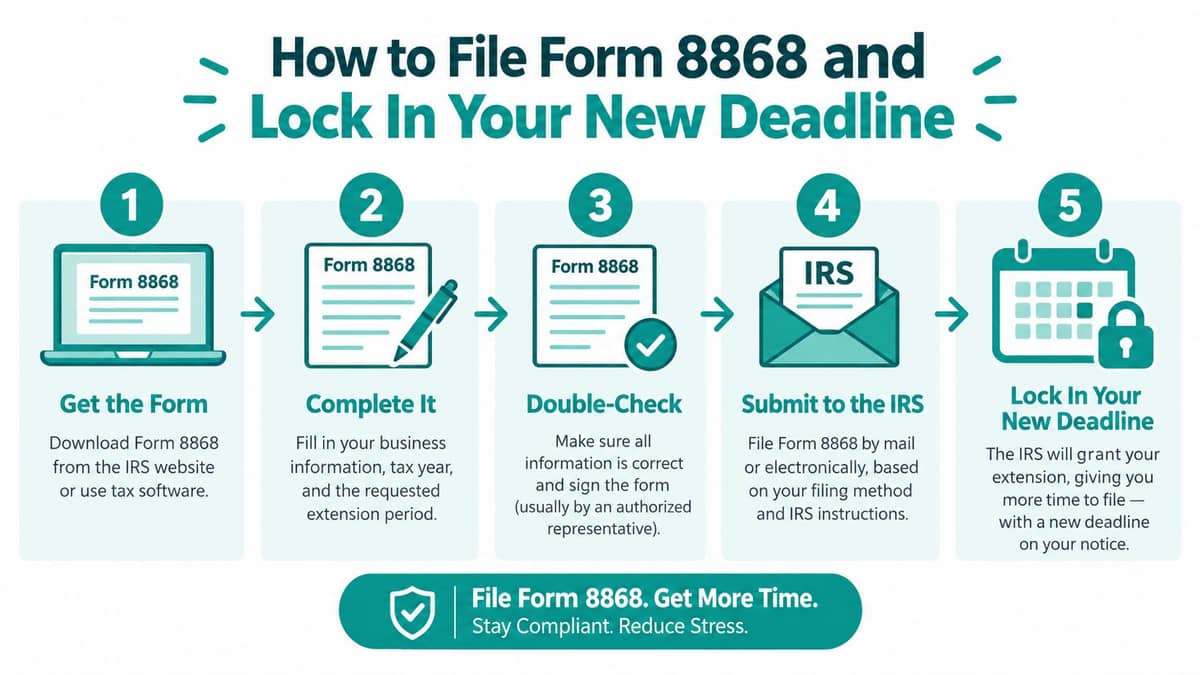
How to File Form 8868 and Lock In Your New Deadline
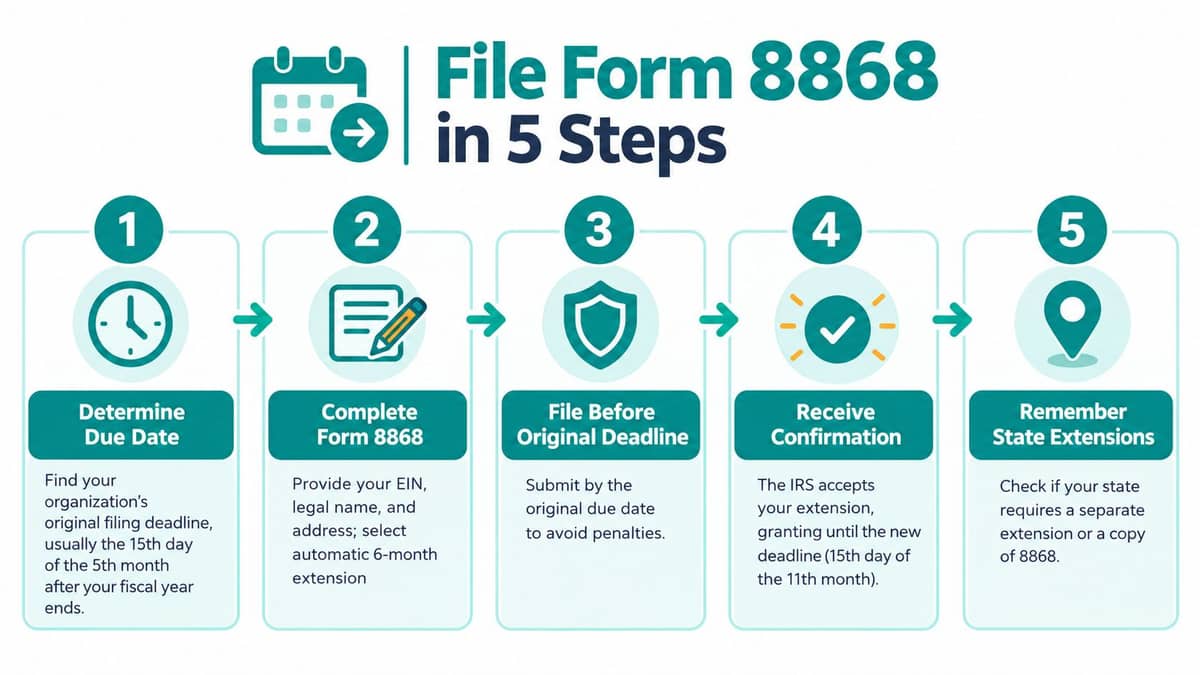
The filing mechanics are straightforward, but the deadline is firm. Form 8868 must reach the IRS by the original due date for the return you are extending.
For a calendar-year organization filing Form 990, submit Form 8868 by May 15. A timely request moves the federal filing deadline to November 15. The IRS instructions for Form 8868 explain the filing requirements.
Start by confirming the exact return and tax year. An old form saved on a shared drive may show the wrong legal name, address, accounting period, or return type.
Prepare the information before the deadline
Form 8868 requires identifying information about the organization and the return. Gather the organization's EIN, legal name, address, tax year, and the specific return being extended.
Have your finance lead, accountant, or authorized preparer confirm that the organization expects to file the return listed. A request connected to the wrong return can create confusion when the final filing is prepared.
Use a short internal review before submitting:
- EIN and legal name: Match the organization's current IRS records.
- Address: Confirm that the address is current and consistent with filing records.
- Tax year: Verify the accounting period ending date.
- Return type: Select the correct exempt-organization return.
- Original due date: Confirm that the request will be filed before that date.
The IRS treats a properly filed, timely request as an automatic extension. You can begin the extension-period work without waiting for a discretionary approval decision.
Save proof and reset the calendar
Keep a dated copy of the completed Form 8868 and the submission confirmation with your annual tax records. Share the new filing date with the board chair, treasurer, accountant, and executive director.
Put the deadline in a shared compliance calendar, not only one person's calendar. Staff changes, vacations, and competing grant deadlines can make a private reminder disappear.
Use the additional time for a defined close plan. Schedule bank reconciliations, restricted-fund reviews, grant schedule updates, donor-record checks, management approval, and final tax preparation. True fund accounting makes this work easier because restricted gifts and program balances are already separated instead of being reconstructed during tax preparation.
Set two dates. The first is the IRS deadline. The second is your internal completion date, which gives the preparer and board time to review the return before submission.
Remember that there is only one extension
The IRS allows one six-month extension per return for a tax year. There is no second extension after that period ends, so the November deadline must stay visible through the summer and fall.
An extension helps only when the underlying records are ready to support completion. Filing Form 8868 and then returning to disconnected spreadsheets, unclear grant activity, or unresolved restricted-fund balances postpones the scramble.
If your organization is reviewing filing technology, compare the workflow rather than relying on sales language. AlignMint's Form 990 filing software guide offers a way to evaluate preparation, records, and review together.
What to Handle While Your Extension Is Pending
Filing Form 8868 is only the federal timing step. During the extension period, your organization still needs to maintain accurate records and check whether state agencies require separate action.
State requirements vary. Some states may require a separate extension, a copy of the federal extension, or another annual filing tied to charitable registration. Contact your state charity regulator and record the requirement in the same compliance calendar as the federal return.

Keep the financial story current
An extension shouldn't stop monthly close work. Your team should continue reconciling bank accounts, recording gifts, reviewing grant activity, and updating restricted-fund balances.
Restricted funds deserve special attention. A gift may be limited to a program, building project, scholarship, or grant-supported activity. If your accounting records combine restricted and unrestricted activity, your team may need to reconstruct those balances manually before the return can be completed.
Grant drawdowns also need current records. Track what your organization received, what it spent, what remains available, and whether expenses match the grant's purpose. Waiting until the final filing month makes missing documentation harder to locate.
A clean extension file contains current numbers, not just a signed request for more time.
Give stakeholders useful interim information
Your Form 990 may not be ready for public review while the extension is pending. Your board, funders, and major donors may still need a clear view of financial progress.
Provide a condensed interim report with the information those audiences use. That may include cash position, budget-to-actual results, restricted-fund balances, grant activity, major variances, and unresolved accounting questions.
The report doesn't need to imitate the full Form 990. It should help leadership understand whether programs remain funded, whether restrictions are being honored, and whether the final filing is on track.
Remove spreadsheet bridges where possible
A system with true fund accounting keeps funds, grants, programs, and restrictions connected to transactions. That reduces the need to copy figures between a bank spreadsheet, donor database, grant tracker, and accounting file.
The difference is practical. When finance and donor data live separately, your team may spend time proving that two systems agree. When records connect natively, staff can review the source transaction and its fund assignment in one workflow.
For a broader review of year-round controls, see this guide to nonprofit financial management. The extension window is a good time to identify which records are reliable and which depend on one person's memory.
What Happens If You File Late Without an Extension
Missing the original deadline creates two problems. First, your organization may face IRS penalties. Second, your board and external stakeholders may receive financial information later than expected.
The IRS bases late-filing penalties on gross receipts and the number of days the return is late. For organizations with gross receipts under $1,208,500, the penalty is $20 per day, up to $12,000 or 5% of gross receipts, whichever is less. For organizations above that threshold, the penalty is $120 per day, up to $60,000, according to the IRS late-filing penalty guidance.
| Organization Size | Daily Penalty | Maximum Penalty |
|---|---|---|
| Gross receipts under $1,208,500 | $20 per day | $12,000 or 5% of gross receipts, whichever is less |
| Gross receipts above $1,208,500 | $120 per day | $60,000 |
These penalties make an on-time extension a straightforward risk-control decision. Filing Form 8868 on time can give eligible organizations the additional filing window without waiting for records to become perfect by the original deadline.
The operational cost is often harder
A late return can trigger urgent calls with your accountant, rushed board approvals, and repeated requests for missing documentation. Staff may stop normal program work to reconstruct restricted activity or explain inconsistent figures.
Donors and funders may also ask why financial reporting is late. They may not know whether the delay reflects a harmless administrative issue or a deeper control problem, and your team then has to spend time restoring confidence.
That doesn't mean every late filing signals financial trouble. It does mean that repeated delays can make ordinary questions feel more serious than they need to be.
Compare the penalty with the prevention
The practical choice is usually simple:
- If records are ready: File the return by the original deadline.
- If records need more work: File Form 8868 before the deadline and document the new date.
- If the return type is unclear: Confirm whether your organization files an eligible return before submitting anything.
- If payment may be due: Treat Form 990-T payment timing separately from the filing extension.
- If the deadline was missed: Contact a qualified nonprofit tax professional promptly rather than waiting for another filing cycle.
More detail on annual filing obligations appears in this guide to nonprofit tax filing requirements. The most expensive approach is usually not asking for time. It's losing track of the deadline while your records remain unfinished.
Stay Ready for Next Year With Less Last Minute Stress
A Form 990 extension works best when your organization already has a year-round financial rhythm. The request gives you additional filing time, but clean fund balances make that time productive.
Start with four habits. Know your return type, calculate the original deadline, submit Form 8868 before that date when eligible, and check state requirements separately. Then keep reconciliations, restricted gifts, grant activity, and donor records current throughout the year.
True fund accounting is especially important for organizations with restricted programs, grants, fiscal sponsorship arrangements, church ministries, or school-based activities. It lets your team see which resources are available, which are restricted, and which expenses belong to each program without rebuilding the answer from disconnected files.
Your technology choice should match that need. QuickBooks can be familiar for general bookkeeping, Aplos offers nonprofit and church-focused tools, and Blackbaud provides established products for organizations with more complex fundraising and administrative requirements. Each has strengths, but you should examine whether your workflow still requires separate systems, manual exports, or spreadsheet bridges.
AlignMint brings accounting, donor management, volunteers, events, marketing, and communication into one platform. Its true fund accounting, restricted-fund tracking, donor and finance records, Minty AI assistant, built-in marketing suite, and plan-based access with no per-seat fees are designed to keep operational and filing information connected. A free tier is available for nonprofits under $100K, which can make the platform easier to assess before committing budget.
For an executive director, the benefit is not another dashboard. It's having fewer places where the numbers can disagree before the Form 990 reaches your board.
AlignMint connects true fund accounting, donor records, grants, volunteers, and Form 990 preparation in one nonprofit platform. Visit AlignMint to see whether its free tier and connected records can help your team stay ready before the next extension deadline.
Ready to try AlignMint with your nonprofit?
Start free — set up donor tools, giving pages, and Minty. Upgrade when you need accounting.