

You're three weeks behind on the monthly close, a major grant reimburses only after expenses reach the bank, and payroll is due Friday. Your board finance committee meets next Tuesday, yet nobody has a clean answer about available cash, restricted balances, or which programs can safely spend.
Nonprofit financial management solves that problem when you treat it as a weekly operating discipline, not a year-end reporting exercise. The practical system is straightforward: separate funds correctly, forecast cash in short intervals, assign responsibility, and give your board information early enough to act.
Quick Answer: Nonprofit Financial Management
Nonprofit financial management is a weekly operating system: separate restricted funds, forecast cash in short intervals, and give the board spendable-cash answers before payroll is at risk. A balanced annual budget is not the same as cash in the bank this Friday.
Start with fund accounting and fund accounting for nonprofits. For cash timing, see nonprofit budget template.
The Reality Facing Executive Directors Today
By Monday morning, your program director wants approval for a new hire, your development lead expects a grant payment, and your bookkeeper is still reconciling last month. The award letter says reimbursement follows documented spending, but the bank account doesn't recognize that promise when payroll arrives.
That tension is normal in nonprofit leadership. Revenue often arrives in uneven installments, donor designations limit how money may be spent, and program teams need resources before reimbursement clears. You're also balancing program delivery against administrative capacity, while knowing an auditor, funder, or regulator may ask you to explain every material transaction.
Practical rule: A budget can say the organization is viable while the bank account says payroll is at risk.
The answer isn't another year-end spreadsheet. You need a repeatable rhythm that connects accounting, fundraising, programs, volunteers, and board oversight. A donor management system should show the gift, its restriction, the acknowledgement, and the remaining balance. A volunteer system should show who is scheduled, where they serve, and whether program activity matches available funding.
Your calendar matters too. Tools for scheduling tools for community organizations can help coordinate people and events, but scheduling won't solve a funding mismatch. Your finance process must show whether an event, program, or staffing decision is affordable now, not merely funded on paper.
Start with the fundraising basics in these quick fundraising tips, then connect every campaign to the cash and restriction data behind it. The executive director's job isn't to become the bookkeeper. It's to ensure that decisions are based on current, trustworthy information.
Fund Accounting as the Foundation
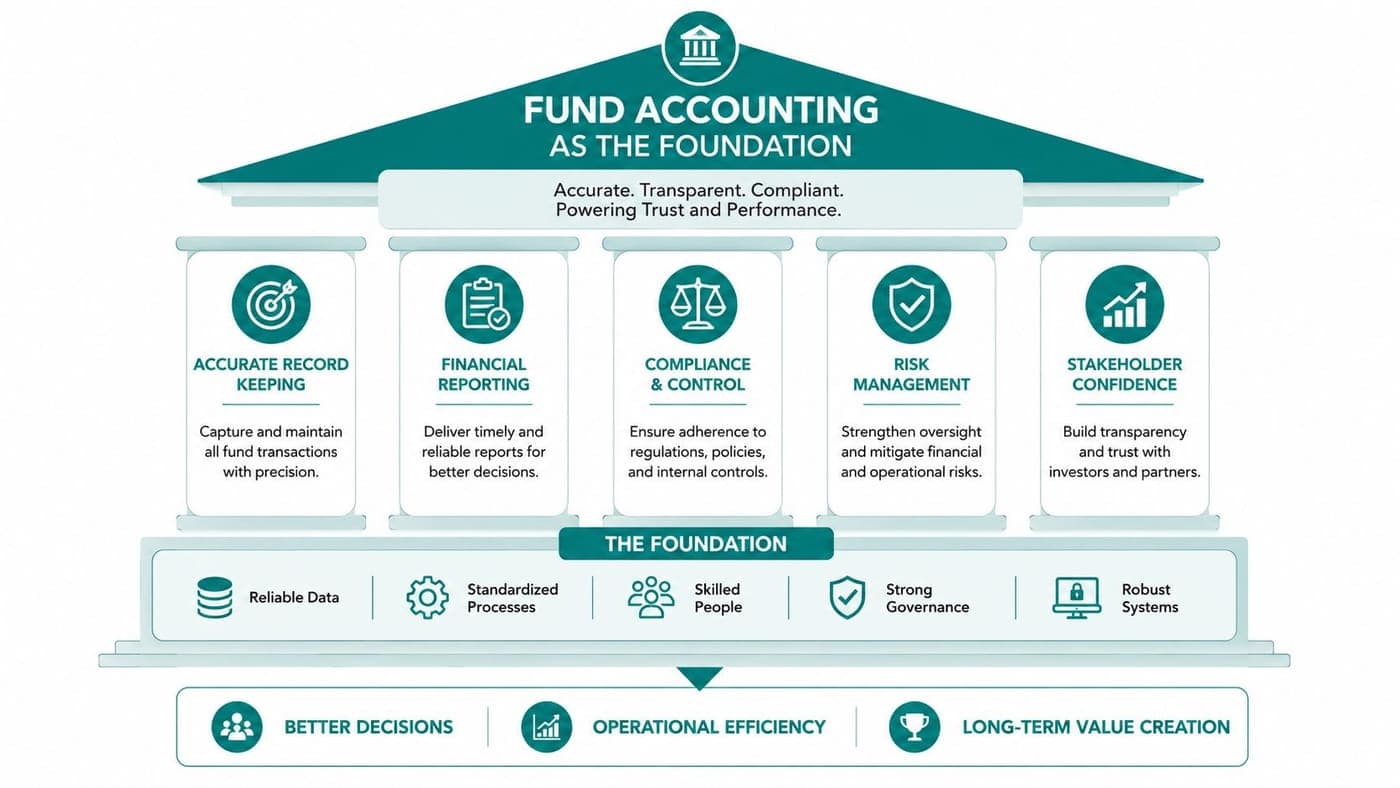
Fund accounting answers four questions for every dollar: who provided it, what restrictions apply, what has been spent, and what remains available. That's different from placing transactions into classes inside a general-purpose bookkeeping file.
Under FASB ASU 2016-14, effective for fiscal years beginning after December 15, 2017, nonprofit reporting distinguishes net assets with donor restrictions from net assets without donor restrictions under ASC Topic 958. The framework also connects to functional expense disclosure and the Statement of Functional Expenses, alongside the Statement of Financial Position, Statement of Activities, and Statement of Cash Flows.
Think of your cash drawer as holding color-coded notes. A blue note might support general operations, while a red note belongs to a specific scholarship or grant. You may have enough cash overall, but you can't spend the red note on a blue purpose because the bank balance looks healthy.
Build the structure before recording transactions
Your chart of accounts should make restrictions visible without forcing staff to reconstruct history. At minimum, define:
- Net asset classes: Separate amounts with donor restrictions from amounts without donor restrictions.
- Fund codes: Identify the purpose or project receiving and spending resources.
- Grant IDs: Connect awards to approved budgets, reimbursement requests, and funder reports.
- Program codes: Show which service area incurred the expense.
- Functional categories: Classify costs as program services, management and general, or fundraising.
This structure reflects the broader nonprofit accounting framework in ASC Topic 958 and related standards, including guidance for exchange transactions, leases, donated nonfinancial assets, and conditional contributions. The rules recognize that nonprofits handle grants, pledges, donated services, and restricted gifts differently from commercial firms.
Make restrictions operational
A restriction shouldn't live only in an award letter or donor email. Record its purpose, amount, timing, supporting documentation, spending activity, and remaining balance at the transaction level. Restricted-fund guidance for nonprofits emphasizes separate tracking because real-time visibility reduces accidental overspending and improves grant drawdown accuracy.
When the condition is satisfied, release the amount from net assets with donor restrictions to net assets without donor restrictions. That release should be supported by documentation, not handled as a year-end estimate.
Read this guide to fund accounting for nonprofits if your current system relies on classes that don't preserve restriction logic. The payoff is practical: cleaner statements, a calmer audit, and better conversations with funders because your numbers answer questions directly.
Budgeting and Cash-Flow Planning That Actually Works
Your annual budget and your cash forecast answer different questions. The accrual program budget asks whether planned revenue covers planned expenses over the year. The rolling cash forecast asks whether money will arrive before each payment becomes due.
You need both. A grant may appear as a receivable in the accrual budget while reimbursement waits for approved expenses and supporting documents. A program can therefore be fully funded in the annual plan and still face a payroll shortage this week.
Keep the annual budget and cash forecast separate
The annual budget should show revenue by source, program commitments, functional allocation, and the full operating year. The cash forecast should show starting cash, expected receipts by week, scheduled disbursements, ending cash, and the minimum reserve line.
Group expected receipts by restriction. That helps you see whether incoming money can support the payment beside it. Don't count a restricted receipt as available for general payroll unless its terms permit that use.
| Week | Starting Cash | Unrestricted Receipts | Restricted Receipts | Total Disbursements | Ending Cash | Cumulative Reserve |
|---|---|---|---|---|---|---|
| Week 1 | Opening balance | Expected amount | Expected amount | Scheduled amount | Starting cash plus receipts minus disbursements | Reserve after Week 1 |
| Week 2 | Prior ending cash | Expected amount | Expected amount | Scheduled amount | Starting cash plus receipts minus disbursements | Reserve after Week 2 |
| Week 3 | Prior ending cash | Expected amount | Expected amount | Scheduled amount | Starting cash plus receipts minus disbursements | Reserve after Week 3 |
| Week 4 | Prior ending cash | Expected amount | Expected amount | Scheduled amount | Starting cash plus receipts minus disbursements | Reserve after Week 4 |
| Week 5 and beyond | Prior ending cash | Update weekly | Update weekly | Update weekly | Recalculate weekly | Recalculate weekly |
Update the forecast every Monday with actual receipts, actual payments, and revised assumptions. Your board doesn't need false precision. It needs an honest view of the next several weeks, including the date when cash becomes uncomfortable.
The cash reserves ratio uses unrestricted cash and liquid investments divided by average monthly expenses, excluding noncash items such as depreciation. Nonprofit financial ratio guidance commonly frames the result as months of runway, with a target of about three to six months. Treat that as a planning reference, not a substitute for short-interval forecasting.
Use this nonprofit budget template for Excel to organize the annual view, then maintain a separate cash forecast that reflects actual payment timing.
Restricted Funds and Grant Management Day to Day
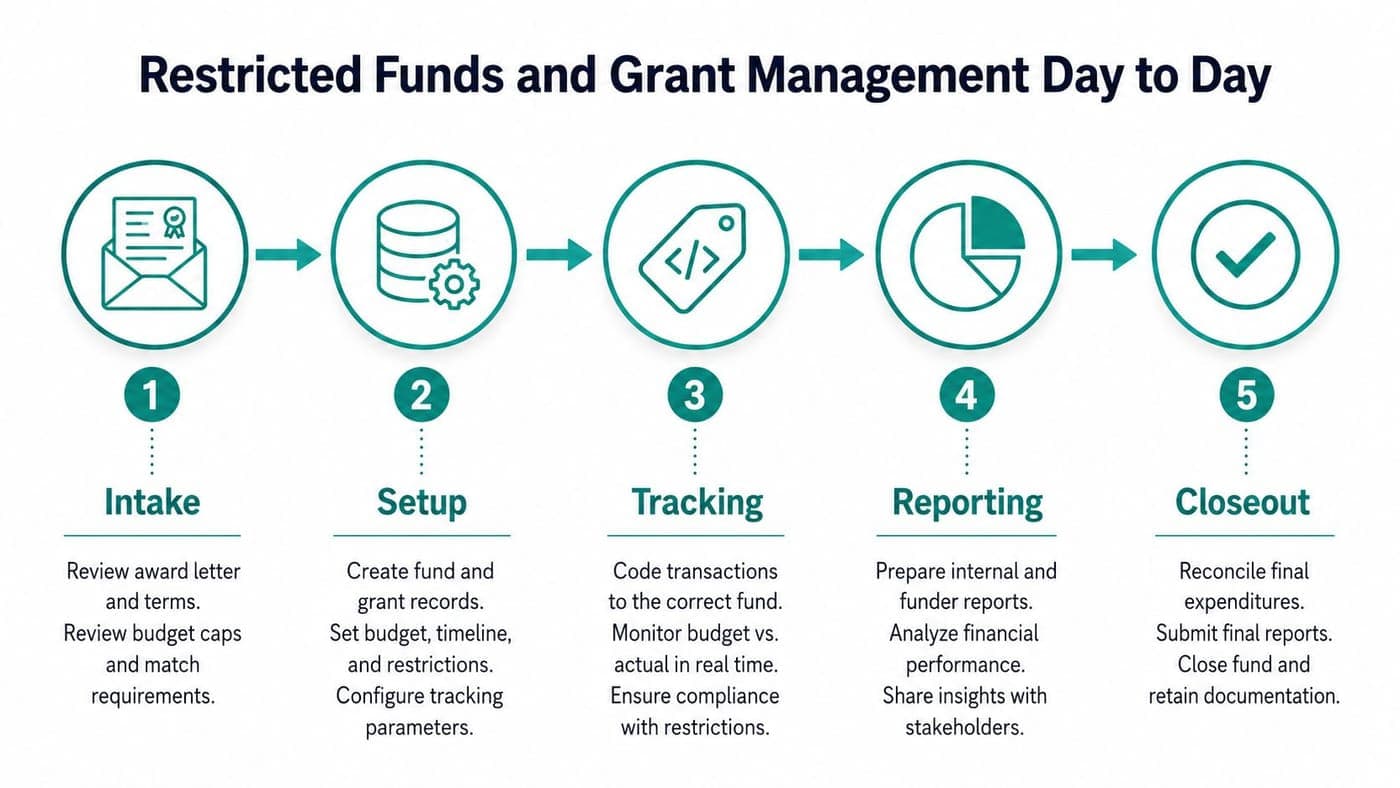
Grant management begins when the award arrives, not when the report is due. A reliable process moves through intake, setup, transaction tracking, drawdowns, reporting, and closeout without asking staff to rebuild the grant history later.
Start with the award letter. Confirm the approved budget, spending period, match requirements, indirect-cost treatment, reporting dates, reimbursement rules, and any prohibited expenses. Then create a distinct grant record connected to the relevant fund, program, budget lines, and responsible manager.
Make every stage visible
At intake, assign one person to interpret the terms and another to confirm the setup. During tracking, code salary, supplies, contractor costs, and shared expenses when they occur. Don't wait until the report deadline, when staff may no longer remember which activity supported the charge.
A practical example is a $50,000 program grant supporting staff time, supplies, and indirect costs. The amount alone tells you very little. You must know how much belongs to each approved budget line, which employees worked on the program, what documentation supports their time, and whether the funder permits each cost. If staff code the entire expense to a generic program class, the problem may remain hidden until the funder requests a detailed report.
Spreadsheets tend to break when budgets change mid-grant, employees divide time across awards, or funder reports use categories that differ from your internal chart of accounts. They also create risk when drawdowns depend on manually matching invoices, payroll records, and bank activity.
Guidance on donor-restricted funds stresses ongoing monitoring rather than year-end attention. Your team should review balances monthly, confirm that releases are supported, and compare internal activity with every funder report before submission.
A grant is not just revenue. It's a set of permissions, deadlines, evidence, and remaining obligations.
For each drawdown, retain the request, eligible expense detail, payroll or invoice support, approval record, and payment confirmation. When conditions are met, document the release from restricted net assets. A clear grant management best-practices process keeps finance, development, and program staff working from the same record.
Reporting and Compliance Without the Year-End Panic
Compliance becomes manageable when each month produces the records that year-end requires. Your close should reconcile bank activity, update restricted balances, review functional allocations, investigate variances, and preserve support for significant transactions.
Form 990 reporting depends on that discipline. The IRS Form 990 instructions require organizations using fund accounting to show current restricted and unrestricted fund balances. The IRS also reports total functional expenses on Part IX, line 25, by adding lines across the required columns.
Treat functional expenses as management information
Form 990 Part IX separates expenses into program services, management and general, and fundraising. Shared costs such as rent, utilities, and salaries need a reasonable, consistent allocation method, as described in functional expense reporting guidance.
Suppose shared monthly rent is $10,000. If square footage supports the allocation below, record the split consistently and retain the calculation:
| Function | Square Footage | Allocation % | Monthly Amount |
|---|---|---|---|
| Program services | Assigned program area | 60% | $6,000 |
| Management and general | Assigned administrative area | 25% | $2,500 |
| Fundraising | Assigned development area | 15% | $1,500 |
| Total | All shared space | 100% | $10,000 |
The point isn't to make program expenses look favorable. It's to represent how your organization uses resources. Changing the method whenever a funder asks a difficult question creates more risk than a transparent allocation that management applies consistently.
Keep three compliance calendars. The first covers IRS filings, including Form 990. The second covers state charitable registrations. The third covers donor and grant reports, which may use different definitions and deadlines.
Your board finance committee should receive the Statement of Financial Position, Statement of Activities, cash forecast, restricted-fund schedule, budget-to-actual report, and explanations for material variances. Auditors and funders will ask questions more easily when those reports agree with one another.
Internal Controls and Finance Policies That Protect You
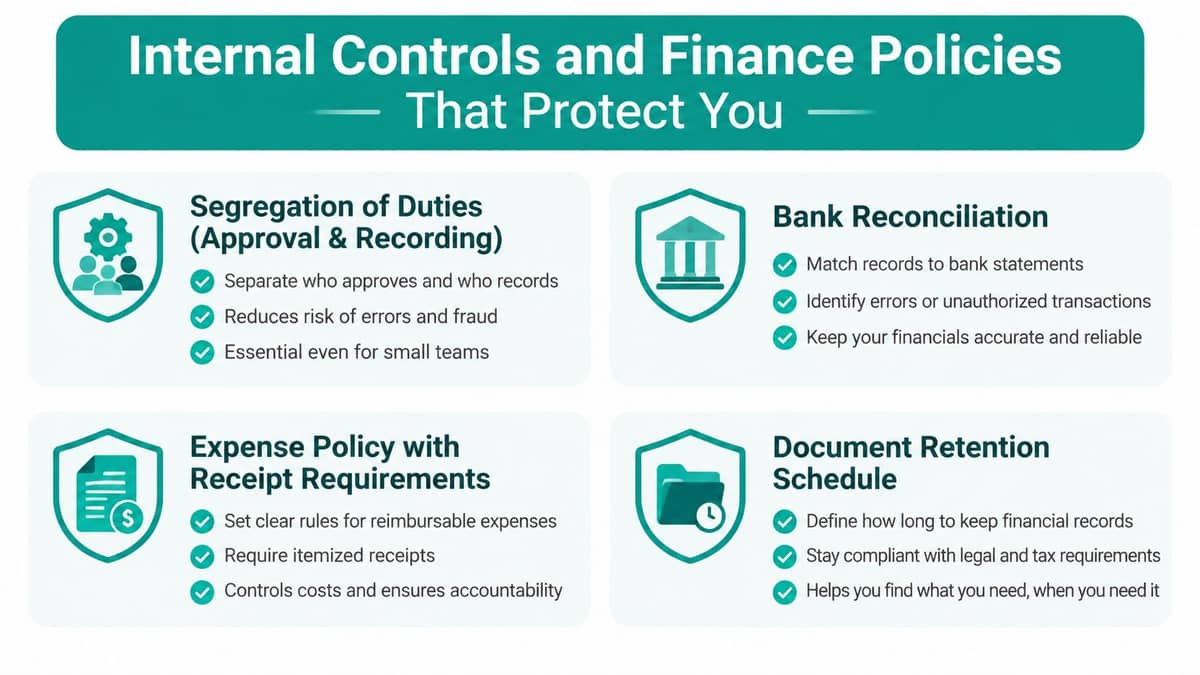
Internal controls protect the executive director as much as they protect the organization. They create a record showing who approved a payment, who recorded it, who reviewed the bank reconciliation, and why the expense served the mission.
A small team still needs separation. If one employee receives money, records the deposit, approves the invoice, and reconciles the bank account, an error can pass unnoticed. You may not have enough staff for perfect separation, so assign compensating reviews instead.
Use practical safeguards for small teams
The board treasurer can review monthly bank reconciliations and unusual transactions. A second approver can review payments above a board-approved threshold. Program managers can confirm delivery before finance pays an invoice, while the executive director reviews payroll changes.
Your written policy set should include:
- Cash handling: Prevents missing deposits, unclear custody, and unexplained differences between receipts and bank activity.
- Expense reimbursement: Requires receipts, business purpose, approval, and timely submission, reducing audit disputes.
- Credit card use: Defines permitted purchases, documentation, limits, and review, which helps resolve disputed charges.
- Procurement: Establishes vendor selection and conflict checks, reducing the risk of favoritism or kickback accusations.
- Conflict of interest: Requires disclosure and recusal when personal relationships could influence a decision.
- Document retention: Preserves award letters, receipts, approvals, payroll support, and donor records after staff changes.
- Gift acceptance: Sets boundaries for unusual, restricted, in-kind, or difficult-to-value gifts.
A policy earns its keep only when staff can follow it on a busy Tuesday.
Review policies when a process changes, not only when an auditor asks. Your finance lead should maintain the procedures, program managers should understand their approval responsibilities, development staff should understand restrictions, and the board should oversee exceptions.
Use this nonprofit internal controls guide to test whether your current procedures protect the organization or merely describe good intentions.
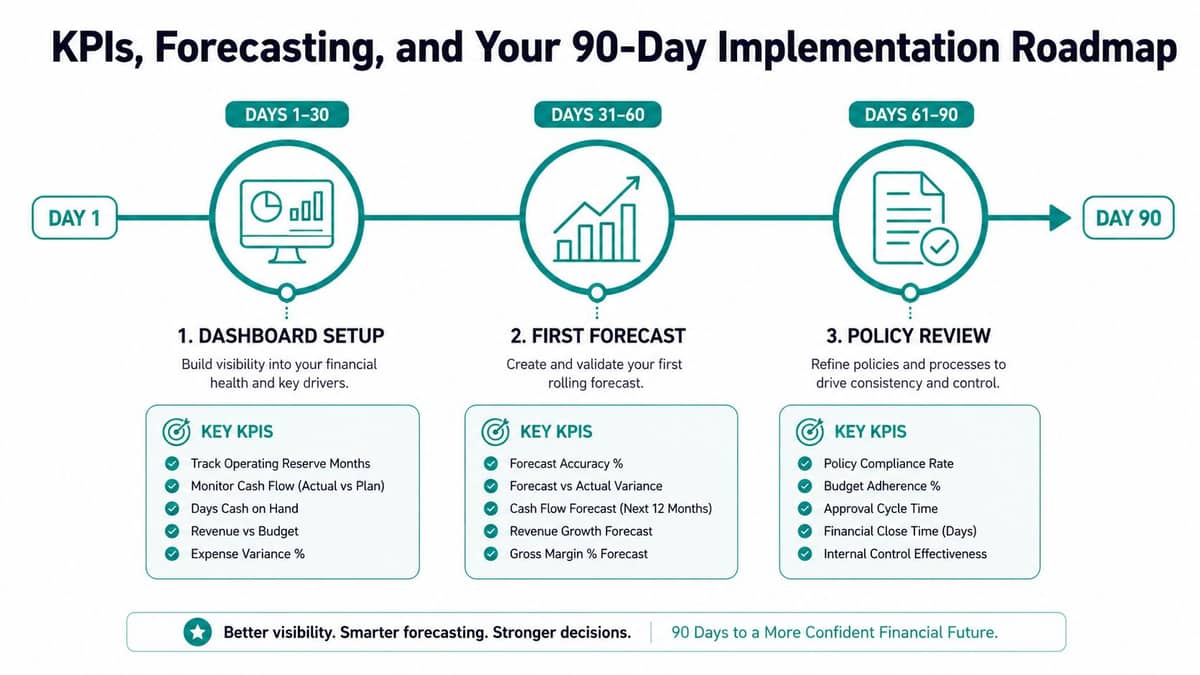
KPIs, Forecasting, and Your 90-Day Implementation Roadmap
Your dashboard should warn you before a decision becomes a crisis. A monthly scorecard that explains last month's results is useful, but it won't tell you whether a delayed grant creates a payroll problem next week.
Track a small set of measures with named owners and written trigger points:
- Operating reserve months: Compare unrestricted liquidity with average monthly operating expenses.
- Unrestricted cash: Watch the amount available for general operations, separate from restricted balances.
- Budget variance: Investigate material differences by program, revenue source, and function.
- Grant reimbursement aging: List claims submitted, approvals pending, and receipts expected.
- Current ratio: Compare current assets with current liabilities to understand near-term obligations.
- Days of cash on hand: Translate liquidity into an operating timeframe your board can understand.
- Functional expense mix: Review program, management, and fundraising costs without treating one ratio as a universal quality score.
The reserve benchmark deserves a practical warning. The 2025 Nonprofit Finance Fund survey reports that 36% of nonprofits ended 2024 with an operating deficit, while 52% had three months or less cash on hand and 18% had one month or less. Many organizations therefore need scenario planning and board trigger points, not just an aspirational reserve target.
Use two forecasting horizons
Maintain a rolling 13-week cash forecast for immediate payment decisions. Separately, maintain a 12 to 18 month scenario forecast for hiring, program expansion, grant concentration, and revenue risk.
Build three scenarios:
- Committed: Include signed awards, reliable recurring revenue, known payroll, and approved contracts.
- Downside: Delay uncertain receipts, increase expected costs where evidence supports it, and identify decisions you'd pause.
- Growth: Add only funding and staffing assumptions you can explain clearly.
Don't hire a large finance team before fixing the process. Standardize the close, fund setup, approvals, allocations, and reporting first. Then choose a general ledger and reporting platform designed for fund accounting rather than forcing nonprofit reporting into a commercial structure.
Roll out the discipline in 90 days
| Period | Key Actions | Outputs |
|---|---|---|
| Days 1 to 30 | Reconcile accounts, document funds and grants, establish KPI baselines, adopt close and variance checklists | Reliable opening balances, documented structures, initial dashboard |
| Days 31 to 60 | Formalize approvals, expense allocations, grant intake, drawdowns, and management reporting | Written policies, consistent workflows, monthly reporting pack |
| Days 61 to 90 | Automate bank feeds and report exports, review restricted releases, test approvals, present scenarios | Tested controls, board dashboard, committed, downside, and growth forecasts |
Assign responsibility across the executive director, finance lead, program managers, development staff, and board finance committee. Your donor CRM should connect gifts and acknowledgements to finance, volunteer management should connect service activity to programs, and event and marketing tools should avoid creating separate records that finance must reconcile manually.
For a small nonprofit, church, or school, an all-in-one platform can reduce duplicate entry when it combines accounting, CRM, volunteers, events, marketing, online giving pages, and team communication. AlignMint includes true fund accounting, restricted and unrestricted tracking, grant and program records, donor and volunteer tools, Minty for questions about your organization's data, plan-based access without per-seat fees, and a free tier for nonprofits under $100K. Fiscal sponsors should also check whether their system can separate sponsored projects, consolidate reporting, and preserve sponsor control over donated funds.
Fiscal sponsorship requires clear agreements. The National Council of Nonprofits guidance on fiscal sponsorship explains that sponsors generally control donated funds and carry legal compliance responsibilities for receiving, reporting, and acknowledging charitable donations.
Don't ask your board to approve a dashboard you can't explain. Give them the current position, the next cash pressure, the assumptions behind each scenario, and the decision that needs attention.
AlignMint brings fund accounting, donor management, volunteer coordination, events, marketing, online giving, and team communication into one nonprofit operations platform. Visit AlignMint to see whether its restricted-fund tracking, Minty, plan-based access, and free tier for nonprofits under $100K fit your organization's next ninety days.
Ready to try AlignMint with your nonprofit?
Start free — set up donor tools, giving pages, and Minty. Upgrade when you need accounting.