

The bank statements are beside the grant award letters, the board packet is due Friday, and someone wants to know why a restricted gift appears in the wrong column. Your nonprofit accounting system should make those answers easier, not force your team to rebuild them from spreadsheets, emails, and separate software.
This guide connects fund accounting, donor trust, cash survival, functional reporting, and board confidence. It also shows where an integrated platform can remove the manual hand-offs that consume small nonprofit teams.
Quick Answer: Nonprofit Accounting
Nonprofit accounting tracks which money is available for which purpose, not only whether revenue covered expenses. Fund accounting, restriction releases, and functional expenses should come from the same ledger your board packet uses.
Start with fund accounting and restricted vs unrestricted funds. For software comparisons, see best accounting software for nonprofits.
Why Nonprofit Accounting Feels Harder Than It Should
Month-end arrives with a familiar scene: the bank reconciliation is open, donor records need checking, a program manager is searching for grant expenses, and the board packet is waiting. Each person may have accurate information, yet the team still spends hours assembling one reliable view.
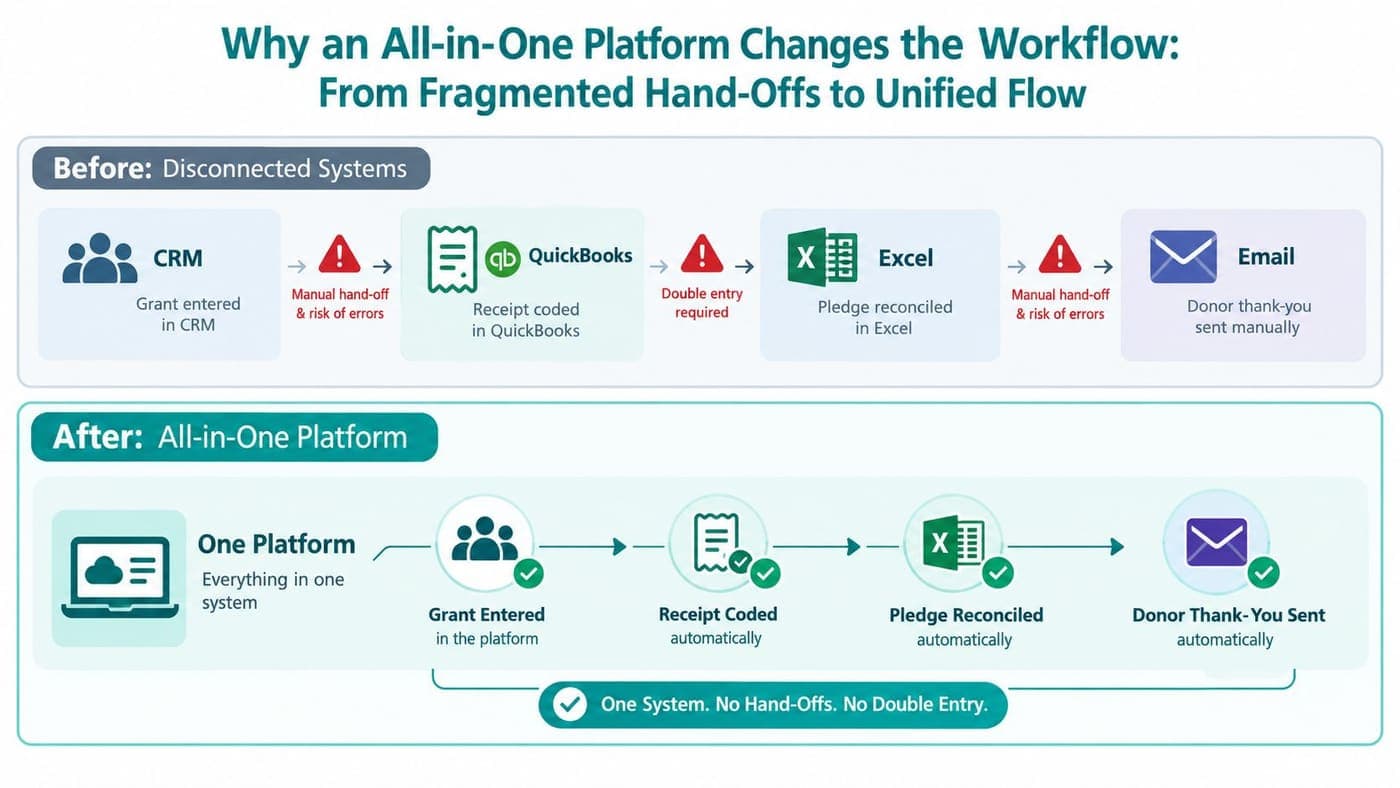
The strain usually comes from the hand-offs. A donation enters the CRM, a receipt is coded in QuickBooks, a pledge is adjusted in Excel, and a grant balance lives in another tracker. Every manual bridge can create a duplicate record, an outdated figure, or a missed restriction.
Practical rule: If your team copies one financial fact into several systems, the reporting process needs attention.
Nonprofit accounting answers more than whether revenue covered expenses. It must also show which money is available, what a donor or grant permits, and how program costs support the organization's purpose. A standard profit-and-loss report may show the overall result while hiding whether a donor-funded program used its resources as promised.
The pressure behind the close
A restricted donation in the wrong category can affect donor reporting, grant compliance, and board discussions at once. An unreconciled deferred grant balance can make available cash appear stronger than it is. Money recorded in the books may still be unavailable for payroll or general operations.
That is why accurate coding and allocation are operating controls, not clerical details. They connect the ledger to cash decisions, funding commitments, and the explanations leaders must give to the board.
A more useful definition
Nonprofit accounting works like a map of promises and resources. It keeps donor intent visible, helps funders follow their awards, and gives auditors a defensible trail from receipt to final use.
A connected platform can reduce the manual bridges between fundraising, accounting, expense management, and reporting. Instead of rebuilding the same story from separate files, a small team can maintain records that flow into the close and support board-ready answers.
When fund accounting, donor records, allocations, and close procedures work together, annual reporting requires less last-minute repair. The result is more than easier compliance. Leaders gain a clearer view of spendable cash, staff recover time from repetitive entry, and donors receive information the organization can support with its records.
What Fund Accounting Actually Is
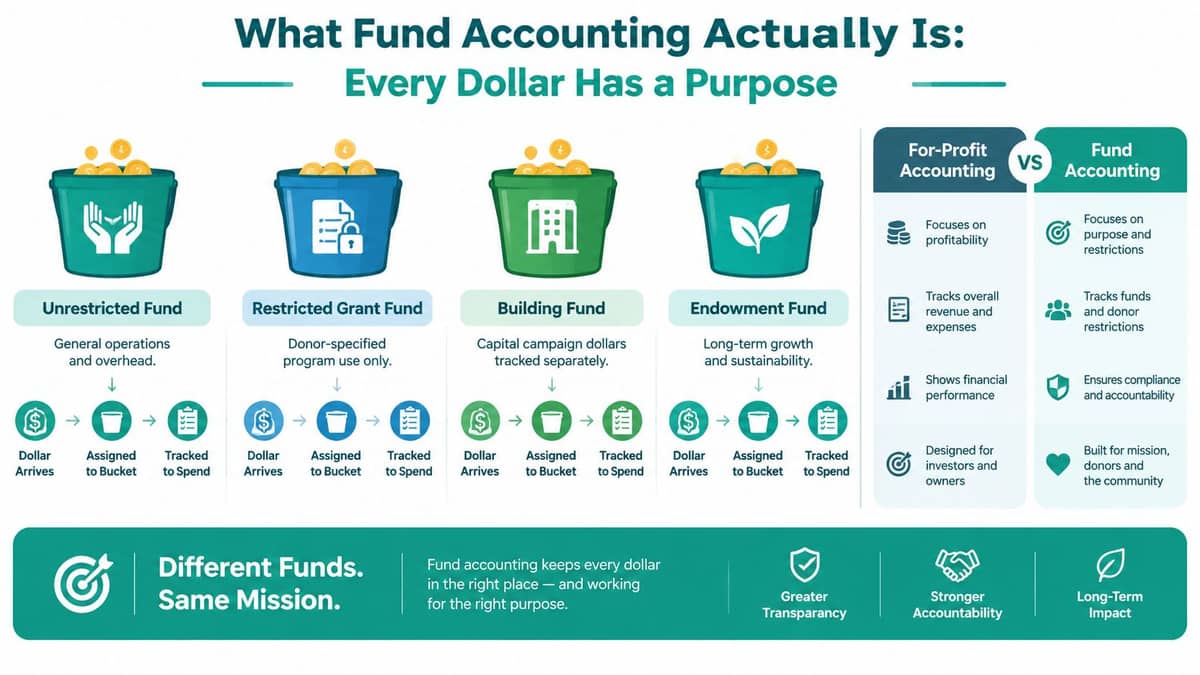
Fund accounting treats money like separate buckets, even when the money sits in one physical bank account. Each bucket represents a purpose, restriction, grant, program, or operating need, and every dollar stays connected to that purpose from arrival through spending.
For-profit accounting usually centers on revenue, expenses, and net income. Nonprofit accounting must answer an additional question: which resources are available for which purposes?
A donor's unrestricted gift can support general operations. A grant may pay only for a named program. An endowment may preserve its principal while allowing investment income to support a designated activity.
Start with the buckets
The traditional explanation uses unrestricted, temporarily restricted, and permanently restricted funds. Under current U.S. GAAP external reporting, ASU 2016-14 simplified net assets into without donor restrictions and with donor restrictions, replacing the older temporary and permanent split. You can still use the traditional terms when discussing the underlying donor intent.
- Unrestricted funds: Your organization can direct these resources toward eligible operating or mission expenses.
- Temporarily restricted funds: The donor or grantmaker has specified a purpose or time condition that must be satisfied.
- Permanently restricted funds: The principal remains restricted, commonly through an endowment arrangement, while permitted returns may support a stated purpose.
Under U.S. GAAP, net assets replace equity as the balance-sheet category describing the organization's residual interest. The overview of nonprofit fund accounting and financial statements explains how donor restrictions shape this reporting model.
One bank account, many responsibilities
A single checking account can contain operating cash, grant cash, building campaign proceeds, and funds held for a sponsored project. The bank statement tells you how much cash exists, but it doesn't tell you how much is available for each purpose.
That's why your chart of accounts and fund tracking must carry the restriction information separately. A useful nonprofit chart of accounts and fund accounting guide can help your team decide which dimensions belong in the ledger and which belong in supporting records.
The most important test is straightforward: was the money used the way it was given? Fund accounting makes that question answerable without reconstructing history from memory.
Restricted vs Unrestricted Funds in Practice
Restricted and unrestricted funds often look similar in the bank account, but they behave differently in your books. The difference comes from donor-imposed purpose or timing, not from the name on the checking account.
An annual fund gift with no donor instructions generally supports unrestricted operations. A donor who specifies “for youth scholarships” creates a restricted resource tied to that purpose. An endowment gift may preserve the principal permanently, subject to the governing documents and applicable accounting treatment.
Recognize the promise correctly
A restricted contribution is recognized when your organization receives an unconditional commitment, even if the related program spending happens later. A conditional promise depends on a future barrier or requirement, so your finance team must review the agreement before recognizing it as an unconditional contribution.
The guide to restricted-fund tracking offers a practical framework for connecting donor language, accounting entries, and supporting documentation.
| Scenario | Fund Type | Recognition Trigger | Release Entry Needed? |
|---|---|---|---|
| Annual gift with no stated purpose | Without donor restrictions | Receipt or unconditional commitment | No donor restriction release |
| Gift designated for youth scholarships | With donor restrictions | Unconditional commitment | Yes, when the documented purpose is met |
| Grant tied to a program deliverable | With donor restrictions or conditional treatment, based on the agreement | Unconditional commitment, unless conditions remain | Yes, when the restriction is satisfied |
| Endowment principal | With donor restrictions | Unconditional commitment | Principal remains restricted under its terms |
Record the release, not just the expense
Suppose a grant is recorded as net assets with donor restrictions when received. When your organization completes the funded program or satisfies the stated time condition, you record a release from restriction, transferring the amount to net assets without donor restrictions before recognizing the related expense.
That sequence preserves evidence that the restriction existed, was tracked, and was satisfied. The restricted-funds management guidance describes this recognition and release logic in practical terms.
Common errors usually begin with an operational shortcut:
- Spending restricted cash on operations: Cash availability doesn't equal legal or donor availability.
- Releasing funds too early: A budgeted expense isn't always proof that the donor condition was met.
- Using weak sub-ledgers: A year-end balance without transaction-level support won't answer a grant reviewer's questions.
Clean restricted-versus-unrestricted discipline makes Form 990 reporting, audit preparation, and donor statements defensible rather than defensive.
Statements of Functional Expenses and Form 990 Readiness
A program director may see one payroll bill, while the finance team must explain three kinds of work inside it. Natural classification identifies what the organization purchased, such as salaries, supplies, occupancy, or professional fees. Functional classification identifies why it incurred the cost, placing it in program services, management and general, or fundraising.
U.S. GAAP ASC 958 requires not-for-profit entities to present expenses by both function and nature. The information may appear on the face of the financial statements, in the notes, or in a separate statement of functional expenses. Form 990 Part IX uses the same basic structure through columns for these functions. Organizations filing the applicable Form 990 presentation under sections 501(c)(3) and 501(c)(4) complete the relevant columns. The IRS Form 990 PDF is the primary reference for the form's structure.
Map each expense in two directions
Consider an employee at a food bank. Part of the employee's time coordinates food distribution, part maintains staff records, and part supports a donor campaign. The payroll remains one natural expense line, but the related cost is allocated among the functions receiving that work.
| Expense Line (Natural) | Program Services | Management & General | Fundraising |
|---|---|---|---|
| Salaries | Staff time delivering or supervising services | Finance, human resources, and executive administration | Development and donor communications |
| Supplies | Food, teaching materials, or client-service supplies | Office and governance supplies | Campaign and event materials |
| Occupancy | Space used directly for service delivery | Administrative office space | Fundraising event or development space |
Charge an expense directly when it belongs entirely to one function. For shared costs, apply a consistent, documented method. Staff time studies can support payroll allocation, square footage can support occupancy, and usage records can support technology or supplies.
Keep the evidence with the allocation
An allocation policy should identify the method, the reviewer, and the records supporting each entry. Timesheets, floor plans, payroll coding, invoices, grant budgets, and approval records can show why the distribution was reasonable. That evidence also gives the board and donors a clearer view of how resources support the mission.
Reconcile the allocation across the full reporting set. The functional expense statement, statement of activities, net asset releases, in-kind contributions, joint costs, and Form 990 Part IX should present one consistent financial story. A mismatch signals a close-process control gap and can create avoidable filing work.
For practical guidance on organizing supporting schedules, review these UAE financial statement preparation tips. The jurisdiction differs, but the discipline of assembling clear support applies broadly.
A Form 990 checklist can help finance and leadership teams find missing schedules before filing becomes urgent. A connected accounting workflow reduces the manual bridges between the ledger, allocation schedules, financial statements, and Form 990, leaving a smaller team more time to protect cash and answer board questions.
How Generic Tools Compare to True Fund Accounting
QuickBooks Desktop, QuickBooks Online, Excel, and standalone grant trackers can all support a nonprofit at an early stage. QuickBooks offers familiar bookkeeping and reporting, while Excel gives you flexibility for budgets, schedules, and one-off analysis.
The question is not whether these tools work. It's whether your process still works when funds, programs, grants, locations, and donor conditions multiply.
Compare the capabilities that matter
QuickBooks classes or locations can approximate fund tracking, especially when your organization has simple reporting needs. They don't automatically create a complete fund-accounting model, and complex release entries may still require manual controls and outside schedules.
Excel can track almost anything if one person maintains it carefully. That flexibility becomes a risk when the workbook becomes the only place that explains restricted balances, pledge changes, or grant spending.
| Tool | Fund Accounting Depth | Grant Restriction Tracking | Functional Reporting | 990 Readiness |
|---|---|---|---|---|
| QuickBooks Desktop | Classes and accounts can approximate fund views | Often depends on separate procedures and schedules | Possible with disciplined coding | Requires review and report preparation |
| QuickBooks Online | Classes, locations, and accounts support dimensions | Suitable for simpler arrangements, with manual work for complex releases | Available through configured reports | Requires reconciliation and mapping |
| Excel | Flexible tracking, but dependent on manual maintenance | Possible through workbooks and controls | Customizable, though difficult to keep synchronized | Useful as a support schedule, not a single source of truth |
| Standalone grant tracker | Focused on award details and compliance schedules | Strong for the tracked grant, separate from the ledger | Limited outside its own reporting scope | Requires ledger reconciliation |
| Fund-native platform | Funds, grants, programs, and restrictions modeled together | Designed to carry restrictions through transactions and releases | Built around multiple reporting dimensions | Can reduce manual report assembly when configured correctly |
Choose based on complexity
You can reasonably stay with generic tools if you have one program, one fund, and one restricted grant. Once those elements multiply, the manual bridges become an executive burden rather than a bookkeeping detail.
Before changing systems, review your chart of accounts, reporting calendar, approval controls, and grant agreements. This guide to choosing accounting software can help you compare those requirements without treating brand familiarity as a complete solution.
QuickBooks remains a capable general accounting product, and Excel remains useful for analysis. AlignMint is one fund-native option that combines accounting, CRM, volunteers, events, and marketing, with true fund accounting rather than QuickBooks classes, a free tier for nonprofits under $100K, plan-based access without per-seat fees, and Minty for questions about your recorded data.
Why an All-in-One Platform Changes the Workflow
Cost of nonprofit accounting often appears between systems. A grant enters the CRM, a receipt gets coded in QuickBooks, a pledge is reconciled in Excel, a thank-you email is drafted in Gmail, and a campaign is tracked in Mailchimp.
Every hand-off asks someone to copy, check, or remember something. That work may not appear as an accounting expense, but it consumes the attention your finance and development teams need for decisions.
Follow one gift through the organization
A connected workflow starts when the donor gives. The system records the gift, tags the correct fund, flags a restriction, generates the receipt, updates the donor profile, and queues an impact message.
The same record can inform finance, development, programs, and leadership. Your volunteer coordinator can see relevant engagement history, your events team can work from the same supporter record, and your marketing staff can communicate without exporting donor lists.
Reduce the bridges around the close
When the gift already exists in the general ledger and CRM, your team doesn't need to re-enter it during month-end. Fund balances remain connected to the original transaction, and functional reporting can draw from the same coded activity rather than a separate spreadsheet.
The operational benefit isn't a promise that software removes judgment. Your team still needs clear policies, approvals, and review. The benefit is that accountants spend less time chasing mismatched records and more time advising you about cash, grants, and program choices.
An all-in-one platform can also support donor management, volunteer management, events, online giving pages, marketing, and team communication alongside accounting. For churches and faith-based organizations, that may mean connecting donations with ministries and volunteers. For schools, it may mean aligning grants, events, and family communications. For fiscal sponsors, it may mean preserving project-level records while maintaining consolidated oversight.
A Repeatable Monthly and Year-End Close Checklist
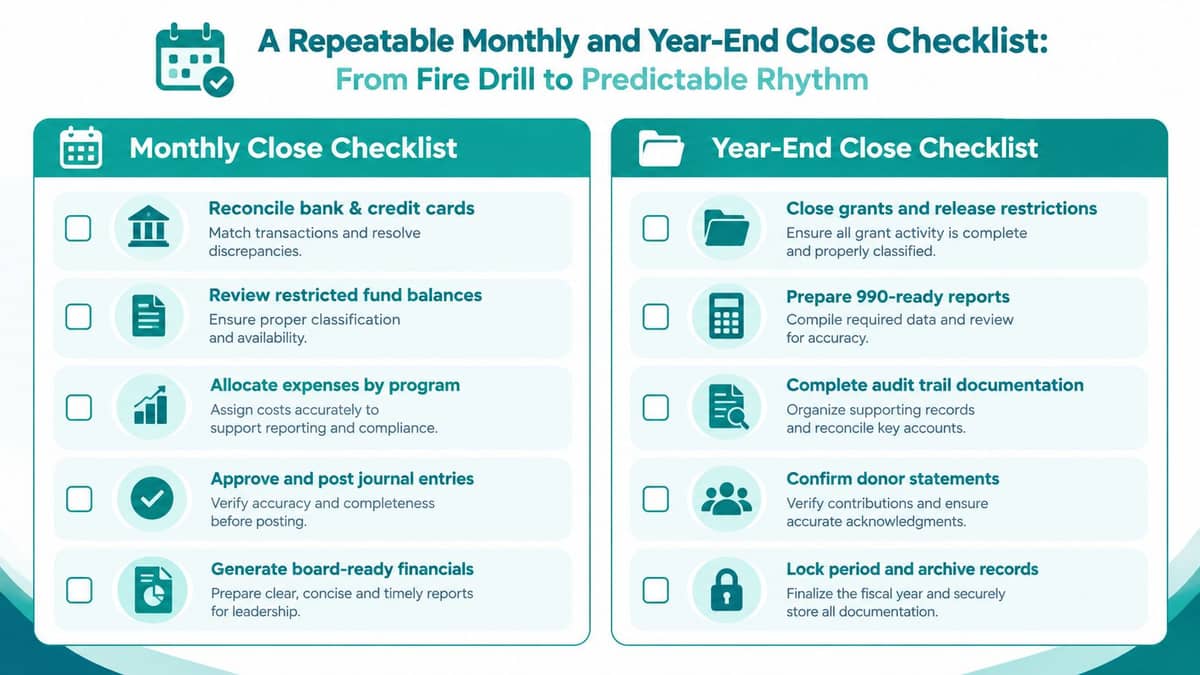
A predictable close gives your board better information and gives your team fewer emergencies. Assign each task to a person, identify the supporting record, and define the warning sign that requires investigation.
Monthly close rhythm
Your monthly checklist should include:
- Bank and card reconciliations: Finance owns the reconciliation, using statements and transaction detail. Stop if unreconciled items remain unexplained.
- Restricted fund review: Finance and program leaders compare balances with grant budgets and donor agreements. Stop if spending exceeds an approved purpose.
- Pledge and grant aging: Development confirms pledge status, while finance reviews receivables and award schedules. Stop if an expected payment lacks documentation.
- Payroll allocation review: Finance checks staff coding against current duties, timesheets, or approved allocation methods. Stop if program assignments changed without updated support.
- Board cash snapshot: The executive director and finance lead review available cash, restricted cash, near-term obligations, and material variances. Stop if restricted resources are being treated as operating liquidity.
The month-end close checklist can give your team a shared starting point for these recurring controls.
Year-end additions
Year-end adds several records that deserve named owners:
- Functional expense verification: Finance confirms natural-to-functional mappings and supporting allocation schedules.
- Audit file assembly: Finance gathers reconciliations, grant agreements, donor records, board minutes, and journal-entry support.
- Form 990 preparation triggers: Leadership confirms which schedules, disclosures, and supporting reports require review.
- 1099 issuance: Finance reviews contractor records and prepares required filings.
- Donor acknowledgment archive: Development confirms that receipts and acknowledgments match the final gift records.
Period close works best when finance, programs, development, and leadership share responsibility. A missing grant document isn't only a finance problem, just as an incorrect donor designation isn't only a development problem.
Bringing It All Together and Your Next Step
Clean nonprofit accounting makes donor trust visible. It shows your board what resources are available, gives funders a traceable record of their awards, and creates an audit trail that can withstand a grant review.
The strongest operating model connects fund accounting, functional reporting, Form 990 preparation, donor management, volunteer activity, events, marketing, and team communication. Your organization spends less time rekeying information, finds fewer reconciliation gaps, and can respond sooner when cash tightens or grant timing changes.
Liquidity deserves particular attention because grant volatility can turn an accounting issue into a survival issue. Coverage of a 2025 federal grant freeze affecting more than 100,000 nonprofits describes cancellations, cash-flow disruption, and reserve stress, especially for organizations with high grant dependence. The nonprofit reporting and grant-volatility discussion also points toward scenario budgeting, grant concentration review, and practical short-term decisions.
Your board doesn't need another collection of impressive dashboards. It needs reliable answers about restricted balances, functional spending, upcoming obligations, and the choices available to protect the mission.
AlignMint brings accounting, true fund tracking, donor records, volunteers, events, online giving, marketing, and team communication into one platform. Its Minty assistant can answer questions from your recorded nonprofit data, while plan-based access and a free tier for nonprofits under $100K provide a straightforward starting point.
See how AlignMint can connect your fund accounting, donor records, functional reporting, and close process in one workspace. Request a short demo focused on your actual month-end cycle, restricted funds, and board packet, rather than a generic software tour.
Ready to try AlignMint with your nonprofit?
Start free — set up donor tools, giving pages, and Minty. Upgrade when you need accounting.