

Restricted vs. Unrestricted Funds: A Nonprofit Guide
A big gift lands in your inbox, and suddenly everyone has an opinion. The program lead wants to spend it now, the treasurer wants to park it, and the donor letter is vague enough to cause trouble. If you're the executive director, you need a clean answer fast, because the wrong call can distort cash flow, reporting, and trust.
The good news is simple. Restricted vs unrestricted funds isn't just accounting jargon, it's a practical decision about what you may spend, when you may spend it, and how you prove it later. This guide gives you the working rules, the reporting impact, the release process, and the controls that keep you out of audit trouble.
Quick Answer: Restricted vs. Unrestricted Funds
Restricted funds are tied to donor or grant terms, while unrestricted funds can support lawful general operations. Track each category separately, document when restrictions are satisfied, and reconcile balances before reporting to your board or funders.
For the finance workflow behind these balances, see fund accounting. For related reading, review stewardship of donors and Form 990 basics for new nonprofits.
| Dimension | Restricted Funds | Unrestricted Funds |
|---|---|---|
| Donor intent | Tied to a purpose, time period, or asset use | No donor-imposed limit |
| Legal weight | Enforceable if the donor's terms bind the organization | Flexible within lawful operating needs |
| Accounting treatment | Tracked in net assets with donor restrictions | Tracked in net assets without donor restrictions |
| Operational use | Released only when the restriction is satisfied | Available for salaries, rent, technology, reserves, and emergencies |
The Question Every Executive Director Asks After a Big Gift
The room gets quiet when the finance committee opens the letter. The donor praised the youth program, the grant agreement named a general purpose, and the acknowledgment email said “thank you for your support.” Nobody wants to offend the donor, but nobody wants to book the gift wrong either.
That's the moment where directors need a rule, not a debate. The right question isn't whether the gift feels generous, it's whether the donor or grantor attached a condition that legally limits use, because restricted money carries an obligation while unrestricted money gives you operating room. As the stewardship conversation gets more complicated, it helps to keep your records tight and your donor language clear, which is why a practical donor stewardship reference like stewardship of donors belongs in every finance director's toolkit.
What you need to settle first
If the giver can object and demand the money back when you spend it differently, treat it as restricted. If the donor merely expressed a preference, you still need judgment, but you don't automatically have a restriction.
Practical rule: donor intent only becomes a restriction when the terms genuinely bind the organization.
That matters because this isn't a paperwork game. It affects how you book the gift, how you spend it, and how you explain it to your board when the quarter closes and the cash is already spoken for.
What Restricted and Unrestricted Funds Actually Mean
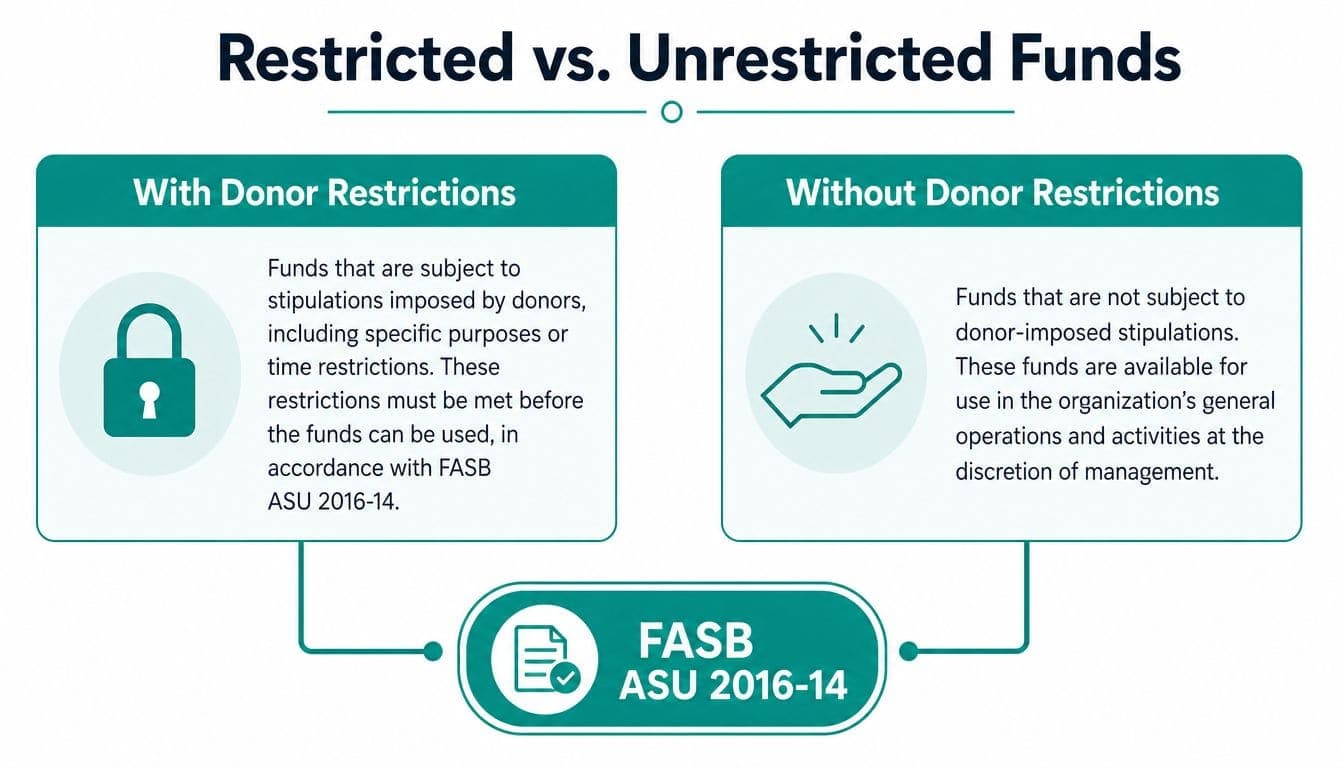
Restricted funds are money donors or grantors have tied to a specific purpose, time period, department, campus, school, project, or asset use. Unrestricted funds have no such limit, so leaders can put them toward payroll, overhead, technology, reserves, maintenance, emergency needs, or a new program that needs immediate support.
The accounting language changed in the years after the FASB update on ASU 2016-14. Nonprofits moved from three net-asset classes to two, net assets with donor restrictions and net assets without donor restrictions, which standardized how restricted balances show up on the statement of financial position. Older software and older filings may still use the older unrestricted, temporarily restricted, and permanently restricted vocabulary, but the current reporting frame is the two-class model. See the accounting shift described in the FASB-based summary of restricted and unrestricted funds, and for a quick reference, see our glossary entry on restricted funds.
The test I'd use at the table
If the resource provider can object and demand the money back when you use it differently, treat it as restricted. That is the cleanest operational test for a busy finance team, and it keeps you from over-classifying every kind note from a donor as a legal encumbrance.
That distinction matters in grant drawdowns, budget setup, and year-end reporting. A promise that sounds generous can still leave you with money you cannot spend on rent, payroll, or a gap in program delivery unless the restriction has been satisfied. Separate records are the only safe way to handle that difference, because once the money is received, the accounting treatment drives how you track it, explain it to the board, and support it in the audit file.
UK charity guidance makes the same point in plainer terms. A donor's non-binding preference is not a restricted fund, and charities need separate records for restricted, designated, and unrestricted funds. If you are sorting through donor language across jurisdictions, review revenue tier disclosure rules can help you think more carefully about how disclosure and classification separate in practice.
A Side-by-Side Look at How They Behave
Restricted money and unrestricted money don't just sit in different buckets. They behave differently in cash planning, board reporting, and grant compliance, and that difference shows up the moment you try to pay a bill.
| Dimension | Restricted Funds | Unrestricted Funds |
|---|---|---|
| Donor intent | Bound to a stated purpose, time period, or capital use | No donor-imposed limit |
| Legal effect | Misuse can create a breach of trust or repayment issue | Leaders can allocate it to general operations |
| Reporting impact | Must be tracked until the restriction is satisfied | Flows straight into operating flexibility |
| Day-to-day use | Not available for any urgent need | Covers salaries, rent, maintenance, and emergency gaps |
The tradeoff you actually feel
Restricted funds protect donor intent, but they reduce flexibility. Unrestricted funds don't solve every problem, but they keep the organization breathing when payroll, repairs, or a funding delay hit at the same time.
That is why many nonprofits budget restricted revenue first and then estimate how much unrestricted money they need to cover the gap. The restricted dollars keep the promise, while the unrestricted dollars keep the doors open.
Bottom line: restricted money is earmarked, unrestricted money is your buffer.
Directors who miss that tradeoff usually don't have a strategy problem. They have a reporting problem, because no one showed them the full cash picture soon enough.
How Restricted Funds Get Released and Reclassified
Restricted money doesn't become unrestricted because someone says so at a staff meeting. It changes status when a real event satisfies the restriction, and that event needs to be documented.
The three-step accounting rhythm
First, analyze the contribution. Second, record it in the correct net asset class. Third, release it when the restriction is satisfied, which is the core flow described in restricted fund utilization guidance and summarized in NetSuite's restricted funds accounting overview.
A purpose restriction releases when qualifying expenses are incurred. A time restriction releases when the stated period passes. A capital restriction releases when the asset is placed in service. A building campaign, a youth program grant, and a multi-year pledge each follow a different trigger, so your bookkeeping has to match the trigger, not the cash date.
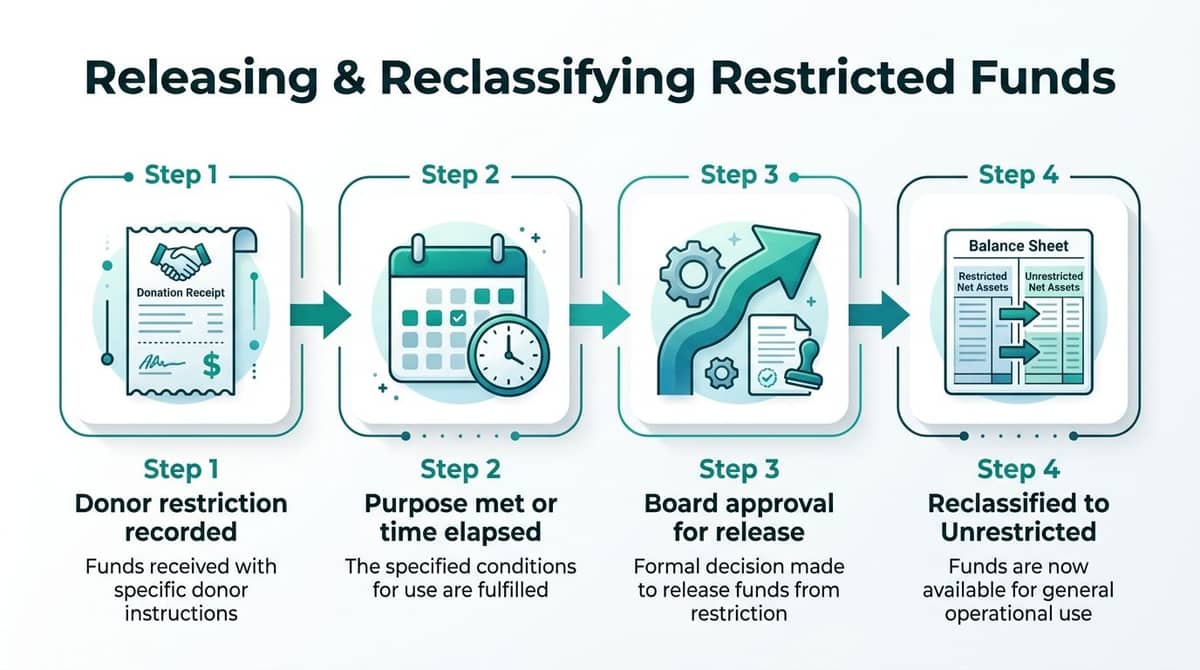
Restricted dollars do not become unrestricted by decision. They become unrestricted by event.
The mistake that causes audit pain
The most common error is reclassifying on receipt instead of on qualifying expense. That looks tidy in the moment, then the audit trail catches up later and the books no longer match the spending reality.
If you want the release record to survive scrutiny, keep the contribution terms, expense support, and release entry together. When those three documents tell the same story, the audit gets easier and the board gets a cleaner picture.
Where These Funds Show Up on Form 990 and Board Reports
The reporting consequences are where a lot of directors finally see the point. Restricted and unrestricted balances don't live in abstract policy language, they show up in the return, the board packet, and the expense schedules your auditor checks line by line.
On Form 990, the balance sheet section reports net assets with donor restrictions and net assets without donor restrictions on Part X. Revenue appears in Part VIII, and functional expenses appear in Part IX, where program, management, and fundraising costs must tie back to the organization's reporting structure. The Statement of Functional Expense is where sloppy coding shows up fastest, because the same costs must reconcile across fund-level totals and functional categories. If you want a plain-language filing refresher, the Form 990 guide for new nonprofits is a practical place to start.

Why board reports need fund detail
A board that only sees a top-line income statement can't tell whether donor intent is being honored. It sees revenue and expense, but it doesn't see whether a restricted dollar was spent on the wrong program or whether a grant drawdown was posted too early.
That's also why QuickBooks classes are a common shortcut, but not a full solution. Classes can help segment activity, yet true fund accounting has to model restricted and unrestricted balances natively if you want reliable board reporting and cleaner 990 preparation.
Donor Preference Is Not the Same as a Restriction
A donor says, “I hope this supports the food pantry,” and someone on the team starts treating that hope like a legal fence. That is how bookkeeping gets messy fast.
A preference is not the same as a restriction. If the language is not binding, the money stays unrestricted, even if the donor would be disappointed. That keeps you from loading the restricted ledger with funds that do not legally belong there. If you want a clean reference point on disclosure expectations, review revenue tier disclosure rules before you decide every donor comment needs a restricted tag.
The practical conversation with a donor
Respect the donor's intent without inventing a restriction. Say, “We want to honor that preference, and we will record it that way if the agreement makes it binding. If not, we will steward it as general support unless we document a specific restriction.”
Short version: nice wording does not create a legal restriction, binding terms do.
That approach keeps trust intact and keeps the books honest. It also stops the bad habit of treating every earmarked conversation as a restricted grant, which clutters reporting and makes real restrictions harder to track.
Internal Controls and Policies That Keep You Audit-Ready
Clean fund accounting doesn't happen because people mean well. It happens because the board approved policies, staff follow them, and the approvals leave a trail an auditor can test.
The four documents that matter
- Gift Acceptance Policy. Define who can sign restricted agreements and who can't.
- Board Reporting Policy. Require regular review of fund balances, not just total revenue.
- Release and Reclassification Procedure. Spell out when money moves, who approves it, and what backup proves it.
- Annual Training Protocol. Make sure staff know the difference between a restriction, a designation, and a preference.
A real-time fund schedule beats a year-end scramble every time. If your team is reconciling restricted revenue only after the books close, you're already late, and the audit work gets longer because the backup is scattered across email and spreadsheets.
Where systems help, and where they don't
Aplos gives many small nonprofits a friendly start with fund tracking, and QuickBooks is familiar to a lot of finance teams. Both can work for basic needs, but neither replaces disciplined policy, and neither removes the need for true multi-fund reporting when your grants and programs get more complicated.
Rule I trust: if the fund change can't be explained from a policy, a grant letter, and a supporting expense report, it shouldn't move.
That's also where a platform matters. AlignMint's true fund accounting ties restricted and unrestricted balances into the same operating record, which helps when the board wants numbers that match the grant file.
Pulling It All Together With the Right Platform
The burden isn't the definition, it's the handoff. Gifts come in, grants get drawn down, program staff spend money, the board wants a report, and finance has to reconcile all of it without inventing a story after the fact.
That's where a single system makes life easier. A donor-centric CRM can connect giving to the ledger, so a pledge to a restricted project lands in the right fund from the start. A proper accounting layer then produces the Statement of Functional Expense without the week of spreadsheet stitching that usually comes at month end.
If you run events or campaigns, pair your fundraising work with tools that keep the money and the intent aligned. A guide to nonprofit events that raise money can help with ideas, but the bigger issue is whether your event revenue lands in the correct fund the minute it's recorded.
What I'd look for before I switch systems
I'd want true fund accounting, not QuickBooks classes. I'd want unlimited users without per-seat anxiety, a built-in marketing suite, online giving pages, team communication, and Minty answering questions against live fund data so you can ask what's spendable right now without exporting to Excel.
I'd also want a platform that handles churches, schools, and fiscal sponsorship cleanly, because those environments make restricted tracking harder, not easier. AlignMint's fund accounting feature is built for that kind of work, and its free tier for nonprofits under $100K means smaller organizations can stop postponing the move.
If you're still managing restricted and unrestricted funds in disconnected tools, compare platforms by whether they keep fund balances, donor records, and reporting evidence connected without adding more spreadsheet work.
Ready to try AlignMint with your nonprofit?
Start free — set up donor tools, giving pages, and Minty. Upgrade when you need accounting.