

Government Grant Accounting Made Simple for Nonprofits
You've just won a government grant, and everyone celebrates until the first reimbursement report arrives. Now you're separating restricted dollars, checking staff time, answering program questions, and wondering whether your spreadsheets will survive an audit.
Government grant accounting gets easier when you treat it as an operating workflow, not a finance exercise isolated from daily work. This guide connects fund accounting, allowable costs, drawdowns, reporting, and functional expense allocation in plain language, so you can protect the award and your organization's credibility.
Quick Answer: Government Grant Accounting
Government grant accounting is the record of allowable costs, restrictions, drawdowns, and remaining balances for a public award. Uniform Guidance sets the cost rules; fund accounting keeps each grant's dollars from mixing with unrestricted cash.
Pair this with what is a Single Audit and cost allocation for nonprofits. For the ledger, see fund accounting.
Introduction Why Government Grants Feel Different
A new award often creates two emotions at once. You're grateful for the funding, but you also know every dollar carries conditions, deadlines, and documentation expectations.
Suppose your organization receives funding for a youth employment program. The award pays for eligible staff time, supplies, and approved program activities. Your team still needs to show which expenses belong to that grant, which costs belong elsewhere, and how each charge supports the approved budget.
That's why government grant accounting feels different from ordinary bookkeeping. You're not only recording income and expenses. You're proving that restricted resources were used for their intended purpose, under the funder's rules, with records someone else can follow.
The practical question: Can you explain every grant-funded transaction without rebuilding your records from scattered spreadsheets?
Federal awards also bring Uniform Guidance requirements under 2 CFR Part 200. Those requirements cover cost principles, administrative rules, and audit expectations for federally funded programs, while fund accounting keeps restricted and unrestricted resources separate (Bill's overview of grant accounting).
The work becomes manageable when you build a consistent rhythm:
- Create a separate tracking home for each restricted award.
- Code costs to the correct project as transactions occur.
- Separate direct, indirect, and unallowable costs.
- Reconcile spending, drawdowns, and supporting documents regularly.
- Report from records that already match the approved budget.
Your board, staff, funders, and community all benefit from that discipline. Clear records protect future funding because they demonstrate stewardship rather than merely reporting an ending balance.
A platform such as AlignMint's grants tools can sit within that workflow, but software won't replace judgment. Your policies, grant agreements, approvals, and documentation still determine whether a cost belongs on an award.
What Government Grant Accounting Really Means for Nonprofits
Think of restricted grant money like a labeled envelope. If the envelope says “after-school tutoring,” you can't move the contents toward building repairs because another account is short.
That analogy captures the heart of nonprofit fund accounting. Grant accounting is a subset of fund accounting, because each award needs a visible financial identity alongside your unrestricted operations and other restricted programs.
Recognition follows the work
Cash arrival doesn't automatically mean grant revenue belongs in the current period. Under the matching principle reflected in IAS 20, grants are recognized in profit or loss systematically over the periods when related costs are recognized (IAS 20 from the IFRS Foundation).
For nonprofit operations, translate that into a simple question. When did your organization incur the qualifying cost connected with the award? If the grant reimburses eligible payroll, supplies, or services, your records should connect recognition with those eligible expenses and the award's conditions.
The grant agreement still controls the practical answer. A payment may arrive before your team has incurred qualifying costs, or the award may require particular reporting before funds become available for drawdown. Keep the cash, recognition, and reimbursement questions distinct.
Grant or exchange transaction
Not every government payment is a grant. A true grant generally provides resources without your organization giving equal value back through an exchange transaction. A contract to deliver services for the government may require different accounting because the government is purchasing an agreed output.
Read the agreement for its substance, not just its label. Look for the required activities, deliverables, reporting terms, cost restrictions, repayment clauses, and ownership conditions.
A simple ledger structure makes the distinction useful in practice:
- Give each restricted award its own fund or project code.
- Attach the approved budget and reporting dates.
- Record eligible costs directly against that tracking home.
- Release restricted amounts as qualifying costs occur.
- Compare the ledger with source documents and the funder's report.
This structure keeps restricted balances visible while your team works, rather than only after year-end cleanup. It also helps prevent one award from covering another award's shortfall.
For organizations working with public-sector data or complicated reporting systems, digna for data engineers offers useful background on data quality and public-sector data governance. The broader lesson applies to nonprofit finance too. Clean inputs produce records people can trust.
Uniform Guidance and the Rules That Determine Allowable Costs
Your most important compliance decision happens before reimbursement. You need to decide whether a proposed cost belongs on the award and document the reasoning clearly.
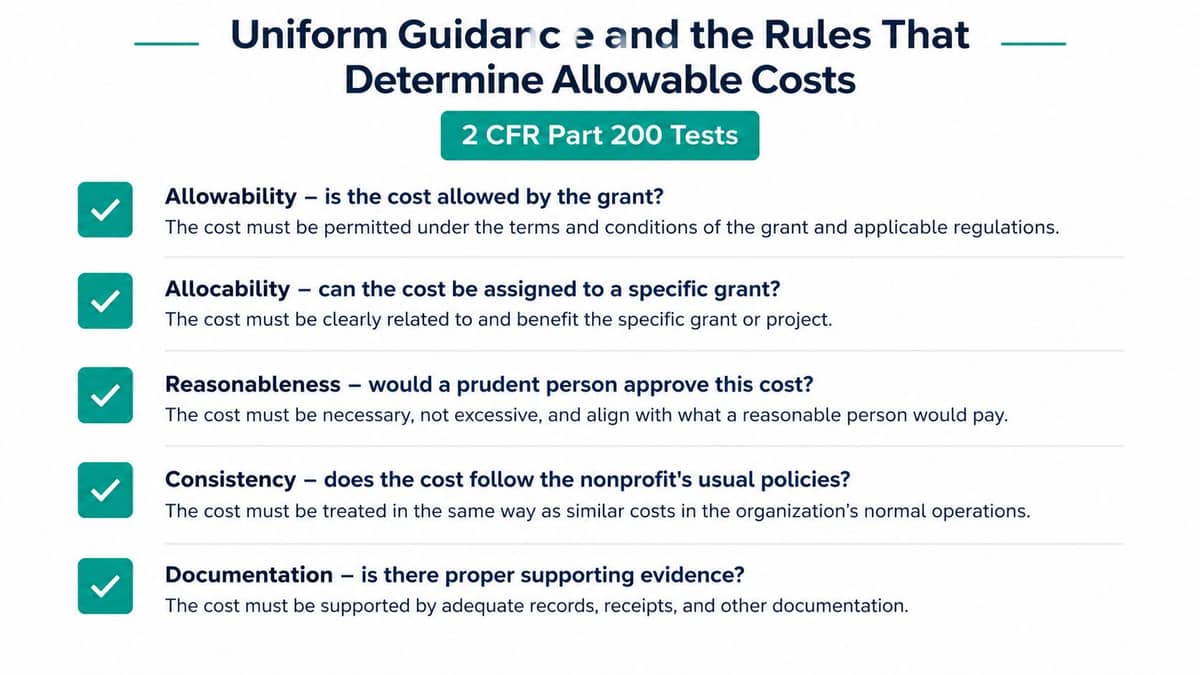
Uniform Guidance requires federally funded organizations to maintain policies covering allowability, allocability, consistency, reasonableness, and cost transfers. Those controls determine whether charges are reimbursable and ready for review (BDO's foundational grants management guidance).
Five questions before approval
Use these questions during budgeting, purchasing, payroll review, and month-end close:
- Allowability: Does the grant agreement and applicable guidance permit this cost?
- Allocability: Can you assign the cost to this award because it benefits the funded project?
- Reasonableness: Would a prudent person approve the amount and business purpose?
- Consistency: Does your organization apply the same accounting policy to similar costs?
- Documentation: Can you produce invoices, approvals, time records, receipts, or other support?
A cost may look sensible but still fail one test. For example, a shared internet bill might support several programs, but charging the entire bill to one government award would need a defensible allocation method.
Direct, indirect, and unallowable costs
A direct cost belongs clearly to one grant or program. A staff member's documented hours spent delivering the funded service may qualify, subject to the award's terms and your policies.
An indirect cost supports multiple activities. Shared administration, facilities, or technology may require an allocation approach that reflects actual benefit. Your written policy should explain how the organization handles those costs and applies the method consistently.
An unallowable cost must stay outside the reimbursement request, even if the organization paid it from a general bank account. Segregating these costs in your ledger prevents accidental inclusion during drawdown preparation.
Cost transfers need a reason
A late transfer from one grant to another deserves more than a journal entry. Record why the original charge was wrong, who reviewed the correction, when the transfer occurred, and how the revised allocation benefits the receiving award.
A clean transfer tells the story: what happened, why the correction was necessary, and how you know the new charge is appropriate.
Your team should also document approval authority, timekeeping, procurement, travel, shared-cost allocation, and record retention. Cost allocation guidance for nonprofits can help your staff turn those expectations into workable policies.
For additional public-sector compliance reading, the GovCon Reviews blog provides context around government contracting and compliance topics. Use outside material to strengthen understanding, while treating each award agreement as the controlling document.

How True Fund Accounting Keeps Every Grant Dollar in Its Place
A generic accounting file can record expenses accurately while still hiding the answer your funder needs. The issue usually isn't whether the transaction exists. It's whether the transaction carries the right restriction, project, budget line, and supporting evidence.
True fund accounting creates that structure natively. You establish one fund or project code for each restricted grant, then route revenue and expenses into the appropriate fund.
Separate tracking beats after-the-fact sorting
A practical grant ledger records the award's budget, restrictions, dates, and reporting obligations. When qualifying costs occur, you post release-from-restriction entries according to your policy. That keeps restricted balances visible and supports monthly or milestone reconciliations against approved budgets and source documents (Blue Cloud CPA's restricted-fund guidance).
A side spreadsheet may still help with narrative reporting, but it shouldn't be the only place where grant identity exists. If your general ledger and spreadsheet disagree, your finance team must investigate before reporting.
Where familiar tools fit
QuickBooks is widely recognized and can work well for organizations needing familiar small-business bookkeeping. Many nonprofits create classes or locations to represent funds, but those fields can require careful configuration, staff training, and supplemental reports.
Aplos focuses on nonprofit and church accounting, with fund-based features that can suit organizations seeking a dedicated nonprofit product. Blackbaud Financial Edge serves larger nonprofit finance teams with deeper financial management capabilities and established reporting practices.
Those products each have strengths. The question is whether your current setup connects grant accounting with the rest of your operating work, including donor records, volunteers, events, communications, and reporting.
Classes and spreadsheets can become difficult when several programs share staff, facilities, supplies, or administrative support. They also make it easier to miss a coding error until month-end or year-end review.
Reporting starts with the ledger
Your grant report should be an output of approved transactions, not a separate reconstruction project. The same structure can support drawdown preparation, budget-to-actual review, restricted balance monitoring, and documentation requests.
True fund accounting features are designed around that separation. AlignMint also combines accounting, donor management, volunteer management, events, and marketing in one platform, with Minty AI available to answer questions about the organization's recorded data.
Your Monthly Grant Workflow From Budget to Drawdown to Report
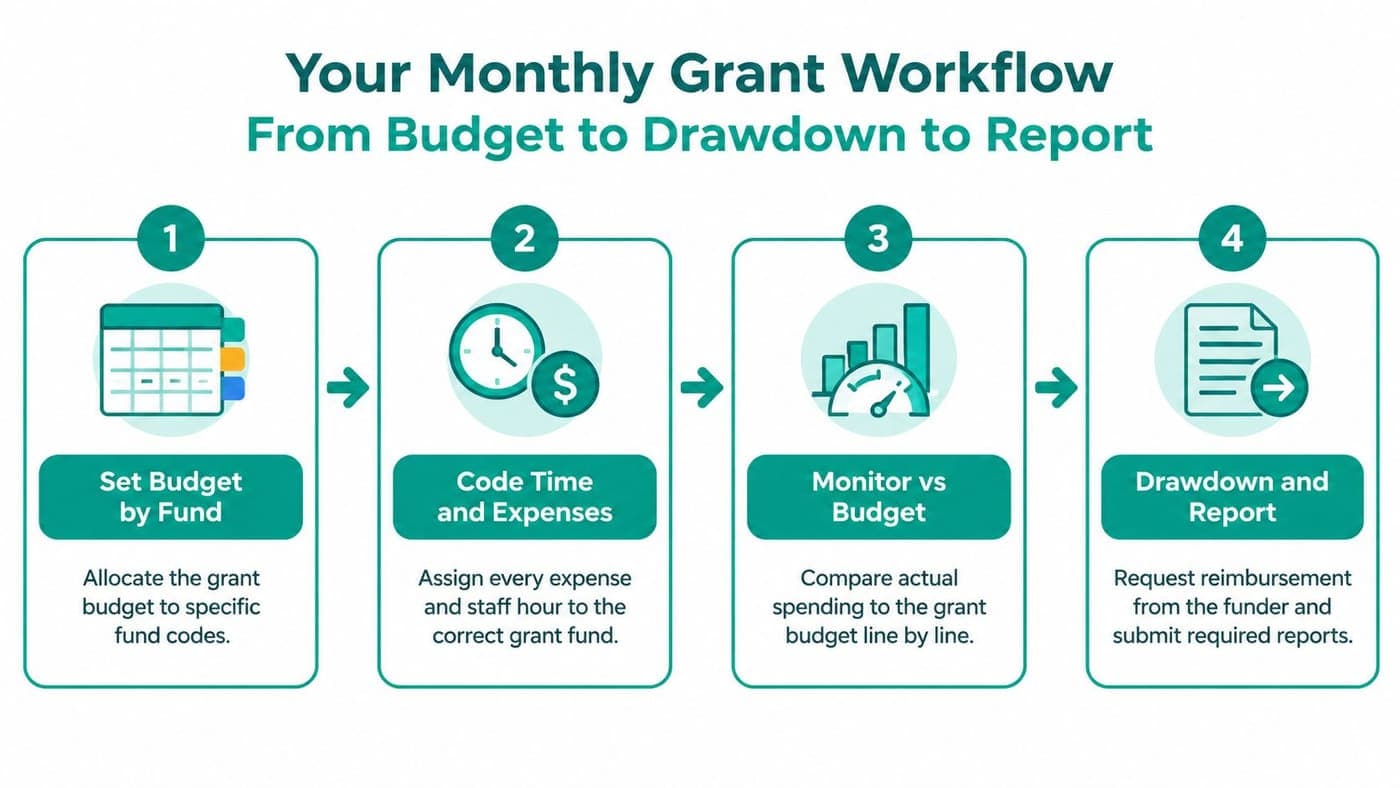
A monthly routine gives your team fewer surprises because each grant receives attention before reporting becomes urgent. The routine can remain simple, provided every person knows what to review and what evidence to retain.
Start with the approved budget
Load the award budget by fund, project, and category before spending begins. Include the reporting calendar, reimbursement rules, match requirements if applicable, and any spending restrictions stated in the agreement.
Assign ownership clearly. The program director confirms whether spending supports the approved work, while finance confirms coding, documentation, and available balance.
Code time and expenses during the month
Staff should record time against the correct grant while the work is fresh. Waiting until month-end encourages estimates, duplicated entries, and vague descriptions that auditors may question.
Purchasing staff should attach receipts, approvals, and business purpose to each transaction. Shared costs should follow your written allocation method rather than personal judgment at the end of the quarter.
An all-in-one platform can reduce handoffs by connecting accounting with donor records, volunteers, events, marketing, and team communication. AlignMint's Minty AI can answer questions from your recorded data, while integrated bank feeds can support reconciliation and balance checks.
Review budget versus actual spending
At close, compare each budget line with actual activity. Ask three questions:
- Coding: Did every transaction land in the correct fund and category?
- Pace: Does spending match the program's progress and approved timeline?
- Evidence: Can someone locate support without asking the original purchaser?
Investigate unusual balances before preparing a drawdown. A low-spend line may reflect delayed activity, while an overrun may require funder approval before additional costs occur.
Match cash requests with eligible costs
A drawdown request should agree with your ledger and the award's reimbursement rules. Don't request cash because the bank balance feels tight. Request the amount supported by qualifying costs and required documentation.
Cash timing can create pressure, especially when payroll arrives before reimbursement. Maintain a clear grants receivable or payable process, and have leadership review cash needs separately from expense eligibility.
Prepare the report from reconciled records
Bring together the financial report, program narrative, payroll support, invoices, allocation schedules, and approval records. Your final review should confirm that totals agree across the ledger, drawdown request, and funder template.
A grant budget template can give your team a consistent starting point. The template won't decide eligibility, but it can help everyone use the same categories and assumptions.
Staying Audit Ready and Reporting Functional Expenses With Confidence
Audit readiness is less about having perfect files and more about making your decisions traceable. Someone unfamiliar with the transaction should understand what was purchased, which program benefited, who approved it, and why the funding source was appropriate.
Keep the agreement, approved budget, amendments, invoices, receipts, payroll records, time documentation, allocation schedules, bank evidence, journal entries, and reports together. Reconcile the grant ledger to source documents regularly, rather than waiting until a funder asks a detailed question.
Functional expenses require a separate view
Organizations filing the full IRS Form 990 must complete Part IX, the Statement of Functional Expenses, allocating expenses across program services, management and general, and fundraising (IRS Form 990 instructions).
For each program service reported in Part IX, applicable section 501(c)(3) and 501(c)(4) organizations must include total expenses in column B and grants or allocations included within those expenses. Grant accounting and functional expense reporting therefore need compatible categories, even though they answer different questions.
A grant asks, “Was this cost eligible for this award?” Functional allocation asks, “Which organizational function benefited from this cost?” One expense may need both answers.
Choose methods that people can explain
Use direct charging when a cost belongs only to one function. For shared costs, document the method your organization applies:
- Time studies: Allocate staff costs using documented hours by function.
- Square footage: Allocate facility costs according to occupied space.
- Headcount or FTE counts: Assign shared services based on staff usage.
- Exception lists: Identify costs that shouldn't be allocated under your policy.
Keep the method stable unless circumstances change. If you revise it, document the reason, approval, effective date, and effect on reporting.
Prepare for changes and repayments
Grant modifications can change budgets, restrictions, reporting dates, or eligible activities. Update the grant record and retain the revised agreement, approval email, board authorization, or other supporting evidence.
Repayments and clawbacks deserve prompt attention after recognition. FASB's ASU 2025-10 specifically added guidance for repayments occurring after a government grant was initially recognized, signaling how easily post-recognition treatment can create uncertainty (Deloitte's summary of ASC 832 guidance).
For federal awards, learn whether your organization's circumstances require a Single Audit. Your external accountant or audit professional should confirm the requirements that apply to your awards and organization.
Choosing a Simpler Path Forward for Your Team
You don't need new software merely because government grant accounting feels complicated. First, test whether your current system can answer practical questions without manual reconstruction.
Can you see each restricted grant's balance, approved budget, eligible spending, receivable, drawdown, and reporting deadline? Can program staff enter time and expenses correctly, while finance reviews allocations and unallowable costs? Can you produce functional expense information without rebuilding categories in another spreadsheet?
If the answer is yes, document your workflow and keep improving staff training. If the answer is no, compare tools by structure rather than appearance.
QuickBooks may remain a sensible choice for teams that value familiarity and already maintain disciplined class tracking. Aplos may suit churches and nonprofits seeking fund-focused accounting. Blackbaud Financial Edge may fit larger organizations needing established financial management and reporting depth. A useful independent starting point is this guide to nonprofit accounting tools.
AlignMint is one option for organizations that want accounting, CRM, volunteer management, events, marketing, online giving pages, and team communication in one platform. It provides true fund accounting, a built-in marketing suite, Minty AI, plan-based access without per-seat fees, and a free tier for nonprofits under $100K, as described by the publisher.
That combination can matter for fiscal sponsors, churches, and schools managing multiple programs with limited administrative time. The right choice is the system your team can maintain accurately, explain confidently, and use consistently each month.
AlignMint connects true fund accounting with grants, CRM, volunteers, events, marketing, online giving, and team communication, so your records support daily decisions and reporting. Visit AlignMint to see whether its nonprofit workflow fits your organization's next government grant.
Ready to try AlignMint with your nonprofit?
Start free — set up donor tools, giving pages, and Minty. Upgrade when you need accounting.