

What Is Single Audit: A Guide for Nonprofits
A single audit is a combined audit of your financial statements and your federal award spending, required when you spend $750,000 or more in federal awards in a fiscal year, and submitted to the Federal Audit Clearinghouse. If that number is on your radar, you're already dealing with a year-round readiness issue, not a once-a-year filing task.
Most executive directors first meet single audit when the finance team says the grant year got bigger than expected. By then, the challenge isn't the audit itself, it's whether your records, controls, and fund tracking already line up with what auditors will test.
Quick Answer: What a Single Audit Is
A single audit is a combined review of your financial statements and federal award compliance. It applies when your nonprofit expends $750,000 or more in federal awards in a fiscal year, and the reporting package goes to the Federal Audit Clearinghouse.
Compare this with OMB A-133 and the single audit and cost allocation for nonprofits. For the ledger, see fund accounting.
What a Single Audit Is and When It Applies to Your Nonprofit
A single audit is a combined review of your organization's financial statements and its compliance with federal award rules under GAGAS and the Uniform Guidance. For a nonprofit finance team, that means one audit covers both the books and the federal money, instead of splitting the work into separate audits for each grant or program. HHS explains the framework in its single audit guidance and FAQs. HHS Single Audit FAQs
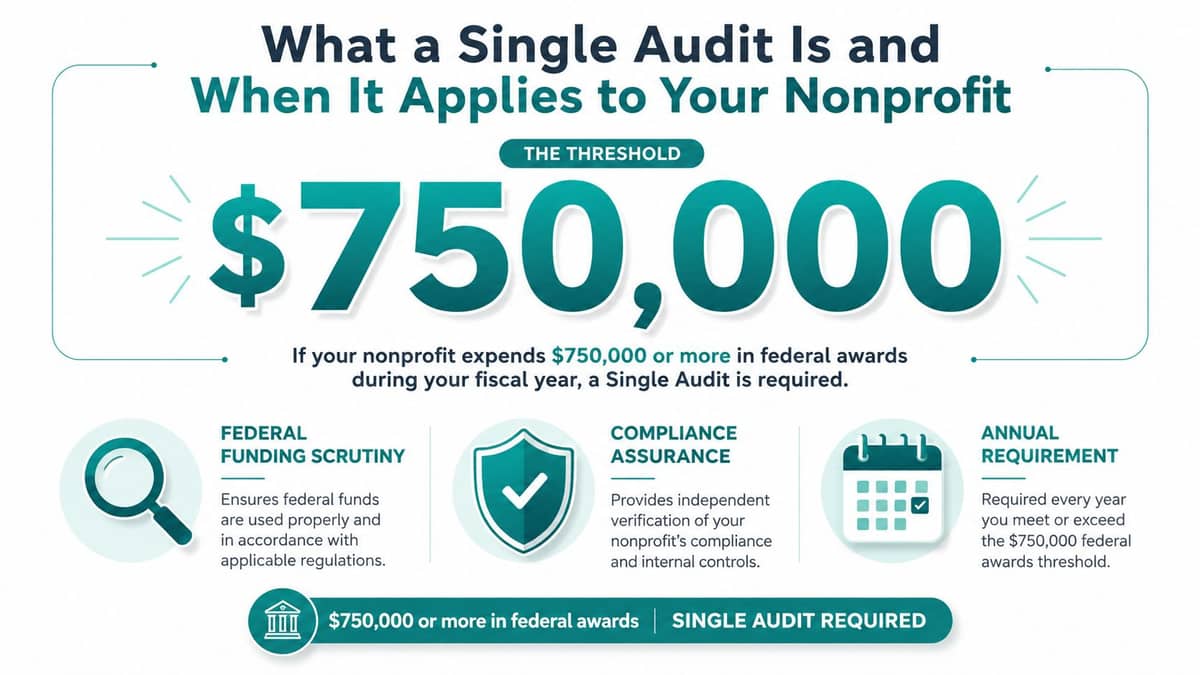
The trigger is straightforward. If your nonprofit expends $750,000 or more in federal awards during a fiscal year, the requirement applies, and the reporting package goes to the Federal Audit Clearinghouse. The threshold is the point where the work shifts from ordinary grant tracking to a formal audit process, and the infographic on the requirement shows that line clearly.
Does it apply to you right now
The fastest way to answer that question is to look at federal expenditures in one fiscal year, not lifetime grant history. A nonprofit can stay below the line for years and then cross it quickly once award spending grows, so the question is less about what came in and more about what was spent.
Practical rule: if your board cannot tell, from one report, how much federal money left the door this year, you are already behind.
Governments, universities, tribal entities, and other recipients of federal money also fall under this framework, but nonprofits feel the pressure most directly when grants expand faster than internal reporting. If you are close to the line, your records should already look like a single audit is possible.
That means monthly closes, grant-by-grant tracking, and a clean record of federal draws and expenditures. It also means treating audit readiness as a standing finance habit, not a year-end cleanup project.
Where Single Audit Comes From and Why It Exists
A nonprofit that grows up around federal awards can quickly end up with separate reviews for separate programs, each one asking for similar records in a different format. That kind of setup burns staff time and makes it harder for a board or finance team to see the whole picture at once.
The modern single audit framework grew out of the Single Audit Act of 1984, was refined by the 1996 Amendments, and was later folded into the Uniform Guidance structure. The goal was straightforward: one organization-level review instead of a string of program-by-program audits, while still keeping federal funds under a consistent standard. A Historical Evaluation of the Single Audit Thirty Years Later
For a nonprofit finance team, that history explains why the process feels so document-heavy now. Federal oversight is trying to read one complete story about the entity, from the financial statements to the federal award spending to the compliance testing that follows.
Why the threshold changed
The threshold moved from $500,000 to $750,000 in federal awards under Uniform Guidance, which shows a deliberate effort to direct audit resources toward larger recipients while still covering a broad group of organizations. The change did not soften the expectations around compliance. It narrowed the number of entities that have to go through the full process. OMB A-133 Single Audit Guide for Nonprofits
That history matters because it shows what federal oversight is trying to do. The government wants one clear view of your organization, not scattered snapshots from separate grant files.
The old patchwork also helps explain why today's audit package has to line up cleanly from start to finish. Reviewers want the financial statements, the federal award schedule, and the compliance testing to tell the same story without gaps or contradictions.
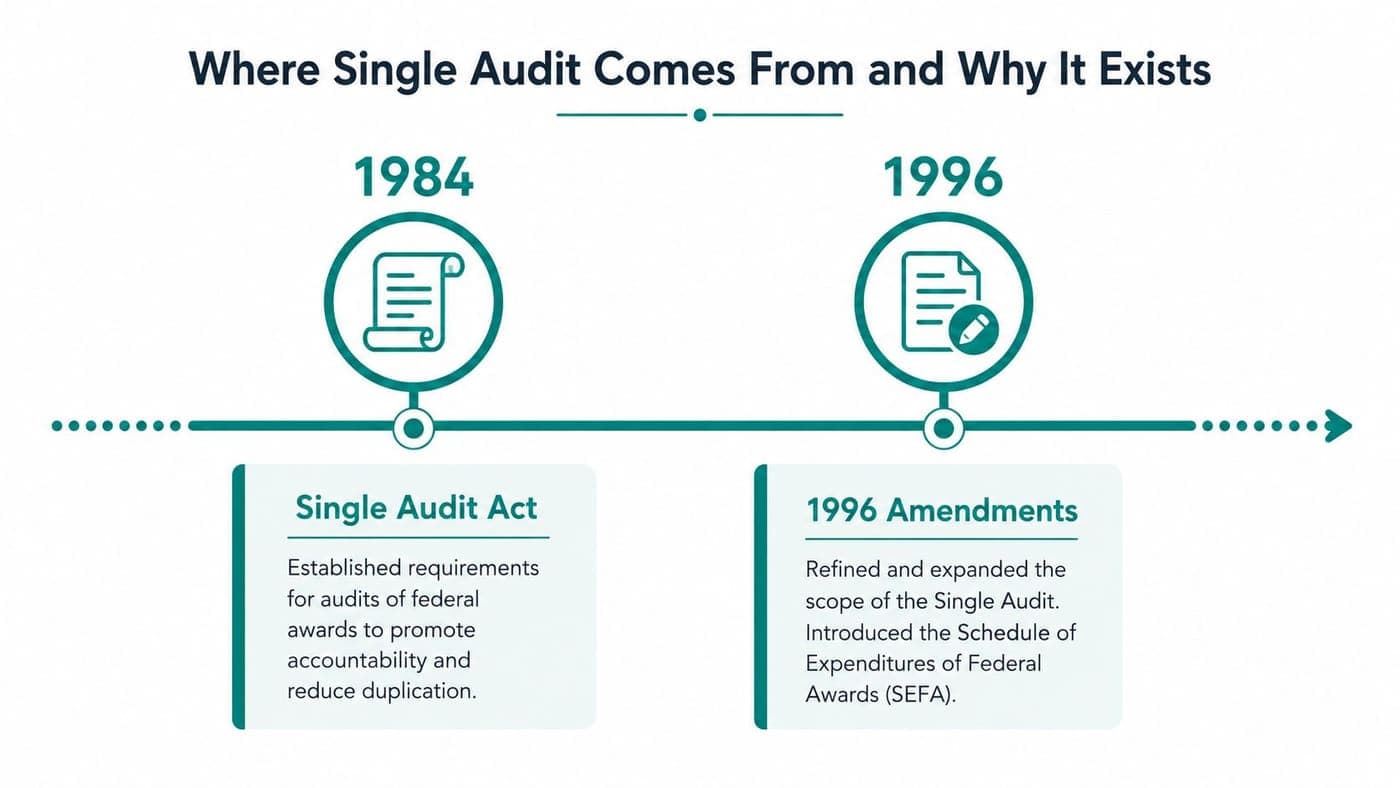
The framework is easier to understand when you see it as a response to fragmentation. Instead of rebuilding the same records for different reviewers, a nonprofit with solid fund accounting keeps the trail intact throughout the year, which is much easier than reconstructing it at audit time.
The Three Core Components of a Single Audit
A single audit has three moving parts, and each one answers a different question. Auditors are looking at your financial health, your federal spending record, and whether you followed the rules attached to those dollars.
The financial statement opinion
The first piece is the auditor's opinion on your financial statements. That's the usual audit work most boards recognize, the review of whether your statements fairly present the organization's finances.
This part matters because federal compliance doesn't sit apart from the rest of your books. If your accounting is messy, the audit gets harder before anyone even starts testing grants.
The SEFA
The second piece is the Schedule of Expenditures of Federal Awards, usually called the SEFA. It's the master list of federal funds your organization expended during the fiscal year, and it often becomes the most error-prone document in the package.
A school, church, or human services nonprofit with multiple awards may need to list each federal stream carefully, including pass-through funding. That's where true fund accounting helps, because the grant lives inside the ledger instead of being rebuilt from spreadsheets later.
The compliance opinion
The third piece is the compliance side. Auditors test whether federal dollars were spent according to the program rules that apply to the awards they selected, which is why a Head Start grant and a USDA food program won't be treated the same way.
Plain-English version: the auditor is asking, “Did you spend the money where the rules said you could?”
Our nonprofit financial reporting guide is a helpful companion if your team wants a cleaner picture of how the audit sits inside the rest of year-end reporting.
How Auditors Decide Which Federal Programs Are Major
Auditors don't test every federal program with the same depth. They start by sorting programs into buckets, then they focus on the ones that matter most financially and operationally.
Type A and Type B in plain language
The first step is identifying Type A programs using the federal expenditure threshold in the auditor guidance. Then the auditor considers risk and decides whether a program becomes major, which means deeper compliance testing.
Type B programs are the smaller awards in the set, but smaller doesn't mean ignored. Auditors still think about whether a smaller award has unusual risk, weak controls, or prior problems.
A useful way to think about it is this. The biggest grants usually drive the most scrutiny, but the auditor still wants to know whether the rest of the portfolio is controlled well enough to trust.
What the auditor is really weighing
The published fundamentals guide says the audit trigger is $750,000 or more in aggregate federal expenditures within a fiscal year, and the audit must evaluate major programs for direct and material compliance requirements. In practice, that creates a materiality-and-risk-driven scope where the auditor uses judgment to decide which programs need deeper testing. Single Audit Fundamentals PDF
If your grants are cleanly tagged in the ledger, the major-program conversation gets much easier.
The practical lesson is simple. Your chart of accounts, grant codes, and support for each cost objective shape how quickly the auditor can understand your federal profile. If staff can't produce that information without a scramble, the auditor notices.
The Findings Most Small and Mid-Sized Nonprofits Actually See
A first single audit finding at a smaller nonprofit often looks less like a crisis and more like a paper trail that was built too late. Auditors usually point to weak documentation, unclear controls, or records that were assembled after the fact.
The issues that show up again and again
A thin SEFA is one of the most common problems. Awards get missed, pass-through details are incomplete, or the schedule does not reconcile cleanly to the general ledger.
Cash disbursement controls also come up often. If invoices, approvals, and coding are not tied together, the auditor has a hard time tracing why a cost landed on a federal grant.
Payroll is another common pressure point. If staff time is charged to a grant, the support needs to show how that cost was allocated and why it was allowable. A timesheet without a clear method is like a receipt with half the ink gone, it may point in the right direction, but it does not give an auditor enough to rely on.
Why these findings happen
These findings are usually not fraud cases. They are signs that the organization grew faster than its paperwork, or that one person has been holding too much of the process in their head.
Quality problems have been real for a long time. In one federal review of 208 single audits from a universe of about 38,500, only 55.3% were rated acceptable, while 14.4% were limited reliability and 30.3% were unacceptable. A GAO summary of the same study reported roughly 49% acceptable and 51% with deficiencies severe enough to be limited reliability or unacceptable.
That history matters because it shows your organization is not unusual if the process feels demanding. It also explains why auditors care so much about clean files, written policies, and timely submission.
A Practical Readiness Timeline for Your First or Next Single Audit
The most helpful mindset is simple. Don't wait for fieldwork to start acting like an auditee.
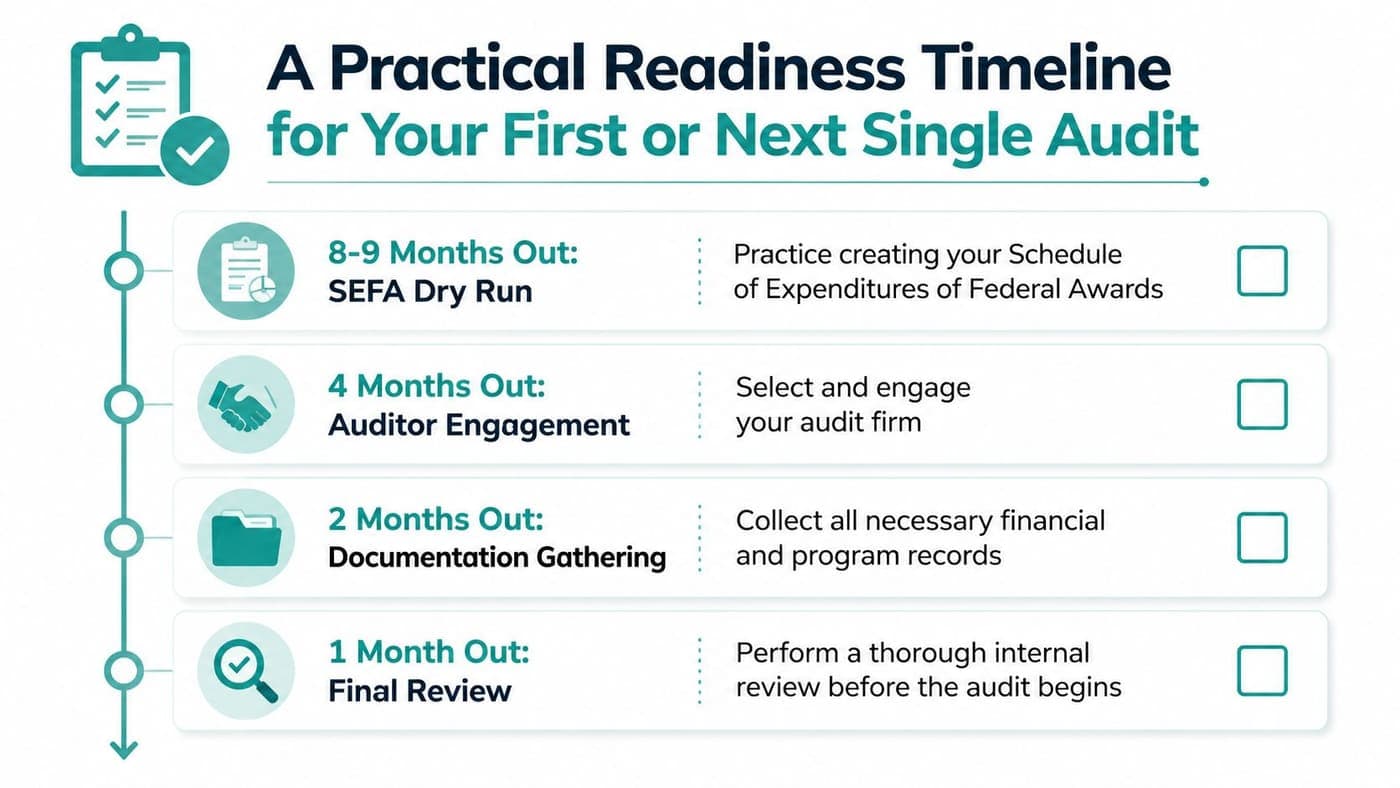
Eight to nine months out
Start with a SEFA dry run. Reconcile federal grants in the ledger, check whether the award list matches your program records, and see where support is thin.
That's also the right time to confirm whether your fund accounting can separate restricted grants, donor gifts, and program spend without manual repair. If it can't, the audit will force that work onto the finance team later.
Four months out
At this point, the job is cleanup. Reconcile federal revenue to the general ledger, confirm drawdowns to bank deposits, and make sure expense coding matches grant purpose and cost objective.
If you work with a fiscal sponsor, fiscal sponsor audit preparation becomes especially important, because sponsored projects often need clearer document trails than staff expect.
Two months out
Gather the audit package, including support for allocations, approvals, and the Statement of Functional Expenses. The cleaner this file is, the less time the auditor spends asking for backup in the middle of fieldwork.
Final weeks
Finish the internal review, confirm open questions, and make sure the finance lead knows who can answer what. That last part saves more time than most boards realize.
Year-round readiness is mostly boring work done on schedule. That's exactly why it works.
What Single Audit Actually Costs and How to Keep It Reasonable
The cost question usually comes right after the compliance question. For small and mid-sized nonprofits, the fee depends less on the calendar and more on how much cleanup the auditor has to do before testing begins.
What drives the bill
The biggest cost drivers are the number of major programs, the quality of your records, and whether the auditor already understands nonprofit federal compliance. If the SEFA is messy or reconciliations are missing, billable hours rise fast.
Hidden costs matter too. Staff time, outside cleanup help, and fixing findings after the audit can cost more than the audit fee itself. Those costs don't always show up in the engagement letter, but they show up in the year.
How to keep the audit reasonable
Clean reconciliations help. So does documenting cost allocations before year-end and keeping grant data inside the accounting system instead of in separate spreadsheets.
An all-in-one platform can reduce the back-and-forth because the auditor doesn't have to rebuild your chart of accounts from scratch. AlignMint is one option that combines fund accounting, donor records, volunteers, events, and marketing in one place, with true fund accounting rather than QuickBooks-style classes.
For more detail on one of the biggest hidden drivers, our cost allocation for nonprofits guide is worth keeping handy.
A Short Readiness Checklist and Where to Go Next
If you only keep one page from this article, keep this one.
Check the threshold. Confirm whether your fiscal year includes $750,000 or more in federal expenditures.
Check the core files. Make sure your financial statements, SEFA, and compliance support match each other.
Check the weak spots. Look for allocation gaps, missing approvals, and grant records that live outside the ledger.
Check the timeline. Start preparation months before fieldwork, not weeks before the deadline.
Check the habit. Treat readiness as part of monthly finance work, not a seasonal rescue project.
If you want a practical place to start, our financial readiness check can help you see where the gaps usually hide. Pair that with better fund tracking, clearer donor records, and tighter team communication, and the audit becomes much less dramatic.
AlignMint gives nonprofits one system for accounting, donor management, volunteers, events, and marketing, with a free tier for organizations raising up to $100K a year and no per-seat fees. If you're ready to make single audit readiness a normal part of your finance rhythm, visit AlignMint and see how your records can stay cleaner all year.
Ready to try AlignMint with your nonprofit?
Start free — set up donor tools, giving pages, and Minty. Upgrade when you need accounting.