

Statement of Functional Expenses Required Rules
You're staring at a year-end spreadsheet, trying to divide payroll, rent, and shared services across programs before your board meeting. The statement of functional expenses required for your organization shouldn't depend on a last-minute reconstruction. It should emerge from daily records that connect spending, funds, programs, and people.
Quick Answer: Functional Expense Requirements
A statement of functional expenses is required when Form 990 or GAAP asks you to show both what you spent and which function it served. Build that split into daily coding so year-end is a review, not a reconstruction.
Start with what functional expenses are and fund accounting. For the full statement, see statement of functional expense.
Why the Statement of Functional Expenses Matters
A statement of functional expenses answers two questions at once. What did your nonprofit spend, and why did it spend it? Natural classifications identify costs such as salaries, rent, supplies, depreciation, and professional fees. Functional classifications show whether those costs supported program services, management and general activities, or fundraising.
That distinction becomes painfully clear at year-end. A development director may work on donor appeals, while a finance manager may support grant reporting and internal controls. Rent may support offices serving programs, administration, and fundraising. If your books record only the bank transaction, someone must reconstruct the purpose later.
That reconstruction creates risk. Staff may remember different allocation methods, supporting records may be incomplete, and the final report may not reconcile cleanly with your accounting system. A consistent workflow gives your board, funders, donors, and auditor a clearer account of how your organization uses its resources.
The report connects spending with mission
Your supporters don't give only to pay invoices. They want to understand how resources move into services, oversight, fundraising, and long-term capacity. The statement makes that relationship visible without pretending that administrative work is unrelated to mission delivery.
A program expense might be easy to identify, such as supplies purchased for a service activity. A shared salary or facility cost requires a reasonable basis for dividing the expense among functions. That basis should reflect actual work or use, rather than a desired program ratio.
The functional expense overview offers a useful foundation for distinguishing what an expense is from the purpose it serves. That distinction helps your finance team explain results in plain language during board and funder conversations.
Practical rule: A defensible allocation reflects how resources were used, not how you wish the report looked.
Compliance becomes easier when records are current
The IRS Form 990 requires specific functional reporting for applicable organizations, while U.S. GAAP requires not-for-profit financial reporting to show expenses by both function and natural classification. Those requirements are easier to satisfy when coding, time records, fund restrictions, and reconciliations happen during normal operations.
The report also improves management decisions. You can compare actual spending with budgets, identify programs that need additional support, and see whether shared costs are being assigned consistently. Your board receives more useful information than a single total expense figure.
The best workflow is therefore not “prepare the statement in December.” It's “capture the evidence throughout the year.” When each transaction carries the right fund, program, natural category, and functional purpose, year-end reporting becomes a review process rather than a rescue project.
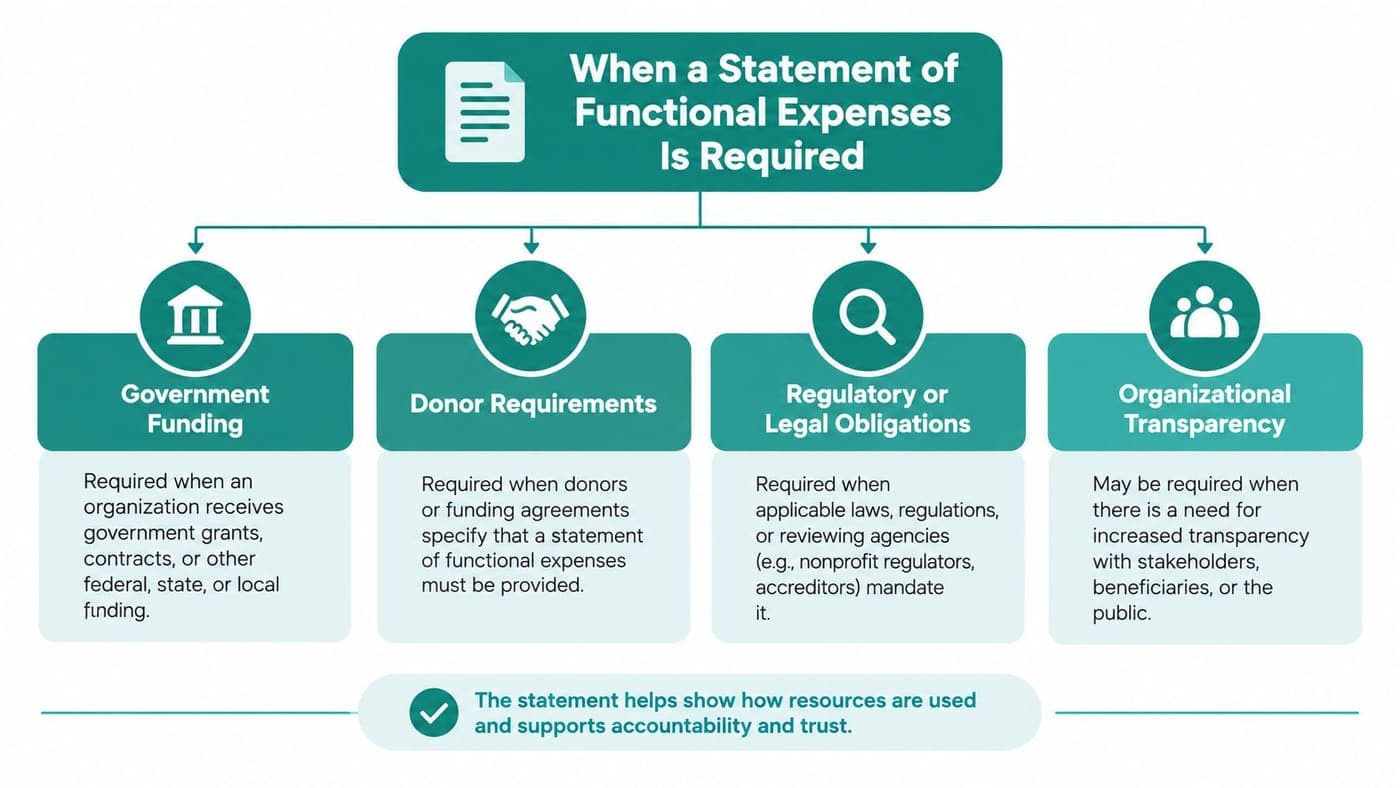
When a Statement of Functional Expenses Is Required
The answer depends on two reporting frameworks, your filing status, and how your financial statements present expense information. The IRS Form 990 and U.S. GAAP overlap, but they aren't identical documents.
For applicable 501(c)(3) and 501(c)(4) organizations filing Form 990, Part IX uses total expenses in Column A, program services in Column B, management and general in Column C, and fundraising in Column D. The form includes named expense lines, a total functional expenses line, and a separate joint costs line, as described in this Part IX explanation.
Form 990 is an allocation framework
Part IX isn't merely a table that someone fills in after the books close. The IRS Form 990 instructions require organizations to use their normal accounting method. If the accounting system doesn't already allocate expenses, the organization must apply a reasonable method and document that method in its records.
The instructions also require line items to appear on the proper lines. The four largest miscellaneous items must be identified separately on lines 24a through 24d, with the remainder aggregated on line 24e. Your totals must reconcile, and your source records should support the figures reported.
That means payroll, occupancy, travel, professional fees, technology, and shared overhead need more than broad labels. Your team should be able to explain the allocation basis, reproduce the calculation, and connect the result to the underlying records.
GAAP asks for both dimensions
Under U.S. GAAP for not-for-profit entities, expenses must appear by natural classification and functional classification. You may present that information in the statement of activities, in the notes, or in a separate statement of functional expenses, provided the required detail is available.
A separate standalone statement isn't automatically required when the financial statements or notes already provide both dimensions. The important requirement concerns the information itself, not necessarily one particular page title or layout.
That distinction prevents two common mistakes. Some organizations prepare a separate report unnecessarily, while others assume their income statement by natural category satisfies the requirement. It doesn't if readers cannot also see the functional breakdown.
Smaller organizations still need a clear answer
Form 990-EZ instructions reference additional financial statements, including a complete analysis of functional expenses. Simplified filing doesn't eliminate the need to understand how expenses were used or how the organization can support its reporting.
The Form 990 checklist can help you identify filing responsibilities, but your CPA or auditor should confirm the rules for your organization's tax status and financial statement presentation. Revenue size alone doesn't answer every reporting question, especially for groups with grants, restricted funds, fiscal sponsorship, or multiple programs.
Understanding FASB Standards and Reporting Thresholds
The major shift came from FASB Accounting Standards Update 2016-14, issued in 2016. Before that change, voluntary health and welfare organizations were broadly expected to present functional expense information, while other nonprofits could report it in different ways.
ASU 2016-14 made the presentation much more universal in U.S. GAAP practice. It applied to annual reporting periods ending in 2018 and later, requiring all not-for-profit entities to provide an analysis of expenses by both functional and natural classification. The FASB reporting guidance explains the change and its presentation impact.
Start with the reporting basis
First, identify which reports your organization prepares. Form 990 reporting, audited financial statements, reviewed statements, internal management reports, and grant schedules may use related information without serving the same purpose.
Next, ask where both classifications appear. If your statement of activities or notes already show expenses by function and nature, a separate standalone statement may not be necessary under GAAP. If they don't, you need another presentation that supplies the missing detail.
Then review consistency. The same allocation methodology should support your financial statements, Form 990, grant reports, and board reporting unless a specific reporting basis requires a documented adjustment.
Don't confuse simplified filing with simplified accounting
A smaller nonprofit may file a shorter return, but it still needs reliable records for restricted funds, program costs, shared overhead, and natural expense categories. A spreadsheet can support that work when the organization has few transactions and disciplined review practices. It becomes harder to defend when multiple people enter data, programs share resources, or grants carry different restrictions.
Your allocation policy should state which costs are direct, which are shared, and which basis applies to each shared category. It should also identify who reviews changes and where supporting records are retained.
For a practical overview of compliant workflows, see FASB-compliant nonprofit accounting. The standard is easier to meet when your chart of accounts and daily transaction process reflect the reporting you'll eventually need.
Ask your advisor about exceptions
Tax status, filing form, donor restrictions, state requirements, audit arrangements, and fiscal sponsorship can change the practical reporting picture. Don't rely on a generic template to settle a question that belongs with your CPA or auditor.
The safest approach is to establish your reporting basis early, document the method, and review it before filing season. That gives your finance team time to correct missing classifications while the source records are still accessible.
Comparing Generic Software to True Fund Accounting
A generic accounting system may record deposits, bills, payroll, and bank activity well. QuickBooks, Xero, and similar products are familiar to bookkeepers and can suit organizations with straightforward reporting needs.
The gap becomes visible when restricted funds, grants, programs, and functional expenses together must be tracked. Classes, tags, spreadsheets, and separate donor databases can fill individual gaps, but every workaround adds another place for information to drift.
| Feature | Generic Business Software | True Fund Accounting Platform |
|---|---|---|
| Fund restrictions | Often tracked through classes, projects, or manual reports | Funds and restrictions are modeled within the accounting structure |
| Functional expenses | Usually requires reports, spreadsheets, or manual allocations | Allocation and functional reporting are part of the reporting workflow |
| Grant tracking | May depend on custom fields or separate files | Grant activity can connect with funds, programs, and reporting |
| Donor records | Often requires a separate CRM | Donor and finance records can share transaction context |
| Volunteer data | Commonly managed outside accounting | Volunteer activity can connect with programs and operational records |
| Team access | Pricing and permissions vary by product | Some platforms offer plan-based access without per-seat fees |
| Reporting risk | Reconciliation depends on several workarounds | Fewer handoffs can reduce duplicate entry and mismatched totals |
Workarounds have a real operating cost
A spreadsheet allocation can appear inexpensive because the file already exists. Its cost shows up through duplicate entry, version confusion, manual review, and time spent explaining why figures changed.
A separate donor system may handle appeals effectively, while a volunteer platform manages schedules and hours. Each tool can perform well on its own. The problem starts when accounting, fundraising, events, and volunteer records use different program and fund structures.
Staff then export files, match names, and investigate differences. That work does not improve services. It can delay the close and make functional reporting difficult to reproduce.
Continuous fund accounting reduces that year-end scramble by keeping restrictions, programs, grants, and transactions connected as activity is recorded. Our fund accounting guide for nonprofits explains how funds, programs, and restrictions are modeled in the ledger.
Choose the system around your reporting reality
True fund accounting starts with the questions nonprofit leaders ask. How much remains in each restricted fund? Which grant supports this program? What did the organization spend by function and natural category? How did giving, events, volunteers, and campaigns contribute to the same mission activity?
An all-in-one platform can reduce handoffs by bringing accounting, donor management, volunteer management, events, marketing, and team communication into one operating environment. Some organizations consolidate these functions rather than reconcile records across separate tools.
Generic software still has a place. QuickBooks may suit a small organization with simple operations and strong external accounting support. The choice should reflect reporting complexity, staff capacity, audit expectations, and the team's tolerance for manual reconciliation. A system that captures the right classifications during daily work can make compliance a byproduct of routine operations instead of a year-end spreadsheet project.
Building a Reliable Expense Allocation Methodology
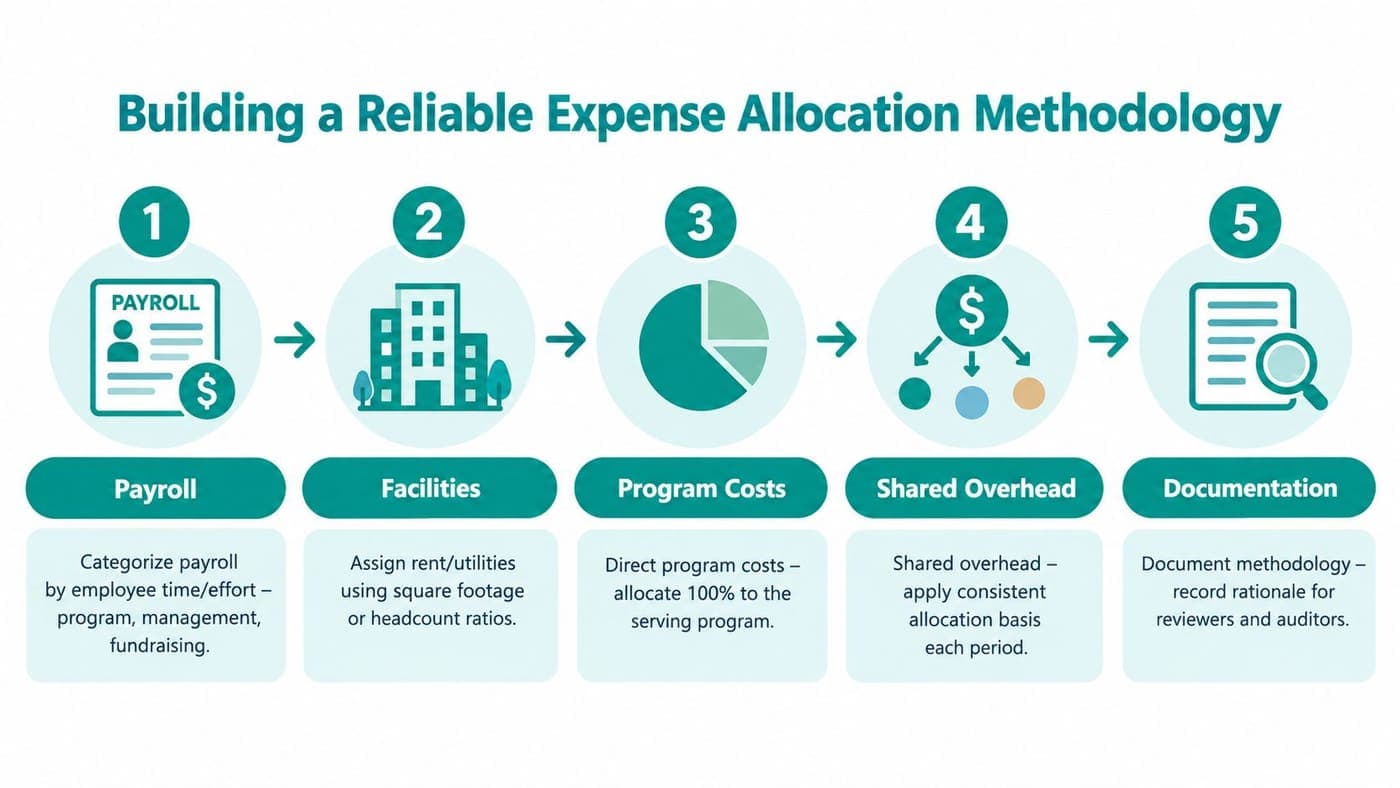
A reliable methodology begins by separating direct costs from shared costs. Direct costs support one identifiable program or function, while shared costs benefit more than one activity and need a reasonable allocation basis.
Write the method before year-end pressure arrives. Your policy should explain the basis for payroll, occupancy, utilities, technology, travel, professional fees, and other recurring shared categories.
Use evidence that matches the expense
Payroll should follow documented time or effort. A staff member working across programs can record time by program and function, while job responsibilities and periodic reviews support the reasonableness of the allocation.
Rent and utilities can follow usable square footage, headcount, or another consistently measured basis. Keep the calculation and update it when space usage changes.
Direct program costs should go entirely to the serving program when the connection is clear. Supplies purchased for one program shouldn't pass through a general overhead pool just because the accounting system makes that easier.
Keep the process reproducible
Apply the same basis each period unless circumstances change. If the method changes, record why, who approved it, and when the new approach begins.
Review the allocation monthly or quarterly rather than waiting for filing preparation. Early review catches missing time records, unusual classifications, duplicate entries, and changes in program activity while corrections remain manageable.
The cost allocation guide for nonprofits can help your team organize the policy and supporting records around practical categories.
A good allocation policy lets another informed person reach the same result from the same records.
Handle joint costs and miscellaneous items carefully
Joint costs require attention because one activity may include fundraising, program communication, and general information. Don't assign the full expense to the most favorable category without examining the activity's purpose and supporting documentation.
For Form 990 reporting, follow the form's line structure and identify the required miscellaneous items separately. Keep the general ledger detail behind the report, so reviewers can see how aggregated figures were created.
A clean methodology won't eliminate judgment. It will make judgment visible, consistent, and easier to defend.
Connecting Daily Operations to Financial Compliance
Compliance improves when your daily tools capture the facts your finance team needs later. An online giving page can connect a contribution with a donor, fund, campaign, and receipt. An event record can identify tickets, fees, payments, and the program receiving support.
Volunteer management adds another useful layer. When volunteers log hours, skills, availability, group participation, and program assignments, your team can understand how people support each activity. That operational context doesn't replace accounting records, but it helps managers review program activity and resource use.
Shared records reduce repeated questions
A donor CRM can connect gifts with restricted purposes and pledge activity. Marketing campaigns can show which communications belong to fundraising, while team communication keeps approvals and handoffs visible.
Churches may need donation and ministry reporting. Schools may need grants, events, and volunteer coordination. Fiscal sponsors may need separate project records and consolidated oversight. These settings differ, but they share one operational problem: people record related facts in disconnected places.
An all-in-one platform can keep those relationships closer to the source transaction. That can help your finance team review coding before the period closes instead of reconstructing context from email and spreadsheets.
AI should answer questions, not replace judgment
AI intelligence can help surface unusual classifications, missing information, or changes that deserve review. It can also answer questions about recorded data without forcing staff to export files into another tool.
Minty AI, AlignMint's assistant, is designed to answer questions about an organization's own data and surface operational insights. Your finance lead still decides whether an allocation is reasonable, whether a correction is needed, and whether the supporting documentation is sufficient.
The important distinction is control. AI can point to a transaction or pattern, but people remain responsible for the accounting policy and final report. Used that way, technology supports review rather than disguising uncertainty.
Next Steps for Streamlining Your Financial Reporting
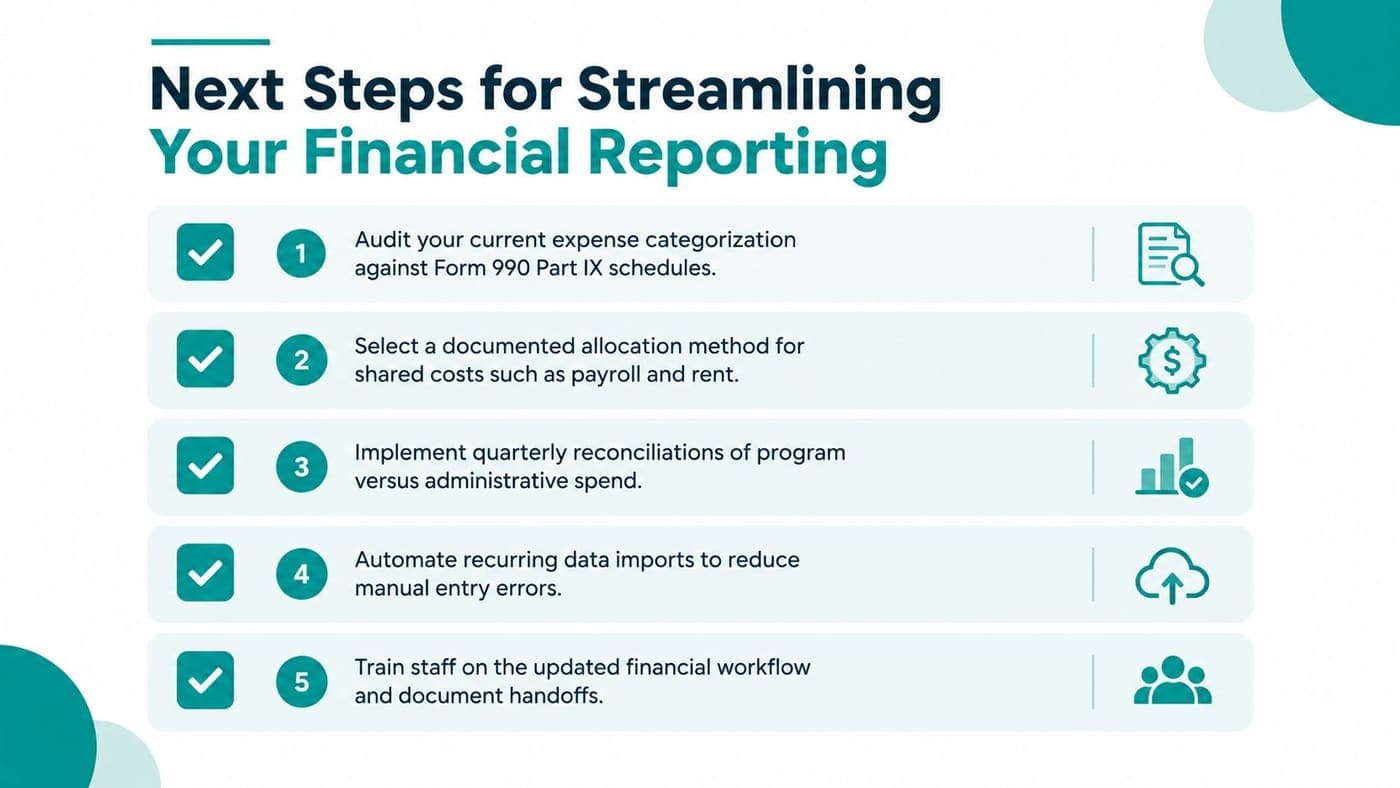
Start with the report you need to produce, then work backward to the records required to support it. Review your chart of accounts, fund structure, program list, staff time records, donor records, and current allocation policy.
A practical review should answer five questions:
- Can you trace totals? Match the statement of functional expenses to the general ledger and related financial statements.
- Can you explain allocations? Identify the basis for shared payroll, rent, utilities, technology, and professional services.
- Can you reproduce results? Ask another informed team member to follow the process without relying on personal memory.
- Can your systems share context? Check whether accounting, giving, programs, volunteers, events, and marketing records connect cleanly.
- Can your team collaborate affordably? Look for transparent pricing, plan-based access, and permissions that don't discourage participation.
Make compliance part of normal operations
The strongest setup records fund, program, natural category, and functional purpose near the time of each transaction. It also gives staff a clear place to review exceptions, attach documentation, and correct errors before reports are finalized.
Your board doesn't need more polished spreadsheets. It needs financial information that explains resource use and supports responsible decisions. Funders need confidence that restricted resources are tracked, and your staff needs a process that doesn't depend on one person's memory.
Evaluate platforms based on what they handle. Look for true fund accounting rather than QuickBooks classes alone, connected donor and volunteer records, built-in marketing and online giving pages, team communication, and reporting that supports Form 990 preparation. A free nonprofit tier for organizations under $100K can also make a new system easier to assess without committing limited operating funds.
The right workflow turns the statement of functional expenses from a year-end burden into a byproduct of daily discipline. That's better for your auditors, your board, your funders, and the people your mission serves.
AlignMint brings accounting, true fund accounting, donor management, volunteers, events, marketing, online giving, and team communication into one platform with plan-based access and no per-seat fees. Visit AlignMint to see whether its reporting workflow can make your Statement of Functional Expenses easier to prepare and defend.
Ready to try AlignMint with your nonprofit?
Start free — set up donor tools, giving pages, and Minty. Upgrade when you need accounting.