

Functional expenses are nonprofit spending categorized by purpose into program services, management and general, and fundraising, then shown on the Statement of Functional Expenses for Form 990 Part IX. If you've ever sat in a board meeting and felt the room turn toward one question, how much really goes to mission, this is the answer you need.
You're probably not looking for accounting theory. You want a clear way to explain the numbers, answer the board, and keep filing season from swallowing your week.
Quick Answer: What Are Functional Expenses
Functional expenses classify nonprofit spending by purpose: program services, management and general, and fundraising. That matrix feeds Form 990 Part IX and the Statement of Functional Expenses, so boards can see how dollars supported the mission versus overhead.
Pair this with the statement of functional expense and fund accounting. For allocation, see cost allocation for nonprofits.
Understanding Functional Expenses in Plain Language
You know the moment. A board member asks where the money went, another person wants the program ratio, and your spreadsheet suddenly feels too fragile to trust. That's when functional expenses stop being an accounting term and become a leadership issue.
What the IRS wants to see
Functional expenses are the nonprofit reporting framework that breaks spending into program services, management and general, and fundraising. The IRS requires organizations filing the full Form 990 to complete Part IX, the Statement of Functional Expenses. The current form includes 24 expense lines plus a total, and 501(c)(3) and 501(c)(4) organizations must complete all columns, according to the IRS form itself. IRS Form 990
That structure matters because it shows how dollars support mission delivery versus overhead and fundraising. It also forces a simple but important discipline, the same expense has to be understandable in two ways, by what it is and by what it was used for.
Practical rule: if you can't explain an expense to a board member in one sentence, your classification is probably too loose.
For a plain-English glossary entry you can keep handy, see our Statement of Functional Expenses glossary page. If you want a broader primer on the nonprofit books behind this reporting, the functional expense reporting guide explains the matrix format clearly.
Why this becomes real in day-to-day leadership
The hard part isn't knowing that the categories exist. The hard part is keeping your records clean enough that the numbers hold up when a donor, auditor, or board member asks why they look the way they do.
That's why functional expenses are more than compliance. They're part of how you tell the truth about your organization's work, without making every month a reconstruction project. If you've been trying to build the report after the fact, the problem isn't just time, it's confidence.
The Three Expense Categories You Need to Know
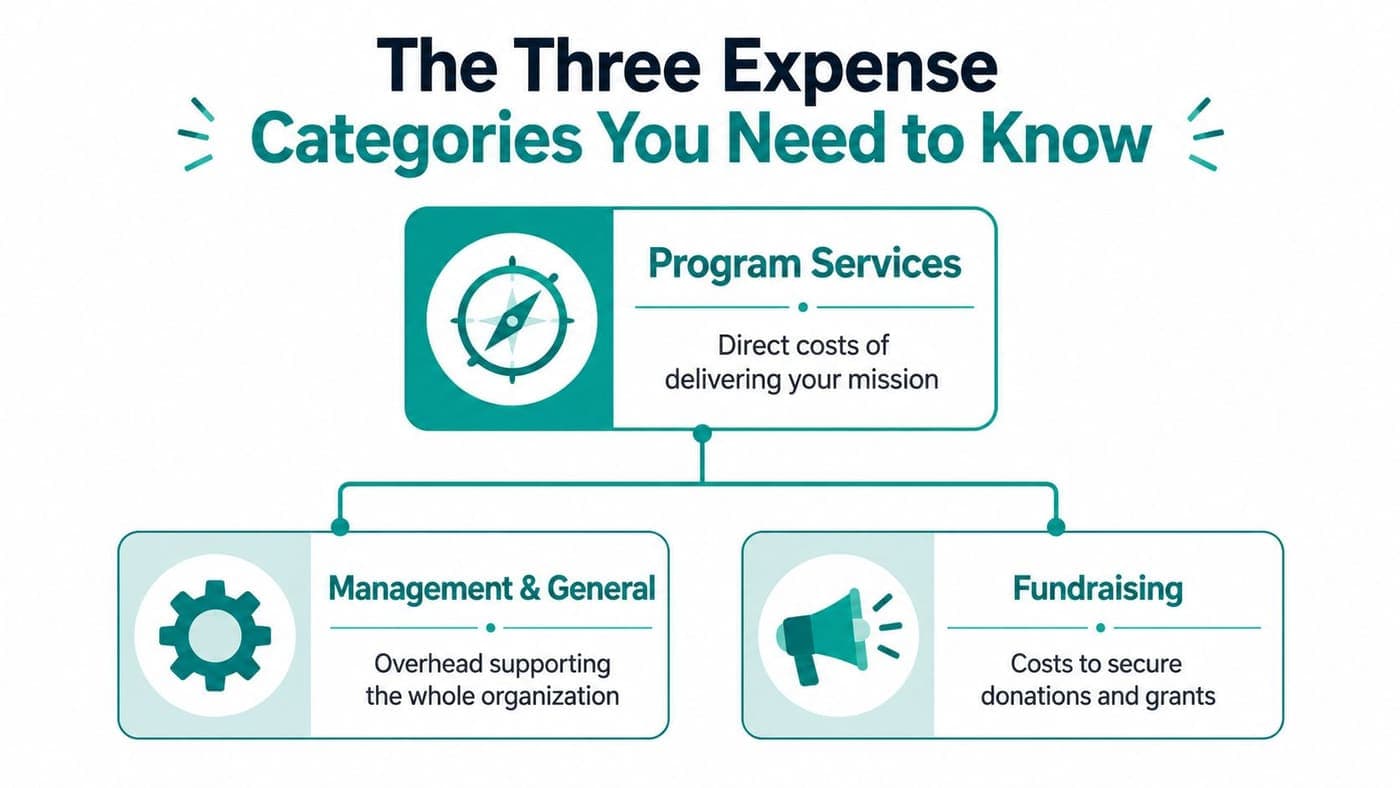
If a board member asks where a dollar belongs, the answer usually starts with one question, what job did that money do? In practice, that question points to three categories.
Program services, management and general, fundraising
Program services are the costs of delivering your mission. If staff work with clients, teach students, or serve meals, that spending belongs here when it directly supports the mission. See our program services glossary page for a simple reference.
Management and general covers the organization's shared running costs. Finance, HR, board support, oversight, and general office work belong here because they keep the nonprofit operating, even though donors may never see them.
Fundraising includes the costs of asking for support. Campaign materials, donor events, grant solicitation work, and staff time tied to bringing in contributions belong here when the purpose is to raise money. For a practical companion on day-to-day coding decisions, the guide on how to categorize expenses practically is a useful outside reference.
A good test is simple. If the expense directly advances mission delivery, it's program. If it keeps the organization running, it's management and general. If it helps bring in money, it's fundraising.
The IRS instructions also say fundraising expenses need allocable overhead tied to solicitation activities, including campaigns for contributions, gifts, grants, and governmental units, as described in the IRS Form 990 instructions.
Why the categories aren't interchangeable
Under U.S. GAAP, not-for-profit entities must present expenses by functional classification so users can assess service efforts and resource use. That disclosure can appear on the face of the statement of activities, in a separate statement, or in the notes. PwC nonprofit accounting guidance
That is why a salary cannot just sit in one bucket because it feels convenient. One employee may split time across multiple functions, and the records need to show that split in a way a board, auditor, or donor can follow. The accounting standard only works when the allocation method matches reality.
How to Allocate Shared Costs Between Categories
Shared costs are where many nonprofit leaders get stuck. Rent, phones, payroll support, insurance, and executive time often serve more than one function, so each one needs a clear, documented split.
Start with the easiest answer first. Direct identification is the preferred method in independent nonprofit accounting guidance. If an expense can be tied to a program or supporting service, assign it there instead of spreading it across several buckets. Functional reporting guidance
A tutor's workshop materials belong in program services. A development consultant's gala fees belong in fundraising. A controller's month-end work belongs in management and general.
When direct coding is not enough, use a reasonable basis for the split. Space-based costs can be divided by square footage. Staff costs can be divided by documented time. Shared technology can be allocated by actual use or another consistent method.
Consistency matters more than perfection. If salaries are allocated by time this quarter and by guesswork next quarter, the numbers become hard to defend. One board-approved method used all year is far easier to explain than a clever formula nobody can follow later.
If your explanation changes every time someone asks, the allocation method is not ready.
Write the method down in plain language. That keeps you from rebuilding the logic from memory when the auditor asks or the board chair wants a summary. Our cost allocation guide shows practical ways nonprofits document those decisions.
General accounting tools often start to strain here. A standard small-business ledger can record transactions, but it usually does not help with the reasoning behind shared costs. That gap shows up fast when salary, occupancy, and overhead have to be split in a way that can stand up under review.
A clean allocation system does not need to be fancy. It needs to be repeatable, documented, and easy for your team to use without a long training session.
Why Functional Expenses Matter for Form 990
Functional expenses aren't just for internal reporting. They flow straight into the public face of your nonprofit, which is why they matter to your board, your donors, and anyone comparing organizations side by side.
The Form 990 turns your accounting into a public record
A nonprofit with gross receipts of $200,000 or more or total assets of $500,000 or more is generally expected to file the full Form 990 rather than Form 990-EZ, which means functional expense allocations must be disclosed in detail. That threshold makes this reporting especially important for mid-sized and larger charities. Hiline on Form 990 thresholds
The Form 990 uses a matrix format. Column A starts with total expenses by natural category, then Columns B, C, and D allocate those same amounts into functional categories. So the same expense appears twice, once for what it is and once for what it served. IRS prior instructions
That dual view is why functional expense tracking saves time later. If your bookkeeping already tags costs by purpose, the return is much easier to build and much easier to defend.
Public disclosure changes the conversation
Your Form 990 is visible to donors, regulators, and analysts. That means your functional expense choices don't just affect filing season, they shape how outsiders read your organization's priorities.
If you want a tax-focused view of how nonprofit filings are read in practice, browse EndureGo Tax advice alongside your own filing checklist. Different countries and systems vary, but the reporting principle stays familiar, classify costs in a way that shows purpose clearly.
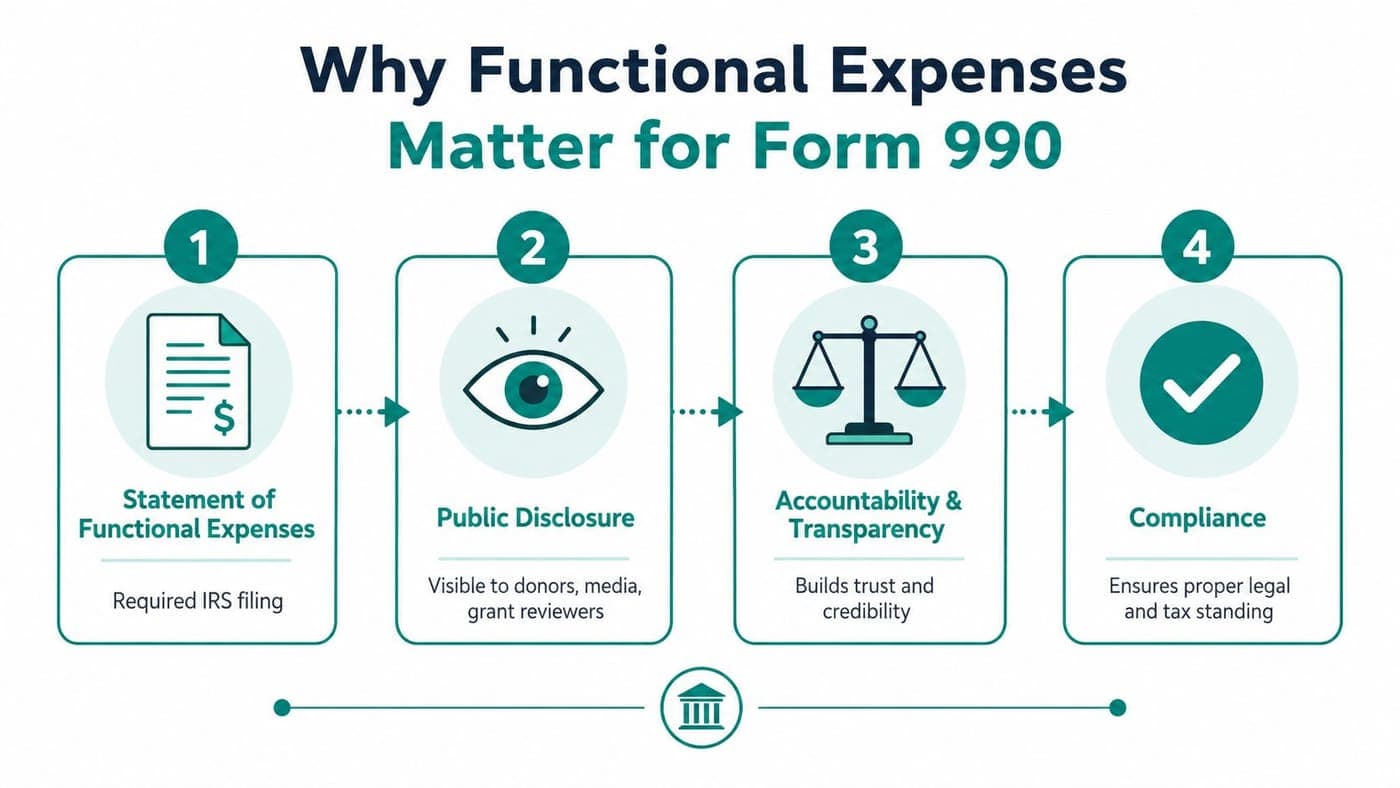
The filing gets even more sensitive when fundraising costs include overhead tied to solicitation activities, because those costs need to be captured in the right place. If the classification is sloppy, the public version of your numbers can look confusing even when the underlying work was legitimate.
Real Examples of Functional Expense Classification
The clearest way to learn this is through actual nonprofit work. Once you see the pattern, the categories stop feeling abstract.
A few situations you'll recognize
A community food bank pays kitchen staff to prepare meals. Those wages are program services because the staff are directly delivering the mission. The executive director's salary is different, because her time usually touches oversight, operations, and development, so it may need to be split across functions.
A youth sports nonprofit rents one building for both games and administration. The gym space can be treated differently from the office area, since the space supports different purposes. A square-footage method gives you a defensible split without guessing.
A children's museum sends donor thank-you postcards after a gala. Those postcard costs belong in fundraising, while exhibit supplies belong in program services. The transaction looks similar in the ledger, but the purpose is completely different.
The invoice doesn't tell you the function. You have to know the work behind it.
Why the audit trail matters
A statement of functional expenses is a matrix-style report that classifies nonprofit spending by both nature and function. Natural categories like salaries, rent, utilities, supplies, interest, and depreciation are mapped into functional buckets like program services and supporting activities, and that dual-axis structure makes the report decision-useful for audits and Form 990 Part IX. Nonprofit Accounting Basics
That is also why recordkeeping matters so much. The same transaction set has to reconcile to both the financial statements and the tax return while preserving a clear trail from source expense to functional allocation. If you can't trace the logic, the report loses credibility fast.
How AlignMint Simplifies Functional Expense Tracking
You don't need to manage this with spreadsheets and last-minute cleanup. When your system records the function at the point of entry, the reporting work gets much lighter.
What changes when the platform is built for nonprofit work
At AlignMint, true fund accounting means restricted funds, grants, and programs are modeled natively, not simulated with classes or tags. That matters because functional expenses sit inside real nonprofit operations, not generic small-business bookkeeping. Our functional expenses documentation shows how the workflow connects expense entry to reporting.
When you code an expense, you assign the program or function once and keep moving. The system then carries that classification into the statements you need later, instead of making you rebuild it in a separate spreadsheet. That's the practical difference between software that understands nonprofits and software you have to translate for.
Why one system helps your whole team
Functional expense tracking usually sits next to other jobs you can't ignore, donor management, volunteer coordination, events, and board communication. AlignMint keeps those pieces in one place, with plan-based access with no per-seat fees, so your staff, finance lead, and program manager can work from the same records.
We also built a free tier for nonprofits under $100K, which helps smaller organizations get organized before reporting becomes painful. The platform includes a built-in marketing suite, online giving pages, and Minty assistant support, so you're not stitching together five tools to answer one board question.
Other options still matter. QuickBooks is strong for general bookkeeping, and many nonprofits start there. The gap is that it doesn't natively model fund accounting the way a nonprofit needs, so the functional expense work often shifts back to you.
If your current process still depends on late-night spreadsheet fixes, it's time to make the reporting easier to trust. Visit AlignMint to see how one platform can handle accounting, donor data, volunteers, events, and functional expense reporting in the same place.
Ready to try AlignMint with your nonprofit?
Start free — set up donor tools, giving pages, and Minty. Upgrade when you need accounting.