

A board member asks whether your donor records, bank information, and grant files are safe. You answer confidently, then realize you aren't sure where every sensitive file lives, who can access it, or what happens if someone clicks the wrong email.
Financial data security isn't an IT project reserved for large institutions. It's a stewardship responsibility that protects donor trust, compliance, payroll, grant reporting, and your ability to keep serving people when something goes wrong.
Quick Answer: Financial Data Security for Nonprofits
Financial data security for nonprofits is stewardship of donor, bank, grant, and payroll records. Know where the data lives, who can access it, and how you would respond if someone clicked the wrong email.
Start with nonprofit software security and nonprofit internal controls. For the ledger, see fund accounting.
Why Financial Data Security Matters for Your Mission
The uncomfortable question usually arrives during an ordinary board meeting. A director asks whether the organization's donation records are protected, and the finance manager explains that some information sits in accounting software, some in a donor database, and some in spreadsheets shared by email.
Nobody has acted irresponsibly. The nonprofit grew gradually, adding tools whenever a new need appeared. But every new tool created another login, another vendor relationship, another place where donor and financial information could be copied or exposed.
That gap affects more than technology. Donors expect careful stewardship of their gifts, grantmakers expect accurate reporting, and staff need reliable access to the information required for daily work. A breach can interrupt payroll, delay grant submissions, damage a community relationship, and consume leadership attention when the mission needs it most.
Leadership responsibility: You don't need to become a security engineer. You do need to know what data you hold, who can reach it, and how your organization would respond.
Strong nonprofit internal controls support that responsibility. Segregated duties, approval workflows, reconciliation, and documented access rules protect financial integrity while making suspicious activity easier to spot.
The practical standard is simple. Protect information according to its sensitivity, give people only the access their roles require, and remove access promptly when responsibilities change. Review vendors with the same care you apply to a bank relationship.
This approach also supports continuity. When records are centralized, permissions are understandable, and response responsibilities are written down, an executive director can make decisions instead of reconstructing the organization's systems during a crisis.
Security deserves board attention because it protects the mission's credibility. Your goal isn't perfect protection, which no organization can promise. Your goal is disciplined stewardship that makes an incident less likely, limits its reach, and helps your team recover without losing public trust.
What Financial Data Security Actually Means
Think of financial data security as a locked filing cabinet with an access register. Authorized people can open the right drawer, sensitive documents stay protected, and the register shows who accessed information and when.
For a nonprofit, the drawers contain more than bookkeeping records:
- Donor payment details: Information connected with online gifts, recurring donations, receipts, and refunds.
- Bank account information: Account details, reconciliations, transfers, and payment approvals.
- Grant records: Budgets, drawdowns, restricted-fund activity, and financial reports sent to funders.
- Payroll records: Compensation information, tax documents, direct-deposit details, and personnel files.
- Form 990 information: Revenue, expenses, functional classifications, and supporting schedules.
Security covers three moments in each workflow. Data at rest means information stored in a database, document system, laptop, or backup. Data in transit means information moving between your donor page, payment processor, bank connection, or staff browser. Data in use means information displayed, edited, exported, or analyzed by an authorized person.
Suppose a supporter gives online. The donation page should protect the information while the donor submits it, the payment process should limit where card data travels, and the resulting gift record should be accessible only to people who need it.
A grant drawdown presents a different example. Your finance staff may need the budget and restricted balance, while a volunteer coordinator doesn't need access to payroll or bank credentials. Good systems make those distinctions ordinary rather than dependent on memory.
You should also know whether your provider encrypts stored data and transmitted data, records administrative access, separates customer information, and supports secure deletion or retention policies. Ask for plain answers, not a pile of technical terms.
Practical test: If you can't explain where sensitive data lives and who can access it, you can't manage its risk yet.
Start with an inventory. List each system, the information it holds, the people who use it, and the outside vendors connected to it. That simple exercise often reveals duplicated exports, former staff accounts, and spreadsheets that deserve immediate attention.
Common Threats and the Real Cost of a Breach
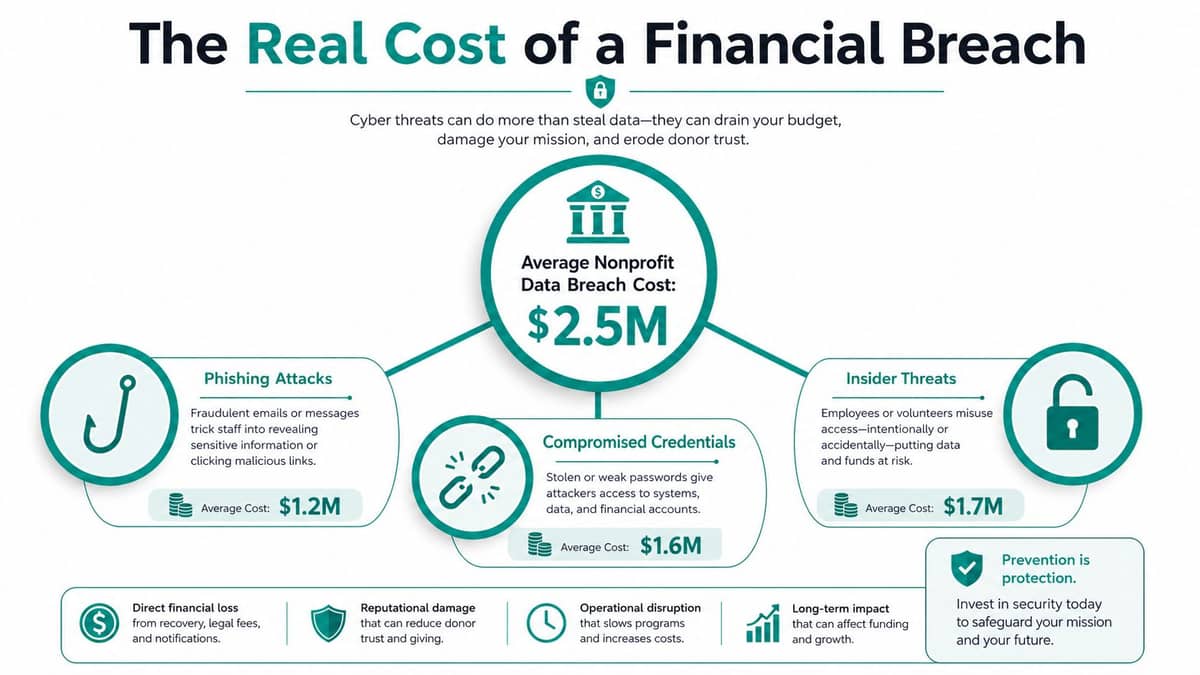
The most common threats follow familiar nonprofit routines. A finance employee receives an urgent payment request, a staff member reuses a password, or an administrator connects a cloud application without checking its sharing settings.
Phishing works because attackers imitate trusted people. They may copy a vendor's tone, reference a real event, or ask for an account change just before payroll. The right response isn't blaming the employee. It's requiring independent verification for payment changes, bank updates, and unusual requests.
Compromised credentials can open accounting, donor, email, and cloud systems at once. A single password becomes dangerous when it grants access to several services. Multi-factor authentication, especially phishing-resistant authentication where available, reduces that concentration of risk.
Cloud misconfiguration creates a quieter exposure. A donor export, grant report, or shared folder may become visible beyond the intended team because permissions were set broadly and never reviewed. Third-party vendors add another path, particularly when your organization exchanges data across multiple systems.
The financial consequences explain why this belongs in board conversations. IBM-derived 2026 breach-cost reporting put the global average breach cost at $4.99 million, while financial services averaged $6.29 million per breach, and the United States average reached $11.5 million.
Those figures describe financial services rather than nonprofits, but they establish the exposure attached to valuable financial and identity-linked information. A smaller organization may face a different incident cost, yet the disruption can still threaten operations, donor confidence, and restricted-fund administration.
The threat has also become more selective. The U.S. financial services sector recorded 739 data compromises in 2025, the highest single-year count in the Identity Theft Resource Center's tracking history for that sector, as reported by Finopotamus.
Attackers pursue useful access, not merely large databases. They want payment authority, donor identities, payroll records, grant information, and trusted vendor relationships. That makes approval controls and vendor review as important as staff awareness training.
Your board doesn't need a technical threat briefing. It needs clear answers about the systems holding sensitive data, the controls protecting them, and the plan for limiting damage when prevention fails. Practical guidance on nonprofit software security can help frame that discussion.
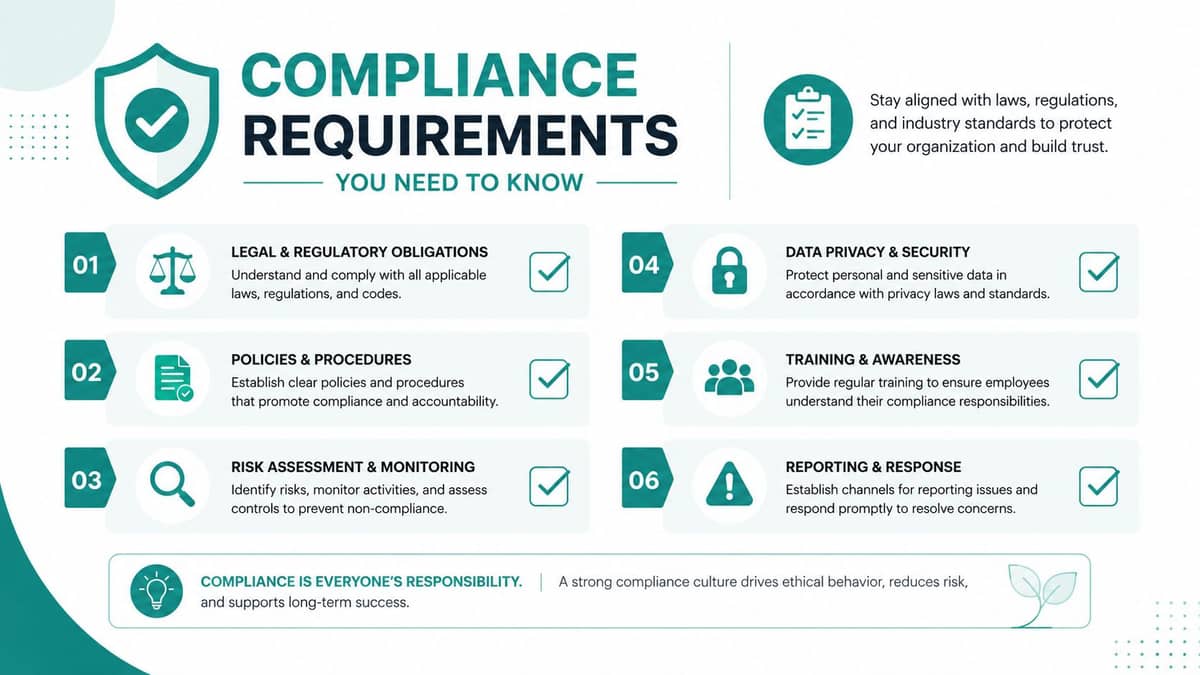
Compliance Requirements You Need to Know
Compliance becomes manageable when you translate each obligation into a daily practice. Start with the payment process, then examine vendor controls, privacy duties, and financial reporting discipline.
Payment information requires boundaries
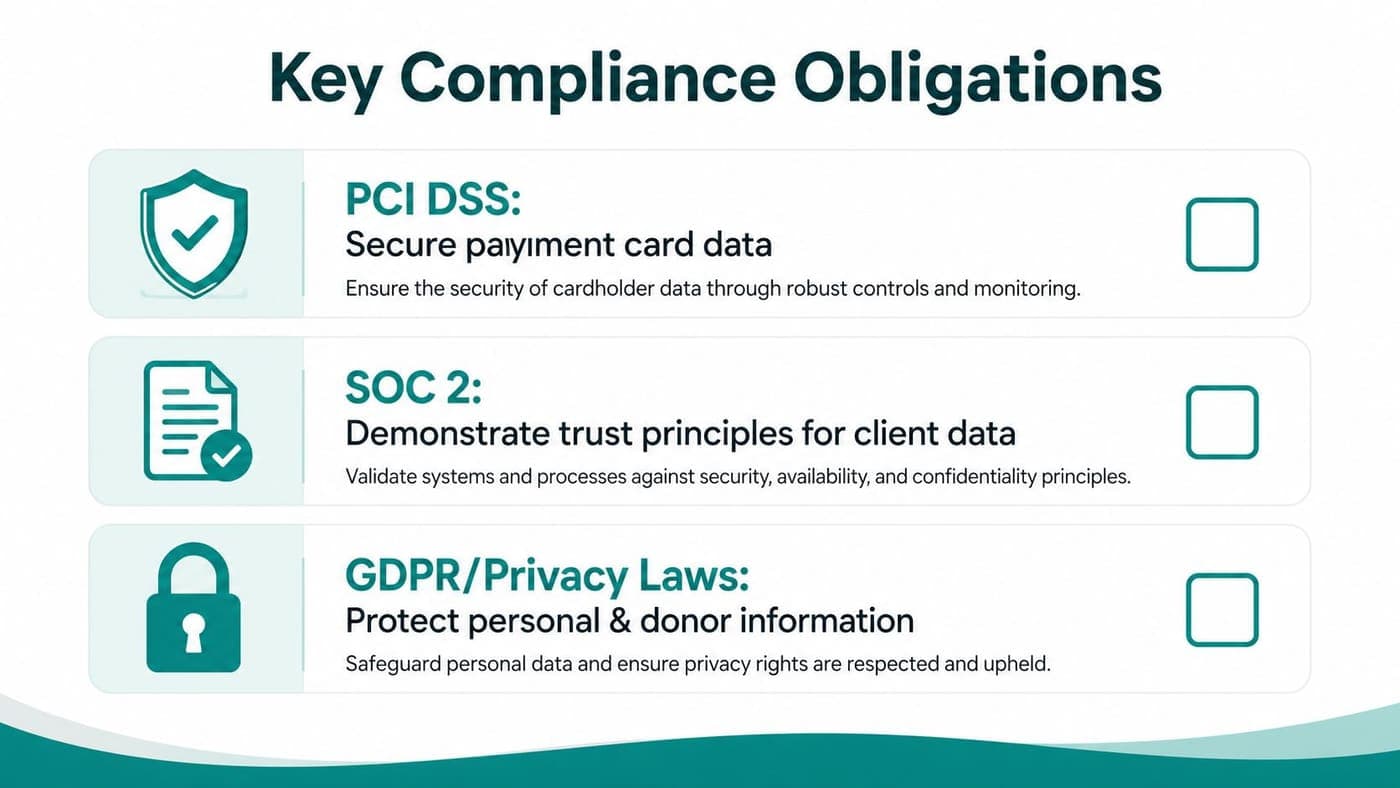
PCI DSS applies to environments handling payment card data. Your organization should understand which party stores full card details, which party processes transactions, and whether your donation page keeps sensitive payment information outside your own systems.
Ask your payment provider how it protects card data, limits staff access, monitors suspicious activity, and handles incidents. Your staff should never request or store complete card numbers in email, spreadsheets, or informal notes.
Vendor reports describe control environments
A SOC 2 report can help you evaluate a provider's controls around security, availability, confidentiality, processing integrity, and privacy. It doesn't automatically make a vendor suitable for your nonprofit, but it gives your finance and leadership teams evidence to review with counsel or an auditor.
Ask whether the report covers the service you'll use, whether an independent auditor examined it, and whether exceptions require follow-up. If your organization works with regulated financial partners, a practical resource on how to pass a FINRA IT audit can provide useful context for control documentation and technology oversight.
Privacy duties follow the data
State privacy requirements differ, and donor information may include names, addresses, payment details, communication preferences, and other personal information. Maintain a clear privacy notice, collect only what your programs need, limit internal access, and document how vendors receive or use donor data.
The same discipline supports your financial reporting. The IRS Form 990 requires organizations filing the full return to report expenses in four columns, total expenses, program service, management and general, and fundraising.
The IRS also defines fundraising expenses as costs incurred while soliciting cash and noncash contributions, gifts, and grants, including allocable overhead for publicizing and conducting campaigns, as described in its Form 990 instructions. Accurate classification requires clear records, consistent approvals, and controlled access.
Use this executive checklist
- Map obligations: Identify payment, privacy, grant, employment, and reporting duties that apply to your organization.
- Review contracts: Confirm breach notification, access controls, data retention, subcontractors, and return or deletion terms.
- Test permissions: Compare actual access with each person's current responsibilities.
- Document decisions: Keep evidence of reviews, approvals, training, and incident exercises.
- Ask for help: Use your auditor, counsel, and compliance resources when requirements exceed internal expertise.
Compliance isn't a certificate on a wall. It's a repeatable operating habit that helps your organization explain how it protects people and manages money.
Technical and Organizational Controls That Work
The best controls reduce exposure without making ordinary work impossible. Prioritize protections that stop unauthorized access, limit the value of stolen credentials, and show you where sensitive information resides.
Encryption protects stored records and information moving between systems. Multi-factor authentication protects accounts when passwords are stolen. Role-based access limits the damage when one account is compromised. Continuous cloud posture monitoring catches sharing and configuration problems before they become public exposures.
Organizational controls complete the picture. Classify data by sensitivity, document approved storage locations, review vendors, and keep an access list that someone owns. These tasks sound basic because they are basic. They're also frequently incomplete.
A 2026 Thales survey of 237 financial-services security and IT executives across 20 countries found that only 32% reported complete knowledge of where their data was stored, and only about half of sensitive cloud data was encrypted. That finding points to an operational problem. You can't protect records you haven't identified.
| Control | Type | Effort | Risk Reduction |
|---|---|---|---|
| Multi-factor authentication for finance and CRM | Technical | Low | Limits damage from stolen passwords |
| Role-based access and quarterly reviews | Technical and organizational | Moderate | Restricts unnecessary donor and bank access |
| Encryption at rest and in transit | Technical | Provider-supported | Protects stored and transmitted records |
| Vendor security review | Organizational | Moderate | Exposes weak contracts and hidden data sharing |
| Data inventory and classification | Organizational | Moderate | Shows where sensitive information actually lives |
| Incident response plan and rehearsal | Organizational | Moderate | Speeds decisions during a breach |
Board question: Ask which control would fail first if one employee's email account were taken over.
For payment workflows, review how card information is handled and what your organization stores locally. AlignMint's payment processing documentation is one example of the detail a provider should make available.
Automation can support monitoring, but don't buy a dashboard you won't review. If you're assessing compliance platforms, a practical discussion of is Vanta right for your startup? may help your team compare reporting needs with the administrative work required.
Choose controls your staff can follow every day. A complicated policy that people bypass offers less protection than a clear process they use.
How to Respond When a Breach Happens
Your first job after a suspected breach is to create order. Don't let staff delete messages, restart affected devices, or contact outsiders before someone preserves the facts.
Use this sequence during the first day:
- Confirm the report: Record what happened, when someone noticed it, which account or system is involved, and what information may be affected.
- Contain access: Disable compromised accounts, revoke active sessions, isolate affected devices, and pause suspicious integrations.
- Preserve evidence: Save relevant emails, alerts, logs, screenshots, and vendor communications. Keep originals intact.
- Activate leadership: Notify the executive director, board chair or designated committee lead, finance lead, insurer, and legal counsel according to your plan.
- Engage specialists: Ask counsel whether forensic investigators, breach counsel, payment partners, or law enforcement should participate.
- Communicate carefully: Prepare accurate internal and external messages after confirming legal, contractual, and regulatory duties.
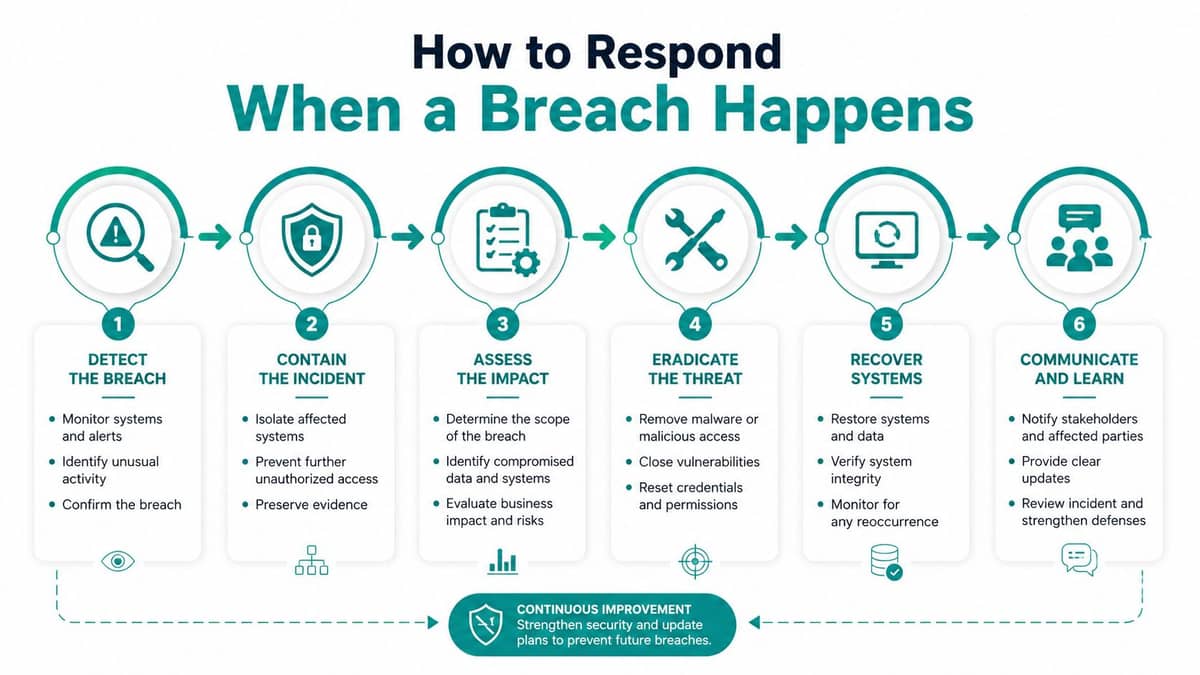
Don't promise that no donor information was accessed until your investigation supports that conclusion. Staff should direct questions to one spokesperson, while finance teams monitor payment activity and preserve reconciliation records.
Response speed matters because attackers can keep using stolen access while your organization investigates. IBM findings reported by UpGuard showed that financial institutions typically identified breaches in 168 days and contained them in 51 days, compared with cross-industry averages of 194 days and 64 days.
Those figures describe industry response patterns, not a target for your nonprofit. They do show why preparation matters. A written contact list, authority matrix, and containment checklist remove hesitation when facts remain incomplete.
For a practical companion, review these DFW data breach response steps with your leadership team. Then store your own plan somewhere accessible when the primary email or file system is unavailable.
After containment, document what happened, notify affected parties when required, reset credentials, review vendor involvement, and correct the control that allowed access. A breach response isn't complete until the organization learns from the failure.
Choosing Vendors and Training Your Team
Vendor selection is a security decision, not just a purchasing decision. Every platform that stores donor, accounting, volunteer, event, or payroll information becomes part of your organization's control environment.
Ask each provider direct questions:
- Protective design: Is information encrypted in transit and at rest, and how are encryption keys managed?
- Customer separation: How does the provider isolate your organization's data from other customers?
- Access governance: Can you assign roles, require multi-factor authentication, review administrator activity, and remove users promptly?
- Incident response: How quickly will the provider notify you, and what assistance will it provide?
- Continuity: What service availability commitments, backups, recovery procedures, and export options support your operations?
- Subcontractors: Which outside providers can access your information, and where do they process it?
An all-in-one platform can reduce risk when it replaces unnecessary handoffs. Combining accounting, donor management, volunteers, events, and marketing means fewer exports, fewer duplicate records, and fewer credentials for staff to manage. It doesn't remove the need for diligence, but it can reduce the number of places where information must be protected.
AlignMint combines fund accounting, donor management, volunteer management, events, marketing, online giving pages, and team communication in one platform. It also offers Minty, an assistant that answers questions about an organization's own data, while plan-based access avoid per-seat fees. Churches, schools, fiscal sponsors, and nonprofits with restricted grants should evaluate whether those workflows fit their actual reporting needs.
Training should be short, recurring, and tied to real work. Teach staff to verify unusual payment requests, report suspicious messages, protect donor payment information, approve transactions through the right channel, and avoid downloading unnecessary exports.
The wider threat environment reinforces the point. The U.S. financial services sector recorded 739 data compromises in 2025, the highest single-year count in the Identity Theft Resource Center's tracking history for that sector, according to Finopotamus' coverage. Vendors and staff both deserve scrutiny because attackers can enter through either side.
For organizations comparing supplier controls, a documented vendor management process helps connect contracts, risk reviews, renewals, and access decisions.
Your Next Steps for Stronger Financial Data Security
You can improve your organization's position this week without buying an expensive security program. Start with decisions that create visibility and remove easy paths into sensitive information.
- Inventory your records: List donor, bank, grant, payroll, Form 990, volunteer, and payment information by system.
- Review access: Remove former users, reduce unnecessary administrator privileges, and require multi-factor authentication for finance and donor systems.
- Check vendors: Ask about encryption, data isolation, subcontractors, incident notification, recovery, and deletion.
- Protect workflows: Require independent verification for bank changes, payment requests, and unusual transfers.
- Prepare response: Write down who can disable accounts, contact counsel, notify the board, speak publicly, and coordinate with vendors.
- Choose simpler architecture: Prefer tools that keep accounting, CRM, volunteers, events, marketing, giving, and communication connected without needless exports.
True fund accounting matters here because restricted funds, grants, programs, Form 990 reporting, and Statements of Functional Expenses depend on trustworthy records. A platform should support those financial distinctions while protecting donor relationships and giving staff only the access they need.
Your security budget may be limited, but your standards shouldn't be vague. Make the inventory, access review, vendor questions, and breach contacts part of your regular leadership rhythm.
AlignMint brings true fund accounting, donor and volunteer management, events, marketing, online giving pages, and team communication into one system with bank-level encryption and data isolation. Visit AlignMint to review the platform, including its free tier for nonprofits under $100K, and decide whether it can reduce your organization's security burden this week.
Ready to try AlignMint with your nonprofit?
Start free — set up donor tools, giving pages, and Minty. Upgrade when you need accounting.