

What Is Grant Accounting for Nonprofits
Grant accounting is the specialized process of tracking every restricted grant dollar from award to final report, proving funds were used exactly as the funder intended. It records each award separately, rather than pooling grant revenue with unrestricted operating money.
You may know the feeling: a board meeting is approaching, several funder reports are due, and your team is searching through spreadsheets to explain why a restricted balance doesn't match the program budget. The problem usually isn't a lack of commitment. It's a workflow that separates fundraising, spending, documentation, and reporting.
Grant accounting connects those activities. It helps you recognize grant revenue correctly, allocate expenses to the right award, monitor compliance, and produce reports that funders can trust. It also gives you a clearer view of whether a program has enough available funding before a cash problem reaches your desk.
Quick Answer: Grant Accounting
Grant accounting tracks each restricted award separately from unrestricted operating money. Record the purpose, the timing rule, and the expenses against that award so a funder report comes from the ledger instead of a reconstructed spreadsheet.
Start with grant fund accounting and fund accounting. For tracking, see grant tracking spreadsheet.
The Purpose of Grant Accounting
A board meeting is approaching, funder reports are due, and your team is searching several spreadsheets to explain why a restricted balance does not match the program budget. The problem is usually the workflow, not the staff's commitment. Fundraising, spending, documentation, and reporting have been separated across people and tools, so no one can produce one dependable answer quickly.
Grant accounting connects those activities. It is a specialized part of nonprofit fund accounting that tracks each award so your organization can verify how restricted dollars were used, monitor compliance, and prepare reports for funders. Sage's overview of grant accounting explains the practical distinction: grants are recorded and reported by award, program, or project instead of being pooled with unrestricted revenue.
Treat each award as its own operating commitment
Ask three questions for every grant: What spending did the funder permit? What has the organization spent? What evidence supports each amount?
Set up each award with its own budget, revenue record, expense coding, reporting calendar, and documentation trail. A connected workflow should carry information from fundraising through purchasing and expense approval to reporting. Integrated software can link those stages and update available balances as transactions are recorded, rather than forcing the finance team to reconcile separate spreadsheets at month-end.
Practical rule: If you cannot connect a transaction to an award, purpose, budget line, and supporting document, the workflow is unfinished.
Reviewing each grant during the month helps staff identify unallowable costs before submission and respond to questions without reconstructing the award's history. Clear records also reduce the risk of returning funds because the organization cannot demonstrate proper use. Board members gain a more accurate view of program performance and remaining funding.
Grant accounting is stewardship, not clerical work
A grant report shows the funder which approved costs the award covered, which deliverables were completed, and which balance remains restricted. That evidence lets the funder verify proper use without a follow-up call.
Grant accounting therefore belongs in operational planning, not only in the finance office. Development staff need accurate award terms, program staff need clear spending rules, and leadership needs timely variance information. A practical guide to accounting for not-for-profit organisations can also help explain how nonprofit accounting supports governance and accountability.
The payoff is practical confidence. Your team can see which funds remain available, which reports need attention, and which program costs require a decision before they become compliance problems. The right workflow turns grant accounting from a final reporting exercise into an ongoing control over fundraising, spending, and delivery.
Understanding Restricted and Unrestricted Funds
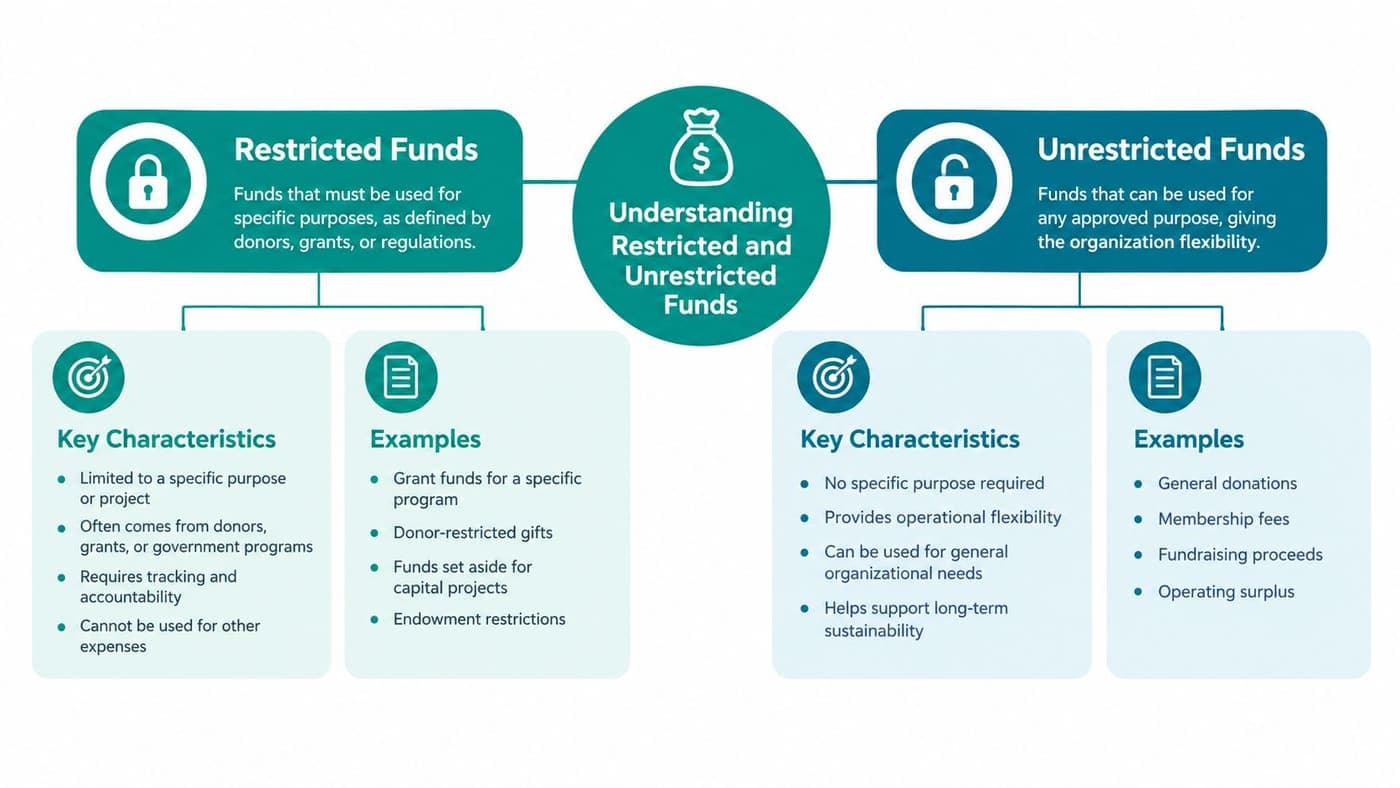
Start with a simple image. Think of unrestricted money as an envelope labeled “general operations.” You can use it for legitimate organizational needs, subject to your policies and board oversight. Restricted money arrives in an envelope labeled for a particular program, time period, or purpose.
You can't open the second envelope for an unrelated expense just because the organization needs cash elsewhere. Nonprofits use fund accounting to separate restricted and unrestricted resources, and restricted gifts are tracked by donor-imposed purpose or time limits rather than pooled with general operating money, as explained in Xero's nonprofit accounting guide.
Read the restriction before recording the money
A restriction can relate to purpose or time. A purpose restriction might limit spending to a named program, while a time restriction may make funds available during a specified period.
Under nonprofit reporting guidance summarized by Xero, net assets are presented in two classes, with donor restrictions and without donor restrictions. The classification affects your statement of financial position and statement of activities, so it isn't merely an internal spreadsheet label.
Use this practical sequence:
- Read the award or gift agreement. Identify the permitted purpose, period, deliverables, and reporting requirements.
- Create the tracking dimension. Use a fund, award, project, or cost center that your team can select when recording transactions.
- Match spending to the restriction. Confirm that the expense supports the approved activity and budget.
- Release restrictions correctly. Reclassify amounts only when the stated time or purpose requirement has been satisfied.
Explain the balance in plain language
Your board doesn't need accounting jargon to make a sound decision. They need to know which money is available for general operations, which money belongs to a specific program, and what remains committed to future work.
A restricted balance can look healthy while your unrestricted cash position feels tight. That's why you should report the two categories separately and explain the practical consequence. Restricted funds may support valuable work, but they can't automatically pay an unrelated payroll bill or facility expense.
Use AlignMint's guide to restricted versus unrestricted funds when preparing a board discussion or training a new finance committee member. The best explanation connects the accounting classification to a decision your leaders must make.
Navigating Revenue Recognition and Timing Rules
The hardest grant accounting question is often not where to code an expense. It's deciding when the grant becomes revenue and when the money must remain deferred or treated as conditional.
Unconditional, conditional, and reimbursable grants are accounted for differently. Foundant's guidance on grant accounting also notes that federal grant rules are becoming more documentation-heavy in 2026, with proposed changes to Uniform Guidance expected to increase justification and reporting requirements for payment requests.
Separate the common grant situations
An unconditional grant generally doesn't depend on your organization first completing a barrier or required action before you have a right to the funds. The accounting still depends on the agreement and applicable reporting rules, but the recognition question differs from a conditional award.
A conditional grant includes conditions that must be met before the organization is entitled to recognize the related revenue. Receiving cash doesn't automatically settle that question. If the conditions haven't been satisfied, the amount may need to remain deferred until the requirements are met.
A reimbursable grant creates a cash timing challenge. Your organization may incur an allowable expense first, document it, and then request reimbursement. The expense and the related receivable or revenue treatment must follow the agreement and applicable accounting guidance.
Under U.S. GAAP, treatment also depends on whether the arrangement is a contribution or an exchange transaction and, if it is a contribution, whether it is conditional or unconditional. Internationally, IAS 20 guidance on government grants establishes recognition when there is reasonable assurance that conditions will be met and the grant will be received.
Protect cash flow with an early review
Ask three questions when an award arrives:
- What must happen first? Look for milestones, matching requirements, allowable-cost rules, or reporting conditions.
- What triggers recognition? Identify whether the agreement connects funding to costs, activities, time, or reimbursement.
- What evidence supports a drawdown? Confirm that invoices, payroll allocations, approvals, and performance records exist before requesting payment.
The danger is recording cash as income too early, then discovering that the award remains conditional. The opposite problem is also costly. If eligible expenses have been incurred but your team hasn't prepared the supporting request, cash can be delayed even while the program continues.
Read how deferred revenue works for nonprofits alongside your award agreement. Your auditor or nonprofit accountant should make the final judgment on unusual terms, especially where a grant combines several conditions.
Designing Workflows for Multi-Grant Organizations
A multi-grant organization needs a workflow that works on an ordinary Tuesday, not only during audit season. The strongest design connects the award record, budget, donor or funder information, expense entry, approval, documentation, and report in one traceable process.
Spreadsheets can help at the beginning. They're familiar, flexible, and inexpensive. They become fragile when several people edit different versions, payroll is split across awards, and each funder follows a different reporting cadence.
Compare the operating choices
| Workflow choice | What works | Where it breaks |
|---|---|---|
| Separate spreadsheets | Quick to start and easy to customize | Duplicate entry, version confusion, and late reconciliation |
| Generic accounting classes | Familiar to bookkeepers and useful for basic categorization | May not provide true fund accounting or award-level reporting |
| Connected nonprofit platform | Links fundraising, expenses, programs, and reporting records | Requires thoughtful setup and clear responsibilities |
| Manual monthly reconstruction | Can answer a one-time question | Consumes staff time and increases coding risk |
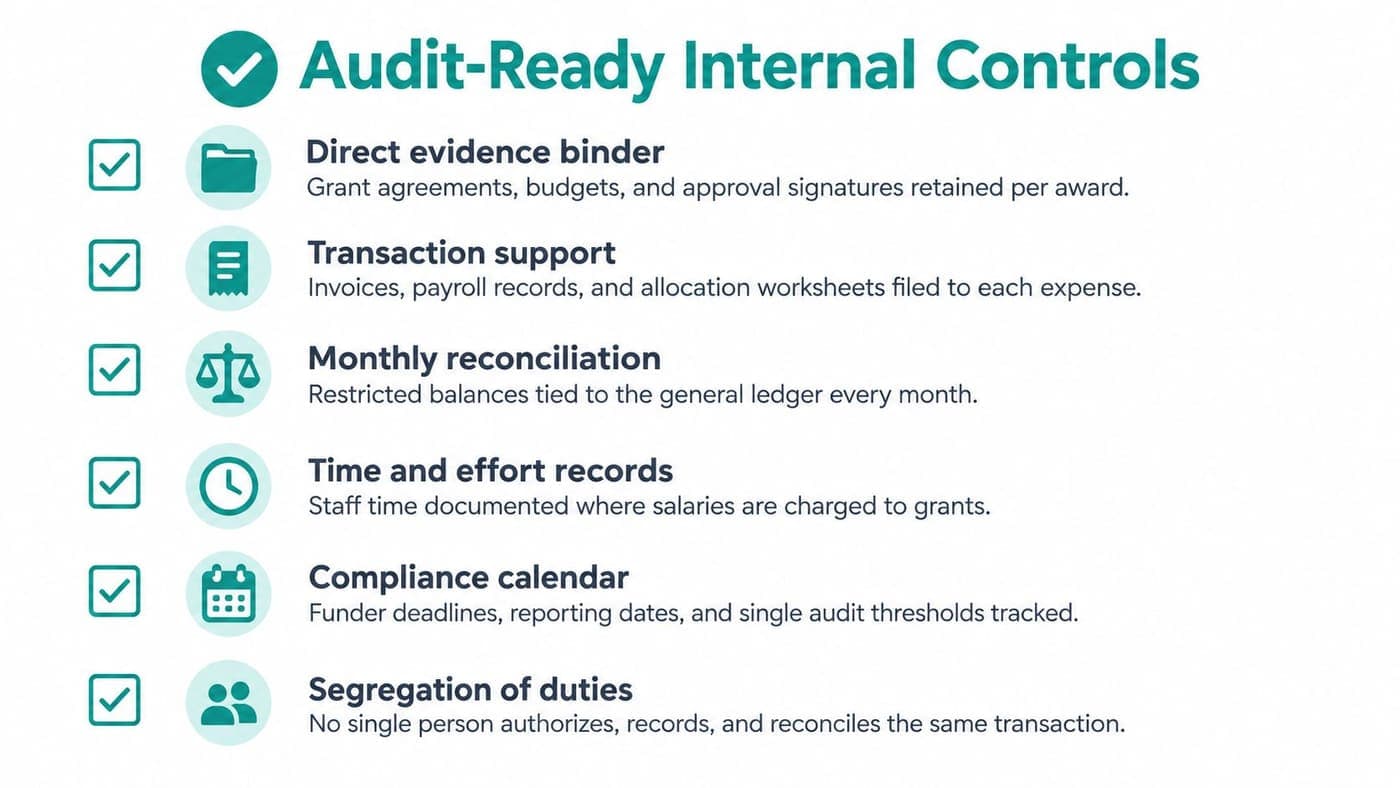
Practical guidance recommends treating each grant as an independent cost center, using dual sign-offs, retaining receipt-level documentation, and reviewing variances monthly. The Grantsmanship Center's grant management guidance emphasizes these controls, while much basic grant content stops at definitions and broad compliance reminders.
Put responsibility beside the transaction
Program staff should know which costs belong to an award before they submit a purchase. Finance should review the coding and supporting evidence, while leadership should see exceptions and material variances without waiting for a quarterly report.
Payroll deserves special attention. When an employee works across programs, your organization needs a defensible allocation method and records showing how the salary was assigned. The same principle applies to shared rent, supplies, contractors, and event costs.
An integrated platform can connect a donor record, grant purpose, fund, expense, and reportable balance. That connection reduces the need to copy information between systems, but it doesn't replace judgment. Your policies still need approval limits, documentation standards, and a monthly review rhythm.
A grant tracking spreadsheet can be a reasonable temporary control. It shouldn't become the permanent source of truth when your organization manages multiple awards and reporting obligations.
Building Audit-Ready Internal Controls
Audit readiness starts with ordinary habits. Your team should be able to retrieve the agreement, approved budget, transaction support, authorization, and allocation logic for an expense without asking several people to remember what happened.
Federal grant recipients commonly maintain supporting documentation, recurring reports, and internal controls that can withstand audit review. The required evidence may include grant receipts, invoices paid by the grant, bid quotes, procurement records, time-and-attendance reports, payroll allocations, lease documents, and contracts, as detailed in MIP's grant reporting guidance.
Build the evidence trail at the start
Don't wait until a report is due to assemble proof. Create an award file when the grant is approved, then add documents as the work progresses.
A practical file structure includes:
- Award terms: Keep the signed agreement, approved budget, amendments, and funder correspondence together.
- Procurement records: Retain bid quotes, selection notes, purchase approvals, and contracts where required.
- Transaction support: Attach invoices, receipts, payment records, and the grant or project code to each expense.
- Payroll support: Preserve time-and-attendance records and allocation worksheets for staff charged across programs.
- Performance evidence: Store deliverables, attendance records, activity summaries, and reports that support the funded work.
Make review part of the rhythm
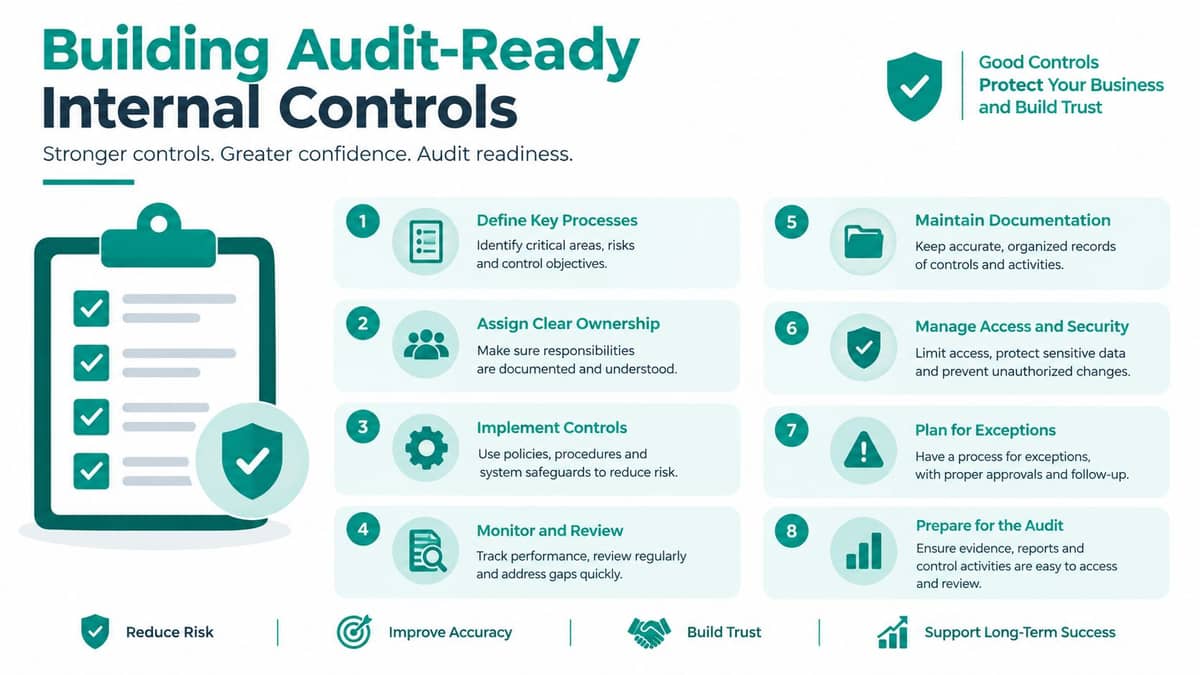
Dual sign-offs don't need to slow down program staff. One person can confirm that the purchase supports the program, while another verifies the coding, approval, and documentation. Separating those responsibilities reduces the chance that one person authorizes, records, and reconciles the same transaction.
Monthly reconciliation then connects the operational file to the general ledger. Compare the grant budget with actual expenses, commitments, remaining restrictions, reimbursement requests, and cash received. Investigate unusual variances while the people involved still remember the transaction.
A clean ledger isn't enough. An auditor needs to follow the path from award terms to program activity, approved expense, payment, and report.
Your compliance calendar should include every funder deadline, internal review date, budget amendment requirement, and payment request milestone. Assign an owner and a backup for each item. This simple practice prevents a deadline from living only in one executive director's inbox.
For a broader governance checklist, use this guide to nonprofit internal controls. Strong controls don't mean building bureaucracy around every purchase. They mean making the correct action easier than the risky shortcut.
Choosing the Right Software for Your Mission
Your software should reduce reconstruction, not merely give you another place to enter the same information. Grant accounting combines budgeting, revenue recognition, expense allocation, compliance monitoring, and financial reporting, and each transaction needs the correct grant or project code when it occurs. NetSuite's explanation of nonprofit grant accounting highlights why late manual reconstruction creates reporting risk.
QuickBooks can be familiar and useful for general bookkeeping. Its class-based approach may help teams categorize activity, but you should ask whether it gives you true fund accounting, restricted balances, grant-level budgets, and nonprofit reporting without workarounds. Blackbaud, Sage Intacct, and MIP each offer nonprofit accounting or fund management capabilities, with different implementation requirements, reporting models, and costs.
Evaluate the workflow, not the feature list
Before choosing a system, ask your team to demonstrate these real tasks:
- Record an award. Can you capture the grantor, purpose, dates, conditions, budget, and restricted fund in one place?
- Record a shared expense. Can staff allocate payroll or facility costs transparently across programs?
- Review the balance. Can leadership see available restricted funds and variances without exporting several reports?
- Prepare a request. Can finance trace reimbursement support back to the source transactions?
- Report to the board. Can the system show grant activity alongside unrestricted operations?
- Answer a question. Can an executive director find the relevant information without depending on a technical administrator?
The all-in-one approach has practical value when it connects accounting, CRM, volunteers, events, marketing, online giving pages, and team communication. Fundraising records should inform finance, volunteer activity should support program reporting, and campaign information should not sit apart from the organization's financial picture.
AlignMint offers true fund accounting for restricted funds, grants, and programs, alongside donor management, volunteer management, events, marketing, online giving pages, and the Minty AI assistant. It also provides a free tier for nonprofits under $100K, with plan-based access and no per-seat fees. You can compare its workflow with other nonprofit platforms in this guide to grant management software for nonprofits.
The right choice depends on your grants, team, reporting obligations, and existing processes. Don't buy a promise of automation before testing whether the system can preserve the evidence trail your funders and board need.
AlignMint brings true fund accounting, donor management, volunteer records, fundraising, events, marketing, and team communication into one nonprofit platform. Visit AlignMint to see whether its integrated workflow can connect your restricted funds, expenses, and grant reporting without adding another disconnected tool.
Ready to try AlignMint with your nonprofit?
Start free — set up donor tools, giving pages, and Minty. Upgrade when you need accounting.