

Explain Deferred Revenue: A Nonprofit Leader's Guide
You're probably looking at a bank deposit from memberships, event tickets, or a prepaid grant and wondering why the books don't agree with the cash. That gap is normal, and it matters because the clean answer protects your board reporting, auditor conversations, and donor trust.
Deferred revenue is the right label when your nonprofit has the money but hasn't yet delivered the promised value. Think of it as a liability first, then revenue later, and that timing is what keeps your reports honest.
Quick Answer: Deferred Revenue for Nonprofits
Deferred revenue is cash you have received but have not yet earned. Record it as a liability first, then move it into revenue as you deliver memberships, events, or other promised value so cash and income do not tell two different stories.
See fund accounting and how to create financial statements. For the balance-sheet view, read statement of financial position.
When a Nonprofit Collects Cash Before Delivering Value
A church retreat fills up, members pay their dues, and a sponsor sends the check before the event takes place. The bank balance looks healthy, but part of that cash still belongs to the future, not to this month's income.
That is why deferred revenue sits on the balance sheet as a liability under accrual accounting. Your organization has received cash for goods or services it has not yet delivered, so the revenue waits until the earning obligation is satisfied Investopedia's deferred revenue definition. In plain nonprofit terms, the money is in hand, but the promise attached to it is still outstanding.
The clean nonprofit way to think about it
If someone pays for a year of benefits today, the organization has not earned the full amount today. The earning happens piece by piece as the service period passes, like a gym membership that gives access over time, not all at once.
Practical rule: if cash arrives before the obligation is finished, the books usually need a deferred revenue liability, not immediate income.
That pattern shows up in membership programs, conference registrations, school tuition, church retreats, and prepaid sponsorships. The accounting is not there to make the books harder to read, it is there to match the income you report with the value you still owe. For a plain-language companion on the income side, see our revenue recognition guide.
What Deferred Revenue Means for a Nonprofit
A nonprofit accepts a membership payment before the year of benefits has been delivered. The cash lands in your account right away, but the access, communications, classes, or other benefits still have to be provided over time.
Under ASC 606 in the U.S. and IFRS 15 internationally, revenue is recognized only when the related performance obligation is satisfied, not when cash is collected ASC 606 and IFRS 15 overview. In a nonprofit setting, that obligation may be a year of programming, event access, educational sessions, or member communications.
Cash received is not the same as revenue earned
A prepaid service plan makes this easier to see. If a member prepays for twelve months of support, the organization has taken in cash, but it has not earned all of it on day one because the service period still lies ahead.
That difference also affects the balance sheet. If the obligation will be fulfilled within 12 months, the amount is usually shown as a current liability. If it reaches beyond a year, it is usually classified as a long-term liability, which changes how leadership reads the organization's financial position and liquidity.
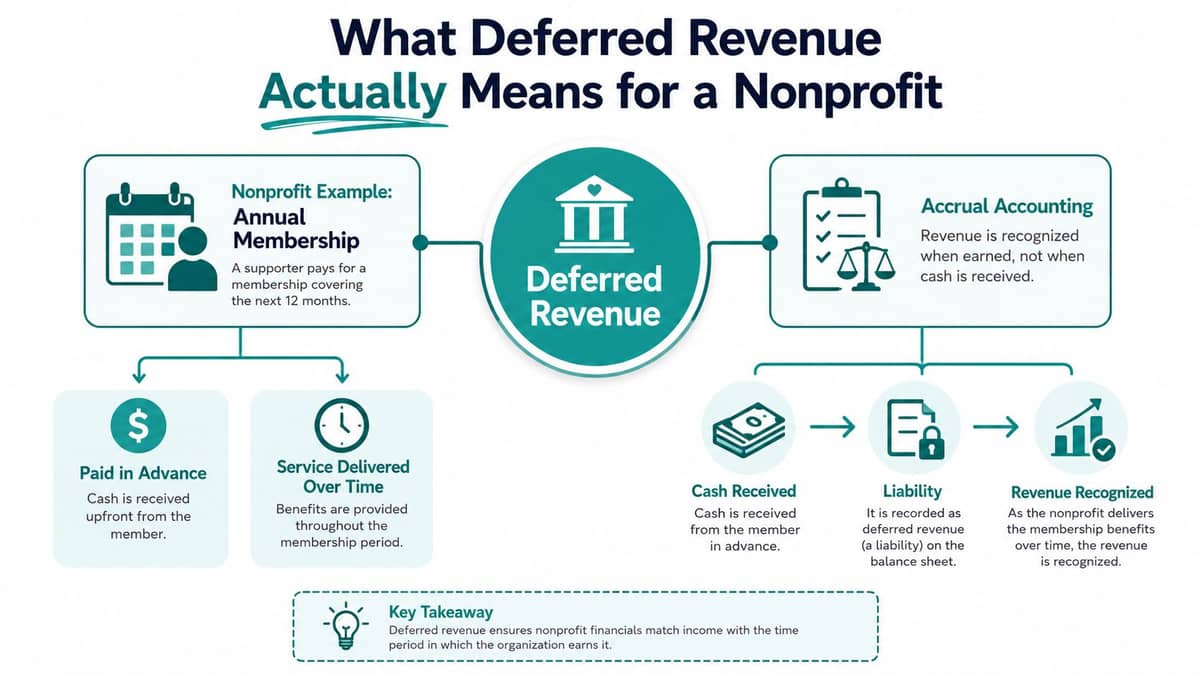
The part that trips up many leaders is simple. Cash is real the moment it arrives, but earned revenue is a separate question. Accrual accounting keeps those two ideas apart so the reports show what the organization has received and what it still owes.
A seasonal program works the same way. If families pay upfront for a summer camp or a year of youth classes, the money may be in hand, but the organization earns it as the sessions take place.
For a deeper look at how this sits inside the books, see our fund accounting article. That is where the liability sits alongside the rest of the nonprofit's financial picture.
Real Nonprofit Examples That Trigger the Treatment
Annual memberships are the most familiar trigger. A supporter renews in January for the full year, and you collect the money upfront, but you only earn it month by month as benefits are delivered.
Conference tickets work the same way. If someone pays in advance for an event that happens later, the cash can't be treated as earned until the event takes place and your nonprofit has fulfilled the promise attached to the ticket.
Four common situations that create deferred revenue
- Membership dues paid upfront: The liability sits on the balance sheet until each month of access or services passes.
- Event tickets sold before the event: The revenue stays deferred until the conference, retreat, or gala is held.
- Advance pledges with scheduled draws: If the donor's payment arrives before the related service or obligation is delivered, the timing can create a deferred balance.
- Restricted grants received ahead of spend: If funds arrive before the matching program activity happens, the treatment needs careful review with your accounting policy and grant terms.
Historically, deferred revenue grew from $2,053 billion to $10,305 billion, a rise of about 402%, showing how common advance payments have become across industries and markets training source on deferred revenue growth. Nonprofits feel that trend too, because prepayments and advance commitments are now part of ordinary operations.
Decision rule: if the cash came in before you finished the obligation, stop and ask whether part of it still belongs on the balance sheet.
That simple test catches most mistakes before they reach the board packet. It's also the best habit to build when your calendar is crowded and your team is small.
Sample Journal Entries You Can Use This Week
The accounting move is simple once you see it. First, record the cash as a liability, then release it into revenue as you deliver the service or program Wall Street Prep deferred revenue mechanics.
Here's the basic flow for a $1,200 annual membership paid in January, with $100 recognized each month.
| Step | Date | Debit | Credit |
|---|---|---|---|
| 1 | January 1 | Cash $1,200 | Deferred Revenue $1,200 |
| 2 | Month-end | Deferred Revenue $100 | Membership Revenue $100 |
That first entry says the money arrived, but the organization still owes twelve months of member benefits. The second entry repeats each month as the obligation is met.
Two more nonprofit examples
For an event ticket sold before the event, the first entry looks the same. Cash comes in, Deferred Revenue goes up, and revenue waits until the program date.
For an advance grant tied to a future delivery schedule, the same principle applies. If the money lands before the related activity happens, part of it may stay deferred until the nonprofit earns it through performance.
A small chart of accounts makes this much easier to manage:
- Cash
- Deferred Revenue
- Membership Revenue
- Event Revenue
- Grant Revenue
The point isn't fancy bookkeeping. The point is making sure your books show what you still owe, not just what the bank received.
For entry setup and examples you can adapt, see our journal entry reference. Once the pattern is clear, the month-end work gets much less stressful.
How Deferred Revenue Connects to Restricted Funds and Form 990
A nonprofit can have cash in hand and still not have earned it, while also holding gifts that come with donor limits on how the money may be used. Those are different problems, and the books should show them separately. Deferred revenue tracks timing, because the organization still owes the promised service, membership benefit, or event. Restricted net assets track donor intent, because the money was given with conditions on use. If you want a plain-English refresher on that difference, the restricted versus unrestricted funds guide helps put the two ideas side by side.
That separation matters on the balance sheet and on the annual return. Deferred revenue belongs in liabilities. Restricted net assets belong in net assets, so the lines tell different stories even when both start with advance cash.
Why the classification matters to your auditor
If the obligation will be satisfied within 12 months, it is usually a current liability. If the work stretches beyond that period, the balance may move into long-term treatment, which gives your auditor a clearer picture of timing and liquidity Bill.com's deferred revenue classification guide.
The board reads those labels in a very practical way. A current liability says the organization still owes value soon. A long-term liability says the obligation remains, but the service period reaches beyond the next year.
Form 990 has to line up with that same story. The balance sheet reporting belongs in Part X, while revenue recognition affects the income reporting lines in Part VIII. Monthly journal entries, year-end close work, and the annual filing all need to agree, or the numbers start to drift in ways that are hard to explain later.
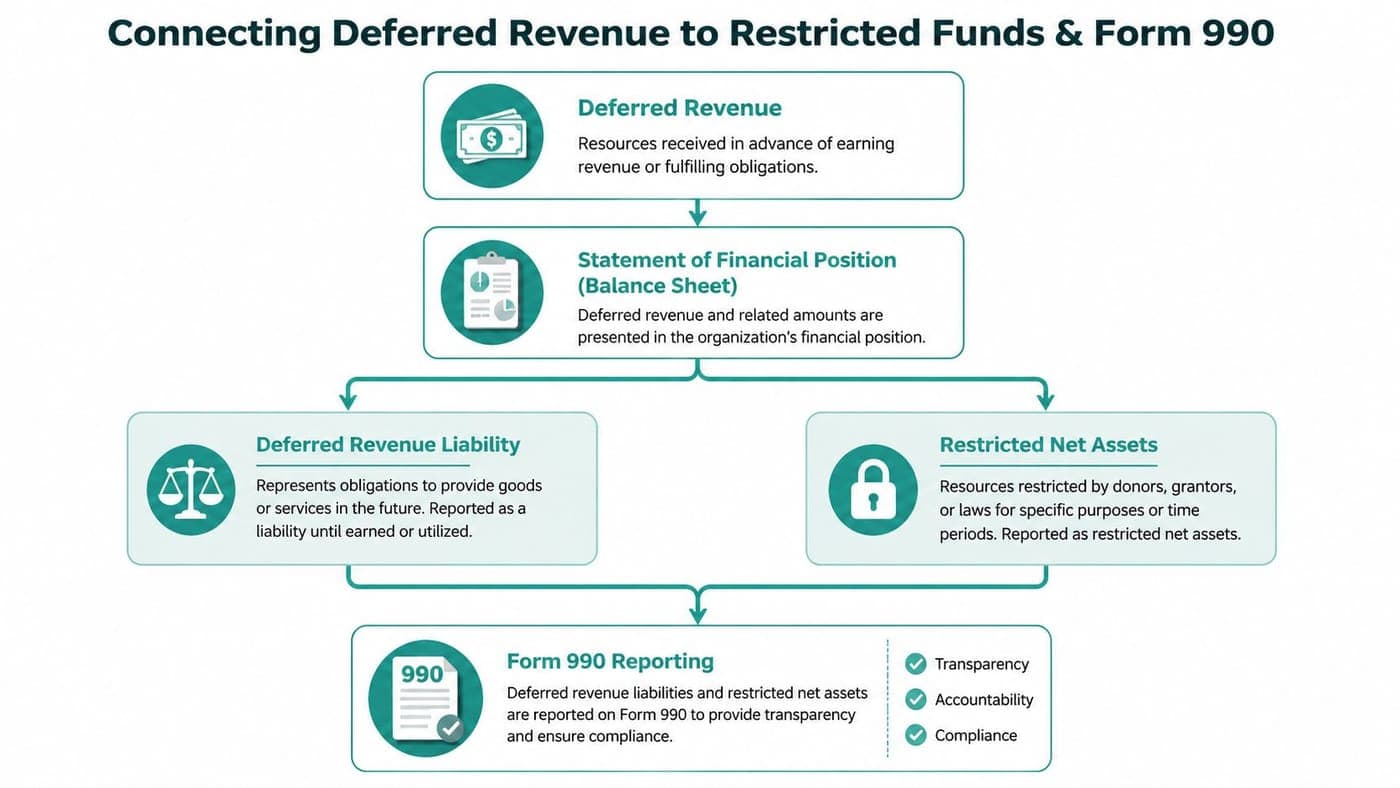
For a clearer view of the reporting split, the chart above shows how deferred revenue and restricted net assets flow through Form 990. That kind of visual helps nonprofit leaders see why the same cash receipt can land in two different places, depending on whether the issue is donor restriction or earned revenue.
Reconciliation Rhythm and Internal Controls That Hold Up
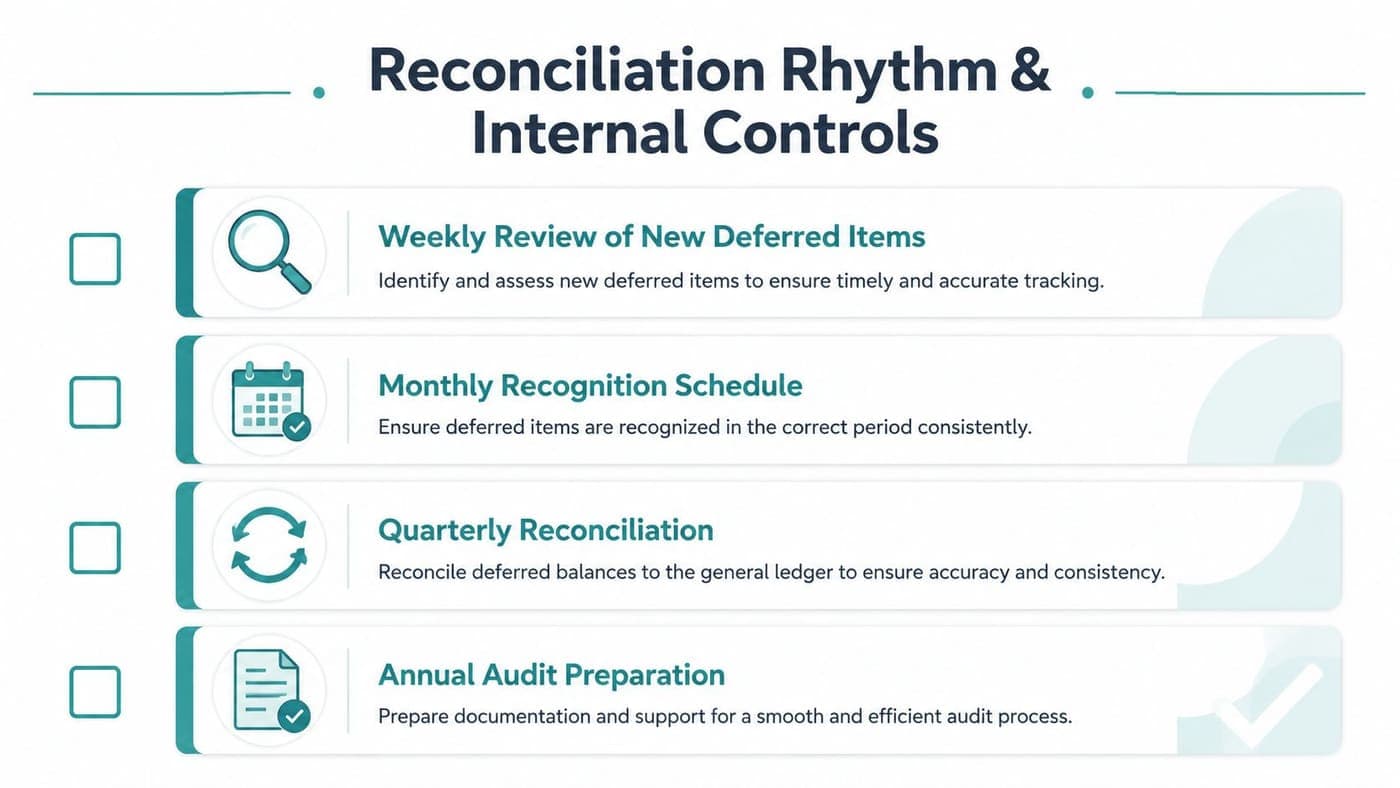
The cleanest deferred revenue schedule is the one you can keep current. A weekly review catches new cash receipts, a monthly recognition check keeps revenue moving correctly, and a quarterly tie-out confirms the balance matches the general ledger.
That rhythm matters because deferred balances can drift. A stale schedule, a missed refund, or an edit in a closed period can leave the board report wrong even when the bank balance looks fine.
A simple control cadence
- Weekly review of new deferred items: Confirm every advance receipt is tagged correctly before it gets buried in the month.
- Monthly recognition schedule check: Release the earned portion on time so revenue doesn't stay parked as a liability.
- Quarterly reconciliation: Tie the deferred balance, the recognition log, and the general ledger together.
- Annual audit preparation: Keep the supporting schedule ready before fieldwork starts.
Practical rule: if your deferred revenue schedule doesn't agree with the general ledger, stop and fix that before you close the month.
The formula underneath the accounting is straightforward. Opening deferred revenue, plus new receipts not yet earned, minus recognized revenue, plus or minus refunds and modifications, equals ending deferred revenue Numeric's deferred revenue reconciliation formula. That's the number your team needs to defend.
For a fuller look at how revenue schedules stay aligned, see our revenue reconciliation guide. Good controls won't make the work disappear, but they do keep surprises out of your audit.
Four Common Pitfalls and How to Avoid Them
The first mistake is booking annual dues as immediate income. The symptom is a strong revenue month in January and a weak one later, even though the service pattern hasn't changed.
The second mistake is treating restricted grants and deferred revenue as interchangeable. They can both involve advance money, but they answer different questions, one is about donor restriction, the other is about whether the organization has earned the revenue yet.
What usually goes wrong
- Annual dues recorded too early: Fix it by moving the unearned portion into deferred revenue and recognizing it over time.
- Restricted funds mixed with deferred revenue: Fix it by separating donor intent from performance timing.
- QuickBooks classes used as a stand-in for fund accounting: Fix it by using a system that tracks funds natively instead of relying on labels.
- Forgetting the current versus long-term split: Fix it by checking whether the obligation ends within a year or stretches beyond it.
QuickBooks is a perfectly respectable general ledger for many small nonprofits, and plenty of teams start there. The gap shows up when you need true fund accounting that enforces restrictions, tracks real-time fund balances, handles inter-fund transfers, and produces nonprofit statements without extra work.

The last mistake is easy to miss because it looks harmless. If you don't separate what is current from what is long-term, the balance sheet can mislead leadership about near-term obligations.
Practical Next Steps and How an All-in-One Platform Helps
A nonprofit finance close gets easier when you run three simple checks each month. First, confirm whether your books show a deferred revenue liability. Second, create a recognition schedule for each advance payment. Third, set aside 30 minutes before the next board meeting to tie that schedule back to the general ledger.
That routine is plain, but it keeps the numbers honest. It also keeps your finance committee from wondering why cash has arrived while revenue still sits on the sidelines.
What a better system should do for you
A nonprofit platform should let accounting, donor records, and the revenue schedule talk to each other. That matters for membership dues, grant timing, pledge tracking, online giving pages, volunteer-connected events, and team communication, because those pieces often touch the same transaction.
AlignMint is built around that reality. True fund accounting keeps restricted funds, grants, and programs modeled natively, while the CRM, volunteers, events, and marketing tools sit in the same place, so you are not stitching together spreadsheets and separate logins.
Deferred revenue stays on the liability side until the organization delivers the promised value, then it moves into revenue, which is why this topic sits close to prepaid and subscription-style nonprofit income. For a nonprofit-specific overview of deferred revenue treatment, see Investopedia on deferred revenue treatment. If your organization raises under $100K a year, the free tier can give you a practical place to start without forcing a software leap you do not need.
If deferred revenue keeps creating extra work in your month-end close, take a look at AlignMint. You will see how true fund accounting, donor management, volunteer tracking, and marketing can live in one nonprofit platform, so your liability schedules and board reports stay in sync without spreadsheet chasing.
Ready to try AlignMint with your nonprofit?
Start free — set up donor tools, giving pages, and Minty. Upgrade when you need accounting.