

You might be staring at a bank balance, a grant report, a donor list, and a board packet deadline. The numbers all exist, but they don't yet tell a clear story. This is how to create financial statements that are board-ready, Form 990-ready, and useful for running your nonprofit.
Most guides stop at generic accounting. Nonprofits need more than that. You need fund accounting, clean treatment of restricted gifts, and a Statement of Functional Expenses that stands up to review.
If those pieces are still split across spreadsheets, review fund accounting and nonprofit financial reporting. They show how daily records become board-ready statements.
Build Your Foundation with a Nonprofit Chart of Accounts
If your chart of accounts is weak, every report after it will be confusing. That's why the first step in how to create financial statements is giving each dollar a proper home.
For a nonprofit, the chart of accounts is not just a list of categories. It's the map of your mission. It should let you see which money is available for general operations, which money belongs to a grant, and which expenses belong to a specific program.
Think in funds, not just categories
A simple way to explain fund accounting is this. Think of your organization as one house with several labeled kitchen jars. One jar is general operating cash. Another is a youth program grant. Another is a scholarship fund. The money may sit in one bank account, but each jar still has its own purpose.
That's why a nonprofit chart of accounts must support fund-based tracking. The chart of accounts in fund accounting must include distinct accounts for each fund so your organization can track revenue, expenses, assets, and liabilities by fund while still keeping one organizational view, as outlined by MIP's explanation of fund accounting structure.
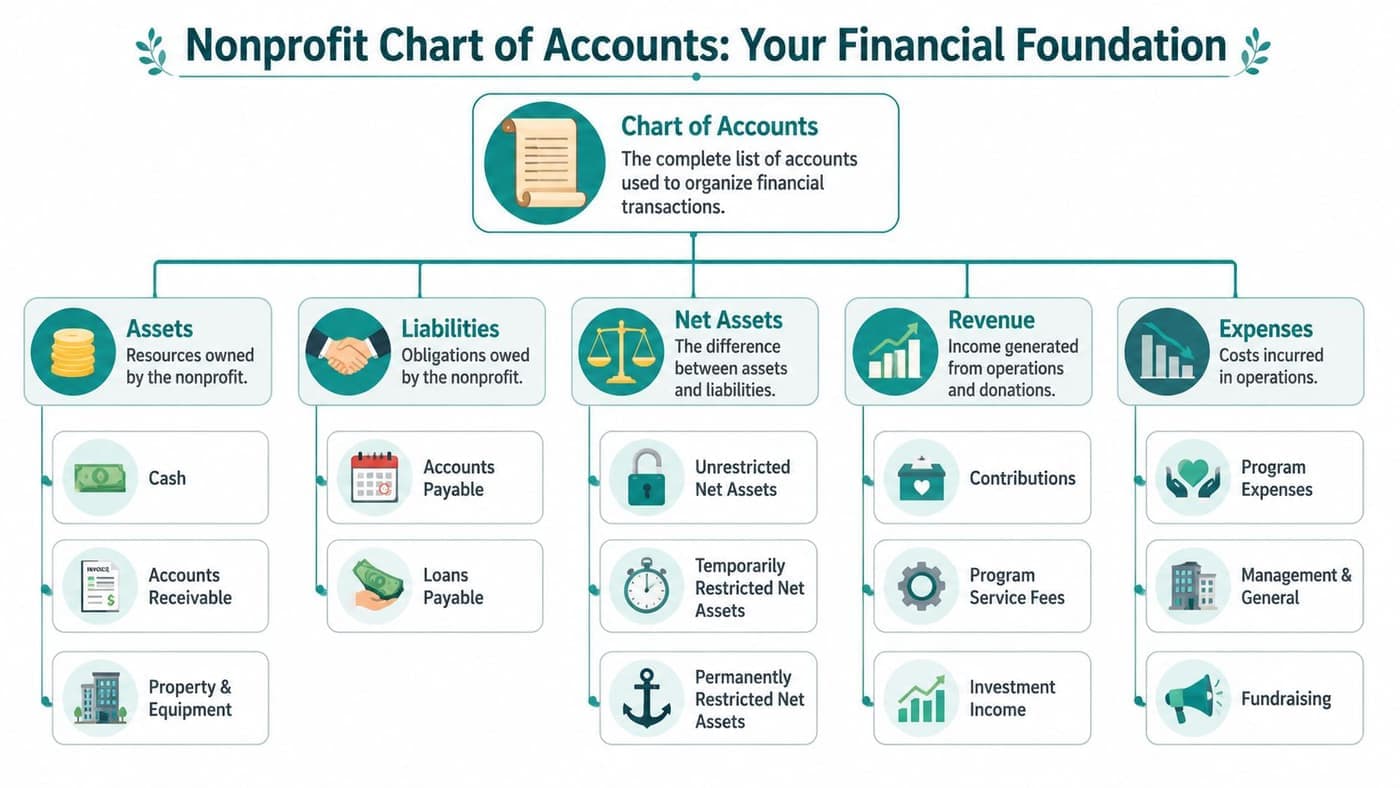
What your chart needs from day one
Start with the normal account groups, then add nonprofit logic underneath them.
- Assets: Cash, receivables, prepaid expenses, property, and equipment.
- Liabilities: Payables, deferred revenue, payroll liabilities, and loans.
- Net assets: For nonprofits, this category sharply differs from business accounting.
- Revenue: Contributions, grants, fees for service, events, and online giving.
- Expenses: Program services, management and general, and fundraising.
Under FASB ASC 958, nonprofits must classify net assets into exactly two categories, with donor restrictions and without donor restrictions, replacing the older three-tier approach, as explained in Charity Charge's summary of nonprofit net asset rules.
Practical rule: If you can't tell whether a dollar is restricted the moment it is recorded, your chart of accounts needs work.
What works and what breaks down
QuickBooks is familiar, and many nonprofits start there. Its strength is broad familiarity. The problem is that class tracking is still a workaround when you need true fund accounting. It can help with simple coding, but it doesn't natively think like a nonprofit with restricted balances, grant drawdowns, and program-based reporting.
What works better is a structure that records the fund, the natural account, and the function from the start. That matters even more if you run a church, school, or fiscal sponsorship program where one legal entity may be managing several distinct activities.
A good setup also supports the rest of operations. Donor management, volunteer management, events, and your marketing suite all create transactions that should land in the right place the first time. If your online giving pages and CRM don't connect to accounting, staff ends up rekeying gifts and guessing at restrictions.
For a practical starting point, use this nonprofit chart of accounts template. It gives you a structure you can review with your bookkeeper, treasurer, or outside accountant before the next close.
Prepare Your Data for Accurate Reporting
Once the chart is in place, you need clean inputs. This part is kitchen prep. If the ingredients are off, the final meal won't improve in the oven.
Financial statements begin with an adjusted trial balance. Standard accounting practice requires a sequence that starts with the income statement, moves to the balance sheet, and ends with the cash flow statement, and that sequence depends on accurate source data and a balanced trial balance, as described in Expensify's guide to preparing financial statements.
Close the month before you draft the reports
You don't create reliable statements by opening a report and hoping for the best. You close the month first.
That close should include:
- Bank reconciliation: Match the books to each bank and credit card account.
- Posting final entries: Make sure payroll, bills, deposits, and journal entries are complete.
- Subledger checks: Confirm donor pledges, grants receivable, payables, and fixed assets agree with the general ledger.
- Adjustments: Record accruals, deferrals, depreciation, and any needed corrections.
A common pitfall is failing to reconcile trial balance to the general ledger and validate subledger matches before assembling statements, which accounts for approximately 32% of material misstatements in nonprofit financial reviews, according to Workday's financial statement preparation guidance.
Reconciliation is where you catch small mistakes before they become board-level confusion.
The practical checks I'd never skip
The basics are not glamorous, but they save time later.
- Confirm cutoff dates: Make sure gifts, invoices, and expenses are in the right period.
- Review restricted gifts: Check that grant and donor-restricted revenue was coded correctly at entry.
- Scan unusual balances: Negative expense balances, duplicate deposits, and stale receivables deserve a second look.
- Review volunteer-related records: If you track volunteer activity operationally, make sure those records agree with the program story you'll tell later, even if they don't all drive accounting entries.
If your finance data comes from separate tools, import discipline matters. Donations, events, church giving, school tuition support, sponsorship activity, and volunteer records can all create mismatches when systems don't line up. That's one reason many teams prefer one platform for accounting, CRM, volunteers, team communication, and marketing rather than stitching together exports.
If you're consolidating outside data before close, this guide to importing data is a useful checkpoint for getting records into the system in a reviewable format.
What good prep feels like
A well-prepared close has a specific feeling. The balances may still need interpretation, but they don't feel shaky. Your development team and finance team are looking at the same gift totals. Your grant records match the ledger. Your board packet won't need apologies in the first paragraph.
Draft the Statement of Activities
This report is typically read first. It answers a plain question. What came in, what went out, and what changed during the period?
For nonprofits, the Statement of Activities plays the role that an income statement plays in a business. But it carries a very different burden. It has to show the effect of restrictions, releases, and mission spending in a way that donors, board members, and grantors can follow.
A simple nonprofit example
Take a community arts program. In January, it receives a grant restricted for youth workshops. The cash comes in immediately, but the organization cannot treat that money as available for general use.
Later, the organization pays instructors, buys supplies, and rents studio space for those youth workshops. At that point, the spending fulfills the grant purpose.
Accounting rules require a formal release from restriction entry that moves the amount from with donor restrictions to without donor restrictions on the Statement of Activities, as explained in Impactra's fund accounting guide.

What the board needs to see
A useful Statement of Activities usually separates revenue and support into meaningful lines, not one dense block. For many nonprofits, that means contributions, grants, program service fees, events, and other revenue.
Expense classifications should align with how the organization operates. Program services must be separated from management and general costs and fundraising costs. This simplifies subsequent functional reporting.
Here's the logic you want:
| Area | What it should show |
|---|---|
| Revenue | Gifts, grants, earned income, and event proceeds |
| Restrictions | Which support is still restricted |
| Releases | Amounts moved out of restriction when purpose is met |
| Expenses | What the organization spent during the period |
| Change in net assets | The period's bottom-line movement by restriction class |
What commonly goes wrong
The most common reporting mistake is treating restricted revenue as if it were fully spendable operating income. That can make a month look stronger than it really is. Then leadership commits to spending that the organization can't freely support.
Another problem is omitting release entries entirely. The spending happened, but the restriction never moved. On paper, the balance sheet keeps showing money as tied up even after the program has delivered on the restriction.
That's one reason generic accounting guidance isn't enough for nonprofits. Many resources explain the three standard financial statements but skip the nonprofit-specific reporting needed for restricted funds and Form 990 support. If you also need the companion report that allocates spending by mission function, this overview of the Statement of Functional Expense helps connect the two.
The Statement of Activities should answer one board question clearly. Did we operate in line with donor intent and program reality?
Assemble the Statement of Financial Position
The Statement of Financial Position is your snapshot date report. It shows what your organization owns, what it owes, and what remains after liabilities are covered.
Board members often look here for stability. Lenders do too. But for nonprofit leaders, the most important question is usually simpler. How much of our reported net assets can we use?
Read the statement from top to bottom
Start with assets. List current assets such as cash, receivables, and prepaid items. Then add long-term assets such as equipment or buildings, if you have them.
Next come liabilities. These can include accounts payable, payroll liabilities, deferred revenue, credit lines, and loans.
The final section is net assets. This part needs to be clean and direct.
- Without donor restrictions: Funds available for general use, unless the board has internally designated them.
- With donor restrictions: Funds limited by donor purpose or timing.
- Total net assets: The sum of both classes.
Why net assets matter so much
A nonprofit can look cash-rich and still be tight on operating flexibility. If much of that cash belongs to a grant or restricted campaign, leadership cannot treat it like open working capital.
Many board packets get muddy. The statement may be technically correct, but it doesn't answer the practical question people care about. How much room do we have to act?
A cleaner presentation often includes a simple supporting schedule showing major restricted balances by grant, campaign, or program. That's especially helpful in fiscal sponsorship settings, church projects, and school programs where several restricted pools may sit inside one legal entity.
If a board member can't tell available cash from restricted cash, the statement needs a better presentation, not more accounting jargon.
Tie it back to your records
The Statement of Financial Position should never be drafted in isolation. It needs to agree with the underlying ledgers, donor records, and the release activity that appeared in the Statement of Activities.
A short review checklist helps:
- Cash: Agrees to reconciled bank balances.
- Receivables: Matches pledge, grant, or invoice detail.
- Payables and liabilities: Reflect unpaid obligations at period end.
- Net assets: Roll forward logically from the prior period.
If you need a practical way to review those changes, this net asset rollforward guide helps you trace opening balances, current activity, and ending balances without chasing separate spreadsheets.
Keep the board version readable
Your audited format may need more detail. Your board format should be easier to scan. That can mean grouping small accounts into broader lines, adding a comparison column, or attaching a short note on major changes.
The aim is confidence. People should see the organization's position at a glance, then ask strategic questions instead of basic clarification questions.
Complete Your Financial Picture
The last two reports often get less attention than they deserve. That's a mistake. The Statement of Cash Flows and the Statement of Functional Expenses are where nonprofit reporting becomes indispensable for decision-making.
One explains liquidity. The other proves how spending supports mission, administration, and fundraising.
Why these two reports matter more in nonprofits
Cash flow matters because revenue timing can mislead. A grant receivable may improve your Statement of Activities while your bank account stays tight. The cash flow statement closes that gap by showing how cash moved.
The Statement of Functional Expenses matters because nonprofit accountability depends on purpose, not just totals. A donor, auditor, or board member wants to know where expenses landed functionally, not only what category they came from.
A Statement of Functional Expenses is explicitly required for all nonprofits filing IRS Form 990, and every expense must be allocated across program services, management and general, and fundraising, as noted in The Charity CFO's nonprofit accounting standards guide.
The manual route versus a nonprofit system
QuickBooks deserves credit for being familiar and widely available. Many bookkeepers know it well. But when you need a functional expense statement, restricted fund visibility, and connected donor records, the manual work grows fast.
A side-by-side view makes the trade-off clearer:
| Task | QuickBooks | Nonprofit-specific all-in-one platform |
|---|---|---|
| Functional expense allocation | Often handled through workarounds and spreadsheet review | Built to support program, management, and fundraising allocation |
| Restricted fund visibility | Often depends on classes and extra reports | Built around true fund accounting |
| Donor and accounting sync | Usually requires separate tools | Finance and donor records live together |
| Volunteer, events, and marketing data | Separate systems | Can live in one place with team communication tools |
That all-in-one approach matters if your team is small. We've seen nonprofit leaders prefer fewer systems because accounting, donor management, volunteer management, events, online giving pages, fiscal sponsorship activity, and marketing all affect the final story in your reports. AlignMint is one example of that model. It combines accounting, CRM, volunteers, events, marketing, Minty, and clear user access by plan, and it offers a free tier for nonprofits under $100K.
A practical review before you finalize
Before these reports go to the board, ask:
- Does cash flow explain our real liquidity?
- Did every expense land in the right functional column?
- Can we support allocations with clear logic?
- Would a reviewer understand the path from operations to reporting?
If you also work with overseas trustees, UK partners, or comparison practices across regions, this comprehensive UK accounting checklist is a useful reference for year-end discipline and documentation.
Prepare for Form 990 and Tell Your Financial Story
At this point, the mechanics are done. The larger job is making the statements understandable.
That matters because 70% of nonprofit boards struggle to interpret financial data, according to Easmea's discussion of financial narrative for nonprofits. If the board can't quickly grasp what changed and why, the reporting package isn't finished yet.
Your Form 990 readiness checklist
A calm Form 990 season usually starts with a simple internal checklist.
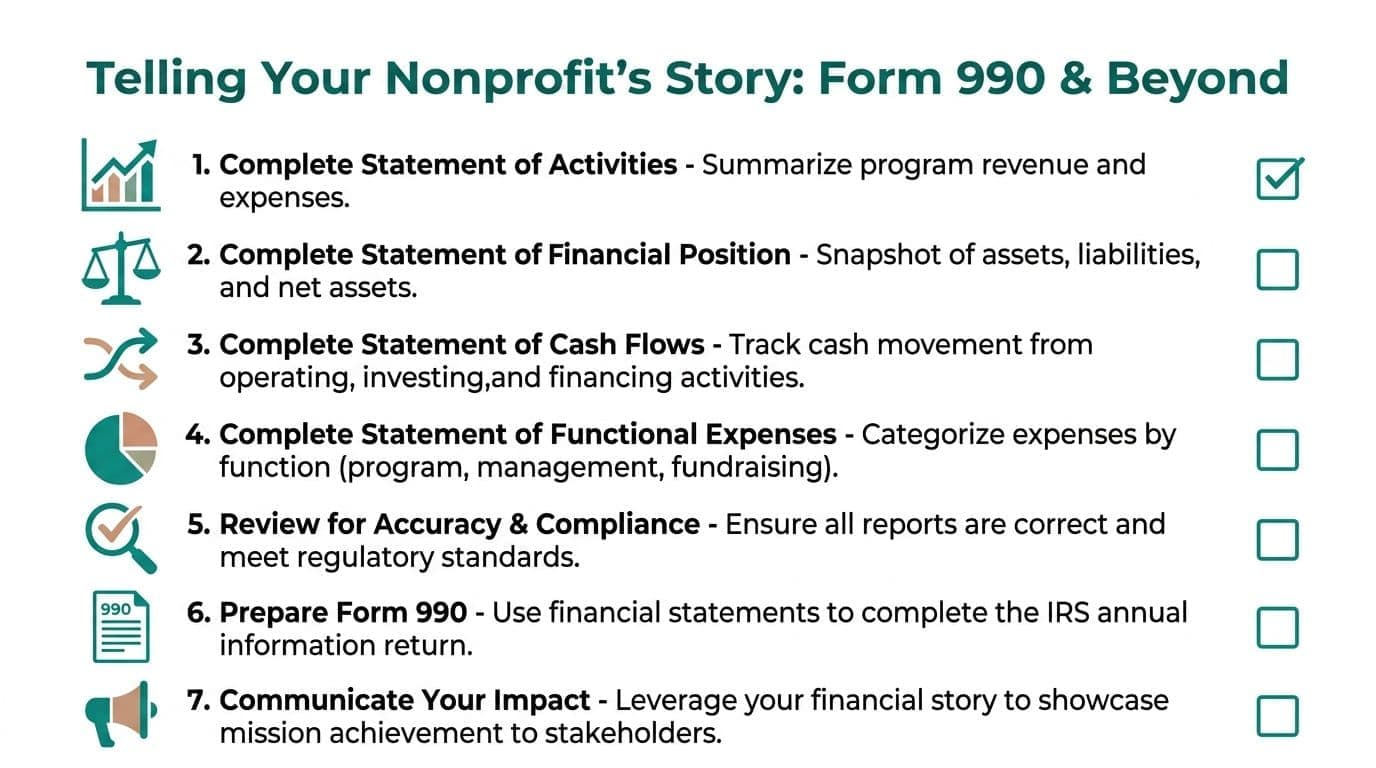
Use this list before you hand anything to your accountant or auditor:
- Statement of Activities complete: Includes restriction activity and release entries.
- Statement of Financial Position complete: Net assets are clearly split by restriction class.
- Cash Flow Statement complete: Ending cash agrees to the balance sheet.
- Statement of Functional Expenses complete: Every expense is allocated by function.
- Supporting schedules ready: Grants, receivables, payables, and net asset details are available.
- Board explanation drafted: Major changes are described in plain language.
- Form 990 support assembled: The package is organized for filing.
For a cleaner filing process, keep a dedicated Form 990 checklist with your monthly close documents rather than rebuilding it at year-end.
Turn reports into a board and donor narrative
The strongest nonprofit financials do two jobs. They satisfy compliance, and they explain stewardship.
A short narrative memo can do a lot of work. Explain why revenue moved. Note whether a grant was received but not yet spent. Call out a timing issue in receivables or payables. If a fundraising event ran below plan but monthly giving improved, say that plainly.
This is also where connected systems help. If donor management, marketing, team communication, and accounting all live apart, staff spends hours stitching together explanations. If the records are connected, it's easier to show how an appeal performed, how volunteers supported a program, or how a church or school initiative affected spending.
Good financial statements don't just prove compliance. They help other people trust your judgment.
If your organization also deals with benefit plan oversight or broader governance reviews, resources like this complete guide to 401k plan audits can be helpful context for understanding how reviewers think about documentation, controls, and reporting support.
A board packet should leave people steady, not confused. They should know what changed, what remains restricted, what risks need watching, and what decisions need action.
If you want fewer spreadsheets and clearer reporting, AlignMint brings accounting, donor records, volunteers, events, marketing, online giving pages, and team communication into one system built for nonprofits. If your team is tired of class workarounds and disconnected tools, it's worth looking at how true fund accounting and Minty can help you get to board-ready financials faster.
Ready to try AlignMint with your nonprofit?
Start free — set up donor tools, giving pages, and Minty. Upgrade when you need accounting.